
 EN (English)


Minor Arcana · Cups (Water)
Seven of Cups
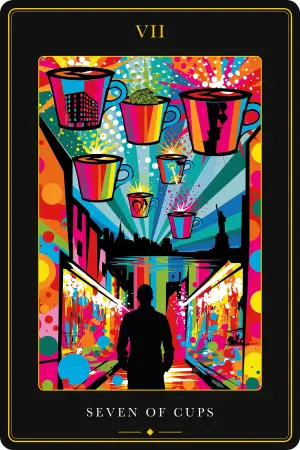
A lone New Yorker stands at the mouth of a glowing corridor while seven coffee cups float above the skyline, each one holding a different temptation and half of them pure packaging.
Read the complete guide: The Tarot Card Seven of Cups: A Complete Guide to Its Symbolism and Meaning
Card at a glance
- Numerology
- 7
- Element
- Water
- Astrology
- Venus in Scorpio (third decan)
- Kabbalistic path
- Netzach in Briah (Victory)
- Timing
- Introspection · mid-to-late November
- Yes / No
- Upright no · Reversed maybe
Upright
Choices
Fantasy
Illusion
Daydreaming
Options
Wishful thinking
Imagination
Indecision
Reversed
Clarity
Reality check
Decision
Awakening
Discernment
Grounding
Willpower
Focus
Seven of Cups in each deck
Every deck reimagines the same archetype. Compare the art, then open a deck to read its full interpretation.
Imagery and symbolism
In the Tarot of New York City the Seven of Cups moves the old cloud of visions into the city that manufactures visions at industrial scale. The classic meaning holds underneath: doubt and choice, an abundance of possibilities, fantasies that distract from the real world, and the need to focus and prioritize among options that may be genuine or deceptive. What changes is the light. Where the Rider-Waite card gave the dreamer a gray cloud, this deck gives him wattage.
A lone figure stands in black silhouette at the bottom of the card, a New Yorker at the mouth of a glowing corridor that is part deli aisle at midnight, part street canyon. He is small against everything above him, hands at his sides, doing exactly what the card describes: standing and looking. Around him the walls blaze with pop-art color, splashes and halftone dots, the sensory overload of a city where every surface is selling something.
Above him float seven coffee cups, the deck's signature vessel, the blue Greek 'We Are Happy To Serve You' cup reimagined in saturated stripes. Here the paper cup is the container of feeling itself, and the seven of them hang in the air like offers. One holds a condo tower, the real-estate fantasy standing in for the RWS castle, the hope of arrival and security without the twenty years of work in between. One holds a stack of cash, the windfall, the exit, the deal that fixes everything. One holds a human profile, the RWS face or mask translated to a city of eight million faces, the idealized person you fall for instead of the human being. One holds a key, the apartment key or the corner-office key, the fantasy of finally getting in. One holds a figure inside a heart, the dream of perfect love, a true desire and also the easiest one to hallucinate. The last two hold only sparks and bursts of light, options with nothing inside them, the shelf items that exist purely to be wanted.
Behind and above it all runs the black silhouette of the skyline with the Statue of Liberty raised at the edge, the biggest promise in the picture and the reason half the city's dreamers came here in the first place. Sunburst rays fan out where the RWS card put its gray cloud, so the dream-fog of this deck is not mist but voltage. Below, the scene reflects in water like a mirage, a reminder that much of what the figure sees is projection.
Core meaning
The Seven of Cups is the city at midnight with every shelf glowing. You stand in the deli of your own life and the options crowd in: the apartment you saw once and keep redecorating in your head, the job that would fix everything, the person who exists mostly in your imagination of them, the version of yourself who finally made it. New York produces those faster than any place on earth. Every open window is a life you could be living, every train door a direction you didn't take.
In the arc of the suit, the Six of Cups was innocent nostalgia and the Eight will be the definitive choice to walk away from illusions. The Seven sits between them as the crucible, the point of maximum friction where a person confronts the multiplicity of adult desires and the hard fact that not all of them can be fulfilled at once. This is the necessary stage of confusion before genuine happiness is possible.
Underneath the glow the card carries one instruction. Imagination is a powerful tool for building a life, but the fog of possibility holds no physical weight until a firm choice is actively made. The skill this card asks for is not finding options. In this city the options never run out. The skill is closing some, reaching into the mist, and drinking from the one cup that is actually there.
Upright meaning
Upright, the Seven of Cups signals a scene crowded with choices and imaginative potential, the daydreamer surveying a multitude of divergent paths. Ideas, plans, and ambitions demand attention at once. The card's warning is that this abundance is a double-edged thing. Faced with so many glowing options, a person can become unable to commit to any single one, scattering energy across too many possibilities and executing none. It also cautions against wishful thinking, the preference for a flawless imagined future over the demanding work of the present.
In love it is the dating app at midnight, an endless shelf of faces where every profile is a possible life. Its deeper subject is projection. One cup holds a face, and the card asks whether you love a person or the silhouette you have painted onto them, the dream partner assembled from three good dates and a lot of imagination. It warns against ignoring glaring red flags to protect a romanticized fantasy.
In career it is the browser with forty listings open and no application sent, a genuine multitude of directions a role could grow. The offers all glow with promise, but not all are realistic, and the card asks you to separate the earthly projects from the penthouses in the air. The honeymoon abundance of a new job or the mirage phase of a job hunt both live here, where every option looks alive largely because it is new.
In finances it is the fantasy portfolio, the crypto about to run, the side hustle that scales itself, the number in your head that would fix everything. New York does offer more ways to make money per block than anywhere, but the plans attached to them often lack a realistic action plan or an honest look at the rent due Friday. The card advises caution before investing energy in the display window rather than the balance sheet.
In health it points to mental fog and the feeling of being chronically ungrounded, sometimes to maladaptive coping like excessive drinking or digital escapism used to numb discomfort. It can also read as the wellness shelf at full glow, the new studio, the diet everyone is on this season, where choosing a program quietly substitutes for doing it.
Reversed meaning
Reversed, the fluorescent light flickers on and the figure sees the shelf plainly: half the cups were props. This marks the arduous transition from passive dreaming to active discernment, the moment a person stops sleepwalking, identifies the one cup with real weight, and commits to a grounded path. Arthur Edward Waite gave the reversal the keywords desire, will, and determination, and modern readers build on that as an awakening, a return to solid ground, the lease you can actually sign and the work you can actually do. Depending on the surrounding cards it can also turn negative: a flat refusal to face reality, or paralysis so complete that a person stands in the aisle until the store closes.
In love it is the morning the projection wears off, when you realize you were dating the idea of a person rather than the person. The fog lifts and forces an unavoidable choice, to love the real human being with their actual patterns and actual Tuesday self, or to admit the beautiful dream had no one inside it and walk on.
In career it can indicate disappointment or a poor choice already made, the dream job that turned out to be a title and a mess. It counsels breaking free of the fantasy, considering the next step carefully, and locking onto concrete, achievable goals. Creative burnout can appear here too, the state where nothing seems good enough because too long was spent in the idea phase.
In finances it says the fantasies must convert to action or evaporate with nothing to show. Discard the get-rich-quick angle and the deal that only works in the pitch, reassess the actual income and the actual costs, then put real money behind real steps. The good news folded in: this is the energy in which a dream stops being a window display and becomes a budget.
In health it is the membership at three studios and attendance at none, the pantry of abandoned diets. The counsel is to choose one or two changes and implement them gradually, the boring way real change happens, and to get out of the head and into the body.
Historical notes
The Seven of Cups the New York deck restages carries a long lineage. In the earliest surviving decks, such as the hand-painted Visconti-Sforza of fifteenth-century Milan, the card simply showed seven ornate chalices meant to represent abundance and prosperity, with none of the narrative scenery modern readers rely on. The Tarot de Marseille of the seventeenth and eighteenth centuries kept this non-scenic tradition, arranging the seven cups in a structured geometric layout that invited the reader to project meaning through Pythagorean numerology, where seven denoted spiritual wholeness while Chaldean tradition read it as a marker of illusion and veiled truths.
The Hermetic Order of the Golden Dawn gave the card its psychological charge. It assigned the Seven of Cups to Netzach on the Tree of Life, correlated it with Venus in Scorpio, and titled it the Lord of Illusory Success, emblem of unbalanced desire and the allure of superficial victories that lack real substance. In 1909 Arthur Edward Waite and Pamela Colman Smith translated that idea into a picture, drawing on the fifteenth-century Sola Busca deck exhibited at the British Museum in 1908. Their silhouetted figure before seven floating chalices of dreamlike apparitions made the concept legible to a wide audience. Waite called them 'strange chalices of vision' in his 1911 Pictorial Key to the Tarot.
Decades later, in 1944, Aleister Crowley retitled the card 'Debauch' in his Book of Thoth, painting decaying lotuses oozing slime into malformed cups. For Crowley it signified emotional dissipation, addiction, and the corruption of the water element, a reading still influential wherever the card touches escapism and substance abuse.
Correspondences
Number. Seven, in numerology the number of mystery, spirituality, and inner wisdom. It is the seeker's number, the pursuit of truth and the drive to understand the deep processes of the soul, and it marks someone in motion toward change who has not yet arrived. In this deck seven is the searcher the city produces in bulk, the person riding one more stop and opening one more door, certain the real thing is just ahead. Its higher octave is the discipline that turns a wanderer into a finder.
Astrology. Venus in the third decan of Scorpio, roughly November 13 to 22. Scorpio's depth and intensity are the city after dark, the hidden currents and the fascination with what is behind the unmarked door, while Venus is the city's glow, the beauty and desire that make the shop window, the stranger, and the skyline all look like answers. Under Venus the sign's hunger for emotional depth gets idealized and gilded, and ideals rarely match inventory.
Element. Water, the suit's element, poured in this deck from the blue Greek coffee cup. Here it is deep immersion in feeling, reading meaning into every reflection in a dark window, and the card asks for comprehension of those currents rather than only submersion in them.
Kabbalah. Netzach, the seventh sphere on the Tree of Life, Victory, the sphere of Venus and of desire. Because Cups belong to the world of Briah, the card is Netzach in Briah, emotional longing at the point where it can tip into illusory success.
Elemental dignity. Among other Water cards the Seven of Cups deepens into reverie and projection. Air cards, especially the Ace of Swords, cut through its fog and pop the illusions. Earth cards ground its options into something buildable, and Fire cards push it toward the willpower needed to finally choose.
Psychological perspective
Psychologically the Seven of Cups is a card about projection and the labyrinth of the imagination. The silhouetted figure is left anonymous on purpose, an everyman or, in Jungian terms, the shadow self, paralyzed in the role of passive observer and overwhelmed by the visions before him. The chalices rest on no solid ground because the options are ungrounded potential, immaterial until a choice gives one of them weight.
Modern practitioners often link the card to the Enneagram Type 7, the Enthusiast, who copes with discomfort by projecting the mind into exciting future possibilities. The dazzling choices in the cups are that same defense mechanism, the attempt to avoid the present by escaping into the endless buffet of what could be. Both the archetype and the personality type face the same developmental task: learning to sit with discomfort and commit fully to the reality directly in front of them.
Internet culture has its own name for this. Readers sometimes call the Seven of Cups the 'go touch grass' card, an admonishment to step away from screens and ground yourself in the physical world, and 'delulu' when it appears over a romance built entirely on projection. Both updates keep the card's oldest lesson intact: a life lived entirely in the clouds yields nothing of substance.
The Seven of Cups across decks
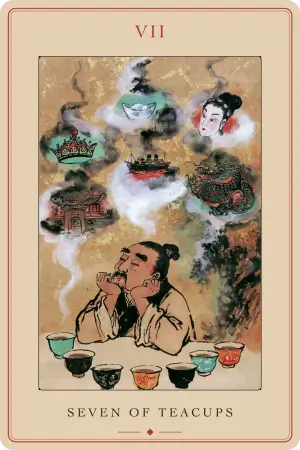
The Seven of Cups shifts its emphasis from tradition to tradition. In the Rider-Waite-Smith deck it is a silhouetted figure before seven floating chalices, each holding a different apparition, keyed to illusory choice and the fantastic spirit. In the Tarot de Marseille it is seven stylized cups in a symmetrical geometric arrangement, an abstraction that leaves the psychology to the reader's own numerology.
Crowley and Lady Frieda Harris's Thoth deck names the card 'Debauch' and fills it with poisonous lotuses dripping slime into malformed cups, pushing the Venus in Scorpio placement toward addiction and the corruption of feeling. Modern indie decks sharpen the shadow further. In the Ethereal Visions deck the card reads less as innocent daydreaming and more as wearing many masks and guarding yourself by living an illusory life. In the Light Seer's Tarot a snake slips out from under one of the cups, warning that the querent is not merely confused but actively tempted by options that are harmful. The consensus across these versions is that the Seven of Cups is rarely benign, more a test of discernment than a gift.
The Tarot of New York City keeps every one of those functions and swaps the objects for the city's own. The gray dream-cloud becomes a sunburst of wattage, the abstract apparitions become a condo tower, a stack of cash, a face, a key, a figure in a heart, and two cups of pure sparkle, and the far horizon becomes the skyline with the Statue of Liberty raised at its edge. Under every version sits the same mandate: tell the real light from the signage, and pick the cup that is actually there.
In combination and context
The Seven of Cups takes much of its meaning from its neighbors. Its most illuminating pairing is with the Seven of Swords, the other card of tricks and truth. Where the Cups deal in internal delusion, the mind playing tricks on itself through wishful thinking, the Swords deal in external deception, the mind trying to trick others. When the two appear together they warn of a devastating loop, a person deceived by someone else while actively participating through their own willful projection.
Major Arcana neighbors tip the card decisively. The Moon magnifies the illusion, deepening the detachment from reality until subconscious fear overrides judgment. The Chariot and the Emperor act as correctives, demanding willpower and structure to cut through the fog. Justice and Temperance temper its excess by weighing dreams against reality. The Ace of Swords pops the bubbles outright, forcing a confrontation with the unvarnished truth, while the Magician can warn of a charlatan using smoke and mirrors to present illusions as facts.
Position sharpens the reading further. Crossing the querent, the card names indecision and fantasy as the obstacle itself. As advice it says stop surveying the shelf, ground yourself, and make one committed choice. As the outcome it depends heavily on the cards around it, promising either the triumphant awakening of clarity or a deeper descent into self-deception.
Questions for reflection
- Of everything glowing on my shelf right now, the apartment, the job, the person, the plan, which cup is actually there when I reach for it, and which is pure packaging?
- Where am I choosing the flawless imagined version of my future over the demanding work the present is asking for today?
- When I picture the person or the life I want, am I seeing a real human being and a real Tuesday morning, or the silhouette I painted onto them?
The general meaning follows the Rider-Waite-Smith reading, the reference used across Tarot Academy. Open a specific deck above for its own interpretation.
Frequently asked questions
Explore the Tarot
Latest Posts
Discover the ancient wisdom of tarot cards and unlock the mysteries of your spiritual journey. Our blog is your gateway to understanding the rich symbolism, meanings, and practical applications of tarot reading.




















































