
 EN (English)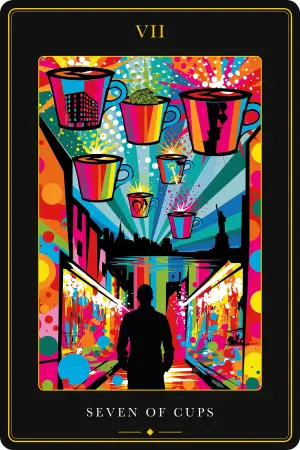


Minor Arcana · Cups (Water)
Eight of Cups
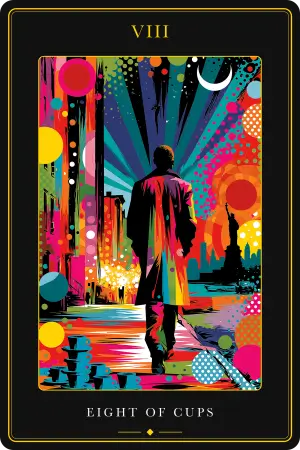
A man in a long coat walks down the cold avenue away from a party still in full swing, leaving eight full coffee cups on the sidewalk to look for the ninth that would actually mean something.
Read the complete guide: Eight of Cups in Tarot: A Complete Guide to Its Symbolism and Meaning
Card at a glance
- Numerology
- 8
- Element
- Water
- Astrology
- Saturn in Pisces (first decan)
- Kabbalistic path
- Hod in Briah (Splendor)
- Timing
- Late winter · Pisces season
- Yes / No
- Yes to leaving · No to staying
Upright
Honest departure
Walking away
Outgrowing the scene
Choosing depth
Renunciation
Soul-searching
Letting go
Liberation
Reversed
Doorway paralysis
Fear of the empty street
Staying out of fear
Drifting back
Half-leaving
Stagnation
Clinging
Unfinished goodbye
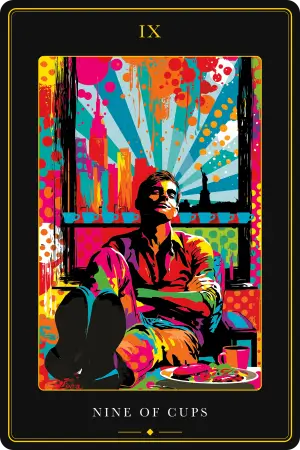
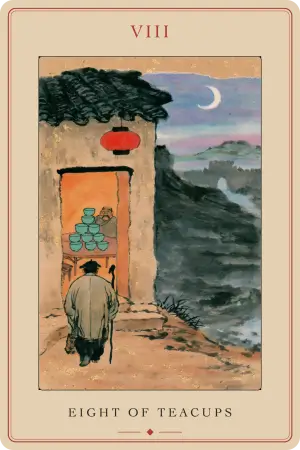
Eight of Cups in each deck
Every deck reimagines the same archetype. Compare the art, then open a deck to read its full interpretation.
Imagery and symbolism
In the Tarot of New York City the Eight of Cups is a man walking away from a party that is still going. The old Rider-Waite pilgrim and his rocky mountains are repainted in the deck's pop-art idiom: halftone dots, saturated color fields, sunburst rays. The classic meaning survives underneath, intact under new clothes.
The central figure is seen from behind, in a long coat, hands in his pockets, moving with the unhurried stride of someone who is not coming back. The card withholds his face on purpose, because the departure is not about who he is but about the act itself. Anyone who has ever outgrown a room becomes this silhouette. His coat blazes with color on the side facing the party and falls into black shadow on the side facing the open street, so he carries the warmth of what he leaves on his back while his front is already given to the dark avenue ahead.
At the bottom edge stand the eight cups, the blue Greek 'We Are Happy To Serve You' coffee cups that carry the suit of Cups through this deck. They sit stacked and clustered on the sidewalk, some still upright and full. Nothing is spilled and nothing is broken. That is the card's essential statement. He is not fleeing a disaster, he is leaving an abundance that no longer means anything to him.
Down the block a stoop glows gold and white with a gathering in full swing, and a small figure still stands in that light, still inside the scene. The party did not end. He did. Above him the night sky opens into teal and deep-blue sunburst rays radiating from a point just past his head, as if the empty street were itself a source of light. A slender waning crescent moon hangs in the corner, the deck keeping the Moon of the traditional card as the sign of intuition, the inner tide thinning out to make room for a new one.
On the horizon, small and distant across the water, stands the Statue of Liberty against a sunrise-colored sky. She is the card's mountain, the far, half-abstract promise of freedom that the figure walks toward with no guarantee of reaching it. The wet-looking sidewalk catches and doubles the colors of everything he leaves, the way the city makes you walk on the reflection of your own past for a block or two after any goodbye.
Core meaning
The Golden Dawn named this card the Lord of Abandoned Success, and in the New York deck that phrase becomes the moment you leave the rooftop party while the music is still playing. Nothing is technically wrong. The drinks are poured, the crowd is warm, the skyline glitters exactly as promised, and that is precisely the problem. The card describes a situation that is full but no longer filling. A job, a relationship, a friend group, a neighborhood, a version of yourself that worked and may even still work, but has quietly stopped feeding you, and some honest part of you has finally admitted it.
The Eight of Cups marks the conscious, deliberate exit. Not a dramatic storming-out, but the quiet act of getting your coat, saying nothing that needs saying, and walking down into the cold avenue alone. You leave the eight full cups lined up on the sidewalk behind you because you have realized the ninth cup, the one that would actually mean something, is not in this room.
The number eight carries structure, mastery, and the endless loop of the lemniscate stood upright. Within the Minor Arcana, eights mark the culmination of a phase and a test of mastery after real achievement. Poured into the water of Cups, that rigid structure becomes an emotional life at full strength that eventually reads as a loop: the same Friday nights, the same conversations, the same warmth on repeat. The mastery of this card is the discipline of knowing when to detach, not knowing how to accumulate a ninth cup.
Upright meaning
Upright, the New York Eight of Cups is the card of the exit already overdue. It signals a realization that a situation has quietly run its course. The leaving is voluntary and deliberate, prompted by inner knowing rather than forced by a sudden disaster like The Tower or an inevitable ending like Death. You trust the feeling that arrived before the explanation did, because 'no longer mine' is reason enough.
In love. A relationship stands like the eight cups on the sidewalk, intact and familiar, nothing spilled, and one heart has quietly walked to the end of it. There was no betrayal to point at and no fight to blame. The connection simply stopped reaching the depth one or both people need. The card marks the honest exit: the conversation had face to face, the goodbye said without cruelty and without the false hope of 'maybe later.' For singles it often means a chosen season of solitude, leaving the apps and the crowded rotation of almosts to walk alone until you can hear what you actually want.
In career. The resignation letter written by someone whose job is, by every external measure, good. The salary is decent, the title respectable, the colleagues fine, and the role has quietly stopped feeding the person inside it. This is the associate who leaves the firm at the peak of the track, the creative who walks out of the agency that made their name. The card counsels a departure that is chosen and clean, notice given with grace, the eight cups of the old career left upright on the sidewalk rather than thrown.
In finances. The decision to walk away from income that pays but no longer pays off. A revenue stream or arrangement is objectively fine, the deposits land, and yet the honest audit says it costs more of you than it returns. The card marks a conscious exit to redirect capital and attention toward something that aligns with where your life is going, usually with a lean stretch while the new structure takes shape.
In health. The decision to leave the habits that stand like full cups and quietly cost the body: the late nights that stopped being fun a year ago, the drinking bundled with every plan. The card favors departure over willpower, physically leaving the routines and rooms where the habit lives rather than white-knuckling moderation inside the old scene.
Reversed meaning
Reversed, the New York Eight of Cups is the person standing in the doorway of the party with their coat half on, for the third weekend in a row. The decision has already been made somewhere inside, the scene is over, the apartment is too small for who you have become, but the feet will not move. The card points to fear of the empty street: fear of missing out, fear of starting over in a city that seems to require a running start, fear that outside this warm loud room there is nothing at all. The doorway is the most exhausting place to live, colder than the street and lonelier than the party.
In love. The goodbye that keeps not happening. Two people share a lease, a routine, a silence, and the relationship ended somewhere back on the calendar, but neither will be the one to say it in a city where leaving means losing the apartment and the friend group. It also governs the return trips, the 1am message to the ex, the reunion that tastes like the memory for one evening and like the reason you left by morning.
In career. The resignation that lives in the drafts folder. The decision was made, sometimes years ago, but every Monday the coat goes back on the hook: fear of the gap on the résumé, fear of the pay cut, fear that no version of you outside this job is hireable. It describes quiet quitting in its literal sense, present at the desk and gone from the work, half-out the door and therefore fully nowhere.
In finances. Funds and effort locked inside something already finished. The unprofitable arrangement kept one more quarter because winding it down feels like admitting failure, the sunk-cost logic of 'I've put too much in to stop now.' It can also mark a return to an old income source driven less by fresh opportunity than by fear of the open street, and delivering less than memory promised.
In health. The health decision stuck in the doorway. Every Sunday the departure is announced and every week the coat goes back on the hook. The card describes half-measures that change nothing, quitting in theory while keeping the routines and hours where the old pattern lives, or ignoring the fatigue and the postponed appointment because looking at it would mean having to leave something.
Historical notes
The Eight of Cups the New York deck restages was fixed by Pamela Colman Smith under Arthur Edward Waite in 1909. Earlier European decks such as the Tarot de Marseille rendered the Minor Arcana through abstract, geometric arrangements of suit symbols with no human protagonist. Smith introduced a figure and an atmospheric landscape, turning the pip into a small narrative that made the esoteric idea legible.
The card's older meanings survive in Waite's Pictorial Key and in Golden Dawn material, where phrases like 'temporary success' and a 'thing thrown aside as soon as gained' suggest impermanence and a lack of follow-through. The Golden Dawn title Lord of Abandoned Success fixed the archetype. Aleister Crowley later sharpened it into something bleaker under the name Indolence, recasting the departure as an escape from decay rather than a hopeful pilgrimage. The New York deck keeps the pilgrim's version, and swaps his barren mountains for the night avenue.
Correspondences
Number. Eight, the number of order, accumulation, and established power, two fours, stability doubled. In this deck the Eights across the suits all show a structure at full strength. In Cups the structure that stands complete is an emotional life, the eight coffee cups lined up full on the sidewalk. Because the shape of the eight is also the lemniscate, that structure becomes a loop, and the card's true mastery is the discipline of knowing when to leave it.
Astrology. Saturn in the first decan of Pisces. Pisces is the Water of the card, the deep emotional current that feels a scene die long before the mind agrees to say so. Saturn is the discipline that makes the departure real, the landlord of the zodiac that presents the bill and ends the lease. Where Pisces alone would ache and stay, Saturn buttons the coat and walks. The pairing produces the card's particular sadness-without-regret: grief acknowledged, then carried down the stairs and out the door.
Element. Water, the suit's element of emotion, intuition, and the subconscious, poured in this deck from the blue Greek coffee cup.
Kabbalah. The card sits with Hod, the sphere of intellect, splendor, and form, in the watery world of Briah. It holds Path 27, which links Netzach (emotion and instinctual drive) with Hod (rational analysis). This is the moment the intellect examines the emotional achievements and finds them wanting. Hod's ruler Mercury adds a restless, critical mind that refuses to settle for shallow joy.
Elemental dignity. Beside other Water cards the disillusionment deepens into pure feeling and withdrawal, while Swords sharpen it toward cold analysis. As a yes or no, it says no to staying and yes to leaving.
Psychological perspective
The Eight of Cups maps neatly onto the hedonic treadmill, the human habit of chasing one milestone after another in the belief that acquiring them will finally yield lasting happiness. This card is the breakthrough where a person sees that external acquisition does not equal internal fulfillment. The disillusionment it pictures is an evolution in consciousness, not a failure.
In the New York deck the psychology lives in one distinction: 'nothing is wrong' and 'this is right for me' are two different sentences. It takes real maturity to recognize that a situation has served its purpose and to honor the grief of leaving something that is still partly good. The card asks you to tell comfort apart from alignment. Staying in a misaligned life out of obligation, habit, or fear of disappointing the people still on the stoop leads straight to the emotional decay that Crowley's version of the card depicts. The developmental task is not to leave everything, but to trust the crescent moon, the intuition that drains you before it can say why, and to answer one honest question by nightfall: what am I walking toward?
The Eight of Cups across decks
The Eight of Cups is a figure every tradition draws to its own emphasis. In the Rider-Waite-Smith deck it is a red-cloaked pilgrim leaning on a staff, walking away from eight stacked cups toward craggy mountains under an eclipsed sky, keyed to courageous departure and the search for meaning. In the Tarot de Marseille it is a formal arrangement of eight cups with no figure and no journey, an abstract pip that leaves the emotional narrative to the reader.
Crowley and Lady Frieda Harris's Thoth deck retitles the card 'Indolence' and draws three rows of shallow, cracked cups in a muddy, toxic landscape, the upper row empty, the lotuses above them drooping and the water they pour running sluggish and dirty. Crowley wrote that it 'is not exactly the morning after the night before; but it is very nearly that. The difference is that the night before has not happened.' The success has rotted from the inside, which makes the departure a matter of survival. The Wild Unknown replaces the human figure with a solitary wolf leaving a shadowy forest, eight empty cups behind it, stripping the medieval pageantry down to the instinctual pull to detach from what no longer nourishes.
The Tarot of New York City keeps each of those functions and swaps the objects for the city's own. The barren mountains become the night avenue, the golden chalices become blue Greek coffee cups, the eclipsed sky becomes a pop-art sunburst over the empty street, and the pilgrim becomes a New Yorker who finally, quietly, left the party.
In combination and context
The Eight of Cups is often set against the Six of Swords, since both are journeys. The Six of Swords is an escape from objective harm, a lower-agency flight to calmer waters that carries its mental baggage along in the boat. The Eight of Cups is higher agency and stranger. It abandons something that looks successful, leaving the physical cups intact while carrying the heavy realization that the search is still unfinished. There is no obvious villain, which is the quiet tragedy of the card.
The Four of Cups reads as its precursor. There the figure sits apathetic and bored, ignoring a cup offered from a cloud, a passive discontent. The Eight is the decisive action once that apathy becomes unbearable: the person has drunk deeply, found the water unsatisfying, and chosen to leave in search of a new source. With The Hermit the resemblance is close, both solitary cloaked figures leaning on staffs and walking into desolate country. The difference is level. The Hermit is a conscious, structured withdrawal toward universal wisdom, lantern in hand, while the Eight works at the level of the heart, walking into the dark guided only by the crescent moon, knowing what to leave without yet knowing where the road ends.
Position sharpens the reading. In the past foundation it says a departure already made is the ground you now stand on. Crossing the querent as the obstacle it points to a leaving you keep postponing in the doorway. As advice it says get your coat, set the date, and walk. As the outcome it promises the cold-avenue stretch first and the freedom of direction after, the sunburst that sits over the empty street rather than over the party.
Questions for reflection
- Which cup do I keep drinking from out of habit alone, and what would it cost me to set it down on the sidewalk and walk?
- Is the pull I feel a call toward something truer, or fear of the empty avenue dressed up as loyalty to the room behind me?
- If I only had to get my coat today rather than make the whole exit, what one honest step would that be?
The general meaning follows the Rider-Waite-Smith reading, the reference used across Tarot Academy. Open a specific deck above for its own interpretation.
Frequently asked questions
Explore the Tarot
Latest Posts
Discover the ancient wisdom of tarot cards and unlock the mysteries of your spiritual journey. Our blog is your gateway to understanding the rich symbolism, meanings, and practical applications of tarot reading.




















































