
 EN (English)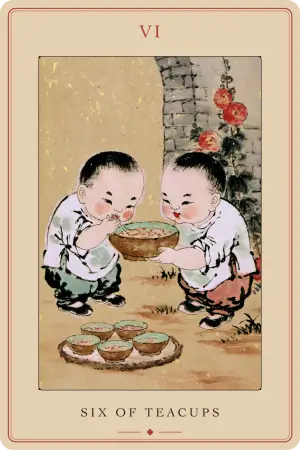


Minor Arcana · Cups (Water)
Seven of Teacups
Seven teas poured and none drunk: every desire rising as steam while the actual cup goes cold.
Read the complete guide: The Tarot Card Seven of Cups: A Complete Guide to Its Symbolism and Meaning
Card at a glance
- Numerology
- 7
- Element
- Water
- Astrology
- Venus in Scorpio · third decan (Nov 13–22)
- Kabbalistic path
- Netzach (Victory)
- Timing
- Late autumn · Scorpio season · a period of high imagination
- Yes / No
- Upright no · Reversed maybe
Upright
choices
fantasy
illusion
daydreaming
possibilities
wishful thinking
imagination
indecision
Reversed
clarity
awakening
reality check
determination
focus
disillusion
decisive action
grounding
Seven of Teacups in each deck
Every deck reimagines the same archetype. Compare the art, then open a deck to read its full interpretation.
Imagery and symbolism
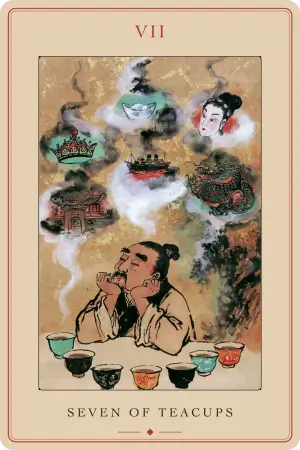
In the Tarot of Beijing the Seven of Cups becomes the Seven of Teacups, and the card moves indoors to a teahouse table. A daydreamer sits with his chin propped on both fists in front of seven full cups. He has drunk from none of them. From each cup a ribbon of steam rises and curls into a vision, painted in the deck's muted washes with vermilion and teal set against gold-flecked kraft paper. The visions hang above him like a private opera, and he watches them instead of the tea.
Each shape in the steam translates a classic temptation into the vocabulary of old Beijing. The opera crown replaces the laurel wreath: honors and applause that exist only under the lanterns, papier-mâché and glass beads. The silver ingot is wealth dreamed whole rather than earned coin by coin at a stall. The beautiful face is the ideal beloved, lovely precisely because it has no household, no temper, no morning voice. The courtyard siheyuan, with its gate and pomegranate tree, is the dream of settled status without laying a brick. The foreign ship is escape, the belief that a real life is happening somewhere past the city walls. The dragon is transformation at imperial scale, the fantasy of becoming categorically greater rather than slightly better.
Above the seventh cup the steam forms nothing at all, a veiled and unresolved shape. This is the deck's version of the RWS veiled figure: the unknown that attracts because it has no face, the option no one can evaluate. It may hold the truest tea on the table or only hot water, and watching the steam never tells you which.
The steam itself is the card's cloud bank, tying every vision to the subconscious and marking each one as temporary by its medium. Steam rises and thins. Meanwhile the cups, the only solid objects in the picture, sit cooling. Tea in this deck is feeling, and an offered cup is an offered heart, so seven cups poured and none drunk is emotion contemplated instead of lived.
Core meaning
The Seven of Teacups is Beijing's Seven of Cups, and the deck states its lesson in one brush line: fragrance is not flavor, and what you desire is not the same as what is real. Seven cups steam on the table, competing ideas and ambitions surfacing at once, and the daydreamer treats admiring them as if it were the same as choosing. It is not. The card's instruction is plain in the deck's own language: choose before the tea goes cold.
This is the card of too much possibility. Where the Six of Cups looked back at an idealized past, the Seven turns the whole gaze inward to the labyrinth of imagination, where every appetite can be indulged at once because none of them has been tested yet. The number carries the weight. Seven is exactly the abundance at which choice stops being freedom and becomes fog, enough options to dazzle and too many to plan. Seven pours the tea. It never lifts the cup. One cup drunk to the bottom is worth more than seven admired from a distance, and the work of the card is learning which cup that is.
Upright meaning
Upright, the Seven of Teacups shows a period of high emotional excitement and a table crowded with appealing options. Many opportunities present themselves, and some are only steam, beautiful and gone the moment you reach for them. The risk is deciding by wishful thinking rather than fact, delaying real work in favor of an imagined future while the actual tea cools. Clarify what you genuinely want, set concrete priorities, and remember that not choosing is also a choice, and it always chooses the cold table.
In love. A charged period of shifting desires and competing scenarios, perhaps a choice between partners or between ways to structure one bond. The warning is the beautiful face in the steam, adored because it has no flaws to accommodate. You may be seeing your love life through pure imagination rather than the person in front of you. Wave the steam aside and ask what you actually need from a partner.
In career. A crowded field of projects and possible paths, each sending up its own fragrant steam. Very few are truly reachable. Separate the grounded work from the opera crown of prestige and the dragon of a role far above your craft, then commit to one target and let the other cups cool. Too much choice here breeds stagnation, not progress.
In finances. A flood of money-making ideas without a plan to reach any of them. The silver ingot floats in tea steam, not in a strongbox, and you may be craving the windfall rather than the coin-by-coin earning of a market stall. Come down to earth, choose one path, and stay cautious: steam has never once paid a rent.
In health. Ambitious visions of a transformed body, a row of steaming futures. The trap is trying every routine at once and finishing none. Choose one protocol and hold it with the patience of morning tai chi at the Temple of Heaven, the same slow forms in every season, because only consistency will change the body.
Reversed meaning
Reversed, the steam thins and the visions dissolve. What remains on the table is seven ordinary cups of cooling tea, and one of them is yours. Often this comes through disappointment: the crown was paper, the ship never sailed, the face belonged to someone imagined. That letdown is also the opening to accept your real circumstances and act on them. The harder version of the reversal is apathy, sitting at the emptied table long after the teahouse has closed, still reluctant to face the facts. Either way the instruction holds. Pick up one cup, drink it, then order the next.
In love. A harsh awakening that strips the beguiling dreams. The idealized image never matched any breathing face, and holding out for it cost you real warmth. Take the cup that is actually offered, with both hands as it is done in this city, or set it down honestly and leave the table. What you may not do any longer is watch it cool.
In career. Disappointment from a poor choice, time and effort spent on what turned out to be steam. Stop treating the job like a daydream over tea and work with the discipline of the cloisonné apprentice who files his eighth vessel while the fair passes unheard outside. Cut the illusions, name any insecurity that stops you executing, and deliver on one attainable objective.
In finances. A demand to convert dreams into action before they dissipate. Discard the unrealistic plans and watch for risky investments built on false expectations, money poured after an ingot that was only ever vapor. Count what is actually on the table the way a market matron counts her till, real income against real costs, then focus on practical milestones.
In health. A scattered approach exposed. Jumping between diets and programs has diluted your focus to nothing, seven regimens sampled and none finished. Strip away the complex protocols, pick one or two sustainable habits, and accept your body's current reality rather than the standard drawn in steam.
Historical notes
In the fifteenth-century Visconti-Sforza deck the Seven of Cups was simply seven ornate chalices, a courtly emblem of abundance with no scene to read. The Tarot de Marseille kept that abstraction, arranging the cups in a tidy geometric pattern that pointed the reader toward numerology rather than narrative. Medieval number lore already leaned the card toward its later meaning: seven carried the tension of the holy virtues against the deadly sins, and Chaldean tradition marked it as the number of illusion and veiled truth.
The card gained its psychology in the occult revival. The Hermetic Order of the Golden Dawn placed the Seven of Cups on Netzach on the Tree of Life, tied it to Venus in Scorpio, and titled it the Lord of Illusory Success, the moment when desire overrides judgment and leads into a labyrinth of one's own making. In 1909 Arthur Edward Waite and Pamela Colman Smith turned that idea into an image, drawing on the fifteenth-century Sola Busca deck shown at the British Museum in 1908. Their card set a silhouetted figure before seven floating chalices filled with dreamlike apparitions, which Waite called strange chalices of vision. In 1944 Aleister Crowley pushed the placement to its dark extreme, retitling the card Debauch and painting decaying lotuses oozing into malformed cups, a picture of dissipation and escape.
The Tarot of Beijing keeps the Golden Dawn's illusory success and gives it a setting. The floating chalices become teacups on a table, the billowing cloud bank becomes rising steam, and the anonymous silhouette becomes a specific daydreamer in a teahouse. The deck is gentler than Crowley, since dreaming over tea is an honorable Beijing pastime and the card does not scold. It only points at the cooling cups.
Correspondences
Number. Seven, the number of secrets, inner wisdom, and the search for truth, and the point at which abundance turns to fog. Seven cups stand on the table, not five and not ten, because seven is the exact quantity at which choice stops being freedom. It supplies the energy to explore and invent while offering no plan to reach any single vision.
Astrology. Venus in Scorpio, in this deck the third decan of Scorpio, roughly November 13 to 22. Venus governs love, harmony, and beauty, which lends the card its aesthetic pull, the loveliness of the face and the elegance of the imagined courtyard. Set in Scorpio's intensity, that longing idealizes easily and blurs into fantasy, so the placement often ends in the sharp disappointment of an ideal meeting a real person.
Element. Water, the suit's element, here filling all seven cups literally. Water asks you to sink into feeling and map the hidden currents of the subconscious, but the goal is not only to inhale the fragrance of emotion. It is to drink it and move through it.
Kabbalah. Netzach, the sphere of Victory, in the world of Briah. The victory the sphere promises here is illusory, which is exactly why the Golden Dawn named the card as it did.
Psychological perspective
The person of this card overflows with ideas and desires, a regular of the mind's teahouse who orders everything on the menu and finishes nothing. A powerful imagination makes them genuinely creative and dangerously optimistic at once. They see the dragon in the steam more vividly than the cup on the table, fixing on the future while the present goes unattended, and their enthusiasm keeps generating expectations that reality cannot meet. Modern readers recognize the pattern as the Enneagram Enthusiast, the type that escapes discomfort by projecting into the next exciting possibility.
The card's shadow in relationships has its own contemporary name: seeing what you want to see and calling it love. The querent projects an ideal onto a partner who does not hold those traits, ignoring plain evidence to protect the fantasy. The remedy the card keeps prescribing is unglamorous. Step back from the glowing cups, put the feeling on trial, and ask whether a desire is rooted in anything real or is a story the imagination told to avoid the present. Applying plain intellect to boundless imagination is how the fog burns off.
The Seven of Teacups across decks
Rider-Waite-Smith. The 1909 card is the direct ancestor: a black silhouette facing seven chalices that float in cloud, each holding an apparition of a head, a veiled figure, a snake, a castle, jewels, a wreath and skull, and a dragon. Beijing keeps the seven-vision structure and the theme of illusory choice, then grounds it, trading the floating chalices for cups on a table and the clouds for steam.
Tarot de Marseille. The Marseille Seven of Cups has no scene, only seven cups in a geometric arrangement that invites a numerological reading. Beijing restores narrative to the pip while keeping the older sense that seven itself is the subject.
Crowley-Thoth. Crowley titled the card Debauch and painted poisoned lotuses draining into broken cups, the Venus in Scorpio placement pushed toward addiction and decay. The Beijing card meets the same shadow more quietly, as steam admired until the tea goes cold and the hour is wasted.
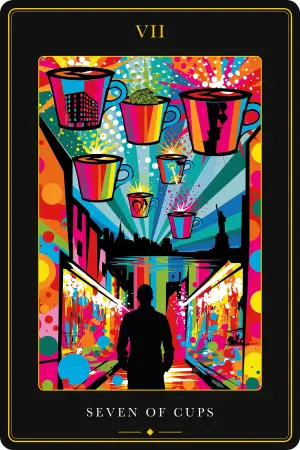
Modern reframings. Contemporary decks often sharpen the card's menace, the Light Seer's slipping a snake from under a cup, the Ethereal Visions reading it as masks and deliberate aloofness. The Tarot of Beijing takes the gentler road, treating the dreamer with sympathy while still pointing, with one calm line, at the cups that are getting cold.
In combination and context
The Seven of Teacups colors a spread with illusion and unmade choice, and its neighbors decide whether the dreaming is fertile or a trap. Next to cards of force and structure it meets a corrective. The Chariot brings the willpower to cut through the fog and commit, the Emperor brings the structure to hold a single course, and the Ace of Swords pierces the illusions outright, popping each steaming vision to leave the plain truth.
Other neighbors deepen the haze. The Moon magnifies the subconscious pull until anxiety overrides judgment, and the Magician can turn the card into a charlatan working smoke and mirrors, selling illusions as facts. The most pointed pairing is the Seven of Swords: where the Teacups shows you deceiving yourself through wishful projection, the Swords shows deception aimed at others, and together they warn of a loop where you are both fooled and self-fooling.
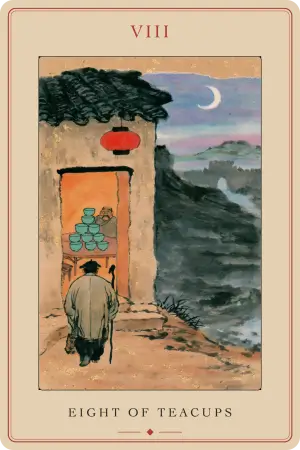
Within its own suit the card is the crucible between the Six of Cups and the Eight. It disrupts the Six's idealized memory with the full complexity of adult desire, and it is resolved only when the Eight of Cups turns its back on the accumulated cups and walks toward one real thing. When the Seven of Teacups keeps returning, treat it as the deck asking you to wave the steam aside and lift the one cup that has actual weight.
Questions for reflection
- Which cup on your table are you admiring from a distance instead of drinking, and what would it cost to finally choose it?
- When you picture the future you want, does it have a temper, a price, and a cold morning in it, or is it only fragrance?
- Where are you seeing what you wish were true rather than what is actually in front of you?
The general meaning follows the Rider-Waite-Smith reading, the reference used across Tarot Academy. Open a specific deck above for its own interpretation.
Frequently asked questions
Explore the Tarot
Latest Posts
Discover the ancient wisdom of tarot cards and unlock the mysteries of your spiritual journey. Our blog is your gateway to understanding the rich symbolism, meanings, and practical applications of tarot reading.




















































