
 EN (English)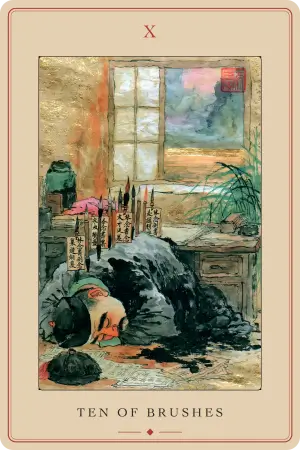


Minor Arcana · Swords (Air)
Apprentice of Brushes
The honest beginning of the mind: a boy copies characters until one stroke among forty comes out true, and he knows which one.
Read the complete guide: Page of Swords in Tarot: A Complete Guide to its Symbolism and Meaning
Card at a glance
- Numerology
- Apprentice (Page)
- Element
- Air, Earth of Air
- Astrology
- Air signs: Gemini, Libra, Aquarius
- Kabbalistic path
- Malkuth (Kingdom) in Yetzirah
- Timing
- New study begun · news likely delayed
- Yes / No
- Upright yes, gather more first · Reversed no
Upright
curiosity
study
beginner's mind
asking why
practice
honest apprenticeship
sharp observation
directness
Reversed
gossip
half-learned knowledge
careless speech
scattered attention
impatience
fear of the blank page
hasty conclusions
abandoned practice
Apprentice of Brushes in each deck
Every deck reimagines the same archetype. Compare the art, then open a deck to read its full interpretation.
Imagery and symbolism
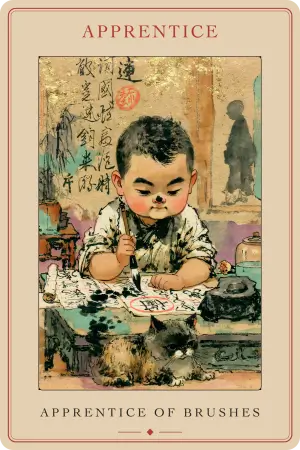
In the Tarot of Beijing the Page of Swords is a small boy at a low desk, gripping a brush too large for his hand and copying characters with ferocious concentration. Where the classic card gives a youth on a windy hill with a raised sword, this deck gives the intellect before it becomes a weapon, a discipline being learned one stroke at a time. The boy fills the center of the card, round-cheeked and frowning with effort, sleeves rolled and already stained.
There is a smudge of ink on the very tip of his nose. He leans too close to his work, the way every true student leans too close to what they love, and in the deck's language that smudge is a badge rather than a flaw: knowledge leaves marks on those who handle it honestly. The oversized brush is the suit emblem, the descendant of the sword, held upright in the small fist so it repeats the vertical blade of the traditional card. Its edge is a soft tip loaded with ink, and the suit's one law rides on it: the first stroke cannot be unmade.
On the practice sheet, characters march in uneven rows across a red grid. Most are crooked, and blots have fallen among them like small black rain, but one character is circled in vermilion, the teacher's mark for the single stroke that came out true. This is the heart of the card. One perfect stroke among forty crooked ones, and the boy knows exactly which one it is.
The ink has traveled, as ink does. Black paw-blots cross the teal desk cloth, and below the desk sits the cat, long-suffering and faintly inked itself, watching with the patience of an animal that has decided to stay anyway. At the boy's elbow stand adult instruments larger than the hands that use them: the dark inkstone with its ground pool, the water jar in the deck's cool teal glaze. Behind him a hanging panel shows a gray silhouette, the master present only as a shadow, who set the model and stepped back. The wall above is warm kraft flecked with gold, carrying columns of running-hand calligraphy and small red seals, the accumulated writing of generations under which this small scribe works.
Core meaning
The Apprentice of Brushes marks the honest beginning of intellectual work. In old Beijing a boy did not start with poems, he started with the same character copied forty times, until one stroke came out true and he could name it. The card places you at that stage: gathering information, copying good models, asking questions that more experienced people find exhausting and that you should keep asking anyway.
It points to the start of a study, a research task, a new field, a first article, a first serious conversation about a difficult subject. The scope may be small, one page of practice paper, but this is where the calligraphy of your future skill begins. News, messages, and fresh information are likely, and the card asks you to treat them as material to examine rather than verdicts to accept. The intellect here is not yet the cold blade of the Swords archetype. It is raw appetite and a fresh eye, a mind that absorbs the way rice paper absorbs ink.
Upright meaning
Upright, the card says to practice in the open, blots and all. Do not hide your crooked strokes, count them, because that is how you learn to recognize the straight one. Ask why until somebody hides, since curiosity is your engine and not your embarrassment. Copy the best models you can find before inventing your own style, and remember the suit's law: think before you write, speak, or send, but do not let that caution stop you from writing at all.
In love. The delight of getting to know someone, the stage of long conversations and eager, slightly smudged messages. It can mark a new acquaintance whose mind is the attraction, a first love with all its clumsy sincerity, or a fresh intellectual spark in an established couple. Say the true thing plainly, even if the phrasing comes out crooked, and keep the beginner's mind: the partner you think you know by heart still has pages you have not read.
In career. A period of active learning and sharpening. New material must be absorbed, a system, a method, a body of documents, and the card favors the boy's approach: copy the best practitioner, repeat until your hand learns it, and record which attempts worked. It is strong for training, onboarding, research, analysis, and editing. The colleague who admits what they do not know learns fastest, and one genuinely well-done piece of work, the circled character, gets noticed above a stack of adequate ones.
In finances. Financial literacy in its first honest form: sitting down with the ledger the way the boy sits with the copybook. It favors studying before spending, reading the contract twice, asking the awkward question about fees, learning how an instrument works before putting a coin into it. Small sums handled attentively matter more now than large sums handled carelessly. The suit's law applies to signatures above all, so understand what you sign.
In health. A student's approach to the body: learn how your own actually works through close, repeated, honest attention. It favors a new practice begun with curiosity rather than punishment, proper form learned slowly, a simple journal of sleep, food, and mood kept like a copybook. Expect awkward sessions at the start and treat them as practice sheets. Among your forty attempts, notice the one that worked, circle it, and repeat that.
Reversed meaning
Reversed, the Apprentice of Brushes shows the boy who has knocked over the inkstone and blames the cat. Study has stalled or turned sour: information gathered carelessly, conclusions drawn from half a page, sharp words flying before thought has caught up with them. It can point to gossip, to unverified news passed along as fact, to clever remarks that wound, or to a promising course of learning abandoned because the first attempts looked ugly. The remedy is the boy's own: slow the brush, reread before you send, and go back to basics without shame, because the practice grid exists for masters too.
In love. Words doing damage: the sarcastic remark that landed harder than intended, the message sent in irritation, the clever argument won at the cost of the evening. It can point to gossip around the couple, to conclusions drawn from a half-read situation, or to a partner who debates instead of listening. Spoken ink does not come off, so put the brush down before composing the devastating reply. The repair is sincere, direct, slightly awkward honesty.
In career. Study and communication going wrong. Instructions half-read, feedback taken as insult, corners cut on the boring foundational parts, sharp remarks in meetings that leave stains hard to wash out. It can show someone overwhelmed by information and hiding it behind confidence, or a habit of forwarding claims nobody has verified. The way back is procedural and humble: reread the brief, redo the basics, ask the question you were embarrassed to ask three weeks ago.
In finances. Conclusions drawn from half a page. Money decisions based on rumor, on a confident retelling, on a headline rather than the document, plus the risk of impulsive spending justified by clever-sounding reasoning. It can also show neglected paperwork: the unread statement, the subscription quietly bleeding coins because nobody looked. Read the actual numbers, ask the naive question out loud, and correct the record while the ink is still wet.
In health. The body suffering from the mind's bad habits: decisions made from headlines and hearsay, a regimen started brilliantly and dropped at the first blot. It can point to self-criticism turned corrosive, seeing only the crooked strokes in the mirror, or to restless mental energy that steals sleep and frays the nerves. Become an honest student of your own body again, verify before you adopt, and restart the abandoned practice at page one without shame.
Historical notes
The card began as the Valet d'Épées of the Tarot de Marseille. In that abstract pattern the suit of swords is drawn with curved lines forming a shape close to a mandorla, and in early decks such as Jean Dodal's the Valet looks deliberately to the left, holding his sword in the left hand. That posture carried secretive, watchful overtones, and cartomantic texts derived from the Ancient Tarot of Bologna attached meanings of surveillance, investigation, and the search for truth to the figure, establishing the investigator and the spy centuries before digital surveillance existed.
The modern scenic version arrived with the 1909 Rider-Waite-Smith deck, illustrated by Pamela Colman Smith. Her Page stands on a rocky ledge, gripping a sword upright with both hands, hair and clouds blown by the wind, birds wheeling in the distance to mark the element of Air. Waite defined the card in his Pictorial Key as authority, secret service, vigilance, and examination. Aleister Crowley and Lady Frieda Harris then dismantled the court structure in the Thoth deck, replacing the Page with the volatile Princess of Swords, the earthy child of Air, at her best perceptive and clear, at her worst cruel and destructive.
The Tarot of Beijing keeps the truth-seeking and the fresh eye but sets them at the start of a discipline rather than on a windswept hill. It trades the raised blade for an oversized brush and the vigilant spy for a copybook student, so the card's ancient link between the intellect and the search for truth survives as a boy learning to write, one stroke at a time.
Correspondences
Number. As a Page the card sits at the point where the suit's energy grounds into physical reality. It follows the 10 of Swords, a card of mental exhaustion and rock bottom, and reads as the fresh, curious mind rising from that wreckage, unburdened by past failures and eager to learn anew.
Astrology. The Air signs Gemini, Libra, and Aquarius, whose young energy the Apprentice gathers. Gemini gives the restless curiosity, the boy who asks why until the master hides. Libra gives the discipline of the grid, each character weighed inside its square and the teacher's just verdict of forty strokes examined and one circled. Aquarius gives the fresh eye, the instinct that the tradition on the wall is a launching board and not a cage.
Element. Earth of Air. The suit of Brushes is Air, mind and words, and the Page's rank is Earth, so the card grounds the swirling airy intellect into the tangible act of a stroke on paper. That friction between the weightless and the solid explains the restless energy of the mind trying to settle into a single true mark.
Kabbalah. Pages correspond to Malkuth, the Kingdom, the sphere of physical reality, here placed within Yetzirah, the formative world governed by Air. The pairing confirms the Apprentice as the initiator of action on the material plane, taking an abstract idea and pressing it into a written character.
Psychological perspective
The person of this card is at the copybook stage of something, whatever their age: a student, a junior colleague, a beginner in a new field, or anyone who has kept the beginner's hunger. Their mind is quick and absorbent, their questions constant and genuine. They ask why until the master hides, not to provoke but because they truly cannot rest until they understand. They notice details others walk past and remember exactly which of their forty attempts was the good one.
At their best they carry the beginner's mind, the openness that recognizes it does not yet hold the mastery of a King or the emotional wisdom of a Queen and compensates with raw intellectual hunger. Their honesty about their own work is disarming, their speech direct and sometimes blunt but without malice. The shadow is a guardedness that hardens into an emotional fortress, an intellect used to avoid the messy business of feeling. Pushed further it becomes the reversed state: paranoia, analysis paralysis, a caustic tongue that mistakes rudeness for honesty. The card's whole lesson is that intellect without empathy or patience turns into a weapon aimed at the self.
Apprentice of Brushes across decks
Tarot de Marseille. The Valet d'Épées stands with his sword in the left hand, looking warily to the side, an abstract figure of surveillance and the search for hidden truth. Beijing keeps the watchful, truth-seeking mind but swaps the wary spy for a boy bent over a copybook, the vigilance turned inward on the work.
Rider-Waite-Smith. Smith's Page grips a raised sword on a windy ledge, hair and clouds streaming, birds marking the restless Air. The Apprentice of Brushes repeats the vertical blade as an upright brush and replaces the racing sky with the silent traffic of characters written across the wall behind him.
Crowley-Thoth. Crowley replaced the Page with the Princess of Swords, the earthy child of Air, capable of piercing clarity and of destructive, amoral logic. Beijing meets that same double edge more gently: the reversed Apprentice is the clever child grown careless, whose sharp words stain like spilled ink.
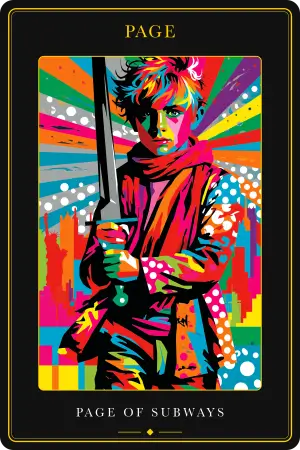
Modern reframings. Later decks often read the card through contemporary life, the messenger becoming email and the watcher becoming the social-media lurker. The Tarot of Beijing reaches the other way, back to the calligraphy master's desk, and frames the beginning of the mind as an apprenticeship in a craft where every mark is permanent.
In combination and context
The Apprentice of Brushes acts as the reactive student of a spread, sharpening or scattering the energies around it depending on what it sits beside. Near cards of raw intellectual power, such as the Ace of Swords, its nascent curiosity meets a razor edge and cuts straight through a problem into decisive clarity. Near the Magician, the willpower to execute frees the Apprentice from unproductive mental loops and turns thought into action.
Other neighbors expose the shadow. Beside the Seven of Swords the watching turns deceptive, the student now hiding an identity and collecting information dishonestly, while the Knight of Pentacles locks the card into a stuck loop where fast thoughts clash with a slow, methodical nature and nothing gets done. In digital-age readings the Page has become the signifier of lurking and surveillance, the person who watches from a safe distance and gathers data without the courage to make contact.
When the Apprentice keeps appearing, treat it as an instruction rather than a verdict. Sit down at the low desk, practice the thing openly, ask the questions you have been pretending not to need, and among the day's forty crooked strokes find the one that came out true and learn to write it again.
Questions for reflection
- What in your life is at the copybook stage right now, and are you practicing it openly or waiting until you can do it beautifully?
- Which question have you been pretending not to need to ask, and who could actually answer it?
- When you look at your own recent work, do you count only the crooked strokes, or can you find and name the one that came out true?
The general meaning follows the Rider-Waite-Smith reading, the reference used across Tarot Academy. Open a specific deck above for its own interpretation.
Frequently asked questions
Explore the Tarot
Latest Posts
Discover the ancient wisdom of tarot cards and unlock the mysteries of your spiritual journey. Our blog is your gateway to understanding the rich symbolism, meanings, and practical applications of tarot reading.




















































