
 EN (English)


Minor Arcana · Swords (Air)
Courier of Brushes
Quick thinking with its feet already off the floor: a young debater who argues before he lands.
Read the complete guide: The Knight of Swords Tarot Card: A Complete Guide to Its Symbolism and Meaning
Card at a glance
- Numerology
- Courier
- Element
- Air (Fire of Air)
- Astrology
- Gemini · Mercury · Fire of Air
- Kabbalistic path
- Tiphereth (Beauty)
- Timing
- Swift · days not weeks · spring wind
- Yes / No
- Upright yes · Reversed no
Upright
quick thinking
verbal courage
decisiveness
direct speech
initiative
debate
mental energy
swiftness
Reversed
haste
aggression
words as weapons
not listening
recklessness
arguing to win
burnout
spilled ink
Courier of Brushes in each deck
Every deck reimagines the same archetype. Compare the art, then open a deck to read its full interpretation.
Imagery and symbolism
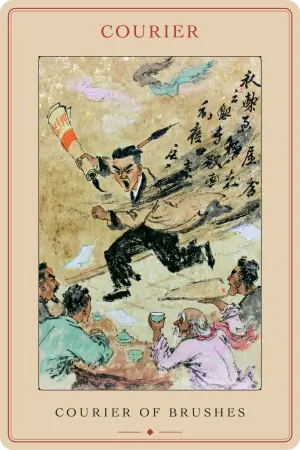
In the Tarot of Beijing the Knight of Swords is the Courier of Brushes, and he arrives at a run. A young man is caught airborne over a teahouse table, both feet off the floor, mouth open in mid-argument. He has not sat down yet and is already debating. Where the Rider-Waite Knight has a charging horse under him, the Courier has only his own legs and momentum, because in the hutongs the mind travels on foot and by bicycle, and it travels fast.
The sword is gone. In its place he holds a rolled newspaper raised like a sabre, a blade made of words: editorials, verdicts, the day's fresh print still smelling of ink, its red-stamped masthead flashing like a drawn edge. A writing brush is tucked behind his ear the way a soldier keeps a spare blade, so he is armed twice, once to speak and once to write. The brush points back along his line of flight, a quiet reminder that everything he says can become a record, and in this suit a record is permanent.
Behind him a storm of black ink streams in long dry-brush strokes, standing in for the gale that whips the Knight of Swords. This is the element of Air drawn as calligraphy: his passage through the room is itself a written character, forceful and impossible to erase. Loose sheets scatter in his wake, the letters and rumors he sets in motion, arriving everywhere at once and rarely in order.
Below him four tea drinkers react around celadon cups: one old man shields his tea, the others turn or shout or wave their own papers back. The teahouse is the deck's parliament, the place where the district thinks out loud, and the Courier treats it as both arena and audience. The teapot at the center sits undisturbed, the calm the argument is supposedly being fought over. In the upper sky two cloud-dragons in teal and rose coil above the scene, mirroring his temper at heavenly scale, a warning that a private squall can grow into someone else's storm. A column of grass-script calligraphy runs down the right, slanted by the same wind. The whole card is warm gold-flecked kraft paper and muted ink, with vermilion only on the masthead and the small red seal, the deck's signature that however fast this all moves, it is still ink set down by a steady hand.
Core meaning
The Courier of Brushes carries the Knight of Swords energy in the Beijing deck: quick thinking, verbal courage, and the readiness to fight for a belief out loud. He is Fire acting through Air, flame fanning the wind of words, so ideas here are not merely held. They are ridden at a gallop and defended to the end, sometimes past the end.
In a reading he marks the moment to make a decision, speak plainly, and move fast. A new project, a change of direction, a public statement, a question circled too long that finally needs answering. The card carries courage and straightforwardness, and a warning stitched into the same figure: the Courier is fast, bright, occasionally right, and never in doubt, and the last two of those are not the same thing. News, arguments, and results arrive quickly under this card, often all at once, like papers scattering behind a running man. His gift to the room is that he says the true thing first, before anyone else has found the nerve. His liability is that he moves so fast he vaults over the people who were about to agree with him.
Upright meaning
Upright, the card says the moment asks for clear thinking and fast, direct words. Say what you actually think, out loud, to the people it concerns. Use logic to cut through the tangle, take the straight line across the courtyard where before you were only circling, and act while others are still drafting memos. Just remember whose teacups you are knocking over, keep one beat of silence before answering a provocation, and check the facts in your rolled newspaper before you brandish it.
In love. A relationship moving at bicycle-messenger speed: rapid development, bold declarations, a partner who says exactly what they think and courts with wit and long arguments about everything. Passion here runs through conversation, and the couple that argues well can love well. Name what you want and ask the real question. The one caution is built into the image, so match the honesty with some care for where the words land.
In career. The fast lane. Quick decisions, an intensive push on a project, initiative taken in the meeting rather than in the corridor afterward. It favors work built on words and wit: journalists, editors, analysts, lawyers, negotiators, anyone whose tool is an argument delivered on deadline. Speak up, volunteer for the hard question, and outpace the committee, but spend one minute on the floor plan first so speed does not run you into an obstacle it could have seen.
In finances. Ambition, confidence, and speed. Successful negotiations, persuasive pitches, contracts won by the sharper argument, a sudden flow of orders that changes the numbers. Money moves fast in both directions here, so decisiveness pays and hesitation costs. Do the reading before the meeting, then speak first, and get the agreement onto paper while the ink of enthusiasm is still wet.
In health. Momentum looking for an outlet: strong reflexes and nervous energy that want a physical channel. It favors fast, sharp activity, running, cycling through the lanes, badminton, martial arts, and it marks a good time to start a regimen cleanly rather than to keep researching one. Give the mind's speed somewhere to run, because a Courier with nowhere to go starts arguments instead.
Reversed meaning
Reversed, the card shows the same young man from the point of view of the overturned table. It points to impulsiveness and haste that bring trouble: decisions made mid-shout, words sent that cannot be recalled, promises written faster than they were thought. It can mean aggression, an inability to listen, and a situation slipping out of control because everyone is talking and no one is pouring tea. Sometimes it describes an inner state, a mind sprinting in circles and picking fights with imagined opponents at three in the morning. The remedy is deliberate: put the newspaper down before you answer, and in the suit of Brushes, where everything written is permanent, write slowly when angry.
In love. Words used as weapons. Quarrels that escalate at running speed, sarcasm where tenderness was needed, a partner who must win every exchange. Harsh things said in haste now sit permanently on the record, because in this suit everything is ink. Stop keeping score, listen to the whole sentence before you reply, and apologize specifically rather than generally.
In career. A storm inside the office: overload, deadlines used as weapons, and conflicts that reproduce faster than tasks close. Criticism gets delivered without tact, and a workplace argument stops being about the work. Slow down, write less in anger and more in drafts, and untangle the dispute from the task before a fast tongue makes a slow career.
In finances. Impulsive money behavior. Deals signed at a run, expenses that were really the cost of proving a point, aggressive negotiation that wins the clause and loses the partner. Be suspicious of anyone waving a document and telling you there is no time to read it. Check figures twice, let contracts rest overnight, and avoid decisions made in anger.
In health. Speed has outrun the body. Overexertion, injuries from skipped warm-ups, crash diets adopted mid-enthusiasm, and the exhaustion of a nervous system that never stops composing arguments: poor sleep, clenched jaw, too much strong tea. Let the ink dry. Walk instead of run for a week and let the body catch up with the mind that has been sprinting ahead of it.
Historical notes
The card behind this figure is the Knight of Swords, and its lineage is martial before it is atmospheric. The Tarot de Marseille drew the Cavalier d'Épée as a straightforward cavalry figure, a horseman striking a decisive physical blow, read less through psychology than through direct action: the moment deliberation collapses into a swift, unavoidable stroke.
The modern card arrived with the 1909 Rider-Waite-Smith deck, where Pamela Colman Smith painted arguably the fastest-moving image in the pack. A knight in full plate charges across a barren plain on a rearing white horse, sword raised into the sky, red cloak and helmet plumes streaming backward in a gale, the trees and jagged stratus-fractus clouds all bent the same way. He does not fight the wind. He rides with it, a localized force of nature. Aleister Crowley and Frieda Harris then reworked him in the Thoth deck as the Prince of Swords, riding a chariot pulled by capricious winged children who leap in whatever direction strikes them, an image of the pure mind: infinitely agile, immensely powerful, and unable to hold a straight course.
The Tarot of Beijing takes the RWS storm rider and translates every part of it into the hutong. The horse becomes the young man's own legs. The sword becomes a rolled newspaper. The howling wind becomes a storm of ink drawn in grass-script strokes, and the barren plain becomes a crowded teahouse full of people with opinions of their own. What survives untouched is the speed, the conviction, and the sense of a mind moving faster than the room around it.
Correspondences
Rank. In the Tarot of Beijing the Couriers hold the place of the Knights, the messengers and adventurers of their suits, so this card carries no pip number. It is the mobile agent of the Brushes, the one who takes the suit's energy out of the study and runs it into the street.
Astrology. This deck sets its Courier of Brushes in Gemini, ruled by Mercury, spanning the third decan of Taurus and the first two decans of Gemini, and it houses him in the third house of neighborhood, short journeys, and communication. That is drawn quite literally as the hutong lane, the bicycle, and the teahouse two streets over where the argument is already waiting. Gemini gives him his double armament, the newspaper and the brush, speech and writing. Note that the older Golden Dawn attribution placed the Knight of Swords instead across the border of Capricorn and Aquarius; Beijing has chosen the Mercurial reading of the same restless mind.
Element. Fire of Air. Each Courier joins the Fire of his rank to the element of his suit, and for Brushes that is Air, so this is flame fanning the wind of words. The mix is brilliant and unstable: at its best, wit and the courage to say an unpopular true thing in a full room; at its worst, hot air moving fast.
Kabbalah. As the Air aspect of the court, the Knight of Swords belongs to the letter Vau and the Formative World of Yetzirah, directed action rather than pure spirit or final matter. The Knights rest at Tiphereth, the sphere of Beauty and harmony, which suggests that beneath the noise the Courier is chasing clarity, even when his methods scatter the papers.
Psychological perspective
The person of this card treats conversation as motion. This is the young debater who strides in mid-sentence, sits down last, and has somehow been leading the discussion for five minutes already. They are driven by ideas and by the need to test those ideas against other people, immediately and out loud. They read everything, quote half of it, argue with the rest, and stand by their beliefs to the end. Their energy is the wind of the suit given legs: it arrives suddenly, rearranges the room, and moves on before the teacups stop rattling.
The shadow is a good mind turned into a sabre with no scabbard, drawn at breakfast and never put away. Here the intellect stops clarifying and starts wounding. It mistakes volume for argument and speed for thought, reloads instead of listening, and answers every insult at triple strength. In its most private form it is the chronic over-thinker lying awake at three in the morning, slicing up its own feelings, trying to out-think a heart it would rather not feel. The work of this card is aim: the blade is genuinely sharp, and the whole question is whether it is pointed before it swings.
The Courier of Brushes across decks
Rider-Waite-Smith. The Knight of Swords charges on a white horse across a windswept plain, sword high, cloak streaming, riding with the gale rather than against it. The Courier of Brushes keeps that headlong speed and conviction but trades the horse for his own legs and the sword for a newspaper, moving the whole charge indoors into a teahouse.
Tarot de Marseille. The Cavalier d'Épée is a plain military horseman, raw martial energy with no atmospheric drama, the decisive blow that ends a period of waiting. Beijing keeps that bluntness and directness while wrapping it in the wit and paperwork of a city that argues for sport.
Crowley-Thoth. Crowley renamed the figure the Prince of Swords and set him in a chariot drawn by unruly winged children who bolt in every direction, the pure agile mind unable to hold a course. The Beijing card echoes that instability in its scattered flying papers, the small consequences of a mind moving faster than it steers.
Modern reframings. Many contemporary decks read this Knight through the lens of the over-active mind: the anxious over-thinker, the argument won and the relationship lost, the impulse to fire off the message before checking the reality. The Tarot of Beijing belongs to that movement, giving the archetype a specific stage, a teahouse full of neighbors, so the cost of the sharp word is always sitting right there at the next table.
In combination and context
The Courier of Brushes speeds up whatever spread he lands in and pushes it toward decision, argument, and news. Beside the Tower he is the intellectual momentum that precipitates a sudden collapse, upright a brilliant breakthrough that shatters an old way of thinking, reversed a warning of a crash caused by moving too fast to check the ground. With Death he makes an ending swift and clinical, the mind that has judged a thing finished and severs it without lingering. Beside the Devil he can show someone rushing headlong into a toxic situation, blinded by their own certainty and refusing to read the obvious red flags.
Within his own suit the neighbors tell you whether the speed is aimed or loose. Near cards of clarity and fair contest he is the debater who did the reading and earned his corner of the table. Near cards of conflict and defeat he is the quarrel picked for exercise, the fight winning the point and wrecking the room it was held in. In love spreads watch whether the surrounding cards pour tea or overturn it: with steady, communicative cards he is honesty that clears the air, and with harsh ones he is the argument that has stopped being about anything but winning.
When he keeps returning to a reading, treat him less as an outside troublemaker and more as a prompt. Something has been waiting for your voice. Say the true thing, in daylight, in order, with the facts checked twice, and let the conversation start moving again.
Questions for reflection
- What have you been softening until it means nothing, and what would happen if you said it plainly to the person it concerns?
- In your last real argument, were you trying to clarify the truth or to win, and could you tell the difference at the time?
- Where could one deliberate beat of silence, before you speak or before you write, save you from a stroke of ink you cannot unmake?
The general meaning follows the Rider-Waite-Smith reading, the reference used across Tarot Academy. Open a specific deck above for its own interpretation.
Frequently asked questions
Explore the Tarot
Latest Posts
Discover the ancient wisdom of tarot cards and unlock the mysteries of your spiritual journey. Our blog is your gateway to understanding the rich symbolism, meanings, and practical applications of tarot reading.




















































