
 EN (English)


Minor Arcana · Pentacles (Earth)
Ace of Coins
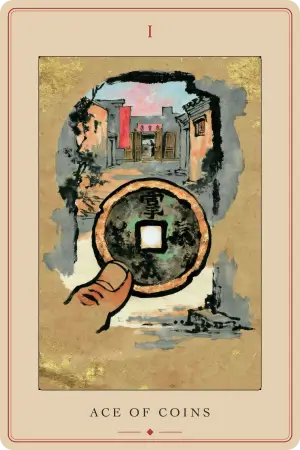
Opportunity arrives coin-sized: an old copper coin held to the morning sun in a hutong doorway, its square hole letting the light through.
Read the complete guide: Ace of Pentacles Card in Tarot: A Comprehensive Guide to Its Symbolism and Meaning
Card at a glance
- Numerology
- Ace
- Element
- Earth
- Astrology
- Earth signs · Taurus, Virgo, Capricorn
- Kabbalistic path
- Kether (the Crown) in Assiah
- Timing
- Dawn · a new venture · winter or early spring
- Yes / No
- Upright yes · Reversed no
Upright
opportunity
new venture
seed money
prosperity
material stability
tangible beginning
groundedness
honest work
Reversed
missed opportunity
loss at the outset
delay
mismanagement
hoarding
financial instability
self-doubt
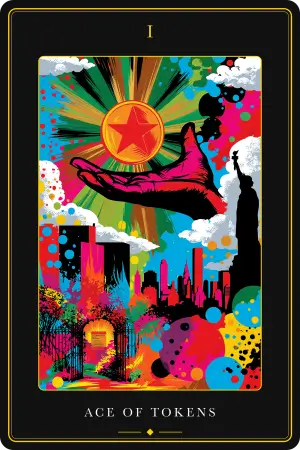
Ace of Coins in each deck
Every deck reimagines the same archetype. Compare the art, then open a deck to read its full interpretation.
Imagery and symbolism
In the Tarot of Beijing the Ace of Coins is a single old copper coin with a square hole, held up by a workman's thumb in a hutong doorway so the morning sun shines straight through the square. It opens the suit of Coins (铜钱), the deck's suit of earth: work, the body, and the courtyard home. Where the Rider-Waite Ace has a hand issue from a cloud, this hand is unmistakably human, a thumb drawn in a few brush lines. The gift does not descend from the sky. It is picked up from the ground of daily life and raised to the light.
The light through the square hole is the card's true center. In Chinese cosmology the round coin is heaven and the square hole is earth, 天圆地方, heaven round and earth square, so the coin holds both between finger and thumb. A coin that let no light through would be mere metal; the opening is what makes it a doorway. Wealth here is always a doorway toward a life rather than an end in itself.
Behind the coin an ink-washed hutong lane recedes to a small shop just taking down its wooden shutters, a red banner beside the door and a figure at work in the entrance. The shop is the future the coin points to, the venture not yet begun, standing at the end of a walkable path. The lane is short and clear: the distance between opportunity and enterprise is a morning's walk. The dawn sky above the rooftops is pale rose and blue, the day of the new venture only just begun and nothing spent yet.
The whole scene sits in a rough ink circle on warm gold-flecked kraft paper, a coin within a coin, so the viewer looks down the lane as if through the square hole itself. The green patina on the copper says the coin is old: opportunity in Beijing has passed through ten thousand hands before reaching yours, and it will pass on. What is offered is a turn, not a possession. The palette stays muted, ink greys and kraft gold with a single vermilion accent on the shop banner, and the gold flecks in the paper hint at prosperity scattered through the ordinary, visible only when the light falls right.
Core meaning
The Ace of Coins is Beijing's Ace of Pentacles, and the deck states its whole meaning in one image: opportunity arrives exactly coin-sized, real, modest, and solid enough to build on. Somewhere down your lane a shop is opening its shutters. A new job, a first order, an investment with long-term promise, a household matter finally ready to be founded. The card does not promise a fortune. It promises a beginning with weight in the hand.
In old Beijing a copper coin was threaded on a string with a thousand others, and every string began with one. The Ace of Coins is that first coin: luck in material matters, the improvement of one's circumstances, and confidence that the ground underfoot will hold. Like every Ace it names potential rather than guarantee. The thumb holds the coin up to the light, but nothing has been bought or built yet; until the hand closes and moves, the potential stays a picture. What the card offers is the seed of earth, and whether it grows into a standing shop or slips back through the square hole depends on the work of the hand that takes it.
Upright meaning
Upright, the card marks a favorable beginning in the material world, the moment when labor starts to bear visible fruit and the conditions for growth are as good as a clear dawn over the market. Take the coin while the sun still shines through its square. This is a time for persistent, unhurried work at the pace of the shopkeeper who opens at the same hour every day. Plan it, organize it, and put your hands to it. Do not despise the smallness of the start; the coin fits the palm precisely so it can be gripped. Treat the first earnings as seed rather than feast.
In love. The relationship acquires ground: solidity and a shared material life. It points toward moving in together, buying the home, planting the pomegranate tree in the courtyard, or founding the family. Affection is spoken in the deck's own dialect, a cup offered with both hands and a door key cut for two, and the small daily coins of care are the real currency of a lasting bond.
In career. A solid foundation for a stable working life: a new position, a promotion, a first commission, or a project with genuine potential for profit. Diligence is noticed and rewarded, the document or contract carries weight, and the shutters of the opportunity are unlocked. It is your hands that must lift them.
In finances. Material abundance at its honest beginning, the first coin of a string that can grow long. It favors investments, opening a business, a significant purchase, or a sum arriving quietly through practical channels: a contract, an inheritance, a profitable offer. Build stability instead of chasing a jackpot, keep the scales honest, and steady income takes its first breath.
In health. The body as ground, and the start of a patient, disciplined care for it. It favors a new training regimen or better diet begun at the elders' pace, the tai chi done at dawn in the Temple of Heaven park, unhurried and durable. Health accumulates like coins in a jar, small deposits made every morning rather than grand sums promised and never paid.
Reversed meaning
Reversed, the coin drops through the fingers. The card points to a missed material opportunity, a loss at the outset, or a venture that never got its shutters open. Planning may have been careless, or the anticipated gain never appeared, or the coin was clutched so tightly that the doorway behind it went unnoticed. In this deck the square hole is what lets the light through, so fixation on the metal itself blocks the very opening it offers. Review the plans and the ledger before the next move, and ask honestly whether the loss came from bad luck or from unreadiness.
In love. Trouble on the material ground of the bond: money quarrels, an unshared budget, or one partner unwilling to invest effort or time in the common courtyard. Sometimes the coin has eclipsed the doorway, so much attention on security and price that affection is weighed on the pawnbroker's scale. The counsel is to give affection its full weight again and rebuild the material footing honestly, together.
In career. Obstacles, delays, and missed openings: the promotion that goes to another, the project postponed, the offer that expires while you deliberate. It can signal instability, job loss or an income interruption, or point inward to poor planning and effort withheld out of doubt. Repair the tools before blaming the trade, and be ready when the light next comes through the doorway.
In finances. Losses at the outset: a deal that falls through before the shutters open, a sudden expense, a failed investment. It may show money slipping through the square hole instead of light shining through it, or the opposite failure, the pawnbroker's grip, funds hoarded so anxiously that they produce nothing while the fair goes by outside. Halt major purchases and check the ground first.
In health. Neglected ground: discipline lapsed, the body's signals ignored, rest treated as an expense rather than an investment. It can also mark the opposite excess, a harsh, miserly regime that guards the body like a locked chest and exhausts it. Restore the basics first, sleep and food and the unhurried morning walk, and rebuild at the elder's pace, one small honest deposit a day.
Historical notes
Long before Beijing reimagined it, the Ace of Coins had its own line of ancestors. In the Tarot de Marseille the suit of Coins belonged to the merchant class and the literal exchange of currency, and the Ace was stark and geometric: a single large coin ringed with botanical flowers, resting alone. It carried no divine hand. The Marseille tradition reserved the hand of God emerging from a cloud for the Aces of Wands and Swords, treating earth as the densest and most mundane element, the immovable rock on which a house is built.
The 1910 Rider-Waite-Smith deck, illustrated by Pamela Colman Smith, added the divine hand the Marseille card withheld. A hand issues from a grey cloud holding up a golden pentacle above a cultivated garden of white lilies, with a path leading through an arch of roses toward distant snow-capped mountains, the long view of material achievement. Waite gave its meaning as perfect contentment and gold. Aleister Crowley's Thoth deck renamed it the Ace of Disks and painted it as a winged helicopter seed, an aerodynamic vessel built for travel, arguing that a true foundation moves with the person and can plant roots in any soil.
The Tarot of Beijing keeps the seed but brings the hand back to earth. Where RWS lets providence descend from a cloud, the Beijing coin is lifted from the ground by a human thumb, and the walled garden becomes an open hutong lane leading to a shop. It takes the Marseille lesson that earth is the mundane foundation and the Thoth lesson that a foundation can travel, and grounds both in one old copper coin passed through ten thousand hands.
Correspondences
Number. One, the seed before the forest and the first coin on a string that may one day hold a thousand. In esoteric numerology it is initiative, originality, and independent beginning; in this deck it is the quiet leadership of the person who starts first and starts honestly. One names potential, not completion, so the harvest of the Ten of Coins is still far down the lane.
Astrology. The card governs the three earth signs, Taurus, Virgo, and Capricorn. Taurus gives it the shopkeeper's patience and the ability to lay foundations that outlast their builder, Virgo the analytical eye and honest ledger, and Capricorn the long climb that turns one coin in a child's jar labeled shop into a shop with its name carved above the door. Some traditions add Saturn for structure and discipline, others Mercury in Capricorn for practical intelligence in service of material aims.
Element. Earth, in its first and purest hour: here the packed grey earth of the hutong lane, the brick of the courtyard wall, the ground a shop stands on. It is the element received rather than aspired to, the foundation everything else is built in.
Kabbalah. Like all Aces the card sits at Kether, the Crown, the first spark of creation, while the suit of Coins belongs to Assiah, the material world of making. The Ace of Coins is therefore Kether in Assiah, the highest divine energy injecting itself directly into the densest matter, the moment intention hardens into something you can weigh in the palm.
Psychological perspective
The person of this arcana has a craftsman's patience and a shopkeeper's eye, the kind who tests silk with two fingers and never confuses price with worth. They value material well-being as ground rather than luxury: a roof that does not leak, a ledger that balances, a lane where their word is good. They find opportunity in modest circumstances the way morning light finds the square hole in a coin, and they build the life they intend brick by brick, trusted precisely because they never hurry.
The shadow of the seed is the shadow of the earth element. Under-tended, it becomes genuine lack, opportunity passing the doorway while the person stares at the wall, resources and skills left unused out of fear of the effort success demands. Over-guarded, it becomes the pawnbroker on the locked chest, cautious to the point of stinginess, safe and nothing more, shutters closed while the fair goes by outside. Both extremes forget what the hole in the coin is for. A coin only clutched is metal; a coin looked through is a doorway, and groundedness means holding the balance of heaven and earth between finger and thumb rather than closing the fist on the metal alone.
The Ace of Coins across decks
Tarot de Marseille. The Ace of Coins is a single large coin ringed with flowers, resting alone with no divine hand, the immovable rock of the material world. Beijing keeps that isolation and that earthbound quality, then hands the coin to a workman's thumb and sets it in a living lane.
Rider-Waite-Smith. A hand from a cloud offers a pentacle above a lily garden and a rose arch, providence descending to a tended landscape. The Beijing card brings the same offering down to earth, replacing the cloud with a human hand and the walled garden with an open hutong.
Crowley-Thoth. Renamed the Ace of Disks, Crowley's card is a winged helicopter seed, a foundation built to travel and root anywhere. The Tarot of Beijing shares its sense that security moves with the person, its old coin already carried through ten thousand hands and destined to pass on.
Modern reframings. Recent decks tend to read the Ace of Pentacles as seed capital and grounded new beginnings rather than mere windfall. The Tarot of Beijing belongs to that reading, its whole theology of earth compressed into one image: the cosmic shown through the small and human, a copper coin held to the morning light.
In combination and context
The Ace of Coins grounds whatever spread it lands in and pulls it toward material beginnings and real, workable opportunity. Among other Aces it signals a large new start: with the Ace of Cups it points to a home filled with love and steady means, emotion and matter in balance; with the Ace of Wands it marries creative drive to physical resources for launching a venture; with the Ace of Swords it turns a clear strategy into a profitable outcome.
Among the Major Arcana its earthy seed is magnified or tested. With the Courtyard Grandmother (the Empress) it is the ultimate sign of stable growth and, in health readings, of fertility and pregnancy. With the Wheel of Fortune it becomes the classic windfall, sudden money that must be grounded quickly before the wheel turns again. With the Devil, ruled by earthy Capricorn, the gift risks corruption: a lucrative opportunity that asks for your freedom, an obsession with wealth, the upright pentagram of spirit over matter inverted into matter over spirit. With the Old Man on Jingshan (the Emperor) it marks the solid start of a well-built, well-stewarded enterprise.
Among the Coins court and pips it grows granular. With the King of Coins it points to the zenith of earthly mastery and real fortune, with the Page toward fame and a fortune built on new study, and with the Seven of Coins toward a favorable change after anxious waiting. Reversed neighbors, or cards of departure like the Eight of Cups, can turn the Ace into advice to walk away and reground on healthier soil. Wherever it falls, the reading is the same at root: the opportunity is genuine and coin-sized, and the harvest depends on the hand that takes it.
Questions for reflection
- What opportunity is standing at the end of your lane right now, small enough to grip and real enough to build on, waiting only for you to walk toward it?
- Are you looking through the coin toward the life it could open, or clutching the metal until the light stops coming through the square?
- What first honest coin could you put in the jar today, knowing the string it may one day become?
The general meaning follows the Rider-Waite-Smith reading, the reference used across Tarot Academy. Open a specific deck above for its own interpretation.
Frequently asked questions
Explore the Tarot
Latest Posts
Discover the ancient wisdom of tarot cards and unlock the mysteries of your spiritual journey. Our blog is your gateway to understanding the rich symbolism, meanings, and practical applications of tarot reading.




















































