
 EN (English)



Major Arcana · X
Wheel of Fortune
In the Rider-Waite deck, fortune turns as a golden wheel of karmic law, with sphinx, serpent, and Anubis marking who rises and who falls.
Card at a glance
- Numerology
- X
- Element
- All four elements
- Astrology
- Jupiter
- Kabbalistic path
- Kaph (Chesed → Netzach)
- Timing
- Turning points · long cycles
- Yes / No
- Upright yes · reversed no · often 'maybe'
Upright
change
cycles
luck
fate
turning point
karma
opportunity
destiny
Reversed
bad luck
stagnation
delays
loss of control
resisting change
instability
negative cycle
setbacks
Wheel of Fortune in each deck
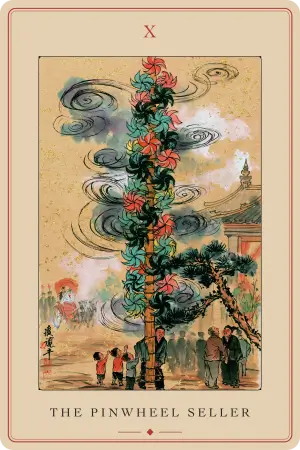
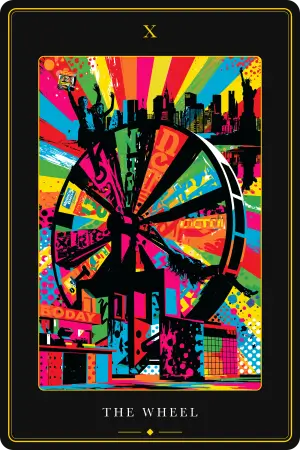
Every deck reimagines the same archetype. Compare the art, then open a deck to read its full interpretation.
Imagery and symbolism
The Rider-Waite Wheel reads less like a scene and more like a diagram of how the universe turns. A great golden wheel hangs in a blue sky. Its rotation is the card's first symbol: the endless rise and fall that says everything has its cycle, and that change is simply part of life. The golden color itself signals favorable change and transformation.
Four winged creatures sit in the corners, an angel, an eagle, a bull, and a lion, each absorbed in reading sacred scripture. They are the fixed, steady frame around the spinning wheel, standing for stability and constancy while everything else moves. They correspond to the four elements, fire, earth, air, and water, and point to the four cardinal directions, so the whole picture holds cyclicality and eternal movement inside a fixed order.
At the top of the wheel sits a sphinx, a figure of wisdom and mystery. It holds a sword that stands for power and control, and for a subtler kind of knowledge: knowing when to act and when to stay passive. Its blue color signals wisdom and truth, and it watches the rotation with acceptance rather than fear. Beside the wheel a snake slides downward, a symbol of transformation, resurrection, and immortality. Shedding its old skin, it stands for rebirth and the constant renewal of life. Climbing the other side is Anubis, the Egyptian god of the dead, who carries the idea of purification and transition to a new level of existence, the continuous cycle of ending and beginning again. Some readings identify this rising figure instead as the Red Dragon or the serpent Typhon, where red means energy, passion, and danger, and the creature stands for chaos and drastic transformation.
Smaller symbols complete the mandala. Clouds mark the Universe and its laws, divine intervention and inspiration. The hieroglyphs around the rim carry alchemical and astrological principles, a reminder of humanity's place within cosmic law. Read around that rim, the Roman letters T, A, R, O interleave with the Hebrew name of God and spell ROTA, TARO, ORAT, TORA, ATOR, the Golden Dawn's loop for the wheel of Tarot speaking the divine law. Blue throughout means spiritual knowledge and truth, gold means favorable change, and yellow means positive energy and enlightenment.
Core meaning
The Wheel of Fortune is the one Major Arcana card that names a cosmic force instead of a human character. Where The Hermit or The Empress carry a single trait, the Wheel stands for impermanence itself, for karma and the law of cause and effect, and for the turning point where one cycle ends and a richer one begins. The wheel has no top or bottom, no beginning or end; each point continuously becomes the next.
In the Rider-Waite reading its lesson is blunt and old. Nothing at the peak or the trough holds. Today's actions shape tomorrow, and accepting instability is part of growth rather than a threat to it. Ruled by Jupiter, the change it brings tends to be expansive and, over the long run, favorable, even when the immediate lurch feels disorienting. Because the card sits under a slow, twelve-year planet, it usually marks a shift in a long pattern rather than a passing mood: a hinge in a life where a karmic cycle closes and a new one opens.
Upright meaning
Upright, the Wheel points to dynamics, growth, luck, and a swift turn in life's unpredictable cycles. It can mark an unexpected wind of change or a sudden coincidence after which your efforts finally start to pay off. The card describes people who meet this energy well: optimistic, active, and adaptable, confident in their luck and treating surprises as chances rather than dangers. Its advice is steady, meet the coming changes with an open mind, trust your destiny, and take the opportunities life offers.
In love. A fateful change or the start of a new phase, often an improvement. A relationship moving through an important stage where old conflicts can finally resolve, or an unexpected romance and a turn of events that asks for a decisive step. It reads as new prospects and a shift toward harmony and lasting happiness.
In friendship and wider relationships. A renewal of your social circle, with room for new acquaintances and reconnections. The Wheel's turn brings sudden but generally positive shifts, a favorable stretch for networking, social events, and deepening the bonds you already have.
In work and business. A turning point that opens a new professional phase: finishing one project and starting another, a promotion, or a fortunate offer. In business it marks the cyclical upswing, expansion, new partners, or a new direction, with the reminder that adapting to new conditions matters more than clinging to a plan.
In finances. Luck, surprises, and change: an unexpected rise in income, an old debt repaid, or new assets arriving almost out of nowhere. A successful new phase, tempered by the card's own warning that everything turns, so keep planning rather than resting on the peak.
In health and the body. A real turning point toward a new level: taking up sport, changing diet, or committing to a fitness practice. The shift can feel abrupt but necessary, an invitation to act on new goals for the body.
Reversed meaning
Reversed, the Wheel's expansive energy is blocked, held in, or thrown off course. The blunt reading is a run of bad luck or a turn for the worse. The more useful one is a stagnant, negative loop: the situation not developing as planned, outside forces slowing progress, and the querent stuck repeating a pattern because the underlying lesson has not landed. It often describes someone digging in against a change that is already overdue, feeling life head somewhere they did not intend and powerless to steer it. For a person who plays the helpless victim of fate, the card flips into a call to take responsibility and break the cycle.
In love. Stagnation or change for the worse: a relationship stalled, efforts yielding nothing, or unresolved problems blocking the way. Underneath is a fixation on the status quo and a fear of the unknown, with recurring issues neither partner will work through. The advice is to pause, reassess, and decide whether to change the pattern or step off it.
In friendship and wider relationships. Attachment to old ways of relating that no longer bring joy, with familiar connections turning predictable and monotonous. Unexpected change brings anxiety, communication grows tangled, and there is a real risk of losing friends or important contacts. A time for reflection and for accepting that change is needed to reach the next cycle.
In work and business. Instability, delay, and stalled progress: problems, unforeseen difficulties, or even job loss, with nothing unfolding as planned. It calls for patience and a reassessment of goals rather than hasty action, on the card's own promise that after a downturn comes an upturn.
In finances. Temporary money trouble: lost income, unexpected expenses, or delayed debts, and the sense that finances are, for now, beyond control. The reversed card still advises learning from past mistakes and mapping each next step, since today's setback can pave the way for later gain.
In health and the body. Stagnation and slowdown, trouble breaking a rhythm that would improve your condition. It can show fixation on outdated diets or interrupted routines and weak self-discipline, stretches of inertia where little changes. The reminder is that calm periods are usually followed by sweeping change once the wheel turns again.
Historical notes
The wheel is far older than the Tarot. Its defining statement is the Rota Fortunae of the sixth-century Consolation of Philosophy, written by Boethius in prison awaiting execution. In it, Lady Philosophy explains that Fortune's wheel turns without malice or plan, lifting paupers to thrones and grinding kings into the mud, and that trying to halt it is simple arrogance, since a wheel that stopped turning would no longer be Fortune's. Only inner virtue and wisdom outlast the spin.
The earliest Tarot versions, in the Visconti-Sforza deck of about 1450 to 1460, put that allegory on the card directly. A blindfolded Lady Fortuna cranks a wheel carrying four human figures labeled by a medieval Latin tag: Regnabo, 'I shall reign,' climbing; Regno, 'I reign,' crowned at the top; Regnavi, 'I have reigned,' tumbling with the crown slipping; and Sum sine regno, 'I am without reign,' crushed at the bottom. In the later Tarot de Marseille the human rulers became grotesque, animal-like creatures, a crowned sphinx-beast at the top, and the wheel often rested on water, a reference to the shifting fortunes of the Greek goddess Tyche.
The card changed for good in 1909, when Arthur Edward Waite and Pamela Colman Smith stripped away the human figures entirely. Drawing on Éliphas Lévi and the Hermetic Order of the Golden Dawn, they rebuilt the Rider-Waite Wheel as a cosmic mandala, less a warning about earthly vanity than a schematic of how the universe is put together. The sphinx, serpent, Anubis, Tetramorphs, and lettered rim that define the modern card all arrive with this version.
Correspondences
Number. X, the ten. In numerology ten is unusual, marking both an end and a beginning: the 1 is the first step, initiation, creation, and leadership, while the 0 is emptiness and potential, cyclicity, universal law, and eternal movement. Together they make a number of fullness and completion that also opens the next level. Ten unites all the digits from one to nine, carrying the idea that nothing ends completely; each close becomes the foundation for the next stage.
Astrology. Jupiter, the Greater Benefic of classical astrology, ruling expansion, optimism, growth, luck, generosity, and justice. As the largest planet it signals immense possibility, and its slow orbit gives the Wheel its scale of years and long cycles. Jupiter also carries the fluctuation of luck, a reminder that not everything is under human control and that sometimes it makes more sense to trust intuition and let fate take its course.
Element. No single element rules the Wheel. It shows all four at once through its corner creatures and alchemical rim: fire, earth, air, and water held together in one turning frame.
Kabbalah. The twenty-first path on the Tree of Life, joining Chesed (Mercy) to Netzach (Victory), under the Hebrew letter Kaph, the palm or closed hand. The palm is where fortunes are read and where a person grasps what fate throws at them. Qabalists title the path the 'Rewarding Intelligence.'
Elemental dignity. As a yes or no the Wheel leans yes upright and no reversed, though its truest answer is often 'maybe,' an outcome still in motion and not yet settled.
Psychological perspective
In the Hero's journey the Wheel is the moment the question shifts from 'Who am I?' to 'What is my mission?' Having gained some self-awareness, the Hero now meets significant change caused by forces beyond their control and learns they cannot always steer what happens. Accepting that, they become flexible, find solutions in any situation, and gain the confidence that any turn of fate carries potential for growth. The card's positive face is the capacity to see the opportunity inside change and to trust that events have their own purpose.
The personality the Wheel describes adapts readily and stays open, attentive to detail and confident that everything has its cause and effect. At its best this shows as flexible thinking and a blend of optimism and realism: staying calm in difficulty, seizing favorable moments, offering unconventional advice, and resolving conflict quickly rather than dwelling in it. The shadow is the same trait overrun. Constant shifting of thoughts and views becomes carelessness, little long-term planning, and inconsistent goals. Without a solid foundation of values, such a person can drift into instability and become a passive observer of their own life, relying on luck while neglecting responsibility for it.
The Wheel of Fortune across decks
The Rider-Waite Wheel is the reference point most modern readers carry, so the other traditions read as departures from it.
Tarot de Marseille. The wheel carries composite, slightly grotesque beasts rather than the RWS mandala, with a crowned, sword-bearing sphinx-creature at the top, and it often sits on water, a reminder of the precarious tides of Tyche's fortune.
Crowley-Thoth. Painted by Lady Frieda Harris, the Thoth Wheel spins as a ten-spoked form in a violet spiral, struck by lightning that destroys old structures and seeds new ones. Its three riders map onto the Hindu Gunas and the alchemical primes: Hermanubis rising as Sattva and Mercury, the Sphinx balanced as Rajas and Sulphur, and Typhon falling as Tamas and Salt. For Crowley the Wheel is a physics engine rather than a moral test, and mastery means finding the still point at its axis.
Modern decks. Contemporary artists recast the Wheel to stress different facets of fate. Weaver decks like Tarot of the Divine replace it with a spider's web or the thread of the Greek Moirai, making destiny an interconnected weave. Nautical decks such as the Mermaid Tarot draw it as a ship's wheel in high seas, where you cannot calm the storm and can only steer through it. The Mary El Tarot reimagines the wheel as a womb, turning mechanical fate into a fertile, biological force.
In combination and context
The Wheel is a hinge, and its meaning swings on where it lands. In an outcome position it announces a turning point and often overrides the tone of the cards around it, promising that the situation is about to move whatever the present looks like.
A well-known community reading shows the mechanism. A querent who had ended a relationship for practical reasons drew Justice, the Wheel of Fortune, and the Four of Wands. Justice confirmed the logic of the breakup and the Four of Wands promised eventual happiness, but the Wheel in the middle mandated patience: outside forces of timing had to align before anything could resolve, and no amount of pushing would speed it. Clarifying a charming card like The Magician or the Queen of Cups, the Wheel can warn instead of a partner running on luck and charm, keeping the querent on an unstable ride.
As advice, the Wheel counsels working with events rather than fighting them. Where the surrounding cards read as burnout or a doomed effort, it often says the cycle itself is shifting: stop forcing the failing plan and let the turn carry your focus toward the next, still unseen opportunity.
Questions for reflection
- Where in your life are you gripping the top of the wheel, and what would it mean to hold that success more lightly?
- Which cycle keeps repeating for you, and is this the turn where you finally step off it?
- When fate closes a door you wanted open, can you trust it is clearing the path for something you cannot yet see?
The general meaning follows the Rider-Waite-Smith reading — the reference used across Tarot Academy. Open a specific deck above for its own interpretation.
Frequently asked questions
Explore the Tarot
Latest Posts
Discover the ancient wisdom of tarot cards and unlock the mysteries of your spiritual journey. Our blog is your gateway to understanding the rich symbolism, meanings, and practical applications of tarot reading.




















































