
 EN (English)


Major Arcana · 11
The Wheel
The city's own rotation, luck rising and falling in cycles that no single hand can stop.
Card at a glance
- Numerology
- X
- Element
- All four elements
- Astrology
- Jupiter · Uranus
- Kabbalistic path
- Kaph (Chesed → Netzach)
- Timing
- Turning points · long cycles
- Yes / No
- Upright yes · reversed no · often 'maybe'
Upright
change
cycles
luck
the lucky break
turning point
karma
opportunity
riding the wave
Reversed
stalled
bad luck
stagnation
resisting change
toxic loops
loss of control
delays
The Wheel in each deck
Every deck reimagines the same archetype. Compare the art, then open a deck to read its full interpretation.
Imagery and symbolism
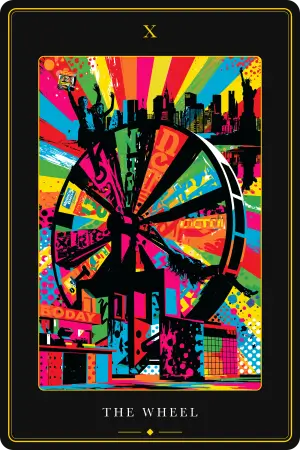
In the Tarot of New York City the Wheel is not an antique disk floating in the clouds. It is a great spinning ride raised against the skyline, part Ferris wheel over the boardwalk, part subway turnstile blown up to the size of fate. It towers over the rooftops the way chance towers over every plan made in this city.
Its spokes are papered with the city's own tokens of luck. A MetroCard stands for the daily coin-toss of whether the swipe goes through. Scraps of lottery and scratch-off tickets carry the folk fortune-telling of the bodega counter. Fragments of signage and newsprint show the headlines that make and unmake a name overnight. Where the Rider-Waite wheel bears alchemical letters and Hebrew characters, this one bears transit passes and ticket stubs, the modern runes by which the city writes out a destiny.
The figures ride it exactly as they do on the old card. At the top, where the sphinx once sat, two people throw their arms up in triumph and one waves a winning scratch-off overhead, the winners of this rotation who do not yet know how long they will keep the height. Low on the wheel a lone figure hangs upside down, sliding toward the bottom of the arc, the deck's Typhon and a reminder that every ascent is paid for by someone's descent. Behind them the skyline stands in silhouette with the Statue of Liberty raising her torch at the edge, the fixed points around which the turning happens and the promise that drew every rider here. The skyline doubles in reflection below, upright and inverted at once, a quiet statement that up and down are the same city seen from different points on the arc. At street level sits the bodega counter where ordinary New Yorkers buy their tickets, the wheel mounted above it like the lottery display over every register in the five boroughs. The whole scene bursts in pop-art color, radiating rays and halftone dots in clashing pinks, yellows, and electric blues, because fortune here is loud. It arrives like a jackpot bell or a train roaring in just as you reach the platform.
Core meaning
The Wheel is the one Major Arcana card that names a force rather than a person. The Hustler, the Old Guard, and the Yellow Cab personify a human trait; the Wheel stands for the city's own rotation, the thing that moves regardless of anyone's hustle, plan, or connections. It is the market, the lottery, the lease cycle, and the raw arithmetic of eight million colliding intentions.
Its message is old and blunt: nothing at the top or the bottom holds. The block you cannot afford was cheap once and will be something else later; the line around the corner today is next spring's vacant storefront. Ruled by Jupiter, the change it brings tends to be expansive over the long run, even when the immediate lurch feels disorienting, and because Jupiter takes twelve years to circle the zodiac, the turn it marks has usually been building for years rather than days. It is a hinge in a life, the moment one phase closes and a richer one begins.
Upright meaning
Upright, the Wheel is the city doing what it does best: turning. A bodega scratch-off pays out, a stock triples, or the apartment you almost skipped touring turns out to be rent-stabilized. Sometimes it is just a stranger waving you through the turnstile when your card reads insufficient. It marks the end of one phase and the start of a richer one, a wind of change coming down the avenue that can turn a whole life around. Efforts made long ago begin paying off now. Under Jupiter the turn reads as broadly fortunate over the arc of a life, so the card asks you to step through the open door without demanding to know why you were chosen, and to stay humble while the wheel is high, because the same rotation lifting you is carrying someone else toward the bottom.
In love. The stalled L train where two strangers finally look at each other, the party you almost skipped, the friend-of-a-friend who turns out to be the right person. The Wheel favors fated timing that no app algorithm could arrange, a pull readers tie to karmic bonds and twin flames. For couples it marks a turn into a new phase, and its hardest lesson is to surrender to divine timing rather than force an outcome.
In career. A turning point in a long-running situation, often years in the making: the reorganization that lands you somewhere better, a recruiter's message out of nowhere, a promotion that arrives a year early. Sometimes it reads as 'not this, not now,' a redirection away from a job you wanted on the promise that the closing door is clearing the path for a better alignment you cannot yet see.
In finances. Money-luck in full spin: an unexpected bonus, an old debt suddenly repaid, an apartment that turns out hundreds under market. The windfall seems to arrive from nowhere, though it usually rides in on something you set in motion long ago. The fine print is the bodega counter's own, so bank a share and do not inflate your life to match one good rotation.
In health. The body moving through its natural cycle, usually toward improvement, and a good moment for a decisive change of routine: the run club along the river, the overhauled diet, the gym membership finally used. The card favors moving when the light changes over forcing a quick fix.
Reversed meaning
Reversed, the Wheel is the swipe that gets eaten, the G train that never arrives, the deal that stalls in someone else's inbox. Unseen forces, a co-op board, a market shift, an MTA control room, are steering, and you are the passenger. The blunt fortune-telling reading is a run of bad luck. The more useful one is a stagnant loop: the same destructive pattern on repeat, the same kind of partner or the same workplace trouble, because the underlying lesson has not been learned. It is the helplessness of standing on a packed platform and watching a third express pass without stopping. For the person who plays the helpless victim of fate, the card flips into a call to action, a mandate to stop pounding on the turnstile, take responsibility, and break the spokes of a cycle that no longer serves.
In love. A relationship stuck in a loop, the same argument on rotation, two people riding the same route past the same stations with neither reaching for the map. It holds together on habit or old attachment rather than fit. The work is to name the pattern out loud, because a pattern seen can be broken while a pattern denied simply repeats.
In career. A path stuck between stations: the promotion frozen in a budget, the restructuring that keeps dragging, the role that has stopped growing. Effort buys no forward motion. Sometimes it is the recognition that a change is already overdue, and the detour, the résumé update, the postponed skill, is the actual route forward.
In finances. A temporary squeeze: a job loss, a surprise bill, a rent hike, a client who pays sixty days late. Money feels out of your hands and the meter runs while nothing moves. Often the trouble recurs because the same habit keeps recreating it.
In health. A stalled cycle, the plateau at the gym or the routine abandoned three weeks in, progress frozen regardless of effort. It asks for a genuine change of approach rather than more of the same, and it promises the plateau is a phase and not an identity.
Historical notes
Long before any deck put it on the boardwalk, the wheel was a fixture of medieval philosophy. Its defining statement is the Rota Fortunae of the sixth-century Consolation of Philosophy, written by Boethius in prison awaiting execution. Lady Philosophy explains that Fortune's wheel turns without malice or plan, lifting paupers to thrones and grinding kings into the mud, and that trying to halt it is arrogance, since a wheel that stopped turning would no longer be Fortune's. Only inner virtue and wisdom outlast the spin.
The earliest Tarot versions, in the Visconti-Sforza deck of about 1450 to 1460, put that allegory on the card directly. A blindfolded Lady Fortuna cranks a wheel of four human figures labeled by a Latin tag: Regnabo, 'I shall reign,' climbing; Regno, 'I reign,' crowned at the top; Regnavi, 'I have reigned,' tumbling with the crown slipping; and Sum sine regno, 'I am without reign,' crushed at the bottom. In the later Tarot de Marseille those rulers became grotesque, animal-like creatures with a crowned sphinx-beast at the top, and the wheel often rested on water, a nod to the shifting fortunes of the Greek goddess Tyche.
The card changed for good in 1909, when Arthur Edward Waite and Pamela Colman Smith stripped the human figures away entirely. Drawing on Éliphas Lévi and the Hermetic Order of the Golden Dawn, they rebuilt it as a cosmic mandala: the TARO and ROTA rim interleaved with the Hebrew YHVH, an alchemical middle ring, an eight-spoked hub for the Pagan Wheel of the Year, and the sphinx, Hermanubis, and serpent riding a frame held steady by the four winged Tetramorphs. The New York deck keeps the winners at the top and the falling figure below, then trades Waite's alchemical letters for MetroCards and scratch-offs.
Correspondences
Number. X, the ten, the number of a completed cycle and an immediate new start. The 1 is the first step off the bus at Port Authority; the 0 is the vacant lot before the tower. Ten gathers the numbers one through nine and folds them into the next turn, the way the city absorbs every arrival and collapse into its next version.
Astrology. Jupiter, the Greater Benefic of classical astrology, ruling expansion, abundance, philosophy, and good fortune. No planet suits New York better, a Jupiter city convinced against all evidence that next year will be bigger. Its twelve-year orbit through the zodiac gives the Wheel its scale of long cycles. Esoteric readers also feel Uranus here, the planet of sudden, electric reversals that upend a situation without warning.
Element. No single element rules the Wheel. Its Rider-Waite alchemical ring shows all four: Mercury for air, Sulphur for fire, Salt for earth, and the sign of dissolution for water.
Kabbalah. The twenty-first path on the Tree of Life, joining Chesed (Mercy) to Netzach (Victory), under the Hebrew letter Kaph, the palm or closed hand. The palm is where fortunes are read and where a person grasps what fate throws. Qabalists title the path the 'Rewarding Intelligence,' the Lord of the Forces of Life.
Elemental dignity. As a yes or no the Wheel leans yes upright and no reversed, though its truest answer is often 'maybe,' an outcome still in motion and not yet decided.
Psychological perspective
The question modern readers put to the Wheel is where to stand while it turns. One well-worn answer is to leave the rim, where the highs are euphoric and the lows crushing, and retreat to the still hub at the center, taking on the detached, observing energy of the Sphinx and watching your own life like a stoic. It is the classic counsel of impermanence: do not get drunk on the peak or drowned by the trough.
More demanding readers push back. Hiding permanently in the center is not mastery but stagnation, a way of opting out of lived experience. Real skill with the Wheel is a rhythm, knowing when to step into the middle for perspective and when to ride the rim again to feel passion and gather actual experience. This is the seasoned New Yorker's poise: the person who stays calm in a stalled train car and checks the side entrance the moment a door closes. Its shadow is the drift of relying on luck instead of taking responsibility, becoming a passenger in your own life who waits for the next lucky transfer instead of choosing a destination. Part of what makes the card so charged is that it confronts a culture raised on constant agency with the plain fact of chance, forces that outrun willpower and the flawless plan.
The Wheel across decks
Tarot of New York City. This deck keeps the wheel's old architecture and re-skins it for the five boroughs: a Ferris-wheel-and-turnstile hybrid over the skyline, spokes papered with MetroCards and scratch-offs in place of alchemical letters, triumphant riders at the top and a falling figure below, the Statue of Liberty's torch at the edge. Fate here is sold retail at the bodega counter for a dollar a spin.
Tarot de Marseille. The wheel carries composite, slightly grotesque beasts rather than people, a crowned sword-bearing sphinx-creature at the top, and it often sits on water, a reminder of the precarious tides of Tyche's fortune.
Crowley-Thoth. Painted by Lady Frieda Harris, the Thoth Wheel spins as a ten-spoked form in a violent violet spiral, struck by lightning that destroys old structures and seeds new ones. Its three riders map onto the Hindu Gunas and the alchemical primes: Hermanubis rising as Sattva and Mercury, the Sphinx balanced as Rajas and Sulphur, Typhon or Apophis falling as Tamas and Salt. For Crowley the Wheel is a physics engine rather than a moral test, and enlightenment means piercing the turning machinery to find the still point at its axis.
Modern decks. Contemporary artists recast the Wheel to stress different facets of fate. Weaver decks like Tarot of the Divine replace it with a spider's web or the thread of the Greek Moirai, making destiny an interwoven fabric. Nautical decks such as the Mermaid Tarot draw it as a ship's wheel in high seas, where you cannot calm the storm and can only steer through it. The Mary El Tarot reimagines the wheel as a womb, turning mechanical fate into a fertile, biological force.
In combination and context
The Wheel is a hinge, and its meaning swings on where it lands. In an outcome position it announces a turning point and often overrides the tone of the cards around it, promising the situation is about to move whatever the present looks like.
A well-known community reading shows the mechanism. A querent who had ended a relationship for practical reasons drew Justice, the Wheel of Fortune, and the Four of Wands. Justice confirmed the logic of the breakup and the Four of Wands promised eventual happiness, but the Wheel in the middle mandated patience: outside forces of timing and circumstance had to align before anything could resolve, and no amount of pushing would speed it. Clarifying a charming card like The Magician or the Queen of Cups, the Wheel can warn instead of a partner running on luck and charm, keeping the querent on an unstable ride.
As advice, the Wheel counsels surrender to the turn. Where the surrounding cards read as burnout or a doomed effort, it often says the cycle itself is shifting: stop forcing the current, failing plan and let the wheel carry your focus toward the next, still unseen opportunity. In this deck the counsel is pure street sense. When the express comes, get on it; when nothing is running, stop fighting the schedule.
Questions for reflection
- Where in your life are you gripping the top of the wheel, and what would it mean to hold that height more lightly?
- Which cycle keeps running you past the same stations, and is this the turn where you finally step off?
- When the city closes a door you wanted open, can you trust the same rotation is clearing the path for something you cannot yet see?
The general meaning follows the Rider-Waite-Smith reading — the reference used across Tarot Academy. Open a specific deck above for its own interpretation.
Frequently asked questions
Explore the Tarot
Latest Posts
Discover the ancient wisdom of tarot cards and unlock the mysteries of your spiritual journey. Our blog is your gateway to understanding the rich symbolism, meanings, and practical applications of tarot reading.




















































