
 EN (English)



Major Arcana · XI
Justice
Pamela Colman Smith's enthroned judge, sword raised and scales level, weighing every deed against the consequence it has already earned.
Card at a glance
- Numerology
- XI
- Element
- Air
- Astrology
- Libra · ruled by Venus
- Kabbalistic path
- Lamed (Geburah → Tiphereth)
- Timing
- Autumn · Libra season
- Yes / No
- Yes if you have been fair · conditional
Upright
fairness
truth
accountability
cause and effect
karma
law
balance
integrity
Reversed
unfairness
dishonesty
bias
avoidance
corruption
denial
imbalance
blame
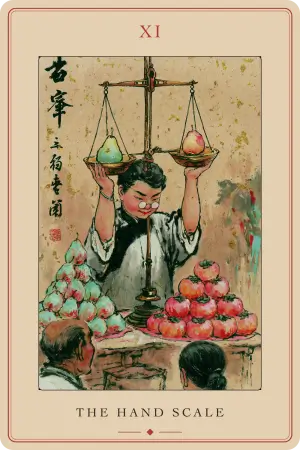
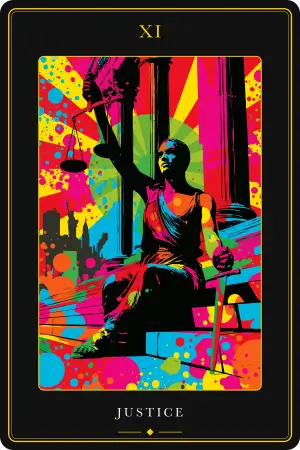
Justice in each deck
Every deck reimagines the same archetype. Compare the art, then open a deck to read its full interpretation.
Imagery and symbolism
Pamela Colman Smith drew this card for the deck Arthur Edward Waite published through William Rider in 1909, and her staging is deliberately theatrical: a single enthroned figure held flat against the picture plane, filled with the plain, unshaded color she used across the Major Arcana. Justice sits on a square stone throne between two pillars, backed by a purple curtain, the same architecture Smith repeats from The High Priestess and The Hierophant. The purple reads as contemplation and hard-won experience, and the curtain stands for the invisible principles of reality, a veil that conceals the true meaning of events until the verdict is in.
In her right hand an upward-pointing sword shows her readiness to act and to accept the consequences of acting. It is the tool of insight, standing for intellect, truth, and well-founded conclusions, and its double edge means the blade cuts both ways: whoever wields judgment is bound by the same measure. In her left hand a level golden scale reflects objectivity and equality, the reminder that every action carries a matching result. Smith gives this Justice no blindfold, unlike the Justitia outside a courthouse, because spiritual fairness asks you to look straight at the truth rather than away from it.
The color does the arguing. Her red dress signifies active interaction with the world and the determination to enforce a ruling, while the green cloak over it stands for growth and renewal and ties her to both the physical and spiritual realms. Her crown is set with square cells, a mark of stability and equality, and reads as wisdom reached by overcoming obstacles. She holds a straight, relaxed, focused posture that shows resolve, seated on a square chair set on a step, placed between the earthly and heavenly realms to hold the two forces in balance. Behind it all the gray background carries composure and absolute objectivity.
Core meaning
In this deck Justice stands for life's patterns, rational analysis, and the duty to take responsibility for what you set in motion. It is the law of cause and effect worn as a person, karma without the moralizing, the principle that every deed and intention returns a matching result. Waite places it at the pivot of the Major Arcana, the checkpoint where the story pauses to be weighed.
The card holds that fairness is not something handed to you while you wait. The world runs on consequence, not sentiment, so Justice asks you to read your own circumstances with that same cold clarity, drop the self-protective story, and audit your part honestly. Balance here is an active, ongoing task rather than a verdict fate delivers. You reap what you sow, and you are the one keeping the ledger.
Upright meaning
Upright, Justice brings the energy of karma: honesty, ethics, and accountability matter now, and you receive what past actions have earned. It signals a reckoning whose outcome will be fundamentally fair, even when it is not the outcome the ego wanted, and it favors logic over unchecked emotion. In dealings with the law, the state, or bureaucracy, the system works as intended and the deserving party is vindicated. It also confirms anyone who has taken the high road that their ethical effort is recognized.
In love. Directness and deep mutual respect, often an official milestone such as marriage or a formal agreement, where love settles into a calmer, balanced state. Partners weigh their true intentions, and the card asks for sincere dialogue and full transparency as the price of lasting stability.
In career. Merit rewarded, fair pay, and ethical leadership. Decisions follow careful analysis rather than haste, contracts sign cleanly, audits and formal negotiations go by the book, and workplace disputes resolve on fair terms.
In finances. Balanced, honest transactions and income proportional to your effort, with hard work paying off and negligence doing the reverse. The card supports settling debts, predicting cash flow, and distributing resources fairly.
In health. A rational, balanced approach to the body, with sensible nutrition, appropriate exercise, and attention to psychological well-being. Your outward appearance reflects that inner equilibrium, and steady, unforced upkeep is rewarded.
Reversed meaning
Reversed, the scales tilt, pushed off level by self-interest, bias, or a refusal to face reality. It warns of dishonesty, poor decisions, and a lack of accountability, and it often points the other way, showing you inside an unfair system, facing dishonest competition, false accusations, or blame for someone else's negligence. The remedy is to examine every detail before judgment falls and to seek proper help with legal trouble, since the imbalance can still be corrected.
In love. Deceit and severe inequality, with one partner who manipulates or hides the truth. Distrust and a lack of respect build stress, complicated by a refusal to take responsibility for past actions, and the harmony breaks.
In career. Bias, unethical behavior, or open discrimination at work, with conflicts, unfair competition, and flawed decisions. Tasks stall for missing facts or poor judgment, and the card cautions against unethical tactics or a bad contract.
In finances. Inequality and the misuse of money, with bureaucratic hurdles, losses from poor management, questionable deals, theft, or deception. Every financial decision needs thorough review, especially where it touches other people.
In health. A punishing or misguided approach to the body, with overtraining, a severe diet, or negative feeling about appearance. Exhausting routines in pursuit of an ideal only harm body and mind, and an urgent, gentler adjustment is called for.
Historical notes
For centuries Justice sat at VIII and Strength at XI, the order in the fifteenth-century Mantegna cards and the Tarot de Marseille, matching how the cardinal virtues were placed in the Italian gaming and Minchiate decks. The change came with the Hermetic Order of the Golden Dawn, which required the twenty-two trumps to line up with the Hebrew alphabet and its astrological signs. In that scheme the letter Teth answers to Leo and Lamed to Libra, and because Leo precedes Libra in the solar year, the Leo card, Strength, had to come before the Libra card, Justice.
Arthur Edward Waite carried that switch into this deck in 1909, setting Strength at VIII and Justice at XI, and defended it in The Pictorial Key to the Tarot only with the line that he did it 'for reasons which satisfy myself,' keeping the astrology out of public view. The new number had its own logic: eleven reduces to two, tying Justice to Judgement at XX, itself a two, a resonance between the deck's two cards of reckoning. Aleister Crowley later rejected the swap, returning the card to VIII as Adjustment while keeping the Golden Dawn's Libra and Lamed attributions.
Correspondences
Number. XI, the master number eleven, a sign of spiritual insight that reduces to two and links Justice to Judgement, the deck's other card of ultimate reckoning. Eleven carries duality, the two pillars, active and passive, yang and yin, and the responsibility of harmonizing them.
Astrology. Libra, the sign of the scales, ruled by Venus. Libra supplies diplomacy and objective measurement and moves constantly between opposites to find equilibrium; Venus supplies the pull toward harmony and relational fairness.
Element. Air, the clear reason behind every judgment, the intellect the raised sword stands for.
Kabbalah. The Hebrew letter is Lamed, the 'ox goad,' an instrument of direction and discipline. Its path runs from Geburah, the sphere of Severity under Mars, to Tiphereth, the sphere of Beauty under the Sun, so the card is the active, sometimes harsh mitigation of force that keeps the center balanced rather than a settled peace. Crowley's title Adjustment names that continual recalibration.
Elemental dignity. Beside Cups the card often marks marriage or a civil union, and reversed there a separation. Beside Swords it turns to contracts and legal disputes. As a yes or no it answers conditionally: yes if your conduct has been fair, otherwise a warning that the same measure falls on you.
Psychological perspective
In Jungian shadow work, Justice lives in the gap between the truth a person claims to value and the reality they will let themselves see. The classic trap is self-righteousness, playing the judge who demands full accountability from everyone else while quietly exempting oneself, until fairness curdles into rigid moral superiority and petty score-keeping, the 'eye for an eye' that mistakes revenge for balance and keeps the cycle of harm turning.
The card also flags projection, where an unintegrated shadow grows hypersensitive to injustice outside and reacts with outsized outrage that conveniently avoids looking inward. The real work submits to one hard question: if these scales were read by someone with no stake in your story, what would they show about your own part? At its healthiest this is the practical, detail-oriented mind that negotiates well, keeps its inner balance, and tempers feeling with clear thought. Pushed too far it hardens into an inflexible perfectionist who judges self and others too harshly, lets logic override intuition, and reads emotional appeals as weakness, sliding toward a constant search for blame.
Justice across decks
Tarot de Marseille. Here Justice keeps its older seat at VIII, a crowned figure enthroned with an upright sword in one hand and the scales in the other, the plain emblem of weighed measure before the occultists elaborated it.
Crowley-Thoth. Retitled Adjustment and painted by Lady Frieda Harris, the card draws on the Egyptian goddess Maat, who embodies cosmic truth and order. Crowley pulls the focus away from human courts toward the exact equilibrium of nature, making justice a universal force that holds the structure of the cosmos together rather than a legal ruling.
Sacred India Tarot. The archetype appears as Varuna, the Vedic god of the waters and of Rta, the principle of natural order and truth. Casting Justice as Varuna frames it as a fundamental law of the universe overseeing moral order, an echo of karma and inescapable cause and effect.
In combination and context
Justice takes its exact tone from the suit beside it. With Wands it turns to professional ethics and fast executive decisions, a situation that demands immediate correction. With Cups it centers on relational equity and often points to marriage or moving in together, though reversed it can mean divorce or legal separation. With Swords it sharpens into contracts, rational choice, and sometimes a hard legal battle. With Pentacles it becomes financial audits, settled debts, and formal business agreements.
Spread position steers it just as much. In the past it marks an earlier reckoning or decision that laid the ground you now stand on. In the present it is a call to assess your reality honestly rather than lean on a comfortable illusion. In the outcome position it predicts a moment of genuine accountability, a resolution that may be uncomfortable but will be authentic and final. As an obstacle it names the avoidance of truth itself, the denial you use to delay an inevitable reckoning.
Justice is easily confused with Judgement, and the difference is worth holding. Justice is the internal, present scale, human ethics and the immediate consequences of earthly choices, the querent auditing their own accounts. Judgement is the external, existential call, the trumpet blast that demands a full rebirth. Justice weighs whether a job or relationship is fair; Judgement is the realization that you can no longer live inside it at all.
Questions for reflection
- If someone with no stake in your story weighed the scales of a situation you are in, what would they show about your own part?
- Where are you waiting for a verdict you already have the standing to deliver yourself?
- Which consequence of a recent choice are you avoiding looking at directly?
The general meaning follows the Rider-Waite-Smith reading — the reference used across Tarot Academy. Open a specific deck above for its own interpretation.
Frequently asked questions
Explore the Tarot
Latest Posts
Discover the ancient wisdom of tarot cards and unlock the mysteries of your spiritual journey. Our blog is your gateway to understanding the rich symbolism, meanings, and practical applications of tarot reading.




















































