
 EN (English)



Major Arcana · IX
The Hermit
The lantern-bearing sage of the Rider-Waite deck, carrying his own light one careful step at a time.
Card at a glance
- Numerology
- IX
- Element
- Earth
- Astrology
- Virgo · ruled by Mercury
- Kabbalistic path
- Yod (Chesed → Tiphereth)
- Timing
- Winter · Virgo season
- Yes / No
- Maybe · not yet
Upright
introspection
solitude
inner light
wisdom
self-analysis
patience
self-discovery
discernment
Reversed
isolation
loneliness
withdrawal
stagnation
avoidance
stubbornness
detachment
The Hermit in each deck
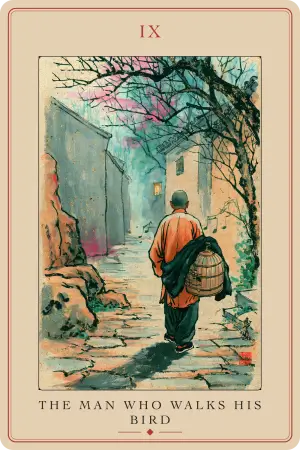
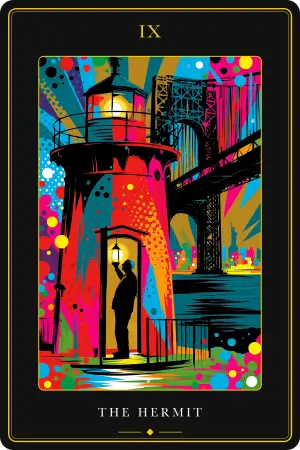
Every deck reimagines the same archetype. Compare the art, then open a deck to read its full interpretation.
Imagery and symbolism
Pamela Colman Smith drew the Rider-Waite Hermit as a tall, bearded elder alone on a snowy summit, wrapped head to foot in a plain grey hooded cloak. He lifts a lantern in his right hand and steadies himself on a long staff in his left, his whole body turned toward the viewer's left, the direction of the past and the inner world. It is the pose of someone at the end of a long climb, pausing to look back and gather meaning from the road already walked.
The lantern is the focus of the picture. It holds a six-pointed star, the Seal of Solomon, and its light reaches only the next step, not the whole slope. Revelation comes through contemplation, and the path is walked on trust. The staff in his left hand gives him stability and balance, the support that hard experience provides on rough ground. Its yellow colour is deliberate in this deck: yellow reads as wisdom, spiritual energy, and intellect, so the thing he leans on is his own accumulated understanding.
The grey cloak carries much of the card's meaning. Grey is neutrality, and it lets the Hermit blend into the mist and stay detached from outside temptation. The cloth conceals his body completely, a sign of withdrawal from the material world, and it shows no badge of rank or status, a quiet sign that worldly affairs weigh less than the life of the spirit. Even the many folds of the fabric mean something here, standing for the many paths he has travelled on the way to self-knowledge. His long white beard is the wisdom stored up over years. The white snowdrifts around him are the purity of thought and action, and the summit itself a spiritual height reached only after a hard ascent. He holds the lamp aloft rather than hiding it, because his inner light is meant to guide others too. In this deck he is guide as much as sage.
Core meaning
The Rider-Waite Hermit is the seeker of truth who withdraws into solitude to find his answers. It takes courage to look within and search out personal truths in spite of obstacles, and that is exactly the pursuit the card names: turning inward and letting understanding arrive through patience and honest self-examination. He is a figure of wisdom and reflection first, and a reminder that some revelations only surface once the noise of the world is switched off.
His number, IX, is the last of the single digits, the completion of a cycle just before it resets. It gathers up everything from one to eight and lets accumulated experience bear fruit, which is why the card reads as a threshold: the end of one path and the start of a new understanding of life. The Hermit favours the solitary road toward truth over the illusions of mass opinion, insisting that what people chase in the outer world is already present within.
Upright meaning
Upright, the Hermit calls for solitude and inner focus, a solemn but positive season of meditation and reflection given over to the search for truth. The answers you want are not in the crowd or in other people's opinions; they have to be drawn out of your own depths. This is a time for patience and discretion, for stepping back from the daily rush and reading yourself and your situation honestly, not for haste or bold public moves.
In love. A time for real self-reflection, for setting personal boundaries and understanding your own feelings before moving forward. It carries the wisdom of past relationships into present choices and asks for room to breathe, whether that means solitude between partners or space respected inside an existing one.
In career. Deep, focused, independent work over networking and self-promotion. The card favours research, study, planning, and the slow improvement of your craft, and it can point to an expert or mentor who helps light up the harder parts of the work.
In finances. A season of clear thinking and careful planning. Stick to a budget, study your situation, weigh new opportunities without rushing, and let considered decisions build real savings and future stability.
In health. Rest and internal work, the quiet the body and mind need. The card supports meditation, yoga, and other slow, conscious practices, and a closer, more attentive listening to what the body actually needs.
Reversed meaning
Reversed, the Hermit's solitude curdles. It can mean excessive introversion and a fear of being misunderstood, a person who has lost their way or gone in the wrong direction and now rejects the help others offer. It can harden into stubbornness, an unwillingness to communicate or to see another point of view. The card still speaks of a need for self-discovery, but it warns against isolating so deeply that solitude stops restoring you and starts to corner you.
In love. Isolation that builds walls between partners, one person feeling rejected or both drifting into a general sense of alienation and unwillingness to share emotions. It can mark someone too preoccupied with their own fears to open up, and it warns against retreating into idealised notions of love that end in disappointment.
In career. Withdrawing from colleagues, over-analysing to the point of missed chances, or exhaustion that is really asking for rest. It can show a reluctance to adapt and a fear of the unknown, with the lesson being to stay open to new ideas rather than let an unwillingness to change limit your growth.
In finances. Excessive caution, indecision, and stagnation, being stuck in financial fears and refusing changes that are genuinely needed. The card calls for decisiveness and a way out of the standstill.
In health. Avoiding self-control and taking a superficial approach to habits, or the opposite, fixating on the body at the expense of everything else. Either way it points to a disconnection from the body and asks you to listen to it again.
Historical notes
Waite built his Hermit partly by arguing with the occultists before him. He rejected Court de Gébelin's flat reading of the card as merely a wise man seeking truth and justice, and he dismissed Éliphas Levi's version, in which the Hermit stood for occult isolation and the guarding of personal magnetism from the profane. That idea of hoarding secrets had passed into French Martinism as the "Silent and Unknown Philosophy," the mantle of a hidden philosopher keeping mysteries from the uninitiated.
Waite set a different claim against all of this. For him the Divine Mysteries protect themselves, since the unprepared simply cannot grasp them even when they are shown, so no human gatekeeper is needed to hide the light. His Hermit is a figure of attainment who lifts his lamp deliberately as a guiding star. The archetype does not keep its illumination back; it declares that where the Hermit stands, any willing seeker may also come. Pamela Colman Smith's drawing encodes that reading directly, with the raised beacon offered outward rather than tucked beneath the cloak.
Correspondences
Number. He is IX, the final single digit and the completion of a cycle before it resets to ten. Nine gathers the essence of every number before it, so the card marks the moment accumulated experience bears fruit. It also carries universality, generosity, and self-sacrifice, and a readiness to help those in need, alongside the solitary streak that turns from mass consciousness toward an inner truth.
Astrology. Virgo rules him, the analytical, service-minded earth sign that seeks truth through careful observation and steady, thorough work. Virgo strives for order and improvement through knowledge, which fits a Hermit who reads every step of his path. Its ruler Mercury appears here in a solitary, investigative guise rather than a communicative one.
Element. Earth, the grounded, methodical ground in which the Hermit's slow work takes root.
Kabbalah. His Hebrew letter is Yod, the hand, the small seed from which the other letters grow, and he holds the path from Chesed (Mercy) to Tiphereth (Beauty). For timing, his snowy scene points to winter and Virgo season, his moonless sky to the New Moon, and his number to spans of nine days, weeks, or months.
Elemental dignity. As a yes or no answer he tends toward "maybe, not yet," a pause for more reflection before a decision can be made.
Psychological perspective
The Hermit is the Wise Old Man archetype. The hero reaches maturity, meets society's expectations, and then turns to ask who he really is and why he came into the world. That question can only ripen in silence, where the process of searching matters more than any prize. The card asks the hero to separate from the outer world, dive into his own depths, and meet the inner sage who reveals the truth of who he is.
Someone carrying this energy listens closely to an inner voice and follows it with confidence, seeking wisdom rather than wealth and staying calm under public opinion. The gifts are self-reflection, a real depth of inner life, and the patience that makes such a person a trusted advisor. The shadow sits close by. A love of solitude can slide into alienation and loneliness, self-analysis into brooding over past actions until it breeds guilt, and deep thinking into a habit that overlooks the plain, practical business of living. Solitude here is chosen and disciplined, but held too long it starts to erode the very clarity it was meant to restore, which is precisely the warning of the reversed card.
The Hermit across decks
The Rider-Waite Hermit reads as an incremental guide: a lantern that shows only the next step, a staff for the hard ground, a figure who lifts his light for others. Placing him beside other traditions sharpens what Pamela Colman Smith chose to emphasise.
Tarot de Marseille. L'Ermite is a wrinkled old man with a red staff and a red flame in his lantern. That flash of red, the colour of vitality, says his inner fire still burns fiercely beneath the withdrawn exterior, where the Rider-Waite version cools the same idea into greys, whites, and a wisdom-yellow staff.
Crowley-Thoth. Crowley abstracts the figure almost past humanity. His Hermit carries a faceted lantern holding a small sun, an Orphic egg wound with a serpent rests before him, and Cerberus crouches at his feet as guardian of the unconscious. A stylised spermatozoon crawls up his leg, the raw seed of life, tying him to the letter Yod, the hand and the seed of all letters. Here the Hermit is a magician of seeds who knows they must be planted in darkness to grow.
Across traditions. However the figure is drawn, the constant is a single lifted light in the dark and a solitary walker who trusts it to show the way.
In combination and context
The Hermit is most often set beside The High Priestess, since both are cards of silence and hidden knowledge, and beginners mix them up. Their methods are opposite. She works through the subconscious, Water and Moon, and already holds the answers within, a passive knowing that asks why you keep questioning when you already know. He works through the conscious mind, Earth and Mercury, and has to seek the truth actively, walking the path step by step and lighting it as he goes.
With The Fool the pairing looks like a contradiction and resolves into a synthesis. The Fool is the blind leap of pure potential, the Hermit the careful study of every step. Together they call for the methodical mystic, someone ready to pioneer something wild while carrying hard-won wisdom, or in love to take a real leap only after the solitary healing that keeps old mistakes from repeating. Reversed together they warn of the trap instead: hiding in isolation to dodge a new start, or throwing that wisdom away in a reckless impulse.
Where the surrounding cards lean toward Swords, the Hermit's analytical edge sharpens toward study and precise thinking. Where they push for speed and public action, his leftward, inward stance is a reminder of just how far this card asks you to turn away from the noise before deciding anything.
Questions for reflection
- What answer are you seeking from other people that only your own solitude could give you?
- Is your withdrawal a chosen retreat that restores you, or an avoidance dressed up as wisdom?
- What single next step is your lantern showing you right now, before the whole path is clear?
The general meaning follows the Rider-Waite-Smith reading — the reference used across Tarot Academy. Open a specific deck above for its own interpretation.
Frequently asked questions
Explore the Tarot
Latest Posts
Discover the ancient wisdom of tarot cards and unlock the mysteries of your spiritual journey. Our blog is your gateway to understanding the rich symbolism, meanings, and practical applications of tarot reading.




















































