
 EN (English)



Minor Arcana · Swords (Air)
King of Swords
Pamela Colman Smith's enthroned judge: the mind mastered and turned outward, impartial judgment carried on the drawn blade of reason.
Card at a glance
- Numerology
- King
- Element
- Air (Fire of Air)
- Astrology
- 20 degrees Taurus to 20 degrees Gemini
- Kabbalistic path
- Chokmah (Wisdom)
- Timing
- Late spring, May to June
- Yes / No
- Conditional, yes to what withstands logic
Upright
intellectual authority
truth
strategy
impartial judgment
clarity
discipline
leadership
clear communication
Reversed
manipulation
abuse of power
coldness
cynicism
tyranny
inflexibility
cruel logic
King of Swords in each deck
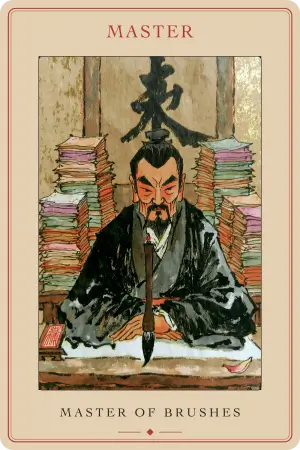
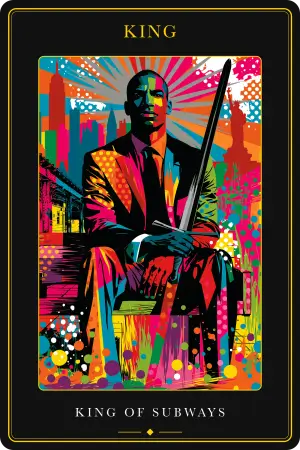
Every deck reimagines the same archetype. Compare the art, then open a deck to read its full interpretation.
Imagery and symbolism
Pamela Colman Smith drew the King of Swords for the 1909 Rider deck as a study in cold, seated authority. He sits enthroned and faces the viewer straight on, his gaze level and critical, the look of a deep thinker who will not turn away from a hard truth. Where Smith gave the Knight a galloping charge and the Queen a profile turned inward, she fixed the King forward and still, a figure who moves on logic and stands for law, justice, and fair, carefully weighed decisions.
The upright blade. The double-edged sword rises in his right hand, the hand of conscious action, tilted just off center. Smith drew it pointing upward, a sign of decisiveness and clarity of intention rather than of attack, a mark of spiritual activity and resolve. The blade is heavy and the hand that grips it looks strained, so the picture carries its own caution: holding the mind this sharp and this ready is a real weight to bear.
The palette and the sky. Smith dressed him in pale blue, the deck's color for depth of thought and composure, against a sky of slow, high clouds. The clouds stand for the realm of air and thought, clear here rather than storm-tossed, though they can also hint at complex matters still waiting to be worked through. Birds cross the sky behind him, the free movement of ideas carried out into the world.
The throne and its carvings. The stone throne is the foundation of law and objective reality, and older decks named this figure the Man of the Law and set him at the magistrate's bench. Smith carved butterflies into the stone, the deck's emblem of transformation and regeneration, a quiet sign that his systems can still change and old divisions can heal. Crescent moons sit near them, tying his reason to a thread of intuition he keeps under strict command. Mountains rise in the far distance, the obstacles already overcome, and a deliberate space opens between the King and the world around him, the distance that lets him judge it without being pulled in.
Core meaning
In the Rider-Waite-Smith reading, the King of Swords is authority built on intellect, the master of the mind who moves forward on logic and clarity alone. He sits at the head of the suit of Air, and by the elemental scheme he is the Fire of Air, willpower driving intellect into a directed force, an individual sharp, analytical, courageous, and fond of a hard argument.
His governing rule is to decide on facts and logic and to keep mood and passing emotion out of the reckoning. At his highest he is the critical thinker who tests an inherited belief instead of trusting it, asking whether a settled conviction is actually true or only a comfortable habit of thought. His authority holds because it answers to evidence, not to ego.
Upright meaning
Upright, he sets a tone of high standards and cool evaluation. He leads with strategy and clear principle, keeps to disciplined routine under pressure, and treats a hard stretch as a long march rather than a sprint, warning against quitting just before the breakthrough.
In love. The head is ruling the heart, and feeling has been set aside. He is drawn to a sharp mind and real intellectual equality more than to appearance, and courtship under his sign can feel like a careful vetting, his guard up until the logic of the match is settled. Once committed, the bond runs on honest, structured talk and steady stability more than on spontaneous passion, and it needs defined boundaries, since ambiguity is what it cannot abide.
In career. Often a mentor or authority figure of real rigor, a judge, surgeon, scientist, or commander who expects work without errors. As your own energy he asks you to lead with strategy, strict protocols, and plain evidence, and to hold the respect of colleagues through competence, not volume.
In finances. Build solid systems and firm budgeting rules, hold off impulsive emotional buys, and favor patient long-term investment over speculation. Structure beats willpower here. He also governs contracts and legal matters settled on verifiable fact.
In health. A clinical, disciplined approach to the body: design a system with measurable metrics, consult verified experts and peer-reviewed research over amateur self-diagnosis, and build real rest into the routine rather than pushing past every limit.
Reversed meaning
Reversed, the Wounded King comes forward. Cut off from ethics and compassion, his logic detaches from justice and turns into a weapon. This is the plain abuse of power, the manipulation, the intellectual upper hand used against people who cannot match it.
The shadow King is merciless and cynical, the cold mind set on its aim whatever the human cost, the con artist and the corrupt official who feels nothing. Readers tie the ill-dignified card to narcissistic and dark-triad traits, the silver tongue that gaslights by twisting words until his self-serving idea sounds like your own. In this state he rules his surroundings through mental bullying and a flat absence of ethical limits.
In love. A partner who uses intellect to dominate or belittle, talk that is authoritative and literal but stripped of the empathy that would carry it kindly.
In career. A tyrant who controls through blame and manipulation, or your own reasoning gone rigid and cold toward the people you work with.
In finances. Cold calculation that ignores the human cost, or a lack of strategy that shows up as rash decisions and missed opportunities.
In health. Rigid extremism that overrides the body's real limits, over-control and an over-strict regimen that drain more energy than they build.
Historical notes
The archetype was long the Man of the Law. Etteilla's deck named him the Homme de Robe, the robed magistrate, and read his stone seat as the judicial bench, a figure of rules and verdicts. The modern coordinates come from the Hermetic Order of the Golden Dawn, which fixed his astrological and Kabbalistic address.
One naming note matters here. The Golden Dawn and Crowley rebuilt the court as Knight, Queen, Prince, and Princess, so the energetic twin of this card in the Thoth deck carries the title Knight of Swords, the Lord of the Winds and Breezes, still the Fire of Air. Whatever the label, the meaning holds steady: the active, outward mastery of the intellect. A.E. Waite and Pamela Colman Smith gave the enthroned, forward-facing figure its definitive form when the Rider deck appeared in 1909, and it is Smith's image that the modern reading grew up around.
Correspondences
Rank. The King, aligned leadership and outward mastery of the element, the mind used to shape the external world rather than only the inner one.
Astrology. By the Golden Dawn scheme he rules from 20 degrees Taurus to 20 degrees Gemini, roughly May 11 to June 10, taking the quick, communicative thought of Gemini and grounding it in the stubborn structure of Taurus. He holds cognitive authority over the Seven of Pentacles, the Eight of Swords, and the Nine of Swords. This deck's own commentary reads him instead under Aquarius, air upon air, ruling the eleventh house of groups and movements, with the originality and social conscience of the fixed air sign.
Element. The Fire of Air, willpower flaring up through intellect into directed force.
Kabbalah. Every King sits in Chokmah, the second sphere, Wisdom, here working within Yetzirah, the formative world of Air. He is the prime mover of thought, the spark that orders chaos into comprehensible structure.
Timing and yes or no. He leans to late spring. As a yes or no he is conditional, a yes to whatever holds up under honest reasoning and a no to what fails it, since he decides on fact rather than feeling.
Psychological perspective
The King of Swords is the archetype of The System, the authority figures and social structures that quietly shape behavior. At his best he challenges the paradigm, pressing you to examine the assumptions, prejudices, and fears absorbed in childhood and to ask whether they hold up as fact. People fear what they do not understand and resist re-opening a question they closed long ago, so this inner rigidity yields only to solid evidence and clean reasoning, never to an emotional appeal.
His central warning is the danger of too much logic. Pushed to the extreme, clear-headedness turns barren, a systematic silencing of the heart's wisdom, reason used to skip over feeling. The card asks for a balance between rational discernment and emotional understanding. In the long argument over how he feels, readers split two ways. One is the void of romance, an executioner who treats attachment as an inefficient distraction and can sever a tie without devastation. The other is the fierce protector, a man who does have feelings but refuses to let them steer his actions, guarding his heart precisely because he knows his own vulnerability. The aim of his growth is empathetic authority, staying truthful and firm while still genuinely kind about how the words land.
The King of Swords across decks
Rider-Waite-Smith. Pamela Colman Smith's 1909 rendering is the reference the modern card is read against: enthroned and forward-facing, sword upright, pale blue robe, butterflies and crescent moons cut into the stone, mountains and birds behind. Her choice to seat him and face him outward, calm and critical, is what fixed him as the judge rather than the charging soldier.
Etteilla and older traditions. The Homme de Robe, the Man of the Law, the magistrate whose stone seat stands in for the bench, an authority of rules and verdicts.
Crowley-Thoth. Because Crowley renamed the ranks, this energy appears as the Knight of Swords, the Lord of the Winds and Breezes, painted by Lady Frieda Harris, still the Fire of Air and the same outward mastery of intellect. The change is one of title, not of essence.
Comparative readings. Practitioners sharpen him against his peers. The Queen of Swords masters Air within herself, while he imposes it on the environment, wielding logic and law to manage others. The King of Cups, the Fire of Water, honors emotion where this King suppresses it to hold his objectivity, and the pair maps the old divide of head against heart. The Knight of Swords is the velocity he governs, the soldier who carries out the orders the King is careful enough to formulate.
In combination and context
The King brings his clinical detachment to whatever sits beside him. With the Three of Swords he can mark intellectualized grief, a mind over-analyzing a heartbreak and replaying conversations to reason a way out of pain, a warning that a feelings problem has no thinking solution. At his highest, though, he lends the nerve to look at a betrayal squarely and set the boundary that keeps it from happening again. With the Tower he turns catastrophe into calculated disruption, dismantling a broken structure on purpose to rebuild it on solid truth. With the Seven of Cups his blade cuts straight through illusion and temptation to a clear choice.
His friction with the watery cards is telling in love. Beside the Ace or Two of Cups he feels genuine new affection yet refuses the rose-colored view, holding love together with firm boundaries. Beside the Lovers he keeps a deep bond strictly analytical, making the choice on rigorous logic rather than passion. Beside the Devil or the Ten of Swords his shadow lights up, an intelligent authority enforcing toxic terms and manipulative control. Paired with the Queen of Swords the two form the ultimate mind trust, a mature, no-nonsense couple whose bond may still run short on warmth.
Questions for reflection
- Which belief have you kept because you inherited it, never because you tested it against the evidence?
- Where are you reaching for clean logic to avoid feeling something you actually need to feel?
- Can you stay completely honest and firm and still be kind about how your words land?
The general meaning follows the Rider-Waite-Smith reading — the reference used across Tarot Academy. Open a specific deck above for its own interpretation.
Frequently asked questions
Explore the Tarot
Latest Posts
Discover the ancient wisdom of tarot cards and unlock the mysteries of your spiritual journey. Our blog is your gateway to understanding the rich symbolism, meanings, and practical applications of tarot reading.




















































