
 EN (English)


Minor Arcana ·
Master of Brushes
Judgment by the standard, not the self: the chief examiner reads every fate and signs it in ink.
Card at a glance
- Numerology
- Master (King rank)
- Element
- Air
- Astrology
- Aquarius · ruled by Uranus
- Kabbalistic path
- Chokmah (Wisdom) in Yetzirah
- Timing
- Winter · Aquarius season
- Yes / No
- Upright yes, if it rests on facts · Reversed no
Upright
intellect
objectivity
verdict
justice
precision
authority
the pursuit of truth
incorruptible judgment
Reversed
cruelty of the letter
excessive logic
manipulation
formalism
coldness
cynicism
verdicts for personal gain
Master of Brushes in each deck
Every deck reimagines the same archetype. Compare the art, then open a deck to read its full interpretation.
Imagery and symbolism
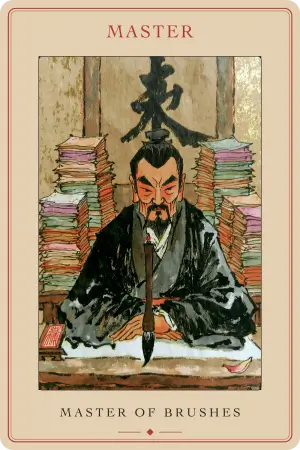
In the Tarot of Beijing the King of Swords holds no sword and wears no crown, because in this city the deadliest blade is a brush. He is the chief imperial examiner, seated dead-centre in the examination hall in an ink-black robe, perfectly symmetrical. The symmetry is the whole argument: nothing in him leans toward either party. His gaze is level and stern, aimed straight ahead at the candidate, at whoever has just placed their fate on his desk.
Before him stands a single vertical brush, upright like a raised blade. This is the deck's translation of the King's sword, the instrument of the verdict, its tip already dark with ink because judgment here is never hypothetical. Ten thousand fates pass under that brush each session, and it has never once trembled, which is either justice or its perfect imitation, and he alone knows which.
Behind and beside him rise tall stacks of examination papers, hundreds of bound essays in faded reds, greens, and violets. They replace the Rider-Waite clouds. This is the air he breathes, an atmosphere made of other people's words and arguments awaiting his decision. Above his head, where a crown would sit, a single great calligraphic character hangs on a wall scroll. His authority is literacy itself, and the character rules the room the way a coat of arms rules a throne hall.
A small red seal rests at the edge of the desk. Once pressed, a verdict becomes law, and its vermilion is one of the card's only two colour accents. On the clean white sheet before him lies the next fate, not yet judged. At the corner of the desk, easy to miss, a single fallen petal has drifted into the hall of standards and lies within reach of his hand. Whether the judge still notices the small living thing beside the document is the question the card asks. The warm kraft-paper ground is flecked with gold, as everywhere in this deck, so even the sternest room in Beijing is lit faintly from within.
Core meaning
The Master of Brushes is Beijing's King of Swords, and his meaning is the verdict. The situation now asks for clear thinking, objectivity, and a decision made the way he makes it: after reading everything, weighing everything, and setting personal sympathy aside just far enough to see the truth. Any judgment reached now should rest on facts, standards, and logic rather than on mood or pressure.
Where the canonical King wields the drawn sword of pure intellect, the examiner wields the brush, which decides fates without ever drawing blood. His power is mastery of the written word: the ability to settle a dispute in one sentence and to take full responsibility for a final answer. This is air ruling the suit of air, mind ruling the suit of mind, so he inherits the King of Swords in its most concentrated form. His authority was earned stroke by stroke across decades at the desk, not granted by a title, and he never signs what he has not read. He serves the standard, not himself, the dynasty, or the candidate, and that service is the source of the trust others place in his word.
Upright meaning
Upright, the card calls for the examiner's discipline. Read the whole page before you grade it. Gather the facts, apply the standard evenly, then decide fully, in ink rather than in pencil. Let the mind lead the heart in this matter without dismissing the heart, because the examiner's justice holds only while he remembers that every essay was written by a living person. Say what you mean in as few strokes as possible, and do not reopen a fair verdict out of anxiety or delay one out of fear.
In love. A bond built on intellect, honesty, and words that can be trusted: long conversations in the teahouse, letters worth keeping, arguments that end in understanding because both people actually listen. The partner of this type is reserved and principled, slow to declare feelings but incapable of declaring false ones. Such a person loves the way he writes, in few strokes and permanent ink. The card's caution is gentle and real. A love administered entirely by reason can starve, so notice the fallen petal on the desk between you, the unscheduled gesture the rulebook does not mention.
In career. The highest level of competence and earned authority, an opinion in the workplace that carries the weight of a verdict. The card favours positions of evaluation and responsibility: examiner, editor, judge, auditor, senior expert, the person whose signature ends discussions. It calls for the concentration of the examination cell, no borrowed brushes, and it can point to a literal examination in the broad sense, a certification or review that, upright, passes on merit. A demanding, laconic, scrupulously fair mentor may stand over your desk, and his rare praise is worth a year of applause.
In finances. Logic, strategy, and disciplined administration of money. This is the man who reads every line of the ledger before signing it: careful accounting, documented agreements, decisions based on calculation rather than impulse. It often points to income earned through intellect and qualification, money that comes because your judgment is trusted. A favourable time for auditing your affairs, formalising contracts, and resolving disputes through official channels. Put it in writing, read what you sign, and keep your accounts the way the examiner keeps his hall, in order and open to inspection.
In health. Discipline, regimen, and the intelligent government of the body. Order, measure, and a standard applied daily without excuses: a considered training plan, regular sleep, posture corrected stroke by stroke like calligraphy. The examiner's body was trained for endurance, hours upright at the desk with a steady spine, so the card favours tai chi at dawn, calligraphy, breathing work, any art where control is cultivated calmly over years. It also values expert judgment: a good physician's verdict and test results read carefully rather than anxiously.
Reversed meaning
Reversed, the Master of Brushes shows intellect that either dominates too harshly or is no longer used honestly. The examiner's chair has been taken by someone who grades by favour, by fee, or by fatigue. It can signify excessive criticism, a cold heart, verdicts issued without reading, or the letter of the rule used to strangle its spirit. This is bureaucratic cruelty, a decision that is technically correct and humanly wrong. It can also describe the opposite failure, your own inability to decide: endless re-reading and re-weighing, the brush held above the paper until the ink dries in the air. Check whose interest your objectivity is actually serving.
In love. Coldness and control dressed as rationality. A partner who grades rather than loves, weighing every gesture and winning every quarrel on points until feelings stop testifying. Emotional distance gets defended as maturity while warmth is treated as a weakness of style. Sometimes the standards themselves suffocate the bond, and the living person across the table can only ever fail the examination. Close the ledger of grievances and notice the petal before your own steady hand sweeps it to the floor with the day's papers.
In career. Despotic or unjust authority: a chief who rules through fear and formalism, criticism that humiliates instead of teaching, evaluations rigged before the papers are opened. A workplace where documents matter more than people and initiative is graded as insubordination. The edge can also turn toward you, as intellectual arrogance, an inability to delegate because no one else's stroke is clean enough, or paralysis before a decision disguised as thoroughness. If the hall itself is corrupt, the finest scholars of old Beijing eventually carried their brushes elsewhere.
In finances. Cold calculation turned against you, or your own analysis failing. It can mean an unfair verdict: a biased audit, a contract whose fine print was written to wound, an expert opinion purchased rather than earned. It can also point to your own errors, decisions made on prestige rather than fact, or rigidity in a strategy the market has already refuted. Watch documents with special care, since what is signed cannot be unsigned, and if you find your own mistake in the ledger, correct it openly.
In health. A regime that has become a tyranny. Discipline curdles into self-punishment: a diet enforced like a sentence, training past the body's honest testimony, a mirror used as an examination hall where the candidate fails every morning. Expect the classic ailments of the examiner, the seized back and neck from long hours at the desk, eyes strained by lamplight, sleep sacrificed to work. Loosen the standard before it breaks the student, because the third watch of the night is for sleeping, not for sitting upright with your hands over your face.
Historical notes
The King of Swords began as a figure of the law rather than the battlefield. In the older Etteilla tarot this archetype was labelled Homme de Robe, the Man of the Law, tying his seat directly to the magistrate's bench. The 1909 Rider-Waite-Smith deck fixed the modern image: a king enthroned on heavy stone, facing forward, a double-edged sword held upright and ready in his right hand. The clear sky and high birds behind him mark the elevated, unclouded realm of pure thought, while butterflies and crescent moons carved into the throne hint that his logic is not entirely dogmatic and guards a vulnerable inner world.
The esoteric structure sits underneath that picture. The Golden Dawn assigned this archetype the elemental dignity of the Fire of Air, the active, outward mastery of intellect, and placed it across the span from 20 degrees Taurus to 20 degrees Gemini. In Crowley's Thoth deck the same energy wears a different title, the Knight of Swords, Lord of the Winds and Breezes, so the Thoth Knight is the exact esoteric equivalent of the RWS King.
The Tarot of Beijing takes the reframing further and keeps only the function. It removes the throne, the crown, and the sword, and sets in their place the chief imperial examiner: the ink-black robe for the armour, the vertical brush for the blade, stacks of essays for the clouds, and a calligraphic character where the crown would hang. The imperial examination was old Beijing's great social machine, the one institution through which a village boy's mind could outrank a nobleman's birth, which makes the examiner a fitting seat for an authority that is literacy itself.
Correspondences
Number. As a King he counts as the fourth figure of his court, and Kabbalistically he answers to the number two of Chokmah, the second sphere. His rank is the summit of the Suit of Brushes, this deck's Suit of Swords, the active outward mastery that stands above the Page, Knight, and Queen of the same air.
Astrology. This deck attributes him to Aquarius, the fixed air sign of originality, systems, and the common good, ruled by Uranus, with his span running from the third decan of Capricorn through the first two decans of Aquarius. His home is the eleventh house of social structures and institutions, which fits the examiner precisely. Aquarius serves an idea larger than any single person, exactly as he serves the standard rather than the candidate, and its Uranian paradox suits him too: the guardian of the system is the one who best understands how it could be overturned. The grounding Capricorn decan supplies the discipline and endurance of long sessions by candlelight. In the older Golden Dawn scheme the King instead governs 20 degrees Taurus to 20 degrees Gemini; the Beijing deck follows the modern attribution to Aquarius.
Element. Air, and specifically air upon air, mind ruling the suit of mind. Under the classical dignity the King of Swords is the Fire of Air, willpower flaming up through intellect into directed, structured force.
Kabbalah. All Kings answer to Chokmah, Wisdom, the second Sephirah, and this one operates in Yetzirah, the formative world of Air. He is the prime mover of thought, the spark that organises chaos into comprehensible order.
Elemental dignity. Fire of Air. Beside watery, emotional cards his clarity cuts through confusion; beside other airy cards his logic compounds into sheer analytical pressure.
Psychological perspective
At his highest, this arcana is the critical thinker who challenges paradigms. He asks whether a cherished belief is factually true or merely a comfortable habit of thought, and he insists that calcified assumptions be won over with evidence and sound reasoning rather than fought with emotion. His authority is exacting toward himself first. It was built stroke by stroke, and its reserve reads as poise rather than coldness, precision rather than talkativeness.
The warning lives in the same faculty. Logic taken to an extreme becomes emotionally barren, and the card can represent the systematic suppression of the heart, using pure reason to bypass feeling. Divested of ethics and compassion, the archetype degenerates into the wounded King: the cold, calculating mind bent on its goal regardless of the human cost, the silver tongue that gaslights and manipulates, the burnt-out judge so tired of weighing others that he has stopped seeing them. The corrective is the fallen petal at the corner of the desk. The examiner who stops noticing it is still accurate, but he is no longer just. The task is to grade the work honestly and see the person anyway.
Master of Brushes across decks
Rider-Waite-Smith. The canonical King of Swords sits enthroned on heavy stone, facing forward, the double-edged blade held upright and ready. Butterflies and crescent moons in the throne soften his rigidity, and the clear sky behind him marks the realm of unclouded thought. The Master of Brushes keeps that impartial forward gaze and that mastery of the mind, but empties the sword hand and fills it with a brush.
Etteilla and the Marseille tradition. Older French decks named this figure the Man of the Law, seating his authority at the magistrate's bench. Beijing preserves exactly that judicial function and moves the bench into the imperial examination hall.
Crowley-Thoth. Crowley renamed the archetype the Knight of Swords, Lord of the Winds and Breezes, keeping the Fire of Air dignity while changing the title. The Beijing reversed card meets the same shadow Crowley emphasised, intellect severed from empathy and turned to manipulation.
Modern reframings. Contemporary decks tend to recast the King as mentor, strategist, or truth-teller rather than martial monarch. The Tarot of Beijing belongs to that movement, replacing the sword entirely with the brush and locating the card's authority in literacy and the verdict rather than in the threat of force.
In combination and context
The Master of Brushes brings clinical detachment and piercing truth to whatever surrounds him. Beside the Three of Swords he warns against intellectualising grief, over-analysing a heartbreak and replaying conversations to logic a way out of pain, though at his best he supplies the bravery to face a betrayal objectively and set firm boundaries. With the Seven of Cups his blade cuts straight through illusion and temptation, granting the clarity to choose amid a sea of confusing options.
With the Tower his energy makes destruction deliberate: an authoritative figure who dismantles a broken structure on purpose in order to rebuild it on the truth. Beside the Ace or Two of Cups he reads as guarded affection, a genuine new connection approached with clear eyes and firm boundaries so the querent does not lose themselves in the rush of romance. Paired with the Devil or the Ten of Swords his shadow surfaces, a warning of intellectual manipulation and control enforced through mental acuity.
When the Queen of the same suit joins him, they signify the ultimate meeting of minds, a mature and honest pair whose connection can lack warmth precisely because both prize duty and logic over feeling. When he keeps appearing in a reading, treat him as an instruction to decide the thing you have been avoiding: read everything first, apply one standard evenly, and then write the verdict once, clearly, and press the seal.
Questions for reflection
- Whose interest is your objectivity actually serving right now, and would it survive being read aloud?
- Is there a verdict you have been avoiding by re-reading the same page, and what would it cost to finally sign it?
- Where is the fallen petal on your desk, the living detail the rulebook does not mention, and have you let yourself notice it?
The general meaning follows the Rider-Waite-Smith reading — the reference used across Tarot Academy. Open a specific deck above for its own interpretation.
Frequently asked questions
Explore the Tarot
Latest Posts
Discover the ancient wisdom of tarot cards and unlock the mysteries of your spiritual journey. Our blog is your gateway to understanding the rich symbolism, meanings, and practical applications of tarot reading.




















































