
 EN (English)



Minor Arcana · Swords (Air)
Queen of Swords
Pamela Colman Smith's hilltop Queen: a vertical double-edged sword of unbiased truth, held by the woman who freed herself and keeps one cut rope as a vow.
Card at a glance
- Numerology
- Queen
- Element
- Air (Water of Air)
- Astrology
- 20° Virgo to 20° Libra
- Kabbalistic path
- Binah (Understanding)
- Timing
- Early autumn, September to October
- Yes / No
- Conditional, yes to truth and boundaries
Upright
clarity
honesty
independence
boundaries
discernment
resilience
objectivity
self-worth
Reversed
coldness
bitterness
cynicism
cruelty
collapsed boundaries
codependency
isolation
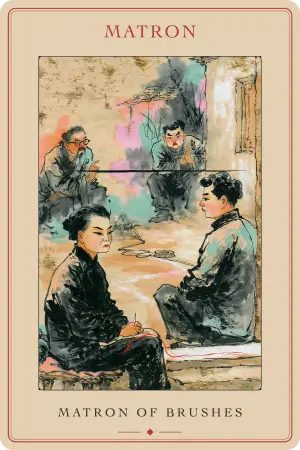
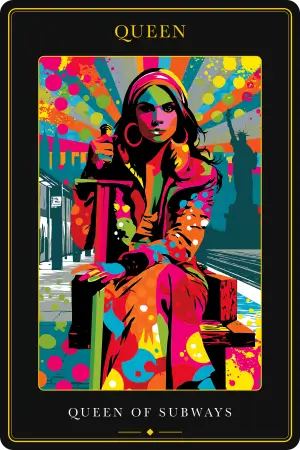
Queen of Swords in each deck
Every deck reimagines the same archetype. Compare the art, then open a deck to read its full interpretation.
Imagery and symbolism
Pamela Colman Smith gave the Rider-Waite-Smith Queen of Swords a portrait far grander than the words Waite handed her. She sits in profile on a heavy stone throne set high on a hill, her status dominant, her posture upright and regal, gazing dispassionately into the distance. Smith's palette carries the meaning. A white robe reads as purity of intention and clarity of mind. A sky-blue cloak embroidered with clouds ties her body to the element of Air. A red headdress shows under the golden crown, a small flare of passion and conscious mind beneath the cool surface. The background is kept light for purity, justice, and impartiality, and the only clouds Smith lets gather sit low at the base of the frame.
The upright sword. She holds the blade perfectly vertical and still, one of only three figures in the deck to do so, and turns it to show its double edge. Smith draws it raised and unsheathed toward the sky, so it works at once as the intellect that severs deception and as a standing warning that she will defend a boundary if it is crossed. The two edges are her habit of weighing both sides of a situation before she rules on it. The deck's own reading names the raised sword as her fitness for intellectual debate and her direct way of stating an opinion.
The extended hand. Her left hand reaches forward with the palm open, at once an offer of counsel to those she governs and a firm stop that marks a threshold of respect. Palmists point to a simian line drawn across it, the head line and heart line merged into one crease, a sign that emotion and logic are fully integrated in her.
The crown, throne, and their carvings. The golden crown is shaped from butterflies, insects of Air and of metamorphosis, so her mental lightness reads as something earned through a painful, self-dissolving change. The throne itself grounds that aerial energy in stone. Its carved supports stand for order and systematic thinking, its base rests flat on the hilltop for the practicality of a mind that works from reality rather than fantasy, and its face carries a cherub for the innocence needed to hold sharp intelligence without turning cynical. Two sickles flank the child's head, reaping what has been sown and echoing the crescent moons on the crown of the High Priestess, a nod to matriarchal authority.
The tassel, sky, and bird. A single severed tassel hangs from her left wrist, a direct link to the Eight of Swords and its bound, blindfolded woman. She is that same woman, freed by her own hand, keeping one cut rope as a vow never to be trapped by illusion again. Above the hill a solitary bird crosses the clear sky for freedom of thought and her hunger for autonomy, while the dark clouds held low on the horizon carry the grief she has already survived. Smith even lets the wind move through the scene as the visible pressure of Air and of the inner strength behind it.
Core meaning
In this deck the Queen of Swords is the element of Air held in the mature, inward register of a Queen: independence, a sharp and honest mind, and the authority to set a boundary and keep it. Smith's hilltop framing makes the point the deck's reading draws out, that she does not fear standing alone or set above others, and that her clarity is a form of power and not a consolation for loss.
Her sharpness is tested rather than raw. It is not the Page's first curiosity or the Knight's blind charge but intelligence that has met real loss and betrayal and come through with its judgment intact. She appears when someone has processed a genuine wound without letting it damage their core identity or harden into nihilism. Her governing belief is that seeing and speaking the plain truth, however uncomfortable, is the only real route to healing and the highest form of kindness.
Upright meaning
Upright, she brings disciplined perception and boundaries that hold. She refuses to sugarcoat reality or soften her standards to keep manipulative people comfortable, and her compassion is real but conditional on respect and honesty. The deck's counsel is to act with independence and clarity of thought, to be critical and rational when deciding, to organize the mind and let logic find the balance, and to take the lead and make the important calls yourself without shutting others out.
In love. She reads as honesty, independence, and intellect in a relationship, someone who looks for a partner who matches her mentally and who analyzes her feelings rather than being swept off by them. She can be the strong, self-defined woman who lives by her own rules and treats a partnership as an addition to a full life. She may come across as distant, since she weights logic and reason so heavily and lets a bond grow on common sense more than passion. After a betrayal she is the internal truth-detector urging you to stop romanticizing a toxic past.
In career. A highly auspicious card at work, often a woman who stands out for strength, experience, and knowledge, or a promotion into a leadership role that demands concentration, analysis, and decisiveness. Her energy suits management, science, and law, and the deck advises approaching projects in a businesslike, well-planned way. In business she is honesty, directness, and the analytic eye that spots the flaw in a plan, sometimes an experienced advisor on legal or administrative matters.
In finances. She points to clarity and strategic planning: considered decisions, a strict budget, control over resources, and profit earned through sensible spending. The deck also reads her as skill in negotiation and the confidence to command a high price for your work.
In health. In the physical register she calls for focus and self-discipline, close attention to a training regimen or diet, and a respectful, well-researched care of the body. Her Virgo-inflected mind can also refuse to switch off, so insomnia is a theme, and the counsel is discipline paired with genuine rest.
Reversed meaning
Reversed, her balanced Water of Air tips one of two opposite ways. In the hyper-aggressive shadow the intellect becomes a weapon stripped of empathy: a bitter, vindictive figure who keeps score, finds each person's weak point, and strikes to cause the most pain. It shows up as gossip, cynicism, and dictatorial control. The deck names the coldness plainly, ruthlessness and harshness, sarcasm, excessive criticism, and a mind that sees only its own side.
In the collapsed-boundary shadow her core strength fails. Judgment clouds under unchecked emotion, red flags go ignored, and she slides into codependent patterns with little self-respect, or else walls herself off from the world behind anxiety and fear of being hurt.
In love. Either cruelty that uses honesty as cover to wound, a coldness that drains warmth until feeling cools, or a loss of boundaries that keeps you where you know you should not stay. The deck's advice is to attend to your partner's emotional state and close the distance with more tolerance.
In career. Cutting words and rigidity that poison a team, hasty decisions and dismissed advice, or an overly cold rationality that costs important connections and tips into burnout.
In finances. Carelessness and impulsive spending, control slipping, taxes or details neglected, and losses that come from overestimating yourself and brushing off risk.
In health. A regimen turned too strict, overexertion without rest, or a self-critical eye that magnifies flaws, all of it asking for a gentler approach and a real ear for what the body is saying.
Historical notes
Arthur Edward Waite defined the card in bleak, gendered terms in his 1910 Pictorial Key to the Tarot: widowhood, female sadness, sterility, mourning, and privation. He wrote that her face suggests familiarity with sorrow, that she does not stand for mercy, and that she is scarcely a symbol of power, with a reversed sense of malice, bigotry, and deceit. The tone reflected Edwardian suspicion of female intellectual authority, and it sat oddly beside the majestic figure Smith had drawn a year earlier for the 1909 Rider deck.
Modern readers noticed the contradiction, and the disparity with the King of Swords, who holds the identical elemental mastery yet was celebrated as a wise judge while the Queen was reduced to a bitter crone. Contemporary practice, led by feminist and psychological readers, reclaimed her as a figure of positive power whose authority is earned through the hardships she survived. Her familiarity with sorrow became the source of her discernment.
Correspondences
Rank. The Queen, the mature and inward mastery of her suit, wisdom held within rather than brandished outward.
Astrology. She governs 20 degrees Virgo to 20 degrees Libra, roughly September 12 to October 12. The final decan of Virgo gives her meticulousness, a critical eye, and a restless mind prone to insomnia. Libra, the dominant cardinal air influence, gives her the obsession with justice, balance, and truth even when the truth is uncomfortable. The deck adds the note of Venus, Libra's ruler, and places her domain in the Seventh House of partnership, so she reads as a fair mediator who hears each side.
Element. The Water of Air, the emotional processing of intellectual concepts. Where the King's Fire of Air burns through a problem, she applies emotional intelligence to logic and understands how words land on the human heart.
Kabbalah. All Queens sit in Binah, the third sphere, Understanding, the Supernal Mother on the Pillar of Severity where limitless energy first takes form. Binah's link to Saturn gives her a sorrowful depth and a wisdom rooted in the laws, limits, and necessary endings of the universe.
Timing and yes/no. She leans to early autumn. As a yes or no she is conditional: yes to truth, boundaries, and self-respect, no to illusion and manipulation.
Psychological perspective
In evolutionary tarot the Queen of Swords marks a specific milestone, the point where raw intellect has been seasoned by lived experience. Her power is the integration of head and heart under pressure, the capacity to hold real emotional depth without letting it corrupt her read on the facts.
Her shadow is a catalogue of cognitive defenses. Intellectualization is the central trap, using analytic clarity to keep feeling at a safe distance and mistaking thinking about an emotion for feeling it, which breeds detachment and sterile relationships. If the grief of the Three of Swords is never processed it calcifies into cynical hyper-vigilance, an attitude of already knowing how this ends that punishes innocent new people for old wounds. At its most toxic she weaponizes truth and uses bluntness as thin cover for cruelty. Online communities argue over her as the so-called ice queen, and experienced readers push back: her coldness is the absence of people-pleasing, a refusal to suffer fools or tolerate manipulation. She often arrives as a persistent stalker card when someone is letting boundaries be trampled, is enmeshed in another person's drama, or is shrinking their own intelligence to keep others comfortable.
The Queen of Swords across decks
This article reads the Rider-Waite-Smith Queen, so the other traditions serve mainly to sharpen what Smith and Waite built.
Traditional cartomancy. As the Queen of Spades she carried grim associations of widowhood, mourning, and separation, the reductive sorrowful-widow label that Waite inherited and that modern practice has largely discarded.
Crowley-Thoth. Titled the Queen of the Thrones of Air and painted by Lady Frieda Harris, Crowley makes her drive absolute independence and freedom of mind. She lends emotion and sensitivity to Air, which gives her the power to transfer and create, but he warns of the imbalance: made only of Water and Air, she lacks the grounding of Earth and the executive will of Fire. Her shadow risks impracticality and a retreat into an idealistic inner world, a sensitivity to outside disturbance she cannot always shield, and, if corrupted, a charm and articulacy that make her a dangerous adversary. Set beside her, Smith's grounded stone throne and hilltop practicality read as a deliberate anchor the Thoth version does without.
Modern decks and readings. Contemporary practice elevates her as an icon of feminist autonomy and compassionate truth-telling. Readers set her against the other Queens to sharpen her: where the Queen of Cups would cry with the heartbroken, the Rider-Waite-Smith Queen of Swords tells them the partner was toxic and helps hire the divorce lawyer, and where the Queen of Pentacles nurtures the body, she sharpens the mind.
In combination and context
Her meaning shifts sharply with her neighbours. Within her own suit she tells a story of survival. With the Three of Swords she confirms that her current clarity was forged by a devastating heartbreak she outlived. With the Seven of Swords she advises using intellect and secrecy to guard against a deceiver. With the King of Swords she forms a power couple of intellectual equals who respect each other's autonomy, though readers warn the pairing can turn clinical, two people trapped in their heads with the passion gone.
Against the Major Arcana she raises deeper tensions. With The Fool she is a cognitive paradox, the demand for evidence meeting the call to a blind leap, and the counsel is to keep your boundaries and mind while still taking a calculated risk. With The High Priestess she pairs conscious logic with unspoken intuition, gut instinct plus the courage to name what is wrong. With The Empress she asks you to balance unconditional love with the sharp, protective intellect that keeps generosity from being exploited.
Questions for reflection
- Where in your life is uncomfortable honesty actually the kindest thing you could offer, to yourself or someone else?
- Which boundary have you been afraid to enforce for fear of seeming cold?
- Are you using clear thinking to process a feeling, or to avoid feeling it at all?
The general meaning follows the Rider-Waite-Smith reading — the reference used across Tarot Academy. Open a specific deck above for its own interpretation.
Frequently asked questions
Explore the Tarot
Latest Posts
Discover the ancient wisdom of tarot cards and unlock the mysteries of your spiritual journey. Our blog is your gateway to understanding the rich symbolism, meanings, and practical applications of tarot reading.




















































