
 EN (English)



Minor Arcana · Pentacles (Earth)
Ace of Pentacles
The Rider-Waite seed of the material world: a hand from the cloud offers a starred coin over a tended garden, real opportunity for wealth and grounded new beginnings, held out but not yet grown.
Card at a glance
- Numerology
- Ace
- Element
- Earth
- Astrology
- Root of Earth · Taurus, Virgo, Capricorn
- Kabbalistic path
- Kether in Assiah (Crown)
- Timing
- Winter and years, or the green of early spring
- Yes / No
- Upright yes · Reversed not yet
Upright
New opportunity
Prosperity
New venture
Manifestation
Financial security
Abundance
Fresh start
Seed capital
Reversed
Missed opportunity
Delay
Poor planning
Financial instability
Bad timing
Scarcity mindset
Greed
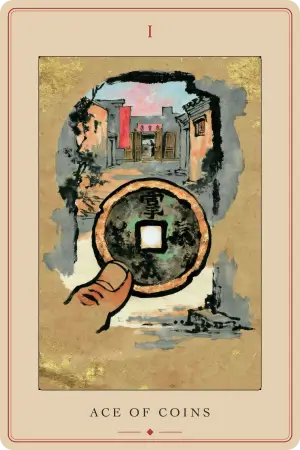
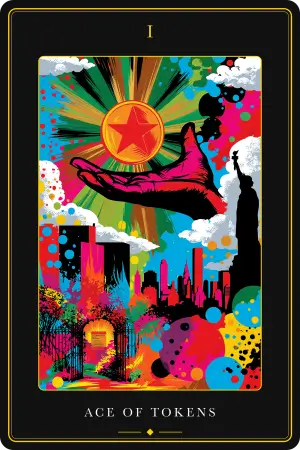
Ace of Pentacles in each deck
Every deck reimagines the same archetype. Compare the art, then open a deck to read its full interpretation.
Imagery and symbolism
Pamela Colman Smith drew the Ace of Pentacles as a single grey cloud opening in the foreground, a disembodied hand reaching out to hold up one large golden coin engraved with a five-pointed star. Waite's own line in the 1911 Pictorial Key to the Tarot is plain: "A hand issuing, as usual, from a cloud holds up a pentacle." The hand asks nothing back. It offers the seed and leaves the rest to you.
Smith's palette carries much of the meaning. The whole scene runs on green and gold, the two colours this deck ties to earth, growth and material wealth, so the card reads as natural abundance before a single symbol is decoded. The cloud marks the coin as a gift or blessing from the universe rather than something earned. The golden coin with its pentacle at the centre is the seed of that abundance. Behind and below the hand climbs a cultivated garden of white lilies and red roses: the white flowers stand for purity of intention, the red for desire and passion, and together they speak to renewal and growth. A bright path cuts through the green toward an archway, the arch itself a sign of firm foundation and stability that confirms the earthly nature of the card. Beyond it rise distant blue mountain peaks, the long view of reliability, high aims and prospects that take time to reach. The light background closes the reading: prosperity and positive change in material life. Smith stages the whole thing as one image of abundance and the realisation of something already begun.
Core meaning
For the Rider-Waite-Smith reading, the Ace of Pentacles is the material beginning: a favourable start in finances, health or work, and the moment plans already laid down begin to become real. It is the genesis of the Earth element, pure potential first touching physical reality, the instant a thought or intention starts to turn into something you can hold in your hand.
The deck's emphasis sits on one distinction. This is an offer, not a guarantee. The hand holds the coin out, but it does not close your fingers around it. The Ace gives you seed capital, the raw funding or opening for a project, and leaves the growing to you. Whether that seed becomes an abundant harvest or withers in unmanaged soil rests on the discipline and effort of the person who reaches out to take it. Smith's version reads a second layer into the gold as well: alongside material wealth it points to spiritual wealth, a balance between the outer world and the inner life.
Upright meaning
Upright, the Ace of Pentacles is a favourable omen across the physical side of life. It signals fertile ground for growth in money, work, home and body, and it calls for concrete action: take the opportunity in front of you and start tending it with persistence, planning and patience.
In love. The card marks the beginning of solidity, stability and material well-being in a relationship. It can point to a new level in an existing bond, to marriage, or to a fertile period for starting a family, buying a home or building something together. This is love grounded in reality and shared practical investment, which can surprise anyone expecting the fire of Wands or the emotional flood of Cups.
In career. At work it opens a period of abundance and a solid foundation for a stable career: a new project with real profit potential, a bonus or promotion, a fresh professional phase, or the launch of your own business. Careful planning and thoughtful decisions are what turn the offer into a result.
In finances. In money spreads it points to material abundance and a good time for investment, a purchase, or a significant sum coming in, sometimes an inheritance, a reward or a profitable contract. The heavy gold coin represents the real weight of what is offered, so the card advises handling resources carefully and saving toward a major asset such as a home or education.
In health. For the body it marks the start of a new phase of self-care: a new diet, an exercise programme or a therapeutic routine, with your approach to health becoming more organised. It asks you to treat the body as the foundation of material well-being and to favour steady, realistic maintenance over dramatic effort that cannot last.
Reversed meaning
Reversed, the earthly energy of the Ace is blocked or mismanaged. In this deck it rarely means outright ruin, which belongs more to the Five of Pentacles or The Tower. It points instead to delays, missed openings and a misalignment of values.
In love. Difficulties around money and stability, an excessive focus on material gain at the cost of the emotional bond, or trouble reaching shared goals. It asks you to reassess priorities and put attention back into the emotional side, since the stability of the relationship is genuinely at risk.
In career. Obstacles, delays and missed opportunities at work, poor investments, or a loss of stability. Professional openings may slip past because you were unwilling or unready to seize them, and rewards or progress may arrive late. Read the details closely, because something important can get overlooked.
In finances. Money slipping through the fingers through poor planning, financial help withdrawn, or the pull of bad investments and unnecessary debt. The shadow here is the fear of lack: hoarding out of scarcity, clinging to a false sense of security, or letting an obsession with material gain feed constant worry.
In health. A warning about self-discipline, whether that is ignoring the body's signals, overeating, skipping exercise or letting self-care slide. It can also mark exhaustion from too much dieting or training. The card asks you to clear the ground first, restore your energy, and take responsibility for your physical well-being before real progress can hold.
Historical notes
The suit of Coins goes back to the Latin-suited playing cards of medieval Europe, where the four suits mapped onto the social orders and Coins belonged to the merchant class and the literal exchange of currency. In the early Tarot de Marseille the Ace of Coins is stark and geometric: a large symmetrical coin adorned with botanical flowers, resting alone, with no divine hand at all.
That absence is the key to what Waite and Smith changed. The Marseille tradition reserved the hand of God for the "higher" Aces of Wands and Swords, classing Earth as the densest, most mundane element, so its Ace stood as the immovable rock to be worked directly with raw physical matter. The Rider-Waite-Smith card keeps the earthy weight but adds the hand from the cloud, the tended garden and the distant mountains, reframing material opportunity as a gift from the universe that still asks for human cultivation. Waite recorded the divinatory sense in the 1911 Pictorial Key as "perfect contentment, felicity, ecstasy; also speedy intelligence; gold." Crowley's later Thoth deck went the other way, renaming it the Ace of Disks and surrounding the coin with helicopter seeds, an image of stability that travels with its owner rather than staying fixed in the ground.
Correspondences
Number. One. In esoteric numerology one is the pioneering, singular seed before the forest, pure undivided energy and the opening of a cycle. It marks a beginning and never a completion; finality belongs to the Ten of Pentacles, since ten reduces back to one and the cycle starts again.
Astrology. As the root of Earth the card governs the earth signs Taurus, Virgo and Capricorn. Taurus lends endurance and solid foundations, Virgo lends analytical planning and care, Capricorn lends a drive toward results. Some traditions add Saturn, the planet of structure, time and discipline; others attribute Mercury in Capricorn, practical intelligence in service of material goals.
Element. Earth, the element of the body, money and the physical world, the densest and most crystalline of the four.
Kabbalah. Every Ace sits at Kether, the Crown, the topmost sphere of the Tree of Life and pure potential closest to the source. In the suit of Earth this is Kether in Assiah, the highest spiritual spark injected straight into the densest matter, which is why the card is also called the Crown of the Princess of Earth.
Elemental dignity. As pure Earth it grounds and steadies the cards around it, agreeing with Water and sitting in tension with restless Fire and Air.
Psychological perspective
Psychologically, the Ace of Pentacles is the point where an inner intention becomes willing to take material form, the moment a person stops picturing a stable life and lays its first stone. The deck ties steadfast intention and quiet self-confidence to this card, the sense that the ground can hold weight.
Its shadow is the fear of lack. When the link to the physical world is healthy, the Ace grounds you in real resources and steady effort. When that link is severed, the same energy curdles into scarcity thinking: hoarding, avarice and a search for outside material validation to fill an inner emptiness. The task the card sets is to accept the seed without either clutching it in fear or refusing the patient work of growing it.
The Ace of Pentacles across decks
The three foundational decks picture the seed of Earth very differently, and the contrast is what makes the Rider-Waite-Smith version specific. In the Tarot de Marseille it is the Ace of Coins, one ornate coin standing alone with no divine hand, the immovable rock that asks you to work directly with heavy matter. In Crowley's Thoth deck it becomes the Ace of Disks, the root of the powers of Earth and the genesis of Assiah, with a pentagram enclosing a septagram and Crowley's own seal at its centre and helicopter seeds floating around it, a foundation built to travel.
The Rider-Waite-Smith card, the one this page follows, sits between those poles. It keeps Marseille's earthy weight but restores the hand from the cloud, then stages the coin over Smith's cultivated garden of lilies and roses, its blooming arch and its distant peaks. Where Marseille leaves the coin bare and Thoth sets it loose to drift, Smith plants it in tended ground and lights a clear path toward the arch, framing wealth as a gift you still have to walk toward and cultivate.
In combination and context
The Ace of Pentacles sharpens with its neighbours, because it describes an opening rather than a fixed result. With the Ace of Cups it points to a new home filled with love, or a relationship that offers emotional fulfilment and material security at once. With the Ace of Wands it becomes an engine of manifestation, creative drive and physical resources together to launch a venture. Beside The Empress it is a primary marker of pregnancy and deep, nurturing growth. With The Wheel of Fortune it reads as a windfall, a sudden promotion or bonus that has to be grounded quickly before the wheel turns again. With The Devil, both cards ruled by Earth, the upright pentagram meets the Devil's inverted one and the warning is a lucrative opportunity that asks for your freedom or morality in return, the gift turned into a golden cage.
Position shifts it too. As advice it says take the coin and begin the practical work. As an obstacle it can flag a fixation on money or security that blocks other kinds of growth. As an outcome it promises a fertile new start whose harvest still rests on the effort that follows.
Questions for reflection
- What concrete opportunity is being held out to me right now, and am I ready to tend it rather than only admire it?
- Where am I acting from a fear of lack instead of trusting that the ground can hold my weight?
- If this seed is real, what is the first small, disciplined step that would help it take root?
The general meaning follows the Rider-Waite-Smith reading — the reference used across Tarot Academy. Open a specific deck above for its own interpretation.
Frequently asked questions
Explore the Tarot
Latest Posts
Discover the ancient wisdom of tarot cards and unlock the mysteries of your spiritual journey. Our blog is your gateway to understanding the rich symbolism, meanings, and practical applications of tarot reading.




















































