
 EN (English)

The Knight of Wands and the Ten of Swords
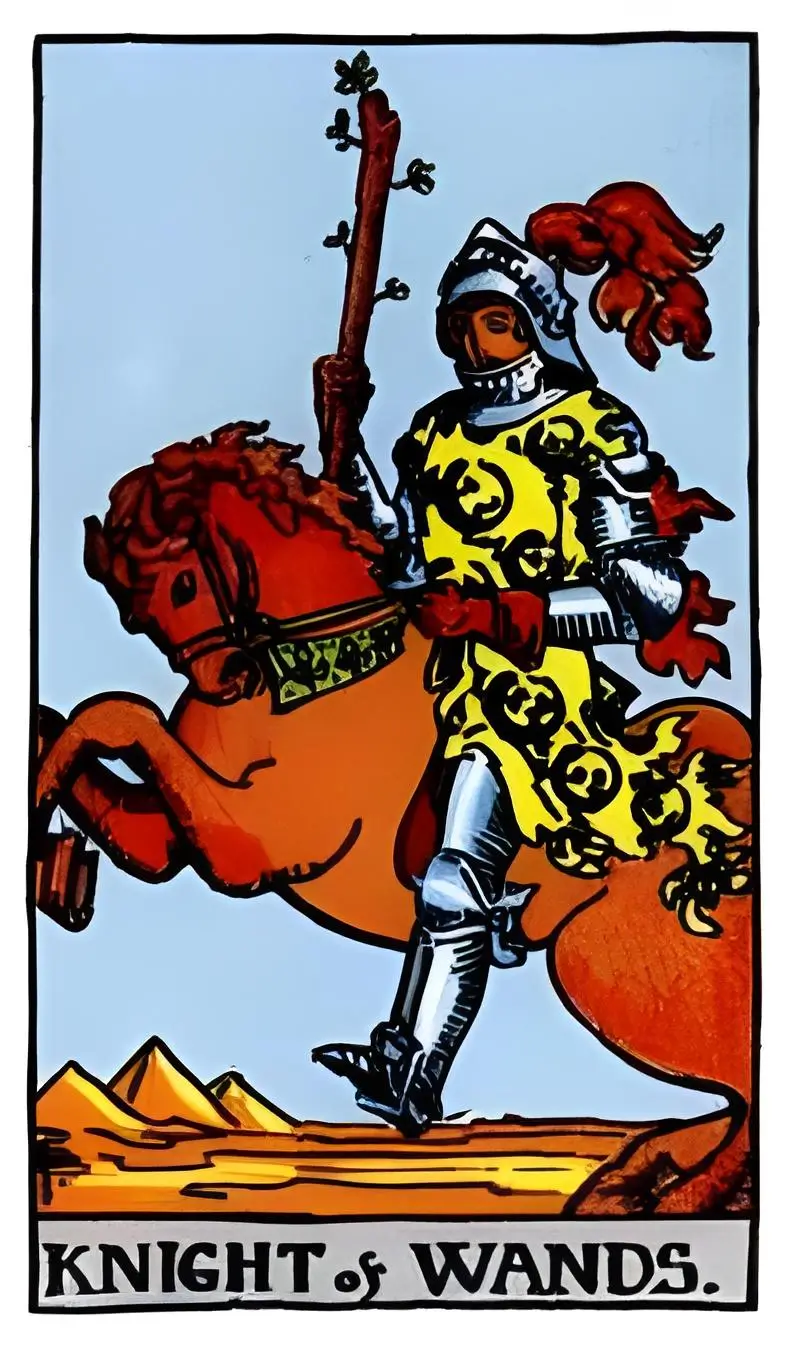
A knight in yellow armour sits a rearing horse, pyramids far off in the desert; a man lies face down on a shore with ten swords in his back under a black sky. The pair asks how fast to move after something has ended.
How the two cards meet
Smith's Ten of Swords lies still on a barren strip of shore: a man face down under a red cape, ten swords set in a line along his spine, flat water behind him and low dark mountains beyond. Above, the sky is black, but a band of gold runs along the horizon. The Knight of Wands could not be less still. His chestnut stallion rears with both forelegs off the ground, his armour burns yellow and orange under streaming red plumes, and the salamanders on his tunic curl without closing into rings.
The Ten is a painful ending, rock bottom, the moment to stop fighting and let a stage close. The Knight is the energy for whatever begins next: bold action, adventure and readiness for rapid change. Air and Fire are on friendly terms, so the Knight can help the querent rise from the Ten's shore. The open question in every state is timing, because a new start taken before the ending is accepted carries the old wound with it.
Combinations are common patterns, not rules
The readings here describe how a pair most often reads. Check each one against two things before you apply it. The first is the question: the same pair says one thing about a relationship and another about a job offer, and the question decides which side of the pair matters. The second is the background, meaning what the querent already knows about the situation, the position each card holds in the spread, and the cards around the pair. When the question or the background points another way, go with them over the general reading. Each pair page lists the exceptions that come up most often.
Four ways the pair can fall
Both upright
Outlook: Mixed Yes or no: Not yetSomething has ended for good, and the Knight is already saddled for a new start; the risk is rushing grief.
A chapter closes with a loss: a job, a relationship, a plan that ran out of road. The upright Ten says stop fighting it, rest and accept the end as fact. The upright Knight brings the readiness for a fresh start, the drive to move and the optimism to try something new, possibly linked to travel. Both are true at once, and order matters. For a single querent after a breakup, the Knight can show someone exciting arriving quickly, and the Ten asks whether the querent has closed the old chapter first. At work, the end of a contract or a gruelling project clears the way for a new direction, and the Knight favours bold steps toward it, while the Ten's money reading warns against risky financial decisions during recovery. The golden band on the Ten's horizon and the Knight's momentum point the same way, toward a new cycle, once the querent has let the old one finish.
Advice
Give the ending a proper close, a last conversation or a final settlement, before you commit to the next big plan.
Knight of Wands upright, Ten of Swords reversed
Outlook: Harmonious Yes or no: Leans yesRecovery after a crisis, carried forward by courage: the querent gets up and rides again.
The darkest hour is behind the querent. The reversed Ten brings survival, slow healing and a return to life after a crisis; the upright Knight adds courage, initiative and the will to start over. Retraining for a new job, finding a fresh way to earn after debt, or launching a project after a failed one all fit here. A relationship that went through serious trials can start to heal as the querent looks plainly at what went wrong, and a single querent regains the confidence to meet someone. Recovery under the reversed Ten is slow and needs patience, so the Knight's speed works best spent on the first decisive steps, with steady effort afterwards.
Advice
Choose the one step that marks your return, a course, an application or a first date, and take it decisively.
Knight of Wands reversed, Ten of Swords upright
Outlook: Challenging Yes or no: NoRecklessness feeds a collapse, and impulsive moves make a painful ending harder to bear.
Impulse speeds the fall. The reversed Knight brings hasty decisions, wasted energy, conflict and broken promises, and the upright Ten is the point where the situation can bear no more. Here the Knight's recklessness is often part of why things ended: an investment made on impulse turns into a serious loss, an overloaded project burns out, a quick passion fades and the relationship breaks under the weight of unkept commitments. Exhaustion runs through both cards, moral and physical. The Ten's counsel is to surrender and recover, and the reversed Knight's is to stop rushing and analyse past mistakes, which means no rebound decisions and no attempts to win everything back in one stroke. Rest comes before any new plan.
Advice
Make no major decision until you have rested, and list the hasty choices that led here so you do not repeat them.
Both reversed
Outlook: Mixed Yes or no: Leans noThe crisis is passing, but clinging on and stop-start effort drag the recovery out.
Recovery is under way, though it keeps stalling. The reversed Ten shows the worst passing alongside an unwillingness to accept the loss: clinging to what ended, old grievances, repeated attempts to avoid the inevitable. The reversed Knight adds delays, postponed plans and indecision, so the querent neither fully lets go nor fully restarts. In love, a relationship after a crisis may keep circling the same hurt, with the querent unsure whether to rebuild or leave. In work and money, the querent knows a fresh direction is needed and keeps putting off the first step, and earlier losses still shape every choice. The reversed Ten says resisting change only increases discomfort, and once the querent accepts the end, the Knight's energy has somewhere to go.
Advice
Decide in plain words what has ended and what you are keeping, then set a date to start the first new task.
When this reading may not apply
The Ten of Swords describes endings, so if the question is about whether to return to a relationship or a job that has already ended, the pair speaks to the querent's recovery and says little about a reunion. If the Knight is read as somebody the querent knows, he shows their experience of someone fast and exciting who appears around an ending; beside the upright Ten, the querent may feel swept along before they have healed. As a card of what lies behind, the Ten shows a crisis already survived and the Knight the energy that came after. In the advice position, the upright Ten tells the querent to stop fighting and rest, and that counsel outranks the Knight's urge to charge.
Frequently asked questions
Latest Posts
Discover the ancient wisdom of tarot cards and unlock the mysteries of your spiritual journey. Our blog is your gateway to understanding the rich symbolism, meanings, and practical applications of tarot reading.




















































