
 EN (English)

The Knight of Wands and the Seven of Swords
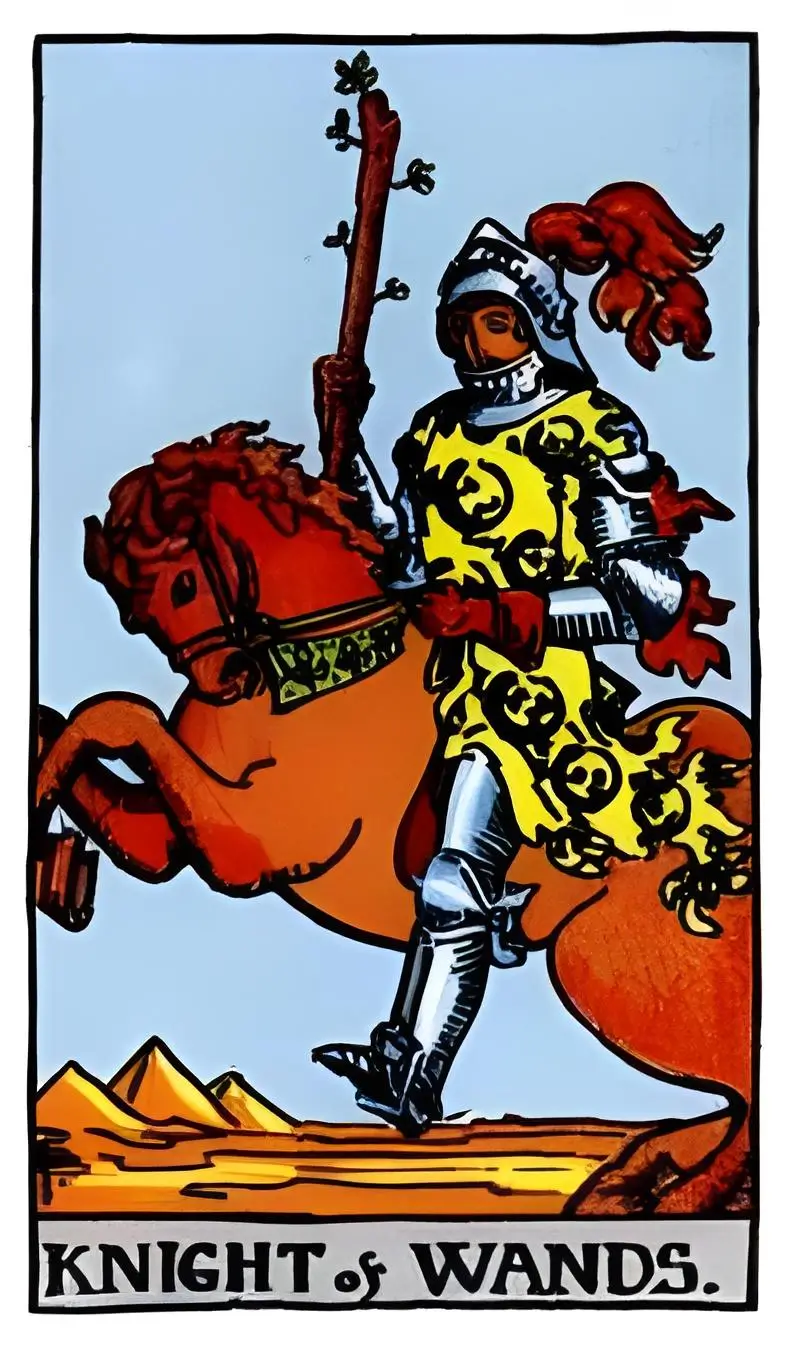
A rider in yellow and orange armour sits a rearing chestnut horse; a man in a fez carries five swords away from a camp where three figures talk, unaware. The pair asks whether a fast move can stay honest when it depends on keeping something quiet.
How the two cards meet
Speed and stealth make an uneasy team. Smith's Knight of Wands sits a chestnut stallion rearing with both front hooves off the ground, red plumes pouring back from his helmet, a leafing wooden wand angled forward like a lance, and on his golden tunic salamanders whose open curves never close. The Seven of Swords is a quieter scene: a man in a polka-dot tunic, a fez and soft red boots edges away from a military camp, five swords bundled against him and held by their bare blades, while he glances back with a half-smile at the two he left standing in the ground. Near the tents, a group of three keeps chatting, unaware of him.
The Knight brings initiative, courage and the urge to act now. The Seven brings strategy, cunning and a plan nobody else sees. Fire and Air are friendly elements, so the Seven's tactics give the Knight's rush a direction; the question in every state is whether that direction stays above board.
Combinations are common patterns, not rules
The readings here describe how a pair most often reads. Check each one against two things before you apply it. The first is the question: the same pair says one thing about a relationship and another about a job offer, and the question decides which side of the pair matters. The second is the background, meaning what the querent already knows about the situation, the position each card holds in the spread, and the cards around the pair. When the question or the background points another way, go with them over the general reading. Each pair page lists the exceptions that come up most often.
Four ways the pair can fall
Both upright
Outlook: Mixed Yes or no: Not yetA bold move works best with a quiet strategy behind it, as long as the shortcut stays honest.
Courage gets a tactician. The upright Knight wants to move decisively and take risks, and the Seven of Swords supplies detours, discretion and an eye for what can be carried off before anyone looks up. Used well, this is ingenuity in a hurry: an unconventional route around an obstacle, a project launched before rivals hear of it. Used badly, it is a venture that is not entirely legal or ethical, pushed through on enthusiasm. A fast romance under these two can carry a secret, a connection kept off the record or one that feels exciting partly because it is hidden, and suspicion grows alongside the attraction. In business, the Knight's rapid financial movement pairs with the Seven's warning about proposals and contracts, so a quick deal deserves a slow reading of the terms. The Seven also asks the querent to observe others' words closely before trusting the momentum.
Advice
Keep your plan confidential if it helps, but check every step of it against the rules before you commit money or a promise.
Knight of Wands upright, Seven of Swords reversed
Outlook: Harmonious Yes or no: Not yetSomething hidden comes to light, and the Knight has the nerve to face it head-on and move on.
Exposure arrives, and with it a jolt of disappointment. The reversed Seven uncovers a scheme, a lie or a story the querent told themselves, and plans may have to change. What helps is the upright Knight's courage: he deals with the revealed facts directly and starts something new instead of hiding from them. A person who learns they were misled in a relationship feels the humiliation, then the Knight's optimism pushes them toward an honest conversation or a fresh start. If the querent kept the secret, this is the moment to come clean and take responsibility. At work, hidden information surfaces and a dishonest arrangement falls apart, and the querent's initiative fills the gap with a cleaner plan.
Advice
Say plainly what you now know to the people it concerns, then put your energy into the plan that still stands once the facts are out.
Knight of Wands reversed, Seven of Swords upright
Outlook: Challenging Yes or no: NoReckless haste reaches for a shortcut, and a hidden scheme rests on poor judgment.
Impulse plus concealment rarely ends well. The reversed Knight loses control: hasty, thoughtless steps, big talk and wasted effort, and the upright Seven offers him a back route around the rules. Capital spent on a poorly considered investment, a corner cut to hide a missed deadline, an arrangement that relies on nobody checking: these are the shapes this state takes in money and work. The Seven warns of deception and fraud around finances, and the Knight's impulsive spending makes the querent easy to mislead. Romantically, the pair describes a connection based on physical attraction and kept secret, intense at first and likely to fade as quickly as it flared, with mistrust setting in on the querent's side. The Seven's better face, close attention to detail, is the only part of this state worth using.
Advice
Stop any deal or arrangement that depends on secrecy, and have one person you trust look over the numbers with you.
Both reversed
Outlook: Challenging Yes or no: NoA rushed plan and a cover story fall apart together, leaving guilt and losses to sort out.
The scheme was badly planned, and now it is out. The reversed Seven brings exposure, failed deception and the fear of being found out, and the reversed Knight explains the failure: impulsiveness, scattered energy and no follow-through. Quickly earned money is quickly lost, and an inadequately developed plan collapses under its first test. For a couple, a hidden flirtation or a broken promise surfaces, and the quick passion behind it gives way to conflict and a sense of loss. Someone single may realise they talked themselves into a story that never matched the facts. At work, missed details and a rushed launch get noticed, and responsibility cannot be passed to anyone else. The reversed Seven still allows that disappointment like this can feed long-term growth, provided the querent studies how the mistake happened rather than reaching for a new scheme.
Advice
Own your share of what went wrong in a direct conversation, then make a realistic plan before you try again.
When this reading may not apply
In a question about fidelity, readers of the Knight take the Seven of Swords beside him as a sign that something is being kept hidden. From the querent's side, it describes a growing sense that the full story is missing, and the useful step is to verify what can be verified before acting on suspicion. Read as someone in the querent's life, the Knight shows how that person feels to them: fast, exciting and hard to pin down. When the querent is the one keeping a secret, the reversed Seven describes their own exposure. As advice, the upright Seven can mean strategic discretion, which is not the same as deceit.
Frequently asked questions
Latest Posts
Discover the ancient wisdom of tarot cards and unlock the mysteries of your spiritual journey. Our blog is your gateway to understanding the rich symbolism, meanings, and practical applications of tarot reading.




















































