
 EN (English)


Minor Arcana · Cups (Water)
King of Cups
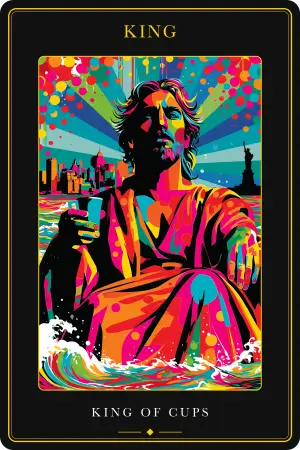
A crownless king sits in the New York harbor, robes soaked to the waist, waves breaking white against his knees, raising a blue coffee cup with a loose hand and completely unbothered.
Card at a glance
- Numerology
- King
- Element
- Water
- Astrology
- Late Libra to mid-Scorpio (Air of Water)
- Kabbalistic path
- Chokmah in Briah (Wisdom)
- Timing
- Late October to late November
- Yes / No
- Upright yes · Reversed no
Upright
Emotional maturity
Composure
Counsel
Diplomacy
Quiet authority
Compassion with boundaries
Reliability
Steadiness under pressure
Reversed
Emotional withdrawal
Coldness as control
Manipulation
Suppressed feeling
Unavailability
Caretaker burnout
Passive aggression
Numbness
King of Cups in each deck
Every deck reimagines the same archetype. Compare the art, then open a deck to read its full interpretation.
Imagery and symbolism
In the Tarot of New York City the King of Cups gives up his throne entirely. Instead of the Rider-Waite monarch perched dry on a stone seat above the surf, this King sits directly in the water of the harbor, robes soaked to the waist, waves breaking white against his knees, and he is completely unbothered. That is the whole argument of the card made visible. He does not rule the water by staying out of it. He feels everything and is run by none of it.
In his raised hand he holds the deck's signature vessel, the blue Greek 'We Are Happy To Serve You' paper coffee cup that stands for the entire suit of Cups. Where the RWS King grips a golden chalice, here the chalice is a two-dollar coffee, because in this city emotional life is not ceremonial. It is daily, and it gets handed across a bodega counter every morning. He holds the cup lightly, without gripping. Mastery, the image says, is a loose hand.
His face turns slightly upward, calm and almost amused, the look of a man who has already heard the worst news the city has to offer and stayed in his seat. His hair and beard hang loose and unroyal. His robes are a riot of pop-art color, pink and orange and teal and gold, rendered in the deck's saturated color blocks held inside a black silhouette outline. The black outline is his composure. The colors packed inside it are everything he feels.
Behind him rise the two poles of his realm: the black cut-out of the Lower Manhattan skyline on one side, the Statue of Liberty on the other. The city of eight million crises stands opposite the harbor figure who greets whatever arrives by water, and he sits between them in the water they share, exactly where the grid of reason meets the element of feeling. A sunburst of rays fans out behind his head as the deck's pop-art halo. His authority is radiant but informal, worn like weather rather than a crown. He wears no crown at all.
Halftone dots rain down through the sky, the deck's recurring texture read here as spray, confetti, and static at once, the constant emotional noise of the city. It falls all around him and none of it lands on his expression. The waves at the bottom of the frame are the roughest thing in the image, curling and breaking in foam. The water is agitated on purpose. The card never pretends the feelings are small, so his stillness is an achievement rather than a temperament.
Core meaning
The King of Cups is the calm at the center of everyone else's crisis. He is the counselor, the steady one, the person the whole building calls when it falls apart, and his mastery is not the absence of feeling but the government of it. As the King of his suit he holds the highest, most externalized command of Water: he takes the fluid, boundless, sometimes overwhelming stuff of emotion and applies conscious will and directed action to it, so that he can lead others through an emotional storm without losing his own footing in it.
In this deck the whole point sits in the posture. He is in the harbor, not beside it, and still no wave moves him. When the King of Cups turns up, the situation asks for exactly that presence. Something charged is moving through your life, a hard conversation, a person in distress, a decision with feelings on every side, and the card says it will be decided by who stays steadiest rather than who argues loudest.
He often marks a season of emotional maturity in your relationships, the point where you become, or are held by, the person others can bring the worst news to. He can also signal a stabilizing figure walking into the situation: a mentor, an older friend, a therapist, a partner who does not flinch. What he asks of you is tact, patience, generosity, and a long memory of what people are actually like, all of which will carry you further here than cleverness or speed.
Upright meaning
Upright, the King of Cups asks you to feel the full weight of what is happening and then answer from clarity rather than from the wave. Be the one who lowers the temperature of the room. Have the difficult conversation with warmth and without cruelty, because in this city everyone is carrying something and gentleness is not weakness. Offer help before it is asked for, and accept that presence is often worth more than solutions. Say the true thing, calmly, and if a steady, experienced person offers you guidance now, take it.
In love it describes a partner, or a stage of a relationship, where feelings run deep and get handled well. This is someone who can hear 'we need to talk' without vanishing for three days, who holds you through the bad week without keeping score, who fights fair and repairs fast. It often marks a relationship settling into its lasting strength, past the audition phase and into the years where love looks like showing up. For anyone searching, it points toward the steady one over the spectacular one, the person whose love is a harbor rather than a wave.
In career it counsels the mantle of the compassionate leader, the mediator, the diplomat. Progress comes through the sensitive navigation of team morale and interpersonal dynamics, not through aggressive expansion or cold calculation. Your composure is currently your strength and likely your path upward, because people get promoted toward the rooms they can keep calm. The card can mark a mentor at work whose door is genuinely open, or a period when your steadiness earns visible trust: the sensitive project, the difficult client, the team nobody else could hold together.
In finances it is the opposite of the hot tip and the fast flip. It represents financial maturity, the person who has lived through a crash and a rent hike and manages money the way he manages feelings, calmly and from experience. Upright it points to stability and quiet prosperity, decisions made on a long horizon, patient strategies like the retirement account over the meme stock. It often signals generosity too, money used to steady the people around you, the friend spotted for rent, the check picked up without ceremony.
In health it stands for the settled, sustainable relationship with yourself that the city's extremes make rare. Not the crash diet or the 5am bootcamp phase but the steady middle: regular sleep, water, walking the thirty blocks, a routine kept because it feels good. It describes maturity in self-care, knowing your body's signals and answering them, resting before the collapse rather than after. Tend the body the way he holds the cup, attentively and without gripping.
Reversed meaning
Reversed, the King of Cups shows the shadow side of the steady one. The calm has become a wall, or it was never calm at all, only control. The situation may involve someone who uses emotional insight to manage and manipulate rather than to connect, who knows exactly what you feel and presses it. Or it may be you, holding everyone up for so long that resentment has pooled under the surface and comes out sideways as sarcasm, coldness, the drink after work that became three. Stop performing composure and check what is actually underneath it. If numbness has replaced calm, that is a warning light, not mastery.
In love it is the harbor with a locked gate: the partner who is charming in public and unreachable at home, who never raises his voice and never opens up either, whose calm you slowly recognize as distance in a nicer coat. It can point to manipulation, a partner who knows your soft spots intimately and works them in arguments, whose apologies are strategies. It can also mark the caretaker dynamic gone stale, one person permanently cast as the steady one until their love has quietly become exhaustion.
In work and business it warns that feeling and judgment have tangled at the top. The leader's calm may be a performance, conflict-avoidant and unreadable, letting problems fester because addressing them means an uncomfortable conversation. Or the emotional intelligence has turned instrumental: charm used on clients, guilt used on staff, loyalty invoked whenever raises come up. Watch too for the classic New York burnout, the employee who has absorbed every crisis and is now running on numbness, one bad Tuesday from quitting on the spot.
In finances the link between feelings and money has come loose. This is emotional spending in its city forms, the retail therapy after the bad week, the fourth delivery order because cooking felt like too much, the lifestyle kept up to avoid feeling behind. It can flag avoidance, the credit-card balance you have stopped looking at, the money talk perpetually postponed with a partner.
In health it points to feelings landing in the body unacknowledged, the local specialty of wearing stress somatically while insisting everything is fine: emotional eating, sleep sacrificed to the scroll, the after-work drinks quietly becoming the main coping system. The counsel throughout is the upright King's own medicine taken honestly. Name the feeling before it names itself in an ugly way, have the conversation you have been steering around, and find the person or place where you finally get to fall apart.
Historical notes
The King the New York deck restages descends directly from the earliest Italian Renaissance decks, long before the occult overlays. He first coalesced in the lavish hand-painted trionfi cards of fifteenth-century Milan, the Visconti di Modrone, the Brambilla, and the Visconti-Sforza, where the King of Cups, called the Roi de Coupe in the French line, was simply a monarch holding a large chalice with none of the astrological or Kabbalistic machinery that would later define him. Early decks were fluid: in the reconstructed Charles VI deck the image now used for the King of Cups was originally meant for the King of Coins.
As the Tarot moved to France and went to woodblock print, the Tarot de Marseille fixed his iconography for a wider public. There he is often shown in profile, facing the sun and raising his cup as if receiving celestial light, his gaze drifting slightly left, a cue later occultists read as the pull of the unconscious. That gesture of lifting the cup toward the light became the act of receiving divine or subconscious illumination.
His migration into the ordinary 52-card deck produced one of the strangest artifacts in playing-card history. The suit of Cups became Hearts and the King of Cups became the King of Hearts, nicknamed the 'Suicide King' for the sword that appears to pass through his own head. That violent image is an accident of copy degradation: the early Rouen pattern showed him wielding a battle-axe raised behind his head, and over decades of worn printing blocks the axe-head vanished and the handle merged with a sword hilt. The mishap has been read back into the card ever since as a symbol of the heavy burden that comes with deep empathy. Arthur Edward Waite and Pamela Colman Smith drew the modern serene King in 1909, keeping the Marseille court titles of Page, Knight, Queen, and King while building on the Golden Dawn's underlying scheme.
Correspondences
Rank. King, the highest and most externalized command of the suit. Where the Queen of Cups internalizes and absorbs feeling as the deep ocean, the King externalizes it, building structures and boundaries from emotional intelligence. If the Queen is the ocean, the King is the seawall and the lighthouse.
Astrology. This deck keeps the Golden Dawn attribution of the King to the third decan of Libra and the first two decans of Scorpio, roughly late October through late November. Libra gives him his diplomacy, the tact of a man who has kept the peace in a crowded building for years. Scorpio, the fixed water sign, gives him his depth, secrecy, and transformation, feeling that runs far below the visible surface. His planetary rulers are Pluto, lord of everything that happens below street level, and Neptune, god of the sea and the harbor fog. In the natural horoscope his home is the Eighth House of shared resources, crisis, and transformation, which suits a King whose specialty is other people's worst moments.
Element. Water, the suit's element, here the moving water of the New York harbor, the tidal East River, the currents under every bridge. As a King he combines the intellectual Air of his rank with that Water, mind presiding over feeling, the ferry captain reading the current rather than fighting it.
Kabbalah. Chokmah, the second sphere on the Tree of Life, Wisdom and the primal active thrust of creation, expressed through Briah, the Qabalistic world of Water. He is therefore the initiating, driving force within the emotional and intuitive realm.
Elemental dignity. As Air of Water he applies clear intellect to the opaque realm of dreams and intuition, the archetype of the counselor and the psychoanalyst who observes his own feelings rather than being swept by them. Balanced, this produces a stabilizing presence. Unbalanced, the same Air-over-Water can cool into detachment, intellect used to avoid genuine intimacy.
Psychological perspective
Psychologically the King of Cups is the zenith of emotional maturity, the figure who applies conscious structure to the chaotic realm of the unconscious. He does not repress his trauma or wall it off with asceticism. He dredges the darkest depths of the subconscious on purpose, accesses painful memory, processes lingering resentment, and comes back with a stable, objective understanding of his own psychological architecture. Emotions, for him, are a valuable source of raw power precisely because they are analyzed rather than merely reacted to.
The New York image stages this as a man sitting in agitated surf with an unchanged face. He is not asked to be unmoved, since he sits in the water rather than above it. He is asked not to be swept. The developmental task the card describes is to let each wave arrive, let it pass through, and answer from the still water underneath.
The shadow is close to the light. Because the King has such command over emotion, his broken form knows exactly how to weaponize it, using feigned vulnerability and mapped weaknesses to steer people rather than connect with them. The subtler failure is his own: the caretaker who holds everyone up until composure hardens into a wall and calm curdles into numbness. Modern readers sort him cleanly into two tropes, the therapist and safe harbor when upright, the master manipulator and depleted martyr when reversed. Both live in the same person, and the difference between them is whether the insight is turned toward connection or toward use.
The King of Cups across decks
The King of Cups is drawn to a different emphasis in every tradition. In the Rider-Waite-Smith deck he sits on a heavy stone throne that floats on a stormy sea, insulated from the churning water by the earthly structure beneath him, a golden cape of conscious fire over a blue tunic of intuitive water, a scepter of authority in one hand and a chalice in the other, with a ship and a leaping fish behind him for purposeful navigation and the sudden surfacing of the unconscious. In the Tarot de Marseille he is a monarch in profile raising his cup toward the sun, blending temporal power with a mystic's receptivity.
Crowley and Frieda Harris's Thoth deck names him differently and paints the Air-of-Water Prince, or the Fire-of-Water Knight, as an ephemeral warrior in armor that looks grown rather than forged, an eagle on his helm, riding a chariot across a watery expanse in a Grail quest for ultimate emotional truth. Modern decks expand the semiotics further: the Sun and Moon Tarot gives him the Holy Grail and a white horse for the mental strength needed to govern the passions, and the Infinite Visions Tarot dresses the court in sea-green before a pounding ocean with instruments ready to play, standing for the music in their souls.
The Tarot of New York City keeps every one of those functions and swaps the objects for the city's own. The stone throne is gone entirely and the King sits in the harbor itself. The golden chalice becomes the blue Greek coffee cup, the stormy sea becomes the tidal water where the skyline meets the Statue of Liberty, and the ship and fish become the halftone spray of the city's constant noise. Under all of it sits the same mandate: chart the deepest water rather than drown in it, and lead yourself and others back to shore.
In combination and context
The King of Cups takes much of his reading from his neighbors and his position in the spread. Beside grounded, practical cards his composure becomes something usable, steady leadership that actually builds. Beside heavy or anxious cards, or reversed by ill-dignified company, his calm can read as avoidance, the serene surface over a room quietly drowning. In readings about infidelity the reversed King alongside the Seven of Swords, the Three of Swords, the Moon, or the Devil sharpens into a specific warning about sophisticated emotional manipulation.
He also shows psychological progression when he sits near other Cups. Against the stagnation of the Four of Cups, where a figure ignores the cups in front of him, the King is the desired end of the road, the same emotions witnessed, understood, and put to use rather than refused. Against the youthful mutual spark of the Two of Cups he marks the deeper, self-aware love that comes later, the difference between fleeting infatuation and a partner you bring your worst news to.
Position sharpens him further. In an advice slot he counsels the diplomat's path, warmth first and honesty right behind it, no cruelty anywhere. As a significator he points to the stabilizing figure at the center of the situation, the one who administers the estate, sits with the grieving family, and holds the joint account steady. As an outcome he promises that the matter settles through steadiness, and that the person who kept their judgment clear of the daily storms is the one still standing when the water settles.
Questions for reflection
- Where in my life am I already the one who gets called at 3am, and who do I get to call when the water rises around me?
- When the next wave arrives today, a sharp email, a friend's bad news, a decision full of feeling, can I let it pass through before I answer instead of answering from inside it?
- Is the calm I am keeping right now real steadiness, or is it a wall I have built to avoid a conversation I know is overdue?
The general meaning follows the Rider-Waite-Smith reading — the reference used across Tarot Academy. Open a specific deck above for its own interpretation.
Frequently asked questions
Explore the Tarot
Latest Posts
Discover the ancient wisdom of tarot cards and unlock the mysteries of your spiritual journey. Our blog is your gateway to understanding the rich symbolism, meanings, and practical applications of tarot reading.




















































