
 EN (English)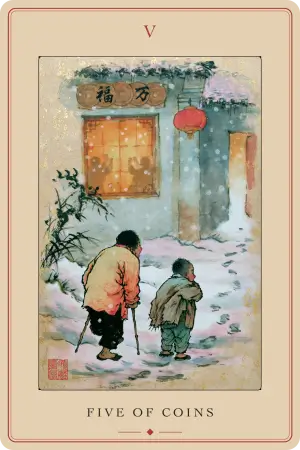


Minor Arcana ·
Six of Coins
Fairness weighed on the same scale as trade: a cloth merchant sits down to eye level and lets two street children watch the copper cash come out even.
Card at a glance
- Numerology
- 6
- Element
- Earth
- Astrology
- Moon in Taurus · second decan (May 1–10)
- Kabbalistic path
- Tiphareth (Beauty)
- Timing
- Late spring · Taurus II · May 1–10
- Yes / No
- Upright yes · Reversed no
Upright
fair exchange
generosity
reciprocity
mutual aid
measured giving
transparency
patronage
receiving with dignity
Reversed
imbalance
strings attached
ingratitude
one-sided giving
a rigged scale
dependence
hoarding
debts unpaid
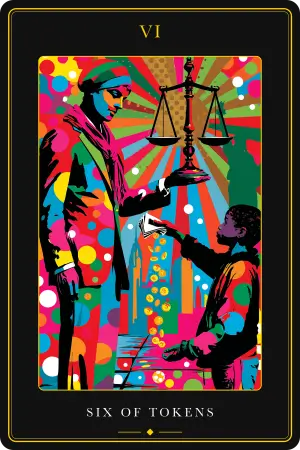
Six of Coins in each deck
Every deck reimagines the same archetype. Compare the art, then open a deck to read its full interpretation.
Imagery and symbolism
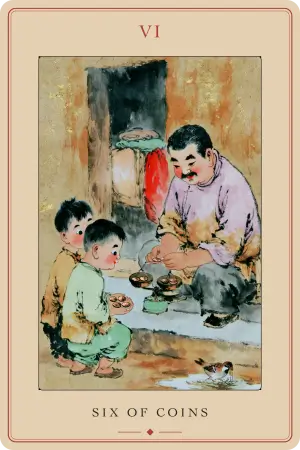
In the Tarot of Beijing the Six of Coins is not an almsgiver standing over the poor. It is a cloth merchant seated on the step of his own shop, and before him two street children. In his raised hand he holds copper coins over a small balance scale, and on each pan sit coins already weighed. The younger child cups an open palmful, his share received, while the elder watches the next weighing. The classic donor stood tall. This merchant sits, bringing his eyes level with the children's, so charity here does not descend from a height. That is the deck's first quiet revision.
The scale is the heart of the card. It is not a special instrument reserved for good deeds but the merchant's own trade scale, the one he uses for cloth and cash all day. In this lane charity is weighed on the same balance as commerce, and that is exactly why it is trusted. Fairness is the daily habit of an honest shop, extended to those who have nothing to trade without a change of tools.
The children watch the balance point closely, and the merchant lets them. This mutual watching is the card's engine: transparency is what turns almsgiving into an exchange between equals. The children are rosy-cheeked and alert rather than wretched, because receiving openly and attentively is drawn here as a dignity, not a shame.
The coins are the square-holed copper cash of the suit, heaven round and earth square, opportunity cut exactly to the size of a coin. They are small denominations. This is not a fortune changing hands but the small, regular circulation that keeps a street alive. Behind the merchant the dark doorway of his shop holds folded bolts of cloth, one of them deep red: his stock and his earned surplus, the full shelf from which giving becomes possible. In the lower corner a sparrow drinks at a puddle of rainwater, the smallest creature of the lane taking its share of what the sky handed out for free. The warm kraft paper is flecked with gold, the ink washes are muted with single accents of red, and a red seal marks the scene like a merchant's chop on an honest transaction.
Core meaning
The Six of Coins is Beijing's Six of Pentacles, the card of exchange, distribution, and support. Its deck-specific accent is transparency: resources move from one hand to another, and they move where everyone can see the balance point. A reward arrives, a debt is repaid, a patron appears, help is offered or asked for. The card marks the moment when generosity circulates and creates more than it spends.
What the deck adds to the archetype is the merchant's posture. He does not give from above. He sits down to the children's level and lets them watch the weighing, so help given openly creates no shame and help received openly creates no servility. The older tradition often reads a hidden power dynamic into the giver's scale, the sense that he judges who is worthy. This lane resolves that in daylight. The scale is not a way to rank the needy but a way to prove the share is fair. You will usually find yourself on one pan or the other, as the one with surplus or the one in need, and the card asks only that the weighing be honest either way.
Upright meaning
Upright, the Six of Coins signifies fair exchange and the healthy circulation of resources. Something is moving toward balance: money, time, knowledge, or attention passing between people in shares both experience as fair. If your shelves are stocked, this is the time to let some of it circulate, measured and at eye level, without theater and without expecting bows. If you are the one in need, receive with your dignity intact, because accepting fair help is participation in the lane's circulation, not a debt of the soul.
In love. Care shown as daily reciprocity, the pot that never empties because someone always refills it. Attention, tenderness, and practical help move both ways in fair shares. One partner may currently give more, but at eye level, without buying power over the other, the way the merchant sits to weigh rather than tossing coins from a height.
In career. Contribution weighed honestly. Recognition, a bonus, or a raise arrives on merit, and mentorship runs strongly, whether a senior shares the trade with you or your own turn comes to teach an apprentice. Help circulates through the team without a bitter ledger. State your contribution plainly and credit others precisely.
In finances. Money moves, and moves honestly: a debt repaid, support from family or community, invested funds returning, or steady earnings that satisfy morally as well as materially. Arrangements go well now precisely when they are conducted like the merchant's weighing, with fair prices, honest accounting, and clearly agreed shares. Measured giving is favored, and so is asking for help without shame.
In health. The fair scale turned on yourself: nourishment, movement, and rest in even shares, no pan left empty. A considerate regimen serves better than a heroic one, and receiving bodily care from others, a doctor, a relative's cooking, a training partner, is part of the card's teaching. The body flourishes on modest, regular provision the way the sparrow flourishes on the puddle.
Reversed meaning
Reversed, the merchant's scale tips or the shop shutter comes down. The card speaks of imbalance in giving and receiving: one pan heavier than the other, and everyone watching while pretending not to see. It can show charity performed for an audience, help with strings knotted to the wrist, a patron who feeds dependence, or a receiver who has stopped saying thank you. Often it means you give and give while the pot is never refilled on your side, or that a gift has arrived with hooks in it.
In love. An unequal exchange at the heart of the bond. One partner invests time, feeling, and money while the other receives with little return, or generosity has become currency for control: gifts that must be repaid in obedience, a ledger of kindnesses produced during every quarrel. Sometimes it is pride on the other pan, a partner too proud to receive, leaving an open hand hanging.
In career. A tilted scale at work. You may carry a disproportionate share of the load while the credit lands on someone else's pan, or watch recognition given for show rather than merit. A boss's flexibility and small favors can turn out to be a leash that makes fair pay unnecessary. Weigh in plain numbers what you give and what you get, then either restore the balance where you are or take your trade to a more honest shop.
In finances. A rigged or tilted scale: unequal exchange, one-sided use of funds, or support that costs more than a loan. Expected help may arrive late or short, gifts may be used as leverage, and accounts between partners or family may not be honest. The opposite failure also shows here, giving beyond your means until your own shelves are bare. Bring every arrangement back into daylight before trust, the lane's real currency, is spent.
In health. A tilted scale in self-care. One pan is overloaded and the other empty: obsessive attention to diet or training while sleep and rest go unfunded, or every resource spent on others while your own body waits outside the shop like an uncounted child. Weigh what you demand of the body against what you give it, and accept care from others without guilt.
Historical notes
The image the modern card inherits comes from the 1909 Rider–Waite–Smith deck, where a well-dressed man Waite described as being in the 'guise of a merchant' dispenses coins to two kneeling beggars while holding a pair of scales in his other hand. The Hermetic Order of the Golden Dawn had already titled the card the Lord of Material Success, a name for prosperity and tangible reward. Pamela Colman Smith drew a heavy horizontal line across the background, one of fourteen such 'stage cards' in the deck, which casts the whole charitable scene as a performance and lets readers ask whether the giving is sincere. A small red square in the kneeling beggar's pocket, read by some as a theater ticket and by others as a tarot card, deepens Waite's hint that everything is not as it seems.
The Tarot of Beijing keeps the merchant and the scale but removes the suspicion. It seats the giver at the children's level, makes his trade scale the guarantee of fairness rather than an instrument of judgment, and depicts the children as alert participants rather than supplicants forced to their knees. The Golden Dawn's material success survives, but the deck relocates it from a staged tableau to the ordinary daylight of a hutong lane, where the visible balance point is what earns trust.
Correspondences
Number. Six, the number of harmony, balance, and responsibility, drawn here as the two pans of the merchant's hand scale finding their level. In the Chinese ear it is auspicious: 六 (liù) echoes 流 (liú), 'to flow,' and the blessing 六六大顺 wishes sixes all the way, everything moving smoothly, which is exactly the state the card depicts. The six follows the Five of Coins, two beggars in the snow outside a teahouse whose door they cannot find, and it is what happens when the door is found: scarcity met by measured, dignified sharing.
Astrology. The Moon in Taurus, ruling the second decan of Taurus, roughly May 1 to 10. Taurus gives the slow, patient accumulation of the cloth shop, wealth built coin by coin the way a wall is built brick by brick. The Moon adds intuition and the instinct for need. It is the Moon that makes the merchant look up from his cloth and know, without a word, which share is fair. In traditional astrology the Moon is exalted in Taurus, its restless emotion steadied by solid earth, which the older sources read as the emotional realization of material security.
Element. Earth, in this deck the packed clay of the lane, the brick of the shop step, the copper of the square-holed coin. Earth speaks of stability and material well-being: the merchant can give because his shelves are stocked, and his shelves are stocked because he has been exact for years.
Tree of Life. The sixes correspond to Tiphareth, the sphere of beauty, harmony, and balance at the heart of the Tree. In the suit of Coins that harmony filters down into the physical world as material success and the fair balancing of external resources.
Psychological perspective
The person of this card is prosperous enough to give and honest enough to give exactly. Their generosity has the character of craft rather than gesture: measured, reliable, repeated daily, done at eye level with whoever is receiving. They are the neighbors who lend without reminding and the shopkeepers whose scale has never lied, and they carry a steady sense of duty to the street they live on, served without any appetite for recognition. Their kindness does not humiliate, because it is exact.
The shadow appears on either pan of the scale. On one side is the martyr who gives past the point of depletion, tying self-worth to usefulness and emptying his own shelves to be needed. On the other is the person who cannot receive at all, blocking help out of pride or an old fear of looking weak, standing outside the shop pretending not to be hungry while the scale sits ready inside. The card's psychological instruction is that receiving gracefully matters as much as giving generously, and that refusing either one breaks the circuit and guarantees stagnation.
Six of Coins across decks
Rider–Waite–Smith. The canonical Six of Pentacles shows a standing merchant weighing coins for two kneeling beggars, a scene many readers treat with suspicion because of its stage line and the hidden red ticket. The Six of Coins keeps the merchant and the scale but seats him level with the children and drops the suspicion, making transparency the whole point.
Tarot de Marseille. The older pip cards show six coins in an ordered arrangement with no human drama, the meaning carried by number and suit alone. Beijing restores a human scene but keeps that plain arithmetic underneath: six coins, two pans, one fair division.
Crowley–Thoth. Crowley strips away the figures entirely and titles his Six of Disks 'Success,' arranging the disks to the geomantic figure Populus, 'the people,' around the sun-sphere of Tiphareth, so wealth radiates outward to a community. The Beijing card reaches the same communal idea through the small circulation of a single lane rather than through sacred geometry.
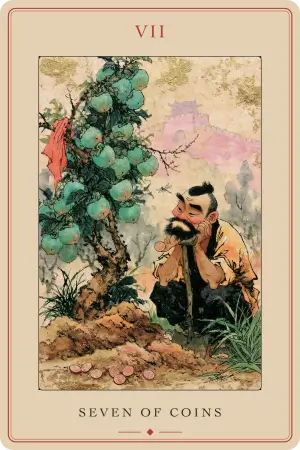
Modern reframings. Decks such as The Wild Unknown drop the power dynamic for natural law, showing a flourishing branch heavy with six fruit and the message that what goes around comes back. The Tarot of Beijing belongs to that movement, mirroring the human weighing with a sparrow at a rain puddle, nature's own version of giving that asks for nothing.
In combination and context
The Six of Coins colors a spread with exchange and asks which pan you are standing on. Near the Five of Coins, its own predecessor, it is the door finally found, the lane's measured answer to the snow. Beside a card of authority such as The Old Man on Jingshan, watch for a power imbalance in the giving, generosity used to set terms rather than to help. With cups and cards of partnership it reads as genuine mutual support, care that flows both ways without a scorecard.
Position matters as much as neighbors. In a 'what to let go of' seat the card turns from description into instruction: stop pouring resources into people who never refill your pan, and restore your own stability before trying to save anyone else. In a money or work seat it favors fair prices, honest accounting, mentorship, and help asked for without shame. The card reversed, or reversed neighbors around it, shift all of this toward the tilted scale of strings, dependence, and ledgers kept in secret.
When the Six of Coins keeps returning, treat it as a request to audit one exchange in the open. Name what you give and what you receive, thank precisely, repay concretely, and let the whole lane see the balance point.
Questions for reflection
- Which of your exchanges would survive being weighed in the open, and which one are you keeping off the scale?
- Are you standing on the giving pan or the receiving one right now, and are you doing that role with your dignity intact?
- Where have you been refilling someone else's pot while your own is never topped up, and what would it take to say so aloud?
The general meaning follows the Rider-Waite-Smith reading — the reference used across Tarot Academy. Open a specific deck above for its own interpretation.
Frequently asked questions
Explore the Tarot
Latest Posts
Discover the ancient wisdom of tarot cards and unlock the mysteries of your spiritual journey. Our blog is your gateway to understanding the rich symbolism, meanings, and practical applications of tarot reading.




















































