
 EN (English)


Minor Arcana ·
Seven of Coins
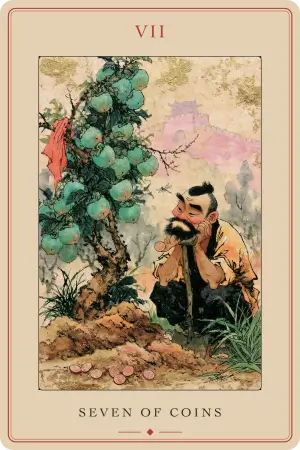
The pause in the middle of long work: a grower leans on his hoe and watches a persimmon tree that is heavy, green, and not yet ripe.
Card at a glance
- Numerology
- 7
- Element
- Earth
- Astrology
- Saturn in Taurus · third decan (May 11 to 20)
- Kabbalistic path
- Netzach (Victory) in Assiyah
- Timing
- Late spring sowing · autumn harvest
- Yes / No
- Not yet · yes if you can wait
Upright
patience
long-term investment
honest assessment
perseverance
tending
compounding growth
faith in the process
the strategic pause
Reversed
impatience
sunk cost
scattered effort
quitting before harvest
forcing results
anxiety over slow returns
disorganization
watering a dead tree
Seven of Coins in each deck
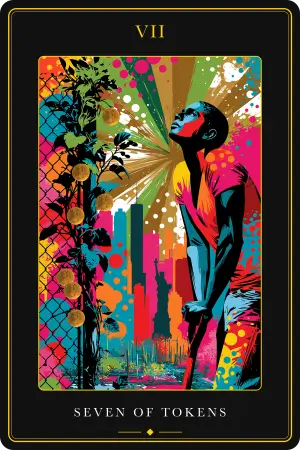
Every deck reimagines the same archetype. Compare the art, then open a deck to read its full interpretation.
Imagery and symbolism
In the Tarot of Beijing the Seven of Coins is a grower outside the city wall. A bearded man crouches beside his persimmon tree, both hands folded on the head of his hoe and his chin resting on his hands, in the classic posture of work paused. The blade of the hoe is sunk in the freshly turned earth. His labor is done for the day, and the picture holds the exact moment after effort and before reward.
The tree is heavy with persimmons, and every one of them is still green, only faintly flushed with the orange to come. This is the card's central statement: the harvest is real, visible, countable, and not yet ready. Nothing in the grower's power can turn the fruit; only the season can. His half-closed eyes and small smile show that he knows this and has made his peace with it.
Six coins lie on the turned earth at the roots of the tree, and the seventh he holds in his fingers near his chin. In this deck the coins are square-holed copper cash, and the buried six are his investments: seasons of work, money, and care committed to ground where no passerby can see them. The seventh coin, still in hand, is the choice the card leaves open. It can join the others at the roots or be kept back, because investment is always a decision.
Smaller signs fix the meaning. A red cloth is tied to one branch, a wish knotted onto the growing thing. A single dragonfly hangs in the air above the grower, and a dragonfly lives one season while a persimmon tree fruits for a hundred years, so the man between them has to think in both spans at once. Far off, washed pale rose by morning haze, rises a gate tower of the city wall, the place where coins are spent and quick fortunes chased. The grower has put that wall between himself and that speed on purpose. Gold leaf flecks the sky like late afternoon light, and the small red seal sits in the corner as it does on every card of the deck.
Core meaning
The Seven of Coins is the deck's card of the long middle: the stretch of a project, a course of study, a savings plan, or a slow relationship when the effort is fully invested and the return has not yet come in. The groundwork is done, the growth is visible, and the harvest is weeks or seasons away. It is a time of tending rather than reaping, and of honest stocktaking, standing back to see whether what you planted is actually growing.
Where the canonical Seven of Pentacles can tip into anxiety or outright failure, the Beijing grower has settled the question in his own posture. He has done everything a man can do for a tree, and the rest belongs to autumn. The card's counsel follows from that: keep watering what you planted, resist forcing a result that only time can finish, and use the pause to count what has grown and adjust your care rather than your goal. Delays here are not failure. They are the ordinary speed of real things, and autumn in Beijing has never once failed to arrive.
Upright meaning
Upright, the card confirms you are in the right orchard at the green-persimmon stage. The work is sound, the growth is genuine, and the correct strategy is continued steady tending rather than dramatic gestures. Do not pick green fruit. Step back the way the grower leans on his hoe, ask honestly what has actually grown this year, and let the answer guide the next season's effort. Everything within your power is done or nearly done, and what remains is the season's business.
In love. A bond that deepens slowly, courtship measured in seasons, or a long relationship in a quiet stretch of building. The tree is healthy and the fruit is heavy, so the task is the grower's patience: let feeling ripen at its own speed and favor the slow proofs of love, reliability and small daily care and plans kept, over grand declarations. The buried coins are the invisible investments of attention and forgiveness, and they are compounding.
In career. The long middle of a job or project, where effort is constant and recognition has not yet ripened. Your results hang on the branch in plain sight, real and countable but green: the promotion not yet announced, the skill not yet mastered. It often marks training or study undertaken for a future position, the classic buried coin. Recognition here comes late but comes solid.
In finances. The card of buried capital. Your money is committed and working, in savings, in a business still building, in education that has not yet raised your income. The placement is sound and the return is not due yet. It favors long-term instruments over quick trades and steady accumulation over windfalls. The seventh coin in hand is today's question, whether to commit one more portion to the long plan or hold it liquid, and either answer can be right if you decide it deliberately.
In health. Training at the green-fruit stage. The workouts are done, the diet is held, and the mirror has not caught up yet, because bodies remodel at the pace of seasons rather than weeks. The card confirms your method is working and favors the buried coins of the body, sleep and mobility work and the boring foundations. Measure real progress in performance and habit rather than by daily glances.
Reversed meaning
Reversed, the grower cannot bear the waiting. He shakes the branch, or digs up his buried coins to make sure they are still there, or walks away from the orchard a month before the persimmons turn. The card points to impatience that spoils long work: abandoning a project close to completion, pulling money from a sound investment at the worst moment, quitting a course of study in its dullest stretch. It can also mark the opposite error, tending something that will never fruit and refusing to admit it. First determine which grower you are. If the tree is healthy and only your patience has failed, put the hoe down and wait. If the tree is genuinely barren, say so and replant while there is still a season left.
In love. A relationship strained by mismatched calendars. One partner shakes the branch, demanding ripeness and certainty on schedule, while the other still needs a season. Or both have stopped tending, and the tree stands neglected while each waits for the other to water it. Restore the small consistent care before judging the tree, because most relationships under this card are starved rather than dead.
In career. Patience run out before the harvest. You may be on the verge of quitting a role in its dullest, most invisible stretch, the month before the fruit turns. Or you have spent years tending a position that will never ripen, out of habit or fear of replanting. Make the grower's honest inspection first, and do not let one impatient week spend three patient years.
In finances. Money undone by impatience: the investor who sells at the bottom, the saver who raids the deposit for a small want, the founder who abandons a venture one season before it turns a profit. It can also mean capital sunk into a genuinely barren tree. Separate what is slow from what is dead. Leave the slow strictly alone, and cut losses on the dead without romance.
In health. Impatience about to undo the body's slow work: the crash diet after three even weeks, the abandoned program in its fourth month, the overtraining that shakes the branch and injures the tree. Sometimes the method itself is barren and honest reassessment would save the season. Slow the judging, not the tending, and protect sleep and recovery, the first things impatience digs up.
Historical notes
Older esoteric traditions cast this card in a far darker light than modern practice. The Hermetic Order of the Golden Dawn titled it the Lord of Success Unfulfilled, and Aleister Crowley's Thoth deck named it, bluntly, Failure. That reading is not arbitrary. The arrangement of the seven coins mirrors the geomantic figure Rubeus, Latin for red, a sign of such ill fortune that in traditional practice its appearance could halt a divination entirely. Crowley tied it to Mars in Scorpio and to matter reaching its lowest, most stagnant point.
The Rider-Waite-Smith deck of 1909, drawn by Pamela Colman Smith under Arthur Edward Waite, softened the fatalism into ambiguity. Its weary farmer leans on a hoe amid a lush garden, gazing at a vine of six pentacles with a seventh on the ground at his feet. In the original printing several leaves are darkened and withered, a subtle hint that the fruit may have grown over-ripe while the farmer stood paralyzed by overthinking. Is he calculating patiently or frozen by exhaustion? Smith left it deliberately open, and readers have debated it for over a century.
The Tarot of Beijing settles the ambiguity toward peace. It keeps the paused posture, the seven coins, and the waiting harvest, and it moves the scene outside a Chinese city wall, swapping the grapevine for a persimmon tree and the pentacles for square-holed copper cash. The grower's half-closed eyes and small smile answer Smith's open question: he is not paralyzed but reconciled, a man who has accepted that wealth out here moves at the pace of fruit.
Correspondences
Number. Seven, the number of the pause, of assessment, and of inner work. After the visible achievements of six, seven turns inward and asks not what you have built but whether it is growing and worth the tending. In the image the arithmetic repeats the lesson: six coins lie committed at the roots, the completed number of six already spent into the ground, while the seventh stays in the grower's hand as the margin of reflection that keeps investment from becoming a gamble.
Astrology. The third and final decan of Taurus, roughly May 11 to 20, governed by Saturn. Taurus supplies the orchard, its stubborn fertility and its love of tangible results, while Saturn supplies the calendar, its delays and its hard rule that everything worth having is paid for in time. Saturn in Taurus is the slowest combination the zodiac offers, and the distant wall tower on the horizon is its gate: the reward exists, on the far side of a fixed span of time, no bribes accepted.
Element. Earth, and nowhere in the deck is the element more literal, since the card's coins are actually in the ground. Earth is heavy and slow, bound by the physical laws of nature and time, which is why a farmer cannot force a seed to germinate faster than its biology allows.
Kabbalah. Netzach, the seventh sphere, translating to victory and endurance, operating in Assiyah, the dense material world of action and manifestation. The card is the friction of the two: the high-energy desire for victory crashing into a physical world that refuses immediate results, and testing whether the grower has the endurance to keep faith while the material world takes its time.
Psychological perspective
The person of this card is built for the long season. They plant before they harvest and accept the distance between the two without complaint, working hard and then knowing how to stop, standing back to assess honestly what the effort has produced. They invest quietly, in skills and savings and relationships, and do not need anyone to see the money in the ground. They rarely dazzle, but they are the ones whose orchard, one autumn, is suddenly and undeniably full.
The shadow is the war with the calendar. Under Saturn's pressure the same temperament curdles into the anxious grower who hovers over every green fruit, or the restless one who abandons each orchard for a newer field. Obsessive overthinking and the fear of a wrong move can lead straight to inaction, which then causes the very failure the person dreaded. Saturn's deeper demand is humility, the quiet acceptance that a person is not entirely in control of the universe. When the grower stops trying to speed up the timeline, the card turns from a picture of stagnation into an affirmation of natural growth.
The Seven of Coins across decks
Rider-Waite-Smith. A weary farmer leans on his hoe amid a lush garden, watching a vine of six pentacles with a seventh on the ground. Pamela Colman Smith left his expression ambiguous, calculating or exhausted, and in the original 1909 printing withered leaves hint that the fruit may be over-ripe. The Beijing grower keeps the posture and resolves the ambiguity toward acceptance.
Tarot de Marseille and Thoth. The historical Marseille arrangement and Crowley's Thoth both order the seven coins into the geomantic figure Rubeus, the sign of ill fortune, and the Golden Dawn named the card Lord of Success Unfulfilled. Beijing keeps the seven-coin pause but drops the fatalism, trusting the harvest to arrive.
Light Seer's and Wild Unknown. Chris-Anne's Light Seer's Tarot shifts the focus underground to a plant's sprawling root system, the invisible progress made during apparent stagnation. Carrie Mallon's Wild Unknown strips out the figure and lines the seven pentacles into a rigid diagonal, a card of strategic assessment and getting one's affairs in order. The Beijing card holds both readings at once: the buried coins are the unseen roots, and the grower leaning on his hoe is doing the strategic stocktaking.
Modern Witch. Lisa Sterle's Modern Witch Tarot reads the pause as permission to rest, stepping away from a nurtured project to gain fresh perspective in an age of burnout. The Beijing grower makes the same case with his wall against the city: out here, away from the speed of quick fortunes, rest is part of the work.
In combination and context
The Seven of Coins pulls a spread toward patience, assessment, and the honest middle of a long undertaking. Its neighbors mostly answer one question: is the tree healthy, or barren? Beside the Ace or Eight of Coins it reads as a sound investment still compounding, a venture that will pay on the harvest's schedule. Alongside cards of loss or the reversed King of Coins it warns of the sunk cost trap, effort poured into soil that cannot produce.
With the Star or the Sun it becomes near certainty of a good harvest, faith rewarded on time. With the Devil or a reversed court card it points to someone trapped by their own refusal to cut losses and walk away, watering a dead tree out of pride. Near cards of haste, the Knight of Wands or the Tower, it sharpens its central warning: forced fruit falls green, and shaking the branch loses the season.
When the card keeps returning, treat it as a cosmic reprimand for impatience. It tends to appear exactly when a querent asks how to make a slow situation resolve faster, and its answer is steady: cool your jets, count what has actually grown, and trust that the work is building even when nothing on the branch has changed since yesterday.
Questions for reflection
- Look honestly at the thing you are tending: is it a healthy tree in a slow season, or a barren branch you keep watering out of pride?
- What are you tempted to dig up and count today, and would checking it actually help, or would it only disturb the roots?
- The seventh coin is still in your hand. What one thing could you commit to the long plan, and are you deciding it deliberately or out of boredom and fear?
The general meaning follows the Rider-Waite-Smith reading — the reference used across Tarot Academy. Open a specific deck above for its own interpretation.
Frequently asked questions
Explore the Tarot
Latest Posts
Discover the ancient wisdom of tarot cards and unlock the mysteries of your spiritual journey. Our blog is your gateway to understanding the rich symbolism, meanings, and practical applications of tarot reading.




















































