
 EN (English)

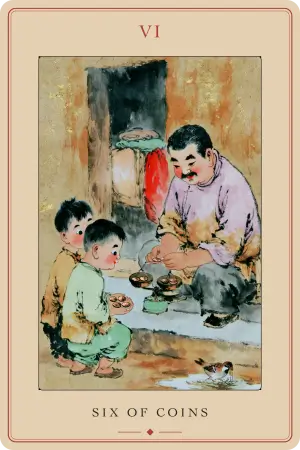
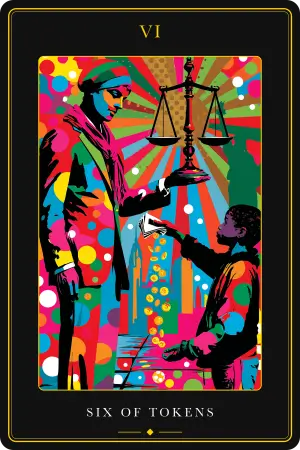


Minor Arcana · Pentacles (Earth)
Six of Pentacles
A merchant weighs coins on scales for two kneeling beggars: the flow of giving and receiving, and the question of who holds the power.
Card at a glance
- Numerology
- Six
- Element
- Earth
- Astrology
- Moon in Taurus (10°–19°)
- Kabbalistic path
- Tiphareth (Beauty)
- Timing
- Early May, or a phase of exchange and rebalancing
- Yes / No
- Upright yes · Reversed no
Upright
Generosity
Charity
Exchange
Balance
Support
Reciprocity
Patronage
Fairness
Reversed
Imbalance
Strings attached
One-sided giving
Debt
Power play
Exploitation
Inability to receive
Six of Pentacles in each deck
Every deck reimagines the same archetype. Compare the art, then open a deck to read its full interpretation.
Imagery and symbolism
Pamela Colman Smith stages a transaction. At the center stands a well-dressed man Waite describes as acting in the guise of a merchant, upright and elevated, dispensing coins from his right hand to two beggars kneeling at his feet with hands held out in need. The blizzard and stained-glass isolation of the Five of Pentacles have given way to a clear bright sky, a signal that the destitute have found shelter and patronage.
The merchant's other hand is what gives the card its edge: he holds a pair of scales, the classic symbol of justice and equality. He is weighing what each figure receives, which means the giving is measured and calculated rather than freely overflowing. It is equitable by his own judgment but not equal, and he keeps full control of the resources, the sole judge of who is worthy and how much they get. Look closely and the scales are not perfectly even and the six coins hang asymmetrically in the air, a quiet undermining of the balance the card seems to promise.
Two further details deepen the ambiguity, and are worth reading against this deck's own straightforward view of the scene as charity and mutual aid. The Six of Pentacles is one of Smith's stage cards, a small set marked by a heavy horizontal line across the background that makes the scene read as a performance rather than a natural moment, so the charity can look staged, an act put on for an audience. And a small red slip juts from the pocket of the kneeling figure in blue, read by some as a theatre ticket suggesting the beggar is an actor who could cast off his cloak, by others as a Tarot card marking a spiritual path still tied to material need. Either way it confirms Waite's own note that here everything is not as it seems. Around the figures the deck grounds the act in society: urban buildings place it on a city street, an exchange between people rather than a private gesture, while green trees point to renewal, and the natural tones tie the whole scene to the material world.
Core meaning
In the Rider-Waite-Smith deck the Six of Pentacles is the archetype of material exchange, the flow of resources between people after the hoarding of the Four and the destitution of the Five. Its traditional title is the Lord of Material Success, and at its simplest it is generosity, charity and the fair circulation of what one has. This deck reads the scene warmly: giving and mutual assistance, generosity that is deliberate and grounded in a sense of justice rather than impulse.
But Smith built the tension into the picture, and it is what makes this card more than a picture of kindness. The merchant holds the scales, and so he holds the power. The card asks who is giving and who is receiving, and on what terms, whether the exchange flows from genuine overflow or comes bound up with control, ego and obligation. It is also a reminder that everyone plays both benefactor and supplicant at different points, and that neither role fixes a person's worth.
Upright meaning
Upright, the Six of Pentacles points to generosity, support and a fair exchange of resources, the movement of money, time, knowledge and care between people. At its best it is mutual aid and patronage, giving without a scorecard and receiving with grace. Its own imagery keeps one caution alive: notice whether the balance is real or whether power sits on one side of the scales.
In love. Harmony and mutual support, a give-and-take that covers both material help and emotional understanding, partners who show up for each other in hard times. It can also describe a functional provider dynamic where one partner is patron to the other, workable as long as it is transparent and consensual.
In career. A workplace of genuine exchange: knowledge and skill shared, effort recognized and rewarded, mentorship and support from senior colleagues. It favours reward for diligence and the kind of reciprocity that builds shared growth.
In finances. Charity and support flowing in a material sense, giving or receiving, with stability built through fair exchange rather than hoarding. It can mark real financial help arriving, and it counsels giving only what you can afford and accepting help gracefully.
In health. A balanced, supported approach to the body: sensible eating, movement that suits you, check-ups when needed, and caring for others' health as well as your own. The theme is equilibrium, meeting the body's needs without neglect or excess.
Reversed meaning
Reversed, the fragile balance of the card breaks and the uneven scales tip fully over. It exposes strings attached, one-sided giving, and generosity used as leverage, or the internal blocks that stop abundance from flowing at all. The question sharpens to who is not giving and who is not receiving, and why.
In love. Imbalance and a loss of harmony, one partner over-giving while the other only takes, feeling drained, undervalued, or made to grovel for basic affection. It can name a power imbalance held on purpose, and it calls for mutual respect, equality and generosity to be restored.
In career. Unfairness in the workplace: exploitation, an uneven share of rewards, effort going unrecognized, one person carrying a disproportionate load without adequate pay. It can also flag an unhealthy financial dependence on a single job.
In finances. One-sided or insincere support, mismanaged funds, aid given unfairly or even fraudulently. It warns the giver to vet who they fund and warns the receiver against a benefactor who uses debt and obligation to control. It can also signal distress from poor judgment or the sudden end of patronage.
In health. An excessive focus on the body that crowds out other kinds of well-being, diet and exercise turned into a burden or a chase after perfection. The card asks for the different parts of life to be weighed back into balance.
Historical notes
Smith's staged scene of 1909 gave the card its lasting drama, and its subversive details reward a second look: the stage line, the uneven scales, and the hidden red ticket all support Waite's insistence that the transaction is not as innocent as it first appears. His Pictorial Key names the central figure only in the guise of a merchant, leaving open whether the donor's motives are pure.
The esoteric backbone is older. The Golden Dawn's Book T titled the card the Lord of Material Success and read it through the geomantic figure Populus, meaning a gathering of people, which is why the card's wealth is communal and social rather than solitary. Crowley's later Thoth deck drops the human scene for pure geometry, titling the Six of Disks "Success": having passed through the crisis of the Five, its consciousness reaches a wiser, more detached and pragmatic view of wealth, respecting money for its use rather than idolizing or despising it. Modern decks keep only the natural law underneath, Kim Krans's Wild Unknown showing a single flourishing branch heavy with six pentacles, giving without the merchant's ego, on the principle that what goes around comes around.
Correspondences
Number. Six: harmony, balance and equilibrium. After the disruption of the Five, the number restores order, and it carries duty and reciprocity, the six directions of space held in balance.
Astrology. The card carries the Moon in the second decan of Taurus, roughly 10° to 19°, about 1 to 10 May. The Moon is exalted in Taurus, its restless emotional tides steadied by fixed, Venusian earth, so the placement reads as the emotional realization of material security, giving and receiving with ease and natural rhythm. Wealth here is meant to breathe, to ebb and flow rather than be hoarded.
Element. Earth, the element of the body, resources and the material world.
Kabbalah. As a Six it belongs to Tiphareth, Beauty and Harmony, the balanced heart of the Tree of Life. In the suit of Earth this is Tiphareth in Assiah, transcendent harmony filtering down into material success and the balancing of external resources.
Elemental dignity. The exalted Moon on fixed Taurean Earth gives the card its stable, unhurried flow, emotional need met through physical comfort rather than friction.
Psychological perspective
Read psychologically, Smith's staged scene turns the card into a mirror for the ethics of giving. The merchant's inner monologue can be genuine care or an egoic broadcast, look how generous I am, and the stage line keeps that question open. The savior complex lives here: the act of giving weaponized to maintain dominance, to force gratitude, or to keep a recipient dependent. The card asks whether charity actually lifts someone toward independence or quietly preserves a hierarchy.
Reversed, the astrological ideal of easy giving and receiving is dammed by ego, shame or trauma, and it splits two ways. At one extreme is the martyr who gives indiscriminately to their own depletion, tying self-worth to being needed rather than to real overflow. At the other is the person who cannot receive at all, blocking help and abundance out of pride or an internalized sense of unworthiness. The card's quiet mandate is that receiving gracefully is as vital as giving generously, and that refusing either breaks the circuit.
The Six of Pentacles across decks
The card's theme of exchange holds while its imagery moves from human drama to pure form. In the Rider-Waite-Smith deck, the version this page follows, it is the merchant weighing coins on scales for two kneeling beggars, the staging that fixed the card's meaning as generosity shadowed by power and conditionality. The stage line and hidden ticket make it, uniquely among versions, a card about the performance of charity as much as the fact of it.
Crowley's Thoth deck abandons the scene for sacred geometry, titling the Six of Disks "Success" and arranging the disks to the geomantic figure Populus, made circular to accord with Tiphareth, wealth radiating out to a community. Kim Krans's Wild Unknown strips the drama entirely to a white branch flourishing against a dark ground, six pentacles hanging like ripe fruit, an image of the natural law of reciprocity with no merchant and no ego. Between them, RWS is the one that keeps the human power dynamic at the center.
In combination and context
The Six of Pentacles reads closely off its neighbours, since the whole card is about a relationship between parties. It sits in the suit's narrative directly after the Five of Pentacles, turning cold destitution into the arrival of help and patronage, and before the settled abundance of the Ten. Paired with The Emperor it often reads, in modern practice, as a stark power imbalance, one party rigidly deciding what the other is allowed to receive, the dynamic behind emotional breadcrumbing.
Position shapes the reading sharply. As advice it says give only what you can afford, ask for help when you need it, and accept blessings gracefully. In a "what to let go of" position it flips to a command, stop pouring resources into people who never reciprocate and cut the one-sided ties. As an obstacle it points to a relationship or arrangement where the scales are held by someone else; as an outcome it promises support and fair exchange, provided the balance it depicts is real and not just staged.
Questions for reflection
- In the exchanges that matter to me right now, am I holding the scales, kneeling for crumbs, or standing in genuine balance?
- When I give, is it from real overflow, or is there a quieter wish to be seen as generous, needed, or in control?
- Where do I find it harder, giving freely or receiving gracefully, and what would it take to open the side that stays closed?
The general meaning follows the Rider-Waite-Smith reading — the reference used across Tarot Academy. Open a specific deck above for its own interpretation.
Frequently asked questions
Explore the Tarot
Latest Posts
Discover the ancient wisdom of tarot cards and unlock the mysteries of your spiritual journey. Our blog is your gateway to understanding the rich symbolism, meanings, and practical applications of tarot reading.




















































