
 EN (English)



Minor Arcana · Cups (Water)
Two of Cups
Smith set the caduceus of Hermes between two bareheaded figures, crowned it with a red winged lion's head, and put a house among trees on the green ground behind them.
Card at a glance
- Numerology
- 2
- Element
- Water
- Astrology
- First decan of Cancer (June 21–July 1), ruled by Venus
- Kabbalistic path
- Chokmah (Wisdom), where the Twos sit
- Timing
- The first ten days of Cancer, the opening of the watery season
- Yes / No
- Upright yes, reversed no
Upright
Mutual attraction
Equal partnership
Union
Reciprocity
Emotional closeness
Harmony
Trust
Joint project
Reversed
Imbalance
Distrust
Breakup
Poor communication
Unequal partnership
Loss of closeness
Disappointment
Emotional manipulation
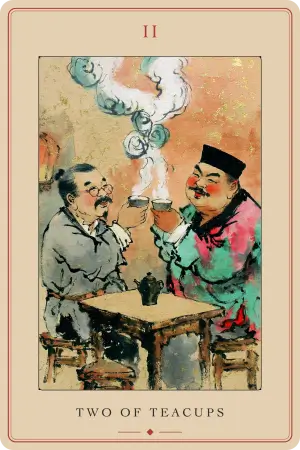
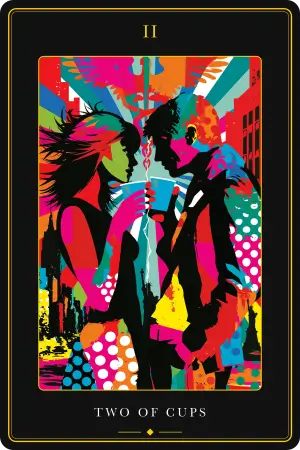
Two of Cups in each deck
Every deck reimagines the same archetype. Compare the art, then open a deck to read its full interpretation.
Imagery and symbolism
Pamela Colman Smith drew this card as a pledge taken in the open air. A youth and a maiden stand facing each other, each raising a golden chalice, and the two cups meet at exactly equal height. This deck reads that exchange as an equal sharing of emotions, ideas and attachment, so the composition itself carries the argument: neither figure is above the other, and neither cup is fuller.
Both figures are bareheaded, and this deck treats that as deliberate rather than incidental. Nothing covers them, so they meet open, sincere and willing to understand one another. They wear floral garlands and laurels, old marks of victory and of affection coming into bloom, and their brightly coloured tunics sit over pure white undergarments, which sets the worldly desire of their outer lives against the sincerity of the intentions underneath.
Between them hovers the caduceus of Hermes, the card's most loaded object. It is a central staff wound by two ascending serpents, the ancient emblem of commerce, physical healing and the messenger god who crosses between the mortal world and the divine. This deck names it a symbol of peace and harmony and reads the entwined snakes as healing and transformation. In the esoteric reading the two serpents are opposing forces brought into balance, the masculine rod and the feminine serpent energy meeting on one axis, and the staff lifts a connection out of biological pull into communicative, spiritual exchange. There is an older story attached to it: Hermes used the staff to separate two copulating snakes, and the act turned the user from male to female for seven years. Relationships change the people in them.
Crowning the staff is a red winged lion's head. This deck says the lion introduces an element of passion and fire, and the wider esoteric reading fills that out: the lion is courageous elemental fire, carrying the resonance of Leo, and the wings are that fire directed by intellect and spirit. Two things follow from the chimera. Genuine union generates a third force stronger than either person alone, and that force is volatile. Some readers hear a deliberate undertone of danger in it, a reminder that merging one life with another is a risk taken on purpose.
The background is not filler. A house stands among trees on a low green rise behind the figures, and this deck reads it as the comfort and safety their bond provides, and as a shared destination where feelings can be spoken freely. The green ground beneath them is fertile, standing for growth and development in the relationship. Bright green leaves emphasise prosperity, and the clear blue sky above reflects a settled, calm state. Marseille put this card underground in an alchemical cellar. Smith put it on a hill in daylight, with a home in view.
Core meaning
This deck states the card plainly: the Two of Cups is harmony, compatibility and the exchange of energy, and it is first of all a card of relationships and spiritual connection. The Golden Dawn title behind it is "Lord of Love," the Two of Cups being Chokmah, the first outward-reaching force on the Tree of Life, expressed through the water of feeling.
What this deck emphasises above everything else is equality. It marks a moment of direct connection where communication becomes profound, and its standing recommendation is to value the partner, express feeling openly, and let the bond develop at its own speed rather than forcing it. The card covers romance, friendship and professional partnership without changing its terms, because what it measures is the quality of the reciprocity, not the social category of the pair.
Across this deck's live categories the reading holds its shape. In money it is a new alliance or joint project where trust decides the profit. In business it is a merger of complementary strengths and negotiations that end well. At work it is teamwork and colleagues worth relying on. In romance it is a soulful meeting with honest exchange and unconditional acceptance. In general relationships it is dialogue that strengthens existing bonds. In the physical realm it is the body accepted rather than corrected. The same two cups, raised in six different rooms.
Upright meaning
Upright, this deck reads balanced relationships, mutual understanding and a period well suited to forming bonds on both the personal and the professional level. It can also mark two people exchanging ideas or beginning a joint project. The advice attached is consistent: speak your feelings openly, treat the other as an equal, and let the connection unfold without rushing it.
In love. A deep emotional connection and a soulful meeting defined by honest exchange and unconditional acceptance. This deck reads it as a strong sign for starting a new relationship, deepening an existing one, or rekindling an old bond. Mutual attraction, harmony and respect sit at the centre, with the partnership resting on trust and genuine support. It is a period for opening the heart, speaking tenderly, and building on shared values.
In relationships more broadly. Harmony and a productive exchange of ideas, with dialogue that strengthens what is already there. Communication happens in a friendly atmosphere, so new connections form easily and trust with people you already know deepens. This deck asks for listening, sincerity and a real willingness to collaborate.
In work. Successful collaboration and strong teamwork, with a partnership built on mutual support and respect among colleagues. It can mean a joint project completed well, a favourable deal, or an agreement that benefits everyone signed into it. This deck tells you to act as a team and lean on the expertise around you, and it allows for new colleagues or partners arriving as reliable support.
In business. Alliance and successful collaboration: a joint venture built on mutual respect and profit, complementary businesses merging, or long-term ties formed with clients, partners or investors. It also reads as harmony inside a team where shared goals make the work productive. Important negotiations are likely to end favourably.
In money. Partnership and collaboration, often the start of a new business alliance or joint project, with collaborative ventures likely to pay. This deck insists on balance and equality in dealings, since mutual trust between partners is what makes prosperity last. It can also indicate a useful exchange of resources, knowledge or material help.
In the physical realm. Acceptance of your body and a balance between appearance and internal health. This deck ties physical well-being directly to emotional state and points to steady self-care through consistent nutrition, regular activity and simple grooming. Health and beauty come from respecting the body's natural diversity rather than fighting it.
Reversed meaning
Reversed, the balance goes. This deck describes relationships that have tipped, a false sense of harmony, or a situation where one partner keeps sacrificing their own interests to hold the thing together. It can point to a failed union or a breakup coming, and the obstacles usually trace back to poor communication, unresolved history, or plain misunderstanding. The recommendation is direct: reassess how you approach the other person, talk honestly about the doubts, and get outside perspective from friends or professionals if the picture will not clear.
The old visual reading still applies. Turn a full cup over and the contents spill. The taste of the relationship is unchanged, but the containment has failed, and what follows is unmanageable feeling and lost boundaries.
In love. Anything from basic misunderstanding to the total loss of emotional connection, with the relationship stalling in disappointment or dissatisfaction. This deck describes one partner unwilling or unable to stay emotionally engaged, and that gap producing detachment and a loss of tenderness. Disagreements turn into mutual resentment easily. It warns of incompatibility or selfishness, and says that restoring closeness requires reviewing the relationship honestly rather than waiting it out.
In relationships more broadly. Disrupted balance and likely conflict. Communication gets difficult and understanding gives way to frustration, with distrust or an inability to see another perspective corroding the bond. This deck traces most of these conflicts to a reluctance to listen or an unwillingness to share information honestly, and it flags inequality: one person maintaining the relationship alone while the other stays indifferent.
In work. Conflicts and misunderstandings with colleagues or clients, a workplace short on harmony and compromise, and sometimes a valuable partnership missed outright. This deck names the specific damage as uneven workload, one person carrying far more than the other until respect erodes. Recovery takes open discussion, tolerance, and a willingness to change how the work is organised.
In business. Conflict with partners and possible separation from them, with collaborations producing stress instead of benefit. Unclear roles and responsibilities breed disputes. This deck warns that mistrust and contradiction end in broken partnerships, terminated contracts and agreements nobody can work with, and that compromise is the price of avoiding that.
In money. Disagreement inside a business partnership, with imbalance and bad communication leading to losses. Arguments over budget and the allocation of resources are typical here. This deck puts it as a warning about paperwork and intent: where agreements lack clarity and trust, the shortfall gets paid in money.
In the physical realm. An imbalance between internal health and outward appearance, often showing as dissatisfaction with your body or exhaustion from chasing physical perfection. This deck describes swings between extremes, heavy dieting followed by poor eating, or erratic exercise that drains energy instead of building it. The discord signals a neglected link between emotional and physical state, and the correction is a steadier, more moderate approach.
Historical notes
The scene Smith drew is not the old one. In the Tarot de Marseille the two cups are almost secondary to what happens beneath them, in a subterranean chamber where two angelic figures work at an alembic, the distillation apparatus alchemists used to purify liquids. Inside it a phoenix undergoes calcination and fiery rebirth, and rising from the top of the apparatus is a strange flower whose leaves are fish heads. That image belongs to the hermetic "Chemical Wedding," where human love and physical intimacy are the sacred vessel in which a soul is transformed. Esotericists reading it through Qabalah link it to "The Queen's Wisdom," a title structurally aligned with Binah while interacting with the force of Chokmah, and there the Queen's Wisdom is defined as Love.
Waite and Smith took the card out of the cellar. The RWS version moves the whole operation above ground into daylight and puts two human beings at the centre of it, then hangs the alchemy overhead as a single emblem, the caduceus with its winged lion. What Marseille dramatised as a chemical process, Smith stages as a social act: two people pledging, with a house behind them.
Crowley and Lady Frieda Harris went the opposite way in the Thoth Tarot and removed the human figures entirely. Their card shows two ornate silver and gold cups on a calm lucent sea, fed by water overflowing from a blooming lotus, with twin dolphins entwined around its stalk. Between those two poles, the Marseille furnace and the Thoth diagram of forces, the RWS card is the one that made the Two of Cups legible to ordinary readers, which is why the exchange of chalices is now what most people picture when the card is named.
Correspondences
Number. Two. This deck reads it as balance, peace and diplomacy, the unification of opposites where different forces interacting produce cooperation instead of friction. It carries creative potential, since the wish to work together tends to end in joint creation, and it marks the shift from independence to interaction, which is what brings stability and makes expansion possible. In this card the number lands as psychological comfort, emotional harmony and the need for mutual acceptance.
Astrology. The first decan of Cancer, roughly June 21–July 1, ruled by Venus. This deck reads that pairing as deep emotional undertones and spiritual compatibility. Cancer is cardinal water and the most receptive sign of the zodiac, associated with the womb, the home, emotional security and loyalty, and Jupiter is exalted there. Venus placed inside that protective environment yields an enveloping, deeply rooted affection rather than fiery passion, and as the first decan it carries new beginnings and the potential for emotional development.
Element. Water. This deck grounds the card in intuition, sincerity and the necessity of emotional exchange.
Kabbalah. All the Twos belong to Chokmah, Wisdom, the second sphere and the first active outpouring from Kether. Because Cups correspond to Water and to the world of Briah, the Two of Cups is Chokmah operating through a fluid medium: initiating force expressed as the urge to cross the distance between self and other. The Golden Dawn called it the Lord of Love for that reason.
Elemental dignity. A Water card, it runs kindly with Earth and can temper Fire, while restless Air tends to unsettle its balance.
Psychological perspective
The people this deck attaches to the upright card connect deeply with those around them. They listen well, communicate openly and show care without being asked, and they perceive the world primarily through relationships and emotions. Drawn to partnership, they do their best work in teams and make reliable friends, valuing balance and mutual respect in every interaction.
Reversed, the same portrait closes. These are people who struggle to understand others or form deep bonds, whose sensitivity turns into a communication barrier and makes them read as touchy or distant. They may act selfishly and ignore what others need, which produces conflict and broken relationships, and the isolation that follows keeps undermining their confidence about trying again.
Underneath the social reading sits an older esoteric one. The Two of Cups is love experienced as mirroring: feeling validated by being reflected back, love as it is shown and returned, which places the card at early recognition rather than at the self-contained maturity of a court card like the King of Cups. Tied to the alchemical vessel, it also describes the reconciliation of two parts inside one psyche, conscious mind meeting submerged unconscious, or inner worth aligning with outward projection. That internal union usually comes first, since the capacity to extend love outward is rooted in receptivity toward the self. The shadow of the card is projection. Pulling it repeatedly for someone unavailable often reflects the querent's own longing for union rather than the state of the bond.
The Two of Cups across decks
Tarot de Marseille. Two cups above an underground chamber where angels work an alembic, a phoenix burning inside it and a fish-headed flower rising from the top. Union as spiritual distillation, with no lovers in sight. Modern analysts have compared the scene to Wilhelm Reich's later account of pleasure as cosmic energy moving through the body, the intimate bond framed as a bio-energetic furnace that forges an integrated self.
Crowley-Thoth. Painted by Lady Frieda Harris, this version drops the figures and shows two silver and gold cups on a calm sea, fed by an overflowing lotus with twin dolphins entwined around its stalk. The dolphins, argent and or in Golden Dawn heraldry, join lunar and solar currents. Crowley attached the card to his axiom "Love is the law, love under will" and to the equation 0 = 2, unity dividing into two balanced opposites, love being the act of recovering that lost oneness.
Rider-Waite-Smith. The version on this page is the human one. Smith kept the alchemical content but compressed it into the caduceus and the winged lion hovering above two people who are simply making a promise, and she gave them a landscape the other decks do not have: fertile green ground, leafing trees, a house, clear sky. The esoteric machinery is still there, hanging in the air over an ordinary hillside.
Morgan-Greer. A pointed psychological revision. The male figure frowns slightly and rests his hand heavily on the woman's shoulder while holding his chalice, her head tilts down, and he leans in. The posture is more dominant than Smith's, and it turns the card into a comment on real power dynamics in romance rather than a picture of equality.
Modern decks. Decks such as This Might Hurt keep the RWS vocabulary, the winged lion and the intertwined snakes, while pressing a caution: this may be the "marriage" card and the love it describes may be life-changing, but as its creators put it, "forever is not a promise any card can make."
In combination and context
The comparison readers reach for first is The Lovers, and the two work on different scales. The Lovers is Major Arcana, a fated karmic event and an internal alignment of anima and animus, tied to values and to a crossroads choice, and forum practitioners note that the connections it heralds can be intensely passionate yet short-lived. The Two of Cups is Minor Arcana and mutable, the daily action of loving someone. That is exactly why readers treat it as the steadier indicator of a healthy bond: it depends on participation and reciprocity instead of destiny.
Inside its own suit the card sits at the start of a sequence. It is the bedrock the Ten of Cups builds on, where harmony hardens into marriage, family and domestic stability, though Crowley titled the Ten "Satiety" and warned that total fulfilment can putrefy into a stagnant dream. The Three of Cups breaks the insular pair open into friendship, community and celebration. Against the King of Cups, a figure with mature emotional sovereignty, the Two is deliberately less mature: it is love recognised in a mirror rather than love understood from the inside.
Reconciliation readings deserve their own caution. Traditionally the card signifies mended feuds and restored harmony, which makes it the omen people hope for when asking about an ex, but experienced readers refuse to take it in isolation. Beside cards of departure or stasis such as the Six of Swords, the Eight of Wands or the Hanged Man, it often shows the former partner forming a new Two of Cups bond with someone else, or a reunion that would cost the querent hard-won independence. The common counsel is to read it as an invitation to reconcile with yourself. Position matters as well: as advice the card says meet the other halfway and keep the exchange equal; as an outcome it promises a connection built on genuine reciprocity.
Questions for reflection
- Smith drew both figures bareheaded, with nothing covering them. Where in your closest relationship are you still keeping something on?
- This deck puts a house among trees behind the couple, the safety their bond provides. What does your version of that house look like, and who is inside it?
- The cups meet at equal height in this image. In the connection you are thinking about, is the exchange actually level, or are you pouring more than you receive?
The general meaning follows the Rider-Waite-Smith reading — the reference used across Tarot Academy. Open a specific deck above for its own interpretation.
Frequently asked questions
Explore the Tarot
Latest Posts
Discover the ancient wisdom of tarot cards and unlock the mysteries of your spiritual journey. Our blog is your gateway to understanding the rich symbolism, meanings, and practical applications of tarot reading.




















































