
 EN (English)



Minor Arcana · Cups (Water)
Ace of Cups
Smith set the chalice in a hand that comes out of cloud, gave it five streams instead of one, and brought a dove down to it carrying the communion host.
Read the complete guide: Ace of Cups in Tarot: A Complete Guide to Its Symbolism and Meaning
Card at a glance
- Numerology
- Ace
- Element
- Water
- Astrology
- The water triplicity: Cancer, Scorpio and Pisces
- Kabbalistic path
- Kether (the Crown), where the Aces sit
- Timing
- The opening of a cycle rather than its span
- Yes / No
- Upright yes, reversed no
Upright
New love
Emotional renewal
Creative inspiration
Intuition
Spiritual enlightenment
Harmony
Openness
Inner balance
Reversed
Blocked emotions
Emotional exhaustion
Missed opportunities
Unrequited love
Disappointment
Fear of opening up
Emptiness
Instability
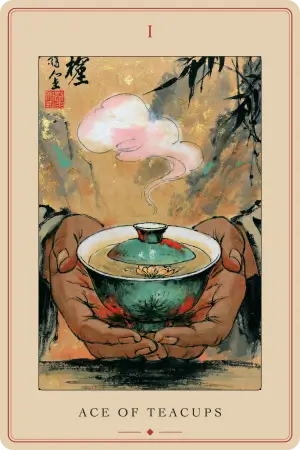
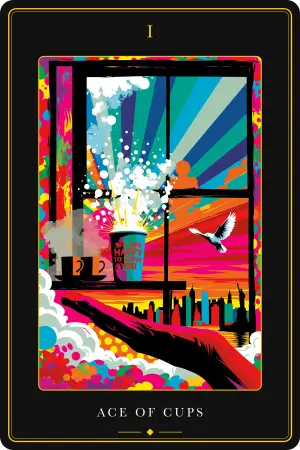
Ace of Cups in each deck
Every deck reimagines the same archetype. Compare the art, then open a deck to read its full interpretation.
Imagery and symbolism
Pamela Colman Smith built this card out of borrowed liturgy. Every RWS Ace is a hand emerging from a gray cloud, holding out the suit's emblem against a flat gray sky, and the flatness is deliberate: it is raw opportunity in its impartial state, before anyone's free will has touched it. The cloud marks the giver as divine or subconscious, a source outside ordinary calculation, and the hand extends the cup as an unearned offering rather than a reward.
The chalice itself is ornate and golden, and Smith did something with it that no earlier tradition required. Five distinct streams of clear water pour from the brim. They are read as the five physical senses, sight, sound, touch, taste and smell, which turns the card into an argument rather than a picture: emotional abundance is not complete until it overflows the vessel and reaches the material world through the body. This deck states the same point plainly, that the new beginning will engage the whole person.
Above the cup Smith placed a white dove descending with a small cross-marked disc in its beak. This is the most openly Christian borrowing in the Minor Arcana. The disc is the sacramental wafer, the communion host, and the dove is the Holy Spirit, so the moment drawn is grace entering the vessel: the host with the cross for sacred transformation through love, the dove for peace. The dove carries an older esoteric weight too, the association with prophecy, miracle and the language of the birds. Around the cup fall small droplets shaped like the Hebrew letter Yod, the seed or spark of the divine, descending like mist so the offering reads as heaven-sent.
Beneath the hand lies a still lake, the subconscious, dotted with lotus blossoms and lily pads. Smith drew some open and some still in bud, which keeps the card from settling into completion: present joy plus a reserve of growth not yet realised. The lotus roots in mud and blooms clean above the waterline, an image of immaculate emotional life rising from old heartbreak. This deck adds the far horizon to the reading, where green mountains stand for spiritual peaks reachable only through effort, and the green landscape around the lake for prosperity and calm.
One detail has never been settled. An inverted letter sits on the face of the chalice, usually read as a W for Water or Womb, sometimes as an upside-down M for Mother. Either way it points at the receptive, feminine principle and at fertility. The hand emerging from the right and pointing leftward is occasionally read, in left-to-right cultures, as the heart's hold on memory and the past.
Core meaning
This deck reads the Ace of Cups as a new beginning offered rather than achieved, and it lists what arrives with it: happiness, love, deep emotional satisfaction, creative inspiration, the development of spiritual abilities. What holds those together is the idea of an instinctive connection with the deep truths of life, a knowing that runs underneath thought.
The emphasis here falls on receptivity. The deck's recommendation for the card is to allow yourself to receive the blessings of the period, stay sensitive to your surroundings, and show gratitude for what is arriving. That is unusual advice for an Ace, which elsewhere in the tarot tends to mean seize the thing. The RWS image explains why: the querent is not holding the cup. Someone else is, and the only available move is to accept.
Across this deck's categories the card behaves the same way in every domain. In money it is a fresh start on the path to wealth, in business the moment to implement an idea, in work a pleasant offer or a step up, in romance the potential for deep connection, in the body a period of harmony and renewal. The consistency is the point. One opening, appearing wherever the querent happens to be looking.
Upright meaning
Upright, this deck marks the beginning of a positive emotional period: warmth, tenderness, emotional renewal and joy. It can signal a new friendship, a marriage, or a creative project starting. The deck describes it as a time of active inner development and spiritual renewal, with an abundance of emotional energy enriching everything around it. The advice attached is to follow your heart, trust your emotions, and stay open to the lessons that come with the period.
In love. A new beginning and the potential for deep emotional connection, with relationships becoming more fulfilling. It can be a fresh romance capable of meeting your emotional needs, or, inside an existing bond, a transition to a new level of mutual understanding. This deck also allows for an old partnership rekindled with new passion. The instruction is to dive into the feeling rather than manage it from a distance.
In relationships more broadly. The start of a new stage in general connection: a friendship, a collaboration, joining a community. Emotional closeness, mutual respect and empathy sit at the base of these bonds. The deck reads the period as one where communication itself becomes satisfying, and where the optimism you carry visibly affects the people around you. Good conditions for strengthening family ties and laying foundations meant to last.
In work. New opportunities and offers that bring genuine pleasure, from a pleasant job to a personal project to a step up the ladder. The deck emphasises a surge of energy and inspiration that helps resolve complex challenges, plus satisfaction and harmony inside a team. It marks the beginning of a new career phase and an environment that actually supports your effort.
In business. A card of inspiration and the right moment to implement an idea capable of real income. The deck favours investment and expansion here, and it expects the venture to bring emotional satisfaction alongside the money. Mutually beneficial collaborations and partnerships may open up.
In money. Abundance and prosperity, with opportunities that carry material benefit. Because the card is governed by Water, the deck asks for an intuitive approach to financial decisions rather than a purely analytical one. It can indicate profitable partnerships, reliable investments, an inheritance, or a new source of income, often fuelled by a creative idea. The deck is honest about the catch, which is that realising these opportunities still takes effort and patience.
In the body. Harmony and well-being, with renewal and healing available. Because the card is tied so closely to emotional renewal, this deck reads the physical shift as a direct consequence of the emotional one. It can begin a phase of self-care around nutrition, rest and movement, and it points toward genuine acceptance of your own body rather than a project of correcting it.
Reversed meaning
Reversed, the flow stops. This deck lists disappointment, sadness and emptiness, with personal feelings ignored and communication failing. It can mean missed opportunities and lost illusions, or a plain dissatisfaction with your life and spiritual energy. The recommendation is to look inside for the source of the feeling instead of its target: heal old traumas, let go of certain attachments, seek support from people who can give it, and reconsider the current loss against the wider shape of a life. The deck treats these disappointments as a possible catalyst for renewal rather than a verdict.
In love. Unexpressed emotions, relationships that go nowhere, and difficulty understanding your own feelings well enough to name them. The deck describes a fear of opening up that turns into a communication problem with a partner. It warns of emotional isolation, a fear of rejection, and a relationship producing more discomfort than satisfaction. Emotional walls have to come down before genuine love can be accepted.
In relationships more broadly. Weakened emotional connection and little tolerance for a differing view. Conflicts and cooling relationships cause real stress, and deep bonds are hard to build in that air. The deck notes that suppressed emotion makes communication painful and that disagreement can cost trust outright. Recovery takes a genuine willingness to change, not just time.
In work. A lack of emotional fulfilment in the current job. Communication with colleagues may be poor and the team may fail to inspire trust. The deck frames the difficulties as usually temporary and turns the card into a question: what would actually satisfy you professionally? It asks you to perceive reality rather than cling to an illusion about the role.
In business. Obstacles and delays, often traceable to resource depletion or emotional overload. The deck warns against hasty action and unwise investment, and it flags loss of inspiration as the real damage. Before moving on, pause, name the pitfalls, and rethink earlier decisions.
In money. Missed opportunities, loss of support, or a struggling venture. The deck names the risk of a financial crisis or the loss of a stable income, and investments that fail to return what was expected, especially in real estate or stocks. Losses tend to follow misallocated resources and ignored advice.
In the body. An imbalance between physical and emotional well-being, with self-care neglected and a reluctance to start better habits. The deck describes exhaustion and a specific disconnect: your appearance no longer matches how you feel inside. Its correction is attention to what the body is actually asking for.
Historical notes
The image this deck fixed is not the old one. In the Tarot de Marseille, decks such as the Nicolas Conver of 1760, Pierre Madenie, Jean Noblet and Jaques Viévil, there is no hand from the clouds and no descending dove. The Ace of Cups is a massive architectural chalice, closer to a walled city, a cathedral or a reliquary monstrance, with pointed towers and battlements sealing the interior from everything outside. Historians trace that structure back to the Visconti-Sforza deck of 15th-century Italy, where a similar form on the World card stood for the New Jerusalem. Read that way the Marseille ace carries a love that is eternal and communal rather than personal, and modern Marseille readers also hear the enclosure as a fear of intimacy or the boundary of an insular group.
Other historical aces went elsewhere entirely. The Vergnano of 1830 makes it a bowl of blossoming flowers. The Avondo Brothers deck of 1880, a soprafino variant, sets a cherub in an urn ringed by green dolphins, creatures sacred to Aphrodite, which pulls the card toward romance and sensual pleasure. Claude Burdel's 1751 version is the most violent reading of the same idea: a phoenix rising from fire beneath a bright sun, emotional rebirth staged as combustion.
Against those, Waite and Smith made a specific choice. They dropped the fortress and imported the Mass. The dove, the host, the Yod droplets and the five sensory streams turn an emblem of enclosed, communal love into an emblem of grace descending on one person. That swap is why the RWS ace reads as intimate and the Marseille ace does not.
Correspondences
Number. One. This deck reads it as initiation, the masculine principle and the start of a new cycle, connected to breakthrough, ambition and self-sufficiency. Applied to a Cup, that initiating force turns inward: a fresh start in emotional matters, a new level of emotional understanding, the beginning of a journey defined by deeper feeling. The number also echoes the Magician's raw agency.
Element. Water, the element of feeling, intuition and the subconscious. This deck insists on water's double nature. It can be calm and soothing or forcefully destructive, and it will either flow around an obstacle or break it. The card's spirituality is described as equally changeable, evolving under pressure from both the inner world and outside events.
Astrology. The Ace governs the whole water element and connects to its three signs. Cancer carries the card's sensitivity, Scorpio brings intensity and passion, and Pisces adds the spiritual side, intuition and deep empathy.
Kabbalah. On the Tree of Life the Aces sit at Kether, the Crown, the first point from which the element descends. The Ace of Cups is that point expressed as undifferentiated emotional potential, which is why this deck calls it pure potential rather than a described feeling.
Elemental dignity. As a Water card it runs kindly with Earth and tempers Fire, while restless Air tends to scatter it.
Psychological perspective
The people this deck attaches to the upright card are charming and emotional, high in empathy and strong in intuition, ready to open their hearts and to sense what others are feeling. What the deck singles out is their ease at blending reality with spirituality, sensitivity carried alongside real psychological understanding rather than instead of it.
Reversed, the same portrait inverts into people who struggle to meet their own emotional needs. Instability and unacknowledged feeling leave them unable to accept or express love. Fear of disappointment closes them to a new relationship, and the deck describes internal resistance appearing on the road to happiness, as though something in them refuses the next phase. Its sharpest observation is the last one: these are individuals so focused on their inner world that they begin rejecting external reality.
That pairing is the psychological content of the card. The same open vessel that receives can also fail to hold. Modern readers use the overflow to name emotional dysregulation, the chase after the high of infatuation without the ground to sustain it, and the oversharing that mistakes an early flood of confession for intimacy. Where the deck's daily reading lands is quieter. It says the heart is offered something precious and asks whether you are open enough to receive it, which makes receiving a skill rather than a mood.
The Ace of Cups across decks
Tarot de Marseille. A walled architectural chalice with no hand and no dove, its lineage running back through the Visconti-Sforza New Jerusalem. Love as foundation and community rather than as a personal gift. Some analysts read the whole Marseille Cups sequence as a story of individuality gradually surrendered, from the sealed fortress of the Ace to the rigid rows of the Nine and Ten.
Crowley-Thoth. Painted by Lady Frieda Harris, the Thoth Ace strips the religious iconography out. It is a brilliantly glowing grail with water exploding upward and outward like an endless fountain, and Crowley named the card "Inner and outer wealth." Nothing is divided into five sensory streams here. The water is a limitless and volatile source, which is why Crowley could describe the Two of Cups as that free-floating stream finally polarised into a negotiated relationship.
Rider-Waite-Smith. Between those two, the version on this page is the domesticated one. It keeps the Marseille chalice, adds the sacramental scene the Marseille deck never had, and channels the Thoth deck's raw water into five measured streams aimed at the senses. The gift is enormous but it arrives portioned, offered to a person rather than poured over a world.
In combination and context
The Ace works as an elemental catalyst, softening harsh cards and amplifying warm ones. With the Ace of Wands it marks intense attraction, sudden passion and frequently conception. With the Empress it is the strongest sign of happiness in the home and successful pregnancy, and the Empress with the Queen of Pentacles alongside it is read as an exceptionally strong indicator that a pregnancy has already occurred. Against the Three of Swords the heartbreak turns toward healing, the cracked vessel letting a purer feeling pour in. The Wheel of Fortune makes it love at first sight, the Tower a sudden emotional revelation that clears stale confusion, the Hermit a sentimental loneliness where the cup is full with nobody to share it. Beside the Ace of Pentacles it is love that also delivers material security, and any Pentacle turns it into intuition applied successfully to business.
The caution readers repeat is about reconciliation. The Ace is a seed, and a relationship takes two, which is the arithmetic of the Two of Cups. So the Ace alone describes an internal shift, a wellspring of feeling not yet assigned to anyone, and it reads more reliably as the emotional weather around an event than as the event. Stronger signals of someone returning are the Six of Cups, Judgement, or the reversed Eight of Cups with its caveat that things are different now. Position matters as well. As advice the card says receive the offer; as an outcome it promises a beginning that still has to be built.
Questions for reflection
- The querent in this card never holds the cup, only accepts it. What is currently being offered to you that you have not reached out and taken?
- This deck reads the reversed card as someone so focused on their inner world that they start rejecting external reality. Where have you done that recently, and what were you protecting?
- Smith drew some lotuses open and some still in bud. Which part of your emotional life is blooming right now, and which part is still waiting?
The general meaning follows the Rider-Waite-Smith reading, the reference used across Tarot Academy. Open a specific deck above for its own interpretation.
Frequently asked questions
Explore the Tarot
Latest Posts
Discover the ancient wisdom of tarot cards and unlock the mysteries of your spiritual journey. Our blog is your gateway to understanding the rich symbolism, meanings, and practical applications of tarot reading.




















































