
 EN (English)


Minor Arcana · Cups (Water)
Two of Cups
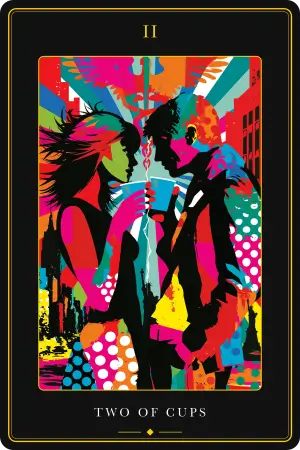
Two black-silhouette hands raise the deck's blue-and-white Greek coffee cups into a toast, and where the cups meet the pink and blue halves of the city blend under one yellow sunburst.
Read the complete guide: The Two of Cups Tarot Card: A Complete Guide to Its Symbolism and Meaning
Card at a glance
- Numerology
- Two
- Element
- Water
- Astrology
- Venus in Cancer (first decan)
- Kabbalistic path
- Chokmah (Wisdom)
- Timing
- Early summer, the first decan of Cancer
- Yes / No
- Upright yes, reversed no
Upright
connection
partnership
mutual recognition
equal exchange
chemistry
reconciliation
trust
finding your person in the crowd
Reversed
imbalance
breakup
miscommunication
one-sided effort
distrust
ghosting
drifting apart
Two of Cups in each deck
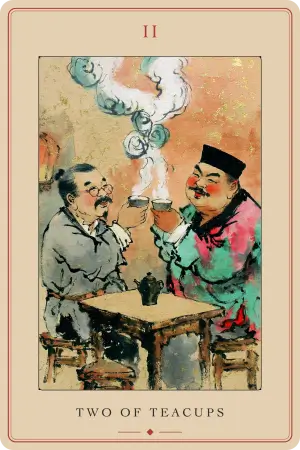
Every deck reimagines the same archetype. Compare the art, then open a deck to read its full interpretation.
Imagery and symbolism
In the Tarot of New York City the Two of Cups drops the Rider-Waite-Smith lovers and their Caduceus and rebuilds the card in the deck's pop-art language. Two hands, drawn in flat black silhouette, reach in from opposite edges toward the center of the frame. Each holds the suit's signature blue-and-white Greek coffee cup, the paper Anthora cup you get on every corner, and they are bringing the two cups together in a toast. The cups meet at exactly the same height. That equal line is the whole argument of the picture: this is a bond between equals, neither hand higher than the other.
The background is split straight down the middle. One half is vibrant pink halftone dots, the other electric blue, the two sides of a city that mostly keeps to itself. Where the cups touch, the colors blend. Above the toast a bright yellow sunburst radiates outward, the new combined energy that these two people make together, something neither had alone.
At the bottom of the frame the skyline sits quiet in layered silhouette. The millions of people out there fade back. For this one moment the connection between two of them matters more than the crowd around them, which is the deck's read on the Golden Dawn title for this card, the Lord of Love. A toast is an old, plain gesture of agreement and mutual respect, and the deck strips the card down to that single act: two cups, one line, one current running between them.
Core meaning
The Two of Cups is the meeting on the corner that changes the rest of the day. It is a balanced, reciprocal partnership, two people coming together in mutual respect and shared intention, with the energy flowing evenly between both sides. Whether it reads as a romance, a business handshake, or a close friendship, the card describes love at street level: the moment two strangers in a city of millions finally look at each other and decide to become a thing.
Underneath the deli-cup toast is the older esoteric charge. The Golden Dawn placed the card at Chokmah, the outward-reaching creative force, expressed here through the water of feeling, and named it the Lord of Love. It is the active will to unite, the urge to cross the distance between self and other and form a genuine bond. The New York deck keeps that meaning and gives it an address. Here the union is not fated and once in a lifetime, it is the daily arithmetic of two: a couple, a friendship, two names on a lease, two people keeping equal measure. That is why readers trust this card as a sign of a healthy connection. It rests on active participation and mutual effort rather than destiny.
Upright meaning
Upright, the Two of Cups is a warm omen of harmony in a city built for solitude. It signals mutual attraction, emotional reciprocity, and a deepening bond in which both people feel seen. Expect successful negotiations, reconciliation, and the quiet relief of finding someone who understands your frequency. The counsel is to engage fully: communicate openly, trust the connection, and cooperate rather than compete. If there has been conflict, this is the moment to extend the olive branch, because the other side is ready to receive it.
In love. Two people drawn together on equal footing, with feeling that runs both ways. It is passion and tenderness in balance, the spark of a new relationship or the renewal of an existing one, and sometimes the mending of a rift. For singles it strongly suggests a significant new connection, one built on real equality.
In career. A strong sign for partnership: a merger, a co-founder dynamic, or a collaboration where complementary skills make the pair worth more than either alone. The chemistry is right and negotiations go smoothly. Agreements rest on mutual trust, and the wins are shared fairly.
In finances. A lucrative and balanced partnership. It favors signing a contract, entering a joint venture, or pooling resources with someone you trust, including something as ordinary and New York as putting two names on a lease. The agreement will be fair and mutually beneficial. Success here runs on transparent talk about money.
In health. Physical harmony and internal balance, the body working well because its systems are in sync. It also points to health benefiting from a positive emotional connection, the stress relief of a good partnership. Holistic approaches that balance mind and body tend to land well now.
Reversed meaning
Reversed, the Two of Cups is a partnership out of balance. The connection is fraying, marred by misunderstandings, unequal effort, or a breakdown in communication. You may be talking past each other on the same corner, or one person is pouring in all the effort while the other simply takes. Turn a full cup over and the contents spill onto the sidewalk: the feeling can still be there, but the containment has failed. The advice is to stop forcing a connection that has lost its balance, address the inequality honestly, and be willing to walk away rather than trade away your own boundaries to keep a dynamic that drains you.
In love. A severe imbalance: poor communication, unequal affection, or the painful feeling of being out of sync. One person may be pulling away, or the relationship has devolved into constant bickering. It can mark a breakup, or a codependent pull where one leans on the other to fix them instead of meeting as equals. A serious conversation decides whether the balance can be restored.
In career. A partnership in trouble, with conflicting goals or mistrust between co-founders or key partners. A merger may fall through, or a vital client relationship may sever. The advice is to renegotiate terms, or, if the breach of trust runs too deep, to dissolve the partnership before it does further damage.
In finances. Financial disagreement inside a partnership, a joint venture souring, or a contract that heavily favors one side. It can surface hidden debts or uneven contributions. The card warns against signing any joint agreement right now, since the imbalance will likely end in resentment.
In health. A physical imbalance, often driven by interpersonal stress. Relationship problems may be showing up as tension, digestive trouble, or a weakened immune system. In the older medical cartomancy the reversal was read more literally, as the body struggling to host or merge with another. The instruction is to restore internal balance by addressing the external stressors in your relationships.
Historical notes
The New York toast inherits a long history. In the Tarot de Marseille the card told its meaning in the language of alchemy: the two cups sat above a subterranean chamber where angelic figures worked at an alembic, a distillation vessel in which a phoenix underwent fiery rebirth, topped by a strange flower sprouting fish heads. This was the hermetic Chemical Wedding, in which the union of two people became a sacred vessel for transforming the soul.
The Rider-Waite-Smith deck, drawn by Pamela Colman Smith under A. E. Waite and published in 1909, moved the scene above ground into a pastoral pledge. A youth and a maiden raise two golden chalices at equal height, and between them hovers the Caduceus of Hermes crowned by a red winged lion's head, the entwined serpents standing for opposing forces brought into balance. Crowley and Lady Frieda Harris took a third path in the Thoth Tarot of 1944, dropping the human figures for two chalices fed by a lotus, with silver-and-gold dolphins entwined around its stalk, the lunar and solar currents joined. Behind all of them the Golden Dawn's Book T fixed the title Lord of Love and placed the card at Chokmah in the world of Briah.
The Tarot of New York City takes that inheritance and translates it into the vernacular of the street. The golden RWS chalices become the blue-and-white paper coffee cups sold on every block, the pastoral meadow becomes a halftone city split pink and blue, and the pledge of troth becomes a plain toast between two silhouetted hands. The alchemical union survives, redrawn as the everyday miracle of two people connecting in a place designed to keep everyone moving and apart.
Correspondences
Number. Two, the first departure from solitude. One is the individual, the single newcomer stepping off the bus, the lone cup of the Ace filling with new feeling. Two is what happens when that feeling finds an answer: duality, dialogue, partnership. On the card it is drawn literally, two hands and two identical cups with one current between them, neither side higher.
Astrology. The first decan of Cancer, from 0 to 10 degrees, ruled by Venus. Cancer gives the emotional depth, the desire for closeness, and the need for a secure bond. Venus, the planet of love, beauty, and harmony, lifts the connection into something mutually rewarding. The pairing yields a rooted, nurturing affection rather than fiery passion.
Element. Water, the element of emotion and relationship, here focused into the flow between two specific points. This is not the single spark of the Ace but that feeling meeting an equal and reciprocal answer.
Kabbalah. Chokmah, the second sphere, Wisdom, the first active outpouring of force, in the watery world of Briah. In this element the outward reach of Chokmah is felt as the desire to connect and recover unity.
Elemental dignity. A Water card, it sits comfortably with Earth and can soften Fire, while restless Air tends to unsettle its balance.
Psychological perspective
Psychologically, the Two of Cups is love experienced as mirroring. The feeling it describes is validated by being reflected back, love as it is shown and returned, which is why the card belongs to early recognition rather than mature, self-contained emotion. Two people see themselves in each other on a crowded corner and feel met. This is the natural partner and collaborator, the person who thrives in a pair, listens well, and looks for fairness and a way to meet the other halfway.
The card also has an inward reading. Tied to the alchemical vessel, it can mark the reconciliation of two parts of one psyche, the conscious mind meeting the submerged unconscious, or inner worth aligning with outer expression. That internal union tends to come first. The capacity to extend love outward is rooted in receptivity toward the self, so the card often says an inner conflict is resolving and a person is becoming whole enough to connect cleanly with someone else.
Its shadow is projection. Pulling this card again and again for someone unavailable can reflect the querent's own longing for union more than the reality of the bond. The rush of a new infatuation mimics the depth of the Two of Cups closely enough to feel like destiny, but a lasting bond still needs consistent choice, shared values, and daily effort. The reversed figures show the other failure: people who demand more than they give, or who cling to a partnership out of fear of being alone until the grip suffocates it.
The Two of Cups across decks
The Two of Cups is one card that every tradition stages differently. In the Tarot de Marseille the two cups sit above an alchemical furnace, the phoenix and the alembic making union a work of spiritual distillation rather than romance. In the Rider-Waite-Smith deck it is the pastoral pledge of a youth and maiden beneath the Caduceus and winged lion, the version most modern readers picture first.
In the Thoth deck, Crowley and Lady Frieda Harris replace the figures with two chalices on a calm sea, fed by a lotus around which silver-and-gold dolphins twine, an image of overflowing joy and of lunar and solar forces joined. Crowley tied it to his axiom that love is the law, love under will, and to the equation 0 = 2, unity dividing into two balanced opposites. Modern decks keep adjusting the emphasis: the Morgan-Greer gives the man a more dominant posture, and decks such as This Might Hurt keep the snakes and winged lion while warning that no card can promise forever.
The Tarot of New York City makes the sharpest translation of all. It keeps the suit name Cups and the meaning of equal union, then swaps every romantic prop for the city's own objects. The chalices become blue-and-white deli coffee cups, the entwined serpents of the Caduceus become the blended seam where a pink half of the frame meets a blue one, and the winged lion's third force becomes a yellow sunburst rising over the toast. The lovers themselves are reduced to two anonymous black hands, any two people, meeting anywhere in the five boroughs.
In combination and context
The Two of Cups is often confused with The Lovers, but the two work on different scales. The Lovers is a Major Arcana card of fated, karmic choice and inner alignment, sometimes intense yet short-lived. The Two of Cups is the Minor Arcana reality of daily emotional exchange, the more dependable sign of a healthy bond because it rests on active participation rather than destiny. Within its own suit it is the foundation the Ten of Cups builds on, while the following Three of Cups breaks the insular pair open into wider friendship and celebration.
In reconciliation readings the card asks for care. Surrounded by cards of moving on or departure, such as the Six of Swords or the Eight of Wands, it can show a former partner forming a new bond with someone else rather than returning. Beside the Hanged Man it may mark a reunion that would cost hard-won independence. Many readers treat it, in that context, as an invitation to reconcile with oneself.
Position matters too. As advice the card says meet the other halfway and keep the exchange equal. As an outcome it promises a connection built on genuine reciprocity. For timing, its ruler Venus in the first decan of Cancer points to early summer, the connection arriving as the watery season begins.
Questions for reflection
- In my closest connection right now, is the exchange truly equal, or am I the only one keeping both cups full?
- Where might I be toasting a reflection of my own longing rather than the real person on the corner in front of me?
- What inner reconciliation would make me whole enough to meet someone else as an equal in a city that keeps everyone moving?
The general meaning follows the Rider-Waite-Smith reading, the reference used across Tarot Academy. Open a specific deck above for its own interpretation.
Frequently asked questions
Explore the Tarot
Latest Posts
Discover the ancient wisdom of tarot cards and unlock the mysteries of your spiritual journey. Our blog is your gateway to understanding the rich symbolism, meanings, and practical applications of tarot reading.




















































