
 EN (English)



Minor Arcana · Wands (Fire)
Three of Wands
A man on the hilltop with his back to you, one wand in his hand and two rooted beside him, watching three ships work the water he sent them out on.
Card at a glance
- Numerology
- Three
- Element
- Fire
- Astrology
- Sun in Aries, second decan (March 31-April 10)
- Kabbalistic path
- Binah (Understanding) in Atziluth
- Timing
- Early April, second decan of Aries
- Yes / No
- Upright yes · Reversed no
Upright
Foresight
Expansion
Anticipation
Enterprise
Progress
Confidence
Long-term vision
Readiness
Reversed
Delays
Failed plans
Fear of expansion
Lack of foresight
Stagnation
Inflated expectations
Loss of direction
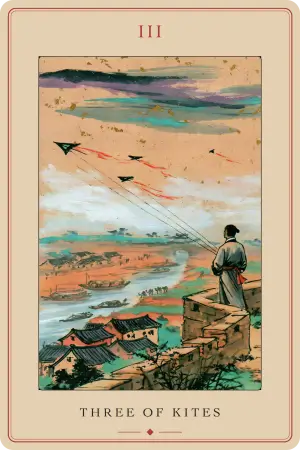
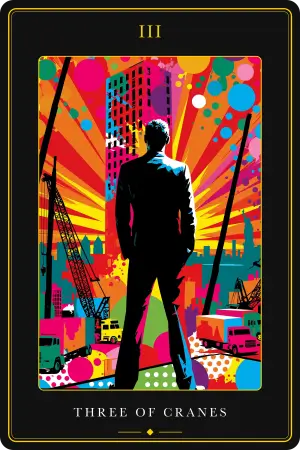
Three of Wands in each deck
Every deck reimagines the same archetype. Compare the art, then open a deck to read its full interpretation.
Imagery and symbolism
Smith gives you the back of a man's head and expects you to do the rest. He stands on the crest of a hill in a richly cut travelling cloak, facing away from the viewer, looking out over water where three ships move under sail. Mountains rise purple in a golden distance. It is one of the few cards in the 1909 deck where the reader is denied a face entirely, and the effect is deliberate: you cannot read his expression, so you are pushed into his position and made to look where he looks.
The wands are the part this deck reads most closely, and its reading differs from the usual description. Three wands stand around him. He holds one of them, and that held wand is the ability to actually use the resources and openings in front of him, creative energy in the hand rather than in theory. The other two are fixed in the ground and stand for stability and a foundation to keep building on. Other readers of the same image describe all three as planted in the soft earth with the figure merely leaning on one for support, portable stability he could pull up and carry at a moment's notice, and they note the green leaves sprouting from the wood as evidence that the plans have rooted and started producing. Both readings arrive in the same place: something is anchored and something is still in his grip. The three together also carry a triple reading in this deck, either past, present and future, or the spiritual, physical and emotional sides of one life.
The three ships are the goals and desires he has already sent out. The sea beneath them is the wider world of commerce, travel and the currents that carry a local ambition somewhere it can grow. Practitioners have argued for a century over whether the ships are leaving or returning. The ambiguity is functional, since either way a plan is irreversibly in motion and the man on the hill has to live with a result he no longer controls. In Waite's own framing the figure is a merchant prince who has dispatched his goods abroad and now stands on the threshold of adventure awaiting his fleet.
Colour does more work here than in most minors. The red clothing is passion, energy, power and achievement, the temperament that got him up the hill. The yellow and green landscape around him reads as optimism, growth, prosperity and positive thinking, and the green ground under the wands is stability, reliability and resilience. Where the Two of Wands puts its figure on grey stone, the Three sets him on living earth. His gaze is fixed forward on the horizon, which is the card's plainest statement: attention on the future and belief in what is coming.
Two details reward close looking. Across his left shoulder hangs a checkered sash in black and yellow, or black and white in some printings, a pattern occultists tie to the chequered floor of a Masonic lodge and its duality of light and dark, order and chaos. Worn openly on the chest it says the opposing forces have been balanced by the man who wears it. Beneath the cloak, other layers show: green at the shoulders grounding the fire into material result, blue on the right sleeve keeping a higher duty in view while he does commercial work. And he wears red slippers, the footwear used in Golden Dawn initiation ritual, which both Waite and Smith knew from the inside.
Core meaning
In this deck the Three of Wands is the realisation of ideas: planning, foresight, confidence in one's own abilities and belief in success. The first steps have been taken and the effort is close to producing something you can touch. That is why the card so often lands as anticipation rather than achievement. It describes the process of seeing prospects, not the moment of collecting them.
What the Rider-Waite image adds to the bare archetype is where the man is standing. He is not indoors, not behind a wall, not holding a model of the world. He is outside on open ground with the actual sea in front of him and his own ships on it. The Ace was the raw spark and the Two was the plan weighed on a parapet. Here the plan has left his hands and the world is answering back.
The deck's own advice for the card is patience with attention: consider every possibility before deciding, weigh each prospect, and think about how today's actions shape tomorrow's circumstances. Spend time on details without losing the long view. That is the discipline the picture is drawn around, and it is why the hilltop reads as a working position rather than a resting one.
Upright meaning
Upright, this is a period of planning and waiting. The questions have been asked and the actions taken, and now the results are on their way. It opens onto prospects and room to expand, whether through travel, a new venture or new alliances, and it carries the particular confidence that follows the first successful steps of a project. In a yes-or-no reading it is a strong yes, especially for long-term plans, foreign travel or an ambitious career move. If you are waiting on applications, pitches or news, the news is coming and is likely good.
In love. A season of planning and anticipation, with active communication and real mutual understanding. Obstacles get met together and the relationship gains confidence from surviving them. Conversations turn to the future: trips, moving in, marriage. A choice has been made and the bond settles into greater stability, with strong interest in the partner and a shared wish to move forward. Through the card's link to distance and geography it often marks long-distance relationships, romance found while travelling, or a partnership joining two different cultural backgrounds. For singles the advice is to look past the usual type and the usual postcode.
In career. Planning, anticipation and expansion. This is the stage where horizons widen: a step up to the next level, or the start of a large and significant project. The progression is long-term and thought through, and the sphere expands substantially if you are genuinely ready for it. Everything necessary has been done, so wait for results while staying open to what arrives. The main labour still lies ahead, but the preparation behind you is thorough.
In business. Expansion, growth and a new phase of work, often the launch of something large-scale. Plans are clear, prospects are trusted, and initiatives carry real energy. It favours international business, partnerships and market expansion, and it points to collaboration where everyone is pulling toward the same outcome. Support from colleagues or partners is part of the picture, and a strong partnership formed now can become the foundation of a durable business.
In finances. Foresight applied to money. Resources go into something that pays later, backed by confidence in the decision. Openings appear for developing a business or widening your financial base, and the card rewards strategic planning over quick returns. It is a time for new proposals, opening investments and closing good deals.
In the body. A readiness to leave the comfort zone, and a signal to act. Widen what you engage with: more effort in sport, a new technique, a different way of eating. Explore rather than repeat, and take responsibility for your own physical condition. Positive change is expected here.
Reversed meaning
Reversed, the ships have hit weather. The card turns to delays, postponed plans and expectations that go unmet. The chosen direction is not producing what was wanted, or a project is failing because the planning underneath it was too thin. Behind that sit feelings of disappointment and a fear of success or of failure that blocks movement. In a yes-or-no reading it turns to no. Shift attention from the goal back to the process, review the plan and name the actual obstacles, and accept that not every plan needs executing. Leave room for rest.
In love. Development stalls, often through indecision or an inability to focus on one partner. Promises go unfulfilled and expectations unmet. Energy and enthusiasm for moving forward drain away, and disagreements surface about shared plans and who carries what. There is uncertainty about where the relationship is going and a sense of being stuck. Fear of major steps is usually underneath it. Sometimes the right move is to let the situation develop at its own pace, since a relationship can need time before it reaches the next level.
In career. Delays, postponements and plans that stall outright. Expansion runs into obstacles, and strategy is vague where it needs to be concrete. Fear of new ventures produces hesitation, and real chances for growth get missed. Unfinished business drags on progress, and the frustration of unmet expectations sets in along with a sense that nobody is backing your plans. The card warns that goals may be unrealistic against the resources actually available.
In business. Stagnation and the feeling of a blocked project. Resources were underestimated or the planning was inadequate, and there is either a reluctance to take risks or an impatience with the slowness of management. Haste creates its own barriers. It also warns of disagreements inside a team and plans too ambitious for the means at hand. Reassess the strategy and the standards, then wait without forcing.
In finances. Losses or unforeseen expenses, delays in business, blocked investments and projects that never materialise. Poorly considered decisions and missing strategy are usually the cause. Indecision leaves money stuck. Do not rush: hasty moves here turn into serious losses, and the situation calls for caution and careful management of what you have.
In the body. Delay and resistance to changes that are needed, rooted in fear rather than in judgement. Motivation is low and the comfort zone is winning. A diet or training routine is not producing results and the disappointment is real. Treat the obstacle as a reason to revisit the plan rather than abandon it. Quick fixes do not hold here.
Historical notes
Before 1909 the card had no scene at all. In the Tarot de Marseille it is the Trois de Bâton, and Marseille pips carry no figures or landscapes, only arranged suit symbols. Three batons cross, usually two forming a saltire with the third bisecting them vertically, and foliage or flowers burst from the otherwise dead wood to signal enthusiasm and an idea coming into leaf. Marseille readers took it as the passage from theoretical knowledge to practical execution, with prospects opening and a push to leave the comfort zone. The same geometry appears in Spanish playing cards, which share the suit of Bastos, and the Florentine Minchiate deck built the three of Batons into its scoring combinations, showing how firmly these suit-and-number pairings sat in early modern European habit.
The scenic version is Waite and Smith's, published by William Rider and Son in London in 1909, both designer and artist members of the Hermetic Order of the Golden Dawn. Waite cast the figure as a merchant prince who has sent his goods abroad and stands on the threshold of adventure awaiting his fleet, and Smith made that a full narrative tableau with a landscape, a costume and a sea. The imagery escaped occult circles quickly enough. T.S. Eliot named "the man with three staves" in The Waste Land in 1922 and, in his notes, associated him with the Fisher King, an association he claimed to have made quite arbitrarily. Critics have been arguing about it since, drawn to the resemblance between the waiting merchant and the wounded king waiting for his barren land to return.
Correspondences
Number. Three, the triad that binds beginning, middle and end into one process: beginning in the one, development in the two, completion in the three. It grows from the digit one, the symbol of beginning and inspiration, taken three times. Combined with the Wands it produces something intense and fast-moving that pushes toward growth, which is why the card demands a clear goal and direction. Three is also expressive and collaborative, so the card leans on teamwork, social connection and the ability to bring other people into the plan.
Astrology. The Sun in Aries, second decan, March 31-April 10. Aries is the first sign and a cardinal fire sign, pioneering and decisive, and the Sun is exalted there, placed in its most honoured position. The Sun rules this decan and supplies confidence, vitality, self-expression and an inner light that reinforces the fire underneath. Together they produce forward momentum, new openings and a clean break from stagnation, along with the understanding that power exists in order to bring intentions to completion.
Element. Fire, in Atziluth, the archetypal world of pure spiritual fire and emanation. Fire here is energy, action and imagination, the drive toward development and new territory.
Kabbalah. Binah, Understanding, the third Sephirah, in Atziluth. Binah is the great mother of the Tree, the containing and structuring force that takes raw energy and gives it functional form. Fire caught by Binah stops being scattered and becomes directed, which is the mathematics behind Crowley's title for the card.
Elemental dignity. A Fire card that strengthens beside Air and meets tension with Water, so its neighbours decide whether the venture accelerates or drags.
Psychological perspective
The person carrying this energy is courageous and sharp-minded, moving deliberately toward goals and always working to widen the horizon. They have firm control of the present situation and a clear view of what is ahead. Plans are formed, expectations are high, and they are waiting for the right moment to move. They are willing to take risks, they rely on connections already built and ventures already proven, and they lead with a settled faith in their own future.
Reversed, the same person is frustrated, afraid or unsure. Obstacles and delays have bred despair or indecision, and confidence has gone along with the clear picture of where they were heading. Dreams start to look unreachable, and the passion that drove them feels lost. They are afraid of the unknown, unready for change, drained by ongoing difficulty. High expectations turn into disappointment when results do not match effort.
The RWS image gives this a specific psychological texture, because a man with his back to you is legible in two opposite ways. He can be looking eagerly at a future he is building with you, or he can be a person who has turned away, absorbed in a horizon you are not part of. Readers meet both in practice: in a hopeful spread the card is anticipation and shared prospects, and in a strained or post-breakup one it reads as cold detachment and a decision already taken. The card also has a reputation online as a persistent visitor, appearing over and over for people frustrated with the pace of their own lives. When it does, it usually carries one of two messages: stop micromanaging forces already at sea, or stop dreaming on the cliff and get on the ship.
The Three of Wands across decks
The Tarot de Marseille Trois de Bâton keeps only the geometry: three batons crossing, two in a saltire with the third through the centre, leafing at the edges. That central intersection was read esoterically as the intertwining of human desire with elemental energy, and the foliage on dead wood as an idea coming out of dormancy. Everything Smith later staged as landscape and costume is there as pattern and number.
Crowley and Lady Frieda Harris's Thoth deck of 1944 titles the card "Virtue" and removes the human figure entirely for elemental geometry. In Crowley's framework the chaotic energy of the Two, which he called "Dominion", meets the stabilising power of three and settles into harmony, so the fire of the Ace finally understands what it is responsible for. He treats it as the ideal precondition for beginning a large work. Its light side is accomplishment, confidence and justifiable pride. Its shadow is moodiness, conceit, insolence, obstinacy and the dangerous overestimation of one's own abilities.
Set the Rider-Waite version against those two and its distinguishing move is obvious: it is the only one that gives the waiting a body, a wardrobe and a view. Marseille gives you the structure of the idea and Thoth gives you the ethics of it. Smith gives you a man on a hill in a red cloak who has already sent his ships out and now has nothing to do but watch the water and stay ready. Modern decks that rework the card tend to keep exactly that posture, the outward gaze and the sense of scale, even when they change who is standing there or drop the figure for the planted staves alone.
In combination and context
The comparison that matters most is with the card immediately before it, since novice readers conflate the two constantly: both show a figure from behind, holding a wand, looking outward. The difference is temporal and physical. In the Two the man stands on an enclosed balcony behind a low stone wall with one wand bolted to the masonry by an iron ring, holding a small globe and still asking whether to go. In the Three he has left the balcony for open ground, the wands are in soft earth rather than fixed to stone, and the ships that existed in the Two only as a logistical idea are on the water. The Two is formulation, the Three is execution and the management of a future already in motion. One reader's version of it: the Two asks what I want to do, and the Three asks how I will do it.
Against the Eight of Cups the contrast is emotional rather than temporal. Both figures depart, but the Eight leaves a situation in grief and finality, sacrificing what was built to go find feeling elsewhere. The Three leaves in confidence, expanding territory rather than escaping it.
Major cards reframe it sharply. Beside the Wheel of Fortune the pairing becomes fate against agency: change will arrive from outside, and this card says you have the foresight and nerve to plan around it. Beside The Tower it converts collapse into cleared ground, illusions broken so the plans held in reserve can finally be built. In love spreads the number spooks anxious readers into fearing a third party, but the community consensus is that it points to distraction rather than betrayal: a partner absorbed in their own career, studies or future, stretched thin by ambition rather than by another person. Literal infidelity belongs to cards like the Three of Swords, or to this card only when heavily modified by something deceptive such as the Seven of Swords or the Moon.
By position, as advice it says look up and stay ready for landfall. As an obstacle it is the fear of a horizon that feels too large. As an outcome it promises returns already sailing toward you, on a timetable that is not yours to set.
Questions for reflection
- In this picture two wands are rooted in the ground and one is in his hand. Which of my own commitments are foundation, and which am I still actively steering?
- Smith drew the ships without telling us whether they are leaving or coming back. What have I already sent out, and how much of my anxiety is about a result that has simply not landed yet?
- He is standing on green earth in a red cloak, looking at the horizon. Am I watching mine with expectation, or with dread?
The general meaning follows the Rider-Waite-Smith reading — the reference used across Tarot Academy. Open a specific deck above for its own interpretation.
Frequently asked questions
Explore the Tarot
Latest Posts
Discover the ancient wisdom of tarot cards and unlock the mysteries of your spiritual journey. Our blog is your gateway to understanding the rich symbolism, meanings, and practical applications of tarot reading.




















































