
 EN (English)



Major Arcana · XVI
The Tower
Pamela Colman Smith's lightning-struck tower, where a single bolt levels whatever the ego built on false ground.
Card at a glance
- Numerology
- XVI
- Element
- Fire
- Astrology
- Mars
- Kabbalistic path
- Peh (Hod → Netzach)
- Timing
- Sudden · without warning
- Yes / No
- Disruptive · usually no for stability
Upright
sudden change
upheaval
revelation
collapse
awakening
liberation
purification
breakthrough
Reversed
resistance to change
delayed crisis
clinging
fear of change
denial
internal upheaval
The Tower in each deck
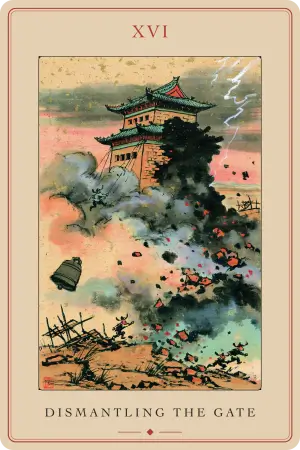
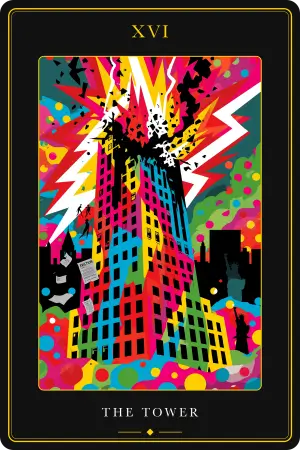
Every deck reimagines the same archetype. Compare the art, then open a deck to read its full interpretation.
Imagery and symbolism
In the Rider-Waite deck the Tower is first of all a designed object, and Pamela Colman Smith's choices carry as much meaning as the disaster they depict. The tower stands alone on a craggy peak with no town, no landscape, nothing around it. Earlier decks often hinted at a setting; Smith stripped it all away, and that extreme negative space is the point. A structure cut off from every natural context reads as an artificial, psychological construct, not a thing rooted in the world.
She drew it too tall and too narrow to shelter anyone, so its proportions alone announce blind ambition that has outrun its own foundation, and she set it on a rocky, uneven precipice, the folly of anything built on premises that were never true. In this deck the tower stands for established belief and the private ego, raised on false ground to give an illusion of security.
The lightning bolt sits at the exact center, oriented from the upper left down into the structure: Spirit descending into matter, a deliberate flash of truth aimed at what it destroys. It knocks a golden crown off the summit and sends it into the dark below. Waite's own Pictorial Key to the Tarot reads that crown as materialistic thought bought cheap and cast down, proof that no rank or fortune shields anyone from cosmic law. Flames pour from three windows, yet in the alchemical grammar Waite and Smith worked in, fire cleanses: it burns off what is obsolete and leaves the essence.
Where the Marseille card scattered abstract colored balls around its tower, Smith drew exactly twenty-two golden drops shaped like the Hebrew letter Yod, the seed-spark of the Tetragrammaton. The count is deliberate. Twenty-two matches the trumps of the Major Arcana, the letters of the Hebrew alphabet, and the twelve zodiac signs joined to the ten sephiroth of the Tree of Life, so the destruction reads as a cosmic event, not a local accident. This deck's own meaning file names the same drops the twenty-two fiery stones, at once the jumbled thoughts of an uncertain moment and the fire of spiritual awakening.
Two figures fall headfirst toward the rocks, one in red and one in blue. They are the pair chained in The Devil, now clothed and thrown clear, and Smith's upside-down descent shows that the flash has overturned everything they assumed about the relation between their conscious and subconscious minds.
Core meaning
Set the archetype aside for a moment as the thing you already know: a sudden shattering of a false paradigm. What the Rider-Waite card adds is a specific claim about mercy. The fire doing the demolishing is a tool of rescue, aimed precisely at what was built on illusion, and the deck's meaning file frames every domain the same way, that destruction here is always followed by rebirth.
Its place in the sequence tells the story. The Tower follows The Devil, and the two figures falling are the ones who stood chained there, having traded a physical bondage to instinct for a subtler bondage to the intellect. What a person will not walk away from voluntarily, the Tower removes by force. The fall is terrifying, but it is the fall that breaks the chains, and whatever gets rebuilt afterward finally rests on solid ground.
Upright meaning
Upright, the Rider-Waite Tower marks a foundational and largely unavoidable change, the collapse of something raised on unstable ground. The deck's reading insists on the turn that follows: however overwhelming the shock, calm comes after the storm, and the querent emerges wiser for having survived the fire.
In love. A sudden breakup, a scandal, or the exposure of a hidden betrayal that shatters the foundation of a partnership. It can also be an abrupt realization about your own worth that prompts an immediate exit. After the collapse, the deck promises, a relationship that survives comes back stronger and more honest.
In career. Unexpected job loss, redundancy, a company reorganized overnight, or a project forced to close. The destruction clears out what was holding you back and leaves a clean slate for something more authentic.
In finances. A crash, a failed venture, a sharp drop, or new legislation that hits your income directly. The card takes money back to basics and offers a chance to rebuild on a healthier footing.
In health. Abrupt shifts in the body or lifestyle, an accident, or pressure long built up and suddenly released. Not every Tower is a disaster: the shock can be welcome, a surprise pregnancy, an exciting relocation, or the clean end of a toxic job.
Reversed meaning
Reversed, the explosive energy turns inward. The common reading is resistance to a change that has to happen. The querent can smell the smoke and knows the foundation is going, yet clings to dead beliefs out of fear of the unknown. That does not cancel the transformation; it drags it into a slow, exhausting crisis.
The other reading is quieter and more hopeful. The upheaval is entirely internal and out of public view, the person questioning their core beliefs and dismantling their own illusions before any outside crisis forces the issue. Here the card encourages, because doing the demolition yourself is far better than waiting for it to arrive from outside.
In love. Staying in a toxic relationship and keeping up appearances, suppressing a dissatisfaction you have already noticed, rather than the clean break the upright card brings.
In career. Clinging to a dead-end job out of fear of the unknown, ignoring the warning signs piling up.
In finances. Refusing to change a strategy that has stopped paying off, propping up an arrangement that is already failing.
In health. Ignoring severe symptoms or resisting the change in diet and routine your body is clearly demanding.
Historical notes
The Rider-Waite Tower is the last link in a long chain, and Waite and Smith kept some inheritances while quietly discarding others. The image is anchored in the Tower of Babel. Scripture only says God confounded the builders' tongues, but medieval folklore wanted a harder ending and showed Nimrod, the arrogant architect, struck by lightning and cast down while the tower burned. That picture of divine wrath, backed by Sodom and Gomorrah and the fire from heaven in the Book of Job, fixed the pattern of falling figures and celestial fire from about 1500.
Medieval Italy gave the card its concrete form. Cities like Bologna and San Gimignano bristled with tall tower-houses raised by rival families as blunt symbols of pride, and their height made them frequent lightning targets, so watching a tyrant's tower burn read to the crowd as cosmic justice. The sixteenth trump carried more alternate names than any other, among them Arrow, Fire, Lightning, and the House of the Devil. In France it settled as La Maison Dieu, the House of God, where the crenellated top knocked loose reads as a crown of revolution and the figures shift from being crushed on the ground to falling through the air. Reimported to Italy the title became La Torre. When Waite and Smith produced their version in 1909 they inherited the Marseille composition and made one signature change, replacing the old scattered balls with the twenty-two Yods that turn a political catastrophe into a Kabbalistic one.
Correspondences
Number. XVI, sixteen, which reduces to seven and makes the Tower the shadow of The Chariot. The deck's own numerology breaks it further: the 1 is initiative and the individual's part in the change, the 6 is the balance and responsibility being overturned, and their sum reduces to 7, the spiritual understanding reached through crisis. The Chariot is willpower driving hard toward a goal; the Tower is what happens when that iron will has been aimed the wrong way all along.
Astrology. Mars, the forceful, warlike planet. Its energy brings turbulence, but it is also the raw drive behind breakthroughs, and the deck names Mars the patron of warriors, the strength a person needs to face fear and rebuild.
Element. Fire, the cleansing blaze that burns off what is corrupt and leaves the essence.
Kabbalah. The Hebrew letter is Peh, meaning 'mouth,' which ties the card straight back to Babel and its punishment of confused tongues. Speech builds towering illusions and the Tower shatters them. The letter's written shape even pictures a small Yod enclosed inside a larger form, the trapped soul waiting for release. Its path is the twenty-seventh, between Hod, the intellect, and Netzach, nature, a reminder that no amount of reason can outbuild the forces above it.
Timing. Sudden and without warning. As a yes or no the card reads as disruptive, usually a no for anything asking after stability.
Psychological perspective
In Jungian terms the tower is the ego's elaborate defenses, the ivory tower of pure intellect and the walls raised against vulnerability. The lightning is the moment reality refuses to match the ego's expectations, a shattering older language called a nervous breakdown but which analysts read as the decompensation of the ego-complex, a kind of ego death. Sallie Nichols, in Jung and Tarot, calls the card the Stroke of Liberation, since collapsing those defenses is what clears the way for individuation, the long work of becoming whole.
Joseph Campbell described the same event as a bolt from the blue that smashes a person's tight ego-system, the invisible prison walls that keep them in dead careers and relationships. Because almost no one dismantles that prison willingly, life sends a catalyst, a job loss or a divorce or a death, that blows the walls out and forces them into the unknown. His counsel for surviving it was Nietzsche's amor fati, the love of one's fate: treat the collapse as the clearing it is instead of despairing over the wreckage.
The deck's own portrait of the Tower personality fits this exactly. It describes someone of real willpower and conviction whose certainty is their strength until change arrives, at which point the same rigidity becomes their downfall. At their best they turn a crisis into self-analysis and radical renewal; at their worst they deny anything that does not fit their assumptions and create chaos around them. The sequence bears the lesson out, the Tower sitting between The Devil and The Star, stripping the false self so the naked, authentic self of the next card can appear.
The Tower across decks
Reading the Rider-Waite version against its neighbors shows what Waite and Smith chose to keep and what they cut.
Early Italian decks. The Sola Busca card names the figure Nenbroto, Nimrod himself, blasted by fire from the sky while his helmet and shield tumble down, and the Charles VI shows a fortified castle with flames bursting from cracks in the stone. Older Bolognese cards were grimmer still, two men lying flat on the ground about to be crushed by the falling masonry.
Tarot de Marseille. Under the title La Maison Dieu the crown-like top is knocked loose by fire from heaven and two figures fall through a field of colored spheres. Its three windows carry the legend of Saint Barbara, imprisoned in a tower where she had three windows cut for the Trinity. Smith kept the windows and the falling pair but swapped those spheres for her Yods.
Variants and modern decks. Some French and Belgian decks drop the building for La Foudre, a lone tree split by lightning, while the Tarot of Paris pictures the Devil drumming before the mouth of Hell. Contemporary indie decks lean into the Mars energy, a few using frankly phallic imagery to stress raw force and sudden release.
In combination and context
The Tower is the violent twin of Death, and the two reward reading together. Death is an organic, foreseeable ending you can meet with some grace; the Tower is the sudden collapse that arrives without warning, and it often turns up precisely when the quieter signals of Death went ignored. It also completes an arc with its neighbors, sitting between The Devil and The Star: the Devil is the bondage you cling to, the Tower is the forced expulsion from it, and the Star is the peace that only becomes possible once the false structure is gone.
Drawn as advice rather than prediction, the card tells you to become the lightning yourself. If you are stuck in stagnation or a bad habit, it counsels a controlled demolition, shedding the facade and making yourself deliberately uncomfortable before the universe does it for you. Readers often call it the 'let that go' card and mean it as relief. The scale can be small too, a cancelled flight or a burst pipe. Whatever the scale, resisting it prolongs the pain while accepting it lets you rebuild on solid ground.
Questions for reflection
- What structure in your life are you holding upright by sheer effort, dreading the day it finally gives?
- If a Tower is coming either way, where could you begin the controlled demolition yourself?
- The last time your certainties were blown apart, what truer thing was left standing underneath?
The general meaning follows the Rider-Waite-Smith reading — the reference used across Tarot Academy. Open a specific deck above for its own interpretation.
Frequently asked questions
Explore the Tarot
Latest Posts
Discover the ancient wisdom of tarot cards and unlock the mysteries of your spiritual journey. Our blog is your gateway to understanding the rich symbolism, meanings, and practical applications of tarot reading.




















































