
 EN (English)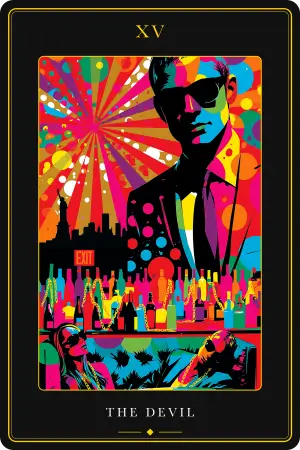


Major Arcana · 17
The Tower
The night the grid failed and the whole city learned in one heartbeat what was real and what was only decoration.
Read the complete guide: The Tower Arcana in Tarot: A Complete Guide to Symbolism and Meaning
Card at a glance
- Numerology
- XVI
- Element
- Fire
- Astrology
- Mars
- Kabbalistic path
- Peh (Hod → Netzach)
- Timing
- Sudden · without warning
- Yes / No
- Disruptive · usually no for stability
Upright
blackout
sudden collapse
revelation
eviction
awakening
liberation
cleared lot
upheaval
Reversed
fear of change
denial
delayed collapse
clinging
brownouts
unopened mail
The Tower in each deck
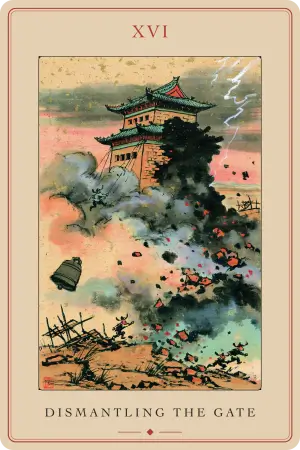
Every deck reimagines the same archetype. Compare the art, then open a deck to read its full interpretation.
Imagery and symbolism
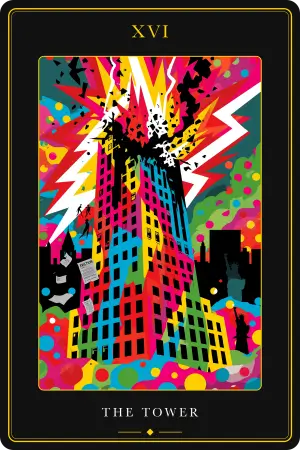
In the Tarot of New York City the Tower is a skyscraper struck by lightning over the five boroughs, rendered in the deck's pop-art language of saturated color blocks, halftone dot fields, and hard black silhouettes. Its central scene is the night of 1977, when the grid failed and every assumption about who was in control vanished at once. A tall pre-war tower rises at the middle, its floors patched together in clashing panels of magenta, cyan, yellow, red, and green. The mismatched colors are the point. This is a building assembled from confidence, from renovations and refinancings and the stories it told about itself, which is exactly why the lightning finds it.
Jagged bolts of white, red, and yellow converge on the tower from both sides of the sky. As in the classic card the lightning is sudden truth and karmic intervention, the flash that illuminates in the same instant it destroys. In the city register it is the power surge and the power failure together: the strike that lights everything brighter than noon a moment before the whole skyline goes black. The crown of the tower is blasted off in an eruption of smoke and flying debris, echoing the falling crown of the Rider-Waite image. What is lost is the top floor, the penthouse view, the illusion of being above it all. The traditional tower stood on a mountain of isolation. This one stands on Manhattan bedrock and discovers that even bedrock does not protect a bad structure.
Two small black figures fall through the air beside the building, the classic pair of tumbling silhouettes, frozen mid-air because the card is the moment of collapse and never the landing. Sheets of paper scatter across the scene, and among them, clearly legible, an EVICTION notice. This is the deck's signature lightning-on-paper. In New York the Tower rarely needs weather, since it arrives by certified mail, by termination email, by a margin call. Along the edges runs the black skyline with the Statue of Liberty appearing twice, once solid and once shadowed, watching the collapse without intervening. Liberty's presence recasts the card's promise, because what the destruction finally delivers is freedom from a structure that had become a prison.
Core meaning
The Tower is the necessary shattering of a false paradigm, the forced liberation from a bondage you would not leave on your own. The New York deck states this in the city's own history. New York demolishes itself continuously in order to exist, and its skyline is a graveyard of previous skylines. The diner that fed the block for forty years goes dark so something else can move in. Whatever in a life was built on a bad foundation eventually meets its lightning, and the strike is not malice but an inspection.
Its place in the sequence tells the rest. The Tower follows The Devil, where the Hero settled into comfortable captivities: the bottle service, the lease signed unread, the job that pays just enough to keep them, the loose chains they kept choosing at 2am and calling freedom. What a person refuses to walk away from voluntarily, the Tower removes by force. The fall is terrifying, but it is the fall that breaks the chains, and in this city no cleared lot has ever stayed empty. Whatever gets built afterward stands on ground that is finally solid.
Upright meaning
Upright, the Tower of the New York deck is the night of 1977. The grid fails, the whole city drops into the dark at once, and a massive, foundational change becomes unavoidable. It is the eviction notice on the door, the layoff email at 9am, the market wiping out a position before lunch, the building you trusted revealed as unsound. These events strike like lightning into a skyline, loud and impossible to negotiate with. Yet the deck insists on the card's second half: it feels like ruin, but it is a clearing, and whatever the initial shock, the querent comes out the other side wiser and more resilient for having survived the fire.
In love. A sudden, painful breakup or divorce, or the exposure of a hidden betrayal that shatters a partnership's foundation. It can also be an abrupt realization about your own worth inside a relationship that prompts an immediate exit.
In career. Unexpected job loss, redundancy, the collapse of a bad investment, or bankruptcy. The destruction clears out a situation that was holding you back and leaves a clean slate for something more authentic.
In finances. A crash, a margin call, or the sudden collapse of a shaky financial structure that had been standing on assumptions that no longer hold.
In health. A sudden illness, an accident, or intense migraines from long-built pressure. Not every Tower is a disaster, though. The shock can be a welcome one, a surprise pregnancy, an exciting relocation to a new borough, or the satisfying end of a toxic job.
Reversed meaning
Reversed, the explosive energy turns inward. In this deck it is the tenant who stops opening the mail because every envelope might be the notice, the landlord repainting a facade over a cracked beam, the trader doubling down instead of admitting the position is dead. The querent can smell the smoke and knows the foundation is crumbling, but clings to dead beliefs or a toxic situation out of fear of the unknown. That does not cancel the transformation. It drags it out, so instead of one clean blackout there are brownouts, flickers, a building failing floor by floor.
The other reading is quieter and more hopeful. The upheaval is entirely internal and out of public view, and the person is dismantling their own illusions before any external crisis forces the issue. Here the card is encouragement, since scheduling your own demolition, however painful, is far better than waiting for gravity to do it.
In love. Staying in a toxic marriage and suppressing deep dissatisfaction, keeping up the appearance of stability while the cracks widen behind fresh paint.
In career. Clinging to a dead-end job out of fear and ignoring the red flags piling up in the unopened drawer.
In finances. Refusing to see the warning signs, propping up an arrangement the numbers have already condemned.
In health. Ignoring severe symptoms or resisting the lifestyle change your body is clearly demanding, the bodily version of the unopened eviction letter.
Historical notes
Long before the New York deck relocated it to a blacked-out skyline, the card was anchored in the biblical Tower of Babel. Scripture only says God confounded the builders' languages, but the medieval imagination wanted a more violent ending, and folklore showed Nimrod, the tower's arrogant architect, struck by lightning and cast down while the structure burned. That image of divine wrath, reinforced by Sodom and Gomorrah, Revelation, and the fire from heaven in the Book of Job, set the pattern for falling figures and celestial fire from about 1500 onward.
Medieval Italy gave the card its concrete form. Cities like Bologna and San Gimignano bristled with tall tower-houses raised by rival families as blunt symbols of pride, and their height made them frequent lightning targets, so watching a tyrant's tower burn read to the crowd as cosmic justice. The card carried more alternate names than any other trump, among them Arrow, Fire, Lightning, and the House of the Devil. In France it settled as La Maison Dieu, the House of God, where the crenellated top knocked loose reads as a crown of revolution and the figures shifted from being crushed on the ground to falling headlong through the air. Reimported to Italy, the title became La Torre, and Waite and Pamela Colman Smith gave it its modern form in 1909, replacing the old scattered balls with twenty-two golden Yods. The New York deck inherits that whole lineage and swaps the Yods for the flying pages of leases and contracts that turned out to be provisional.
Correspondences
Number. XVI, the sixteen, which reduces to seven and makes the Tower the shadow of The Chariot. The Chariot is willpower driving hard toward a goal. The Tower is what happens when that iron will has been driving in the wrong direction all along. In the deck's terms the number reads like a demolition order posted on a facade, with the individual's own hand on the lease that signed the structure into being.
Astrology. Mars, the forceful, warlike planet. No card in the New York deck carries its signature more visibly. Mars is the red in the lightning, the siren in the dark, and the first crew on the cleared lot at dawn, force aimed at clearing away the obsolete so something stronger can grow.
Element. Fire, the cleansing blaze that burns off what is corrupt and leaves the essence behind.
Kabbalah. The Hebrew letter is Peh, meaning 'mouth,' which ties the card straight back to Babel, where the punishment was the confusion of tongues. Speech builds towering illusions, and the Tower shatters them. Its path is the twenty-seventh, running between Hod (Intellect) and Netzach (Nature), a humbling reminder that no amount of reason can outbuild the natural and divine forces above it.
Timing. The card points to something sudden and without warning. As a yes or no it reads as disruptive, usually a no for anything asking about stability.
Psychological perspective
In Jungian terms the tower is the ego's elaborate defenses, the ivory tower of pure intellect and the walls we build to feel safe from vulnerability. The New York deck gives that abstraction a street: the blackout is the moment reality refuses to match the ego's expectations, the shattering that older language called a nervous breakdown but which analysts read more precisely as the decompensation of the ego-complex, a kind of ego death. Sallie Nichols, in Jung and Tarot, names the card the Stroke of Liberation, since collapsing those defenses is what clears the way for individuation, the long work of becoming whole.
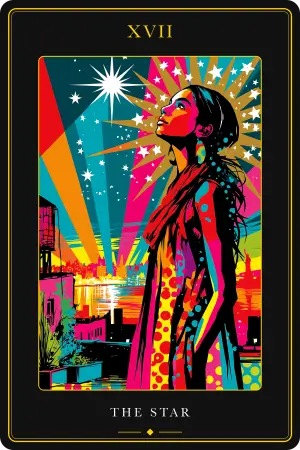
Joseph Campbell described the same event as a bolt from the blue that smashes a person's tight ego-system, the invisible prison walls that keep them in unfulfilling careers or dead relationships. Because almost no one dismantles that prison willingly, life sends a catalyst, a job loss, a divorce, a death, that blows the walls out and forces them into the unknown. His counsel for surviving it was Nietzsche's amor fati, the love of one's fate, treating the wreckage as the clearing it is rather than despairing over it. The deck makes the sequence literal. The Tower sits between The Devil and The Star, and its Star is a woman on a rooftop who can finally see stars because the lights went out. The collapse of the false light is what makes the true light visible.
The Tower across decks
Early Italian decks. The Sola Busca card names the figure Nenbroto, Nimrod himself, blasted by fire from the sky while his helmet and shield tumble down, and the Charles VI shows a fortified castle with flames bursting from cracks in the stone. Older Bolognese cards were grimmer still, two men lying flat on the ground about to be crushed by the falling masonry.
Tarot de Marseille. Under the title La Maison Dieu the tower's crown-like top is knocked loose by fire from heaven and two figures fall headlong through a field of colored spheres. Its three windows carry the legend of Saint Barbara, imprisoned in a tower where she had three windows cut for the Trinity.
Variants and modern decks. Some French and Belgian decks drop the building entirely for La Foudre, a lone tree split by lightning, while the Tarot of Paris pictures the Devil drumming before the mouth of Hell. Contemporary indie decks lean into the card's Mars energy, a few using frankly phallic imagery to stress raw force and sudden release. The New York deck sits at the modern end of that line, keeping the falling pair and the dislodged crown while trading the divine fire for a power surge and the colored spheres for flying eviction papers.
In combination and context
The Tower is the violent twin of Death, and the pair are worth reading together. Death is an organic, foreseeable ending you can meet with some grace. The Tower is the sudden collapse that arrives without warning, and it often shows up precisely when the quieter warnings of Death have gone ignored. It also completes an arc with its neighbours, sitting between The Devil and The Star: the Devil is the bondage you cling to, the Tower is the forced expulsion from it, and the Star is the peace that only becomes possible once the false structure is gone.
Drawn as advice rather than prediction, the card is a direct instruction to become the lightning yourself. If you are stuck in stagnation or a bad habit, it counsels a controlled demolition, shedding the facade and making yourself deliberately uncomfortable before the universe does it for you. New York readers often call it the 'let that go' card, and they mean it as relief. Not every Tower is a catastrophe, since it can be as small as a cancelled flight, a burst pipe, or the noisy neighbor who ruins the quiet. But whatever the scale, the city reads it the same way it reads the diner going dark: resisting the collapse prolongs the pain, while accepting it lets you rebuild on cleared ground with real materials.
Questions for reflection
- Which structure in your life are you keeping lit by sheer effort, dreading the night the power finally goes out?
- If the blackout is coming either way, where could you throw the switch yourself and schedule your own demolition?
- The last time your certainties went dark all at once, what real thing was left standing when the lights came back on?
The general meaning follows the Rider-Waite-Smith reading, the reference used across Tarot Academy. Open a specific deck above for its own interpretation.
Frequently asked questions
Explore the Tarot
Latest Posts
Discover the ancient wisdom of tarot cards and unlock the mysteries of your spiritual journey. Our blog is your gateway to understanding the rich symbolism, meanings, and practical applications of tarot reading.




















































