
 EN (English)



Major Arcana · XIX
The Sun
Smith's one bareback child under a face-bearing sun, riding out past the wall with nothing hidden and nothing held back.
Card at a glance
- Numerology
- XIX
- Element
- Fire
- Astrology
- The Sun · Leo
- Kabbalistic path
- Resh (Hod → Yesod)
- Timing
- Summer · full daylight
- Yes / No
- An emphatic yes
Upright
joy
vitality
clarity
success
self-realization
warmth
the inner child
abundance
Reversed
delayed joy
blocked energy
burnout
false happiness
loss of clarity
inflated ego
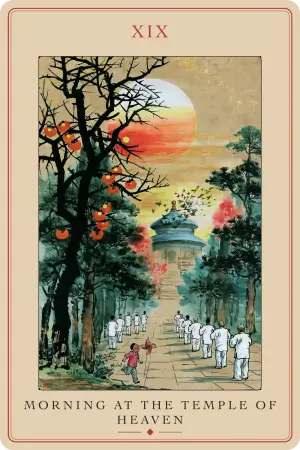
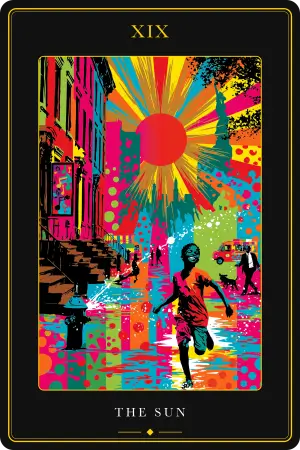
The Sun in each deck
Every deck reimagines the same archetype. Compare the art, then open a deck to read its full interpretation.
Imagery and symbolism
Waite made one deliberate break with the tradition he inherited. Every standard European Sun for four centuries showed two children before a wall, the Marseille twins, and the Golden Dawn's own deck kept them. In 1909 Waite directed Pamela Colman Smith to drop the pair and use a single naked child on a pale horse, an image he pulled from the obscure Vievil deck printed in Paris around 1650. That choice is why the Rider-Waite Sun looks nothing like the card most of Europe knew.
The sun itself fills the top of the card, personified with a calm human face. In this deck's reading it is enlightenment as an entry of light into a life, waking intuition and inner wisdom, and its shine stands for an energy that never runs out. Some readers count twenty-one distinct rays, one for each of the other Major Arcana cards. By leaving itself out of that count the card names its own job: it is the light everything else is seen by.
Below it the child rides bareback, no saddle and no reins, greeting the high vibration of the luminary above. The nudity is innocence and freedom, since nothing can be concealed in light this strong, and the red plume in the hair is the same feather The Fool wears, so the whole arc of the trumps has come back to wonder carrying its wisdom. The white horse is purity, nobility, and courage, the animal drives now carried willingly. Riding it without tack reads in this deck as freedom together with control over the inner world.
The child's left hand holds a large red banner for life force and bravery, red being the color of celebration, and it marks vitality triumphing over the stagnation of the cards just passed. Behind them a low brick wall runs across the card. It is the boundary of the known world and, read the other way, a sign that this life is protected and standing on a reliable foundation. Four huge sunflowers bloom along it for life, joy, and spiritual awakening, and they carry the four suits and the four elements in harmony turned toward the solar center. Their bright green leaves are fertility, health, and growth. The sky above is entirely clear, which Smith uses for clarity of thought and openness, and the whole background is flooded with light.
Core meaning
In the Rider-Waite deck the Sun is specifically about realizing your life purpose and the capacity to thrive. The card's claim is that life is joyful and that abundance is already around us if we learn to appreciate it, so it reads as a celebration of life holding light, truth, energy, and enlightenment together.
Waite's own note is narrower than the general reading of joy. He described the card as the passage from the manifest light of this world into the light of the world to come, a state that goes before the aspiration of Judgement and is typified by the pure heart of a child. The conscious mind has prevailed completely over the fears and illusions of the unconscious, which is what makes this the card that answers The Moon directly.
Smith's single rider tightens that meaning. Where the twins made the card about a pair inside a garden, one child riding out gives you autonomous forward momentum and mastery over the animal nature, and it is the first thing to read when this card lands in a spread. Conditions are transparent and nothing stands in the way of the goal.
Upright meaning
Upright, this is the perfect moment for positive action. Take the initiative, act on what you actually want, stay open and honest instead of hiding what you feel, and let the creative side show. Effort gets rewarded here and you receive what you worked for, in any field.
In love. Joy, clarity, and harmony, a stretch of mutual love and deep attachment where both partners feel the pull and are ready to care for each other. The bond is sincere and warm, and the happiness in it is genuine rather than performed. It can mark maturity in a relationship, confidence in the choice of partner, and a high level of trust, with shared plans and decisions made together. With other people generally it brings easy communication, generosity, and celebrations.
In career. Prosperity, recognition, and self-realization. Work brings satisfaction and confidence, the goal is clearly in view, and you know how to reach it. This is the time for leadership and decisive action, and a project or initiative is likely to land well.
In finances. The right moment to invest, launch, or expand. It points to well-deserved reward for effort already spent, favorable deals, rising fortunes, and real independence. The prosperity is conditional: it comes through hard work and skillful management of resources, not luck alone.
In health. Strong vitality and a thriving appearance, healthy skin, and physical energy worth using. It often nudges toward more daylight and active time outdoors, or a new movement practice like dancing, running, or yoga. It is also among the deck's strongest fertility signals, especially beside The Empress or the Ace of Wands, and it carries a fresh awareness of the body, its routines, and self-love.
Reversed meaning
Reversed, the light is still there but something stands in front of it. The deck reads this as an eclipse, a temporary stretch of darkness or uncertainty, with obstacles, lost clarity, and a drop in enthusiasm. Faith in your own potential can go missing for a while. The counsel is patience and a clearer look at what is actually happening, ideally from a different angle, then gradual movement forward without despair.
Reversed here the Sun also becomes blinding light that conceals reality rather than revealing it, which is where burnout and exaggerated self-importance enter. Crowley put the same warning more bluntly: without the depth of water, the sun will create a desert.
In love. Bonds weakening and feelings losing definition. Everything may look fine while something clouds the joy, with unspoken things, thinner sincerity, and less of the understanding that used to be there. The remedy is to name the problems and talk them through.
In career. Delays, disappointment, and work that has stopped feeling joyful. Too much energy goes into clearing obstacles for too little result, motivation drops, and rewards fall short of expectation. Reassess the approach, the goals, and how energy and time are being allocated.
In finances. Blocks and delays, miscalculations, poor investments, or debt. It warns against a dependence on material security that crowds out the rest of life, and against the discovery that money did not bring the happiness expected. New openings may still be hiding behind the current trouble.
In health. Low energy, fatigue, vitamin deficiency, or a body being neglected. Skin dulls, health feels fragile, and rest is genuinely needed. It marks a lost balance between mental and physical life and asks for real recovery rather than more pushing.
Historical notes
The card Waite and Smith were revising had a long and stable form. The earliest surviving Suns are classical: in the Visconti-Sforza tarocchi of about 1475 a naked winged putto crosses the sky on a stylized cloud holding a glowing mask of Helios above his head, with no terrestrial figures at all. The Sola-Busca of around 1491 wrapped the card in humanist and alchemical learning for an educated elite.
The Tarot de Marseille then fixed the standard that lasted four centuries, the earliest known example produced by Jean Noblet in Paris around 1650: a massive solar disc over two nearly identical children before a low brick wall, with drops of moisture drawn upward toward the sun for the alchemical work of distillation. The wall makes a hortus conclusus, a protected garden where innocence can play, and the twins carry Castor and Pollux and the constellation Gemini, brotherhood and the reconciliation of mortal with immortal.
Waite's own order had already systematized the card before he redesigned it. The Golden Dawn gave it the title Lord of the Fire of the World, tied it to the dying and resurrected solar gods Adonis and Balder, and defined it as the point where knowledge of the higher realms becomes available to the lower material self. Their deck kept a naked boy and girl in front of the wall, with the boy on green grass for Earth and the girl in a pool for Water, and replaced the falling teardrops with Yods, the flame-shaped first letter of the Tetragrammaton, marking the rays as divine grace entering the physical world.
Waite took the doctrine and threw out the picture. Published by William Rider & Sons in 1909 and illustrated by Smith, both of them Golden Dawn initiates, the deck reached past the twins to the Vievil card of about 1650, where a single naked youth gallops across a field on a pale horse holding a banner aloft. That motif of autonomous momentum and mastery over the animal nature is what the modern world now pictures when it thinks of The Sun.
Correspondences
Number. XIX. The digits give leadership, independence, and new beginnings in the 1 and completion, wisdom, and spirituality in the 9, so nineteen spans opening and closing processes and carries a full cycle held together by constant forward movement. It reduces first to ten, tying the card to the Wheel of Fortune as a higher octave of those cycles, mastered rather than merely suffered, and then to one, the Magician's unified self and the original cause.
Astrology. The Sun itself, and the sign Leo, the fixed fire of confidence, creative expression, generosity, and a frankly theatrical appetite for visibility. It rules the fifth house of play, joy, and creativity. In astrology the Sun governs the heart, spirit, and soul, and stands for individuality, so the card carries self-discovery and the awareness of one's true self against the inward, reflective Moon just before it.
Element. Fire, the warmth that gives life and, unchecked, scorches.
Kabbalah. The Hebrew letter is Resh, 'Head' or 'Face,' numerical value 200, the conscious mind facing reality directly. Its path is the thirtieth, running from Hod (Glory, the rational mind, on the Pillar of Severity) down into Yesod (Foundation, the subconscious and the Treasure House of Images). The Sepher Yetzirah calls it the Collecting Intelligence, since it gathers the force of the intellect and projects it downward to steady chaotic astral images with rational clarity. Unlike Path 31 or Path 32, which both reach into Malkuth, this path never leaves the mind: it is the mind illuminating itself. The card is also linked to Tiphareth, the sixth Sephirah at the center of the Tree.
Timing. Summer and the full light of day. As a yes or no this is an emphatic, unambiguous yes.
Psychological perspective
The key term for this card is enlightenment, and in the Rider-Waite reading it lands as personal transformation: self-awareness building confidence, inner freedom, and fulfillment. A person carrying its energy is balanced and self-assured, knows what they want, and has the will to get there. They rejoice in each new day, meet work with enthusiasm, hold up well under stress, and radiate enough warmth that others are drawn to them. Their luck looks effortless because their confidence makes it so.
The deck is equally clear about the failure mode, which is an excess of the same virtue. Someone this absorbed in their own ideas stops noticing problems. Optimism at that pitch dulls vigilance, real risk gets underrated, and self-belief slides into egotism. Crowley named the same danger from the Thoth side as arrogance, self-complacency, and the habit of promising much while doing nothing.
Modern practice sharpens the edge further. Where Victorian occultists saw gentle divine grace, contemporary readers describe a harsh light, a blistering brightness that sears away comfortable illusions the way the fire of Shiva burns off maya. Anyone hiding in self-deception gets exposed in broad daylight, pleasant or not. That is why the card's shadow maps so exactly onto toxic positivity, the 'good vibes only' pressure that shames real pain out of the room, and why the hardest case is drawing the Sun during a depression. Read properly it is not mockery. It exposes the lie that the darkness is permanent and insists the sun still burns above the cloud cover, asking for radical patience while the dawn comes back.
The Sun across decks
The Rider-Waite version is the outlier that became the standard, and its distinguishing move is the single rider where nearly everyone else painted a pair.
Visconti-Sforza. Around 1475 the card is a naked winged putto on a stylized cloud holding a glowing mask of Helios overhead, purely celestial, with no children, wall, or flowers.
Tarot de Marseille. The four-century European standard: two nearly identical children before a brick wall under a huge rayed sun, alchemical dew rising toward the light, the walled garden of innocence and the Gemini twins.
Golden Dawn. Waite's own order stayed with the Marseille template, a naked boy and girl holding hands before the wall, the boy on grass for Earth and the girl in water, with Hebrew Yods falling in place of the dew.
Crowley-Thoth. Painted by Lady Frieda Harris between 1938 and 1943 and published in 1969, the card is tied to the Solar Phallic current and the manifestation of True Will. Crowley kept the glory and the blossoming but added the caveat that without the depth of water the sun will only create a desert.
Modern decks. The Robin Wood Tarot follows Waite and Smith closely while shrinking the brick wall and turning the sunflowers to face the child rather than the sun, so the awakened inner child outshines the star overhead, and the rider wears a crown of white roses with a red feather. The Voyager Tarot replaces the figures with stacks of gold coins and a golden mask fringed in sunflower petals that echoes the Visconti Helios, set among Californian poppies, monarch butterflies, and a Pacific sunset. Readers uneasy with Smith's naked child, which forums nickname the 'naked baby on a horse,' reach for the Light Seer's Tarot or the Healing Light Tarot, which carry the same solar joy through emotion, silhouette, and clothed figures.
In combination and context
This card is built to be read against The Moon immediately before it. The Moon is fog, borrowed light, and fear of what hides in the dark, while Smith's Sun is a cloudless sky and a rider with nothing to conceal, so the pair together usually shows an illusion being stripped away to protect the querent's vitality. It also closes the recovery arc that runs from the Tower's collapse through the Star's fragile hope.
Its trickiest use is in reconciliation questions, where readers argue hard about it. Despite its reputation, in a broken-relationship spread the Sun often works as brutal clarity rather than reunion. It can mean real happiness arrives only by moving on alone, once the querent finally sees their own worth and values their peace over a toxic dynamic. Or a reunion flares up joyfully and then the same harsh light exposes every unresolved issue that ended it. Beside the King of Wands it can show an ex enjoying their freedom with no wish to return.
In simpler contexts the reading is direct. As an outcome it promises joy, recognition, and a phase completed on your own terms. In a fertility question, especially with The Empress or the Ace of Wands, it is among the strongest signs of a healthy pregnancy in the deck. As a significator it describes someone brimming with energy and optimism who intuitively knows how to act to succeed, and reversed it describes a person whose difficulties are blocking their potential.
Questions for reflection
- The child rides bareback with no reins. Where in your life are you still gripping the reins on something that would carry you fine without them?
- The wall behind the sunflowers is both a boundary and a protection. Which of yours is which right now?
- Where are you performing a joy you do not actually feel, and what would it take to feel it for real?
The general meaning follows the Rider-Waite-Smith reading — the reference used across Tarot Academy. Open a specific deck above for its own interpretation.
Frequently asked questions
Explore the Tarot
Latest Posts
Discover the ancient wisdom of tarot cards and unlock the mysteries of your spiritual journey. Our blog is your gateway to understanding the rich symbolism, meanings, and practical applications of tarot reading.




















































