
 EN (English)



Major Arcana · XVIII
The Moon
Smith's nocturnal landscape, where the tamed and the wild both howl at a borrowed light and the road runs off into fog.
Card at a glance
- Numerology
- XVIII
- Element
- Water
- Astrology
- Pisces · ruled by Neptune
- Kabbalistic path
- Qoph (Netzach → Malkuth)
- Timing
- Pisces season · night
- Yes / No
- Usually no · the fog hides too much to proceed
Upright
illusion
fear
intuition
subconscious
deception
anxiety
dreams
the unknown
Reversed
clarity
release of fear
truth exposed
confusion lifting
inner awareness
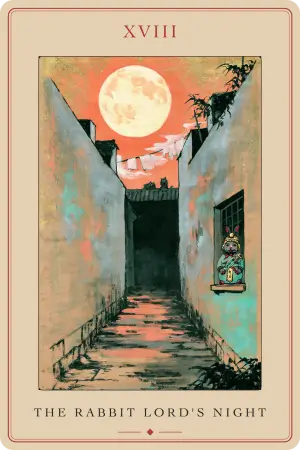
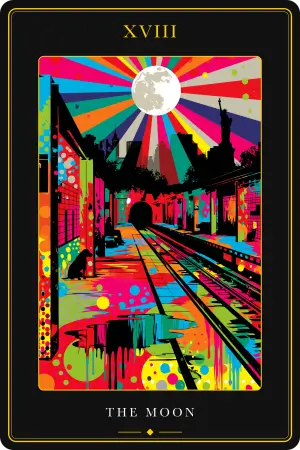
The Moon in each deck
Every deck reimagines the same archetype. Compare the art, then open a deck to read its full interpretation.
Imagery and symbolism
Pamela Colman Smith fixed the modern image of this card in 1909, and her rendering is what most readers now picture when they think of The Moon. She kept the furniture of the older Tarot de Marseille (the pool, the crayfish, the two animals, the pair of towers) but staged it as a single fully illustrated scene with deliberate psychological weight, and she carried over the meandering path that Éliphas Lévi had drawn as a trail sprinkled with blood.
A full moon dominates the sky, a faint human profile set inside a crescent, shedding a light it does not own. The moon works on the landscape like a magnet, drawing the moisture of the earth upward and pulling on the primal depths below. At the foot of the card a small pool opens, and a crayfish crawls out of it onto dry land, the oldest and most primitive stirring of consciousness climbing up out of the collective unconscious to begin its journey.
On the shore a domesticated dog and a wild wolf howl at the light from either side of the road. They are the two halves of the mind, the tamed civilized ego and the untamed primal id, and Smith shows both of them equally gripped by the irrational pull of the moon. The path between them winds off toward the horizon and passes through two tall towers that mark the threshold between the known country of the conscious mind and the uncharted territory of the unconscious. Drops of dew fall from the moon along that road, Lévi's blood-sprinkled trail softened into Smith's line. Every part of the scene is lit only at second hand, by reflected light, so nothing in it can be trusted to be quite what it appears.
Core meaning
Where the Marseille card gave you a bare emblem to interpret, the Rider-Waite deck stages the whole psychological drama as one landscape, so the meaning is legible in the picture itself. This is the card of the unconscious and of intuition, of illusion and the dark night of the soul, the murky water of instinct and the hidden truths that sit just under conscious awareness.
In the Rider-Waite reading it stands for the unknown, for secrecy, and for unpredictability, and it points to a feminine current of knowledge that arrives through feeling rather than analysis. When it turns up it behaves less like a forecast than like a mirror, reflecting a reality the querent is currently distorting with their own fears, projections, and old wounds. Its steady warning is that things are not what they seem and that vital information is missing. Its quieter invitation is to stop fighting the dark and go down into it, following the dreams and the shadow material toward the buried thing that has to be recovered before the fog will lift.
Upright meaning
Upright, The Moon brings illusion, instability, and insecurity. The situation is not what it appears, a repressed memory may be resurfacing as sadness or anxiety, and the plain practical counsel is to make no permanent decision while the road is this obscured.
In love. Murky emotional waters. The card can point to deception, a secret life, or infidelity, especially next to the Seven of Swords or The Devil. Just as often it is internal paranoia, an old wound projecting malice onto an innocent partner and mistaking a spell of emotional flux for failure.
In career. A toxic environment built on lies, hidden agendas, and false promises, where the signed contract may not match what was said behind closed doors. Trust your gut, avoid any gamble, and wait for the morning sun to burn off the fog before you commit.
In finances. Too little information to move safely. Not a time for speculation or risk.
In health. Mental health above all: depression, anxiety, paranoia, and for women a link to hormonal and menstrual cycles. The card also reads strongly as pregnancy, life developing unseen in the dark of the womb.
Reversed meaning
Reversed, the fog starts to clear and the illusions dissolve. The card marks the release of fear, the unblocking of repressed emotion, and the end of a stretch of confusion. The clarity is liberating even when it arrives brutally.
Often a reversed Moon means a secret, a lie, or a hard truth that had been buried is finally hauled into daylight. The self-deception can no longer hold, and though the exposure hurts, the collapse of the illusion brings real relief and lets the querent face the problem on grounded footing.
In love. A deception coming to light, or the lifting of a paranoia that had been poisoning a sound relationship.
In career. Clarity at last, a hidden agenda exposed so that confident, informed decisions become possible again.
In finances. The missing information surfaces, and a situation that felt too risky to touch becomes legible.
In health. Anxiety easing and a clearer read on what the body has actually been signaling, once fear stops distorting it.
Historical notes
The Rider-Waite-Smith Moon is the endpoint of a long evolution, and Waite and Smith built it by synthesis rather than invention. Published in 1909 by William Rider & Sons, the deck was conceived by Arthur Edward Waite and illustrated by Pamela Colman Smith, both initiates of the Hermetic Order of the Golden Dawn. Waite's aim was to encode the order's teaching in the pictures while moving away from the bare pips of the Marseille tradition toward fully illustrated scenes.
For this card Smith took the standardized Marseille template (the water, the crayfish, the two howling animals, the two towers) and rendered it with psychological depth, then folded in Lévi's nineteenth-century addition of the meandering path. Behind that template lay stranger beginnings. In the fifteenth-century Visconti-Sforza deck the card was not a landscape at all but the goddess Diana with an unstrung bow and a white girdle, an allegory of chastity for the Milanese court, and other early decks showed a man buckling under the weight of the moon like Atlas or a man serenading a woman by moonlight. The nocturnal landscape and its turn toward night and deception arrived with the mass-produced Marseille decks of the seventeenth and eighteenth centuries, whose first recorded divinatory meaning, in a 1750 manuscript, was simply 'Night.' Smith inherited all of it and gave it the form the modern world reads.
Correspondences
Number. XVIII, the eighteen, which reduces to nine (1 + 8) and ties The Moon to The Hermit. Both are cards of isolation and the turn inward, but the Hermit withdraws on purpose by his own lantern, while the Moon is a forced, unconscious immersion in the dark. It stands as the last psychological hurdle before the triumph of The Sun.
Astrology. Pisces, the twelfth sign and the wide ocean of the collective unconscious, ruled by Neptune, the planet of dreams and dissolving boundaries that blurs the line between reality and fantasy.
Element. Water, formless and reflective, the medium of emotion and instinct and a fitting mirror for a moon that only borrows its light.
Kabbalah. The Hebrew letter is Qoph, 'the back of the head,' pointing to the cerebellum and brainstem, the oldest and most instinctual part of the brain. Its path is the nineteenth, running from Netzach down into Malkuth, the descent into dense material reality that the Sepher Yetzirah names the Corporeal Intelligence.
Timing. Pisces season and the hours of night. As a yes or no the card almost always reads no, not a permanent refusal but a sign that too much fog and too little information stand in the way.
Psychological perspective
The Rider-Waite Moon is the deck's clearest portrait of the Shadow, the repressed and disowned parts of the self, all the desires and traumas the conscious ego finds too painful to hold. The Jungian analyst Marie-Louise von Franz read the moon as the Anima, the buried feminine current of moods and intuition, which is why Smith's card so often mirrors the querent's inner weather instead of forecasting an outer event.
The path of Qoph runs through the brainstem, and that is why logic is useless here. Descending it means confronting biological drives, old survival fears, and the unreasoning parts of the psyche, and crossing a hallucinatory landscape on intuition alone without tipping into paranoia. The dog and the wolf stage the same problem in miniature: the civilized self and the animal self howl at one light, and the work is not to silence either voice but to walk the road between them without losing your footing.
The Moon across decks
Set beside its siblings, the Rider-Waite version stands out for staging the psyche as a full landscape rather than an emblem or a diagram.
Visconti-Sforza. The oldest surviving version is purely allegorical, the huntress Diana with her unstrung bow and a white girdle for chastity, with none of the later crayfish, animals, or towers in sight.
Tarot de Marseille. Here the template that Smith would inherit locks in: a pool with a crayfish, two dogs baying at a many-rayed moon, and two towers on the road, a scene of nighttime distortion whose earliest recorded meaning was just 'Night.'
Crowley-Thoth. Crowley and Lady Frieda Harris discard the landscape entirely and turn the card into a Gateway of Resurrection. Two jackal-headed Anubis gods stand as psychopomps guarding dark pillars, and below them the scarab god Kephera pushes the sun's disk up through the underworld toward dawn, while nine Yod-shaped drops of blood fall along the path as fertilized seeds, terror and rebirth in one image.
In combination and context
The Moon is most often confused with The High Priestess, and telling them apart is the key to reading it. Both are lunar, feminine cards of secrets and intuition, but the Priestess is the subconscious in its serene, elevated form, the wisdom you set out to uncover, while the Moon is the raw unconscious, the secrets you hide from yourself out of fear. The Priestess gently illuminates the truth and asks for quiet meditation; the Moon distorts it and demands real shadow work.
The neighbouring cards sharpen the warning. With The Tower it points to a self-deception or fraud that triggers sudden collapse; with Justice, to false accusations or slander built on lies; with The Lovers, to an illusion of love or a false lover. Beside the Seven of Swords or The Devil it reads as a real red flag for deceit, though an experienced reader always weighs an external betrayal against the querent's own paranoia.
One bright exception cuts through the gloom. In a fertility question the Moon is a celebrated sign of pregnancy, a rival to The Empress, the unseen life growing in the dark of the womb, and its falling drops read as the seeds of conception.
Questions for reflection
- What truth are you keeping from yourself because meeting it in daylight feels too dangerous?
- Is the threat you fear real and outside you, or a shadow cast by an old wound of your own?
- Which choice are you rushing to make in the fog that would read far more clearly by morning?
The general meaning follows the Rider-Waite-Smith reading — the reference used across Tarot Academy. Open a specific deck above for its own interpretation.
Frequently asked questions
Explore the Tarot
Latest Posts
Discover the ancient wisdom of tarot cards and unlock the mysteries of your spiritual journey. Our blog is your gateway to understanding the rich symbolism, meanings, and practical applications of tarot reading.




















































