
 EN (English)



Major Arcana · XII
The Hanged Man
Smith's chosen suspension: a serene hang that trades upright control for the truer, inverted view.
Card at a glance
- Numerology
- XII
- Element
- Water
- Astrology
- Neptune · Pisces
- Kabbalistic path
- Mem (Geburah → Hod)
- Timing
- Late winter · Pisces season
- Yes / No
- Not yet · a pause
Upright
conscious sacrifice
surrender
inverted perspective
suspension
patience
re-evaluation
spiritual growth
letting go
Reversed
stagnation
stubbornness
fear of change
procrastination
martyrdom
refusal to change
inaction
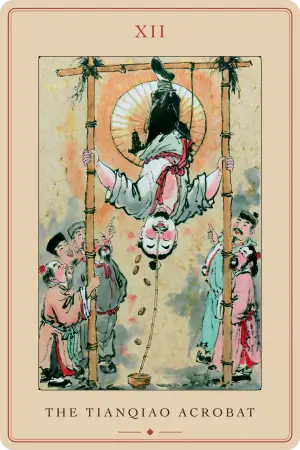
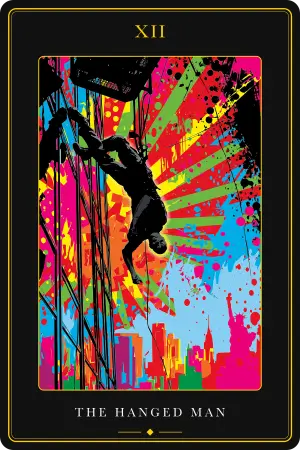
The Hanged Man in each deck
Every deck reimagines the same archetype. Compare the art, then open a deck to read its full interpretation.
Imagery and symbolism
Pamela Colman Smith's card, drawn for the 1909 Rider-Waite deck under the direction of A. E. Waite, shows a young man hung by one ankle from a wooden beam. His free leg crosses behind the other to make a figure four, his hands are tucked out of sight behind his back, and a bright yellow nimbus rings his head. The pose reads as torture, yet his eyes are open and his face is calm. That contradiction is the card: this is a suspension he chose, not an execution forced on him.
In The Pictorial Key to the Tarot, Waite dictates the geometry Smith drew. The gallows is a Tau cross, the T-shaped cross of St. Antony the Great and monastic asceticism, and it is made of living wood with leaves still growing on it, which turns an instrument of death into a Tree of Life connecting earth and heaven. Green shoots break from the beam to say that even this hard suspension brings growth.
Smith encoded the rest as alchemy. Seen from the man's own upside-down orientation, his crossed legs point up as the fire triangle while his arms and head fall as the water triangle, and the two together draw the alchemical sign for sulphur, the active principle mid-transmutation. His legs also form a fylfot cross, an ancient figure tied in Hindu use to Shakti, the primordial cosmic energy. The palette carries the same balance: a blue tunic for water, passivity, and the subconscious deep, red leggings for fire and courage. A ribbon binds his right leg to the tree while the left hangs free, and the glowing halo is the enlightenment the pose finally produces.
Core meaning
In this deck the Hanged Man is conscious self-sacrifice and an inverted view of reality, a transitional pause that works as a crucible for insight. Its logic is exchange: lasting value costs the surrender of immediate comfort. To hang willingly is to trust the rope is a tether rather than a noose, to stop struggling to stay upright and let the world turn over so you can see it from the other side.
He sits at a pivot in the Major Arcana, right after Strength and just before Death, the surrender of ego before its total clearing. His number, twelve, reduces to three and ties him to The Empress: if she is the vessel of creation, he is the material inside it, dissolving and reorganizing before it can be reborn. The card asks for the one thing modern life resists most, a deliberate stop, and treats that halt as an opening for internal change rather than a problem to escape.
Upright meaning
Upright, the Hanged Man marks a delay that is either forced on you or genuinely needed, a pause to reassess your values and let a situation ripen. It asks for radical acceptance and warns against the hubris of forcing the timeline. The reward for surrendering the struggle is a new perspective, the shift that only comes from letting yourself hang inverted for a while.
In love. Waiting and emotional suspension. The relationship is on hold while you reevaluate your feelings, and the phase often asks for real self-sacrifice for a partner's sake. Read for someone's feelings, it shows deep contemplation, withdrawn and not yet ready to act, though not indifferent.
In career. A forced period of stagnation to accept as time to reassess your trajectory. Long-awaited changes take even longer to arrive. You may drop current projects or sacrifice immediate comfort to focus on a more promising long-term path.
In finances. A suspension in your affairs and a loss of immediate stability. Hold off on new investments or major deals, and expect to trade short-term cash for a much larger long-term goal.
In health. A full pause to reexamine your habits. Delay drastic changes, invert your standard approach to diet and exercise, and let deliberate rest do the work that forced activity cannot.
Reversed meaning
Reversed, the surrender sours into stubborn stagnation and an active refusal to change perspective. The querent is stuck in the past, avoiding a crucial decision, paralyzed by helplessness while outdated fears anchor them in place. Often the pause has become sheer procrastination, or busyness dressed up as progress to avoid the real issue underneath.
In love. Toxic stagnation and a refusal to compromise. One partner sacrifices everything while the other gives nothing, breeding resentment, and waiting has decayed into apathy. The martyr role has to be dropped.
In career. Stubbornness and a refusal to adapt, time wasted in a fruitless wait. Processes stall because there is no will to change tactics, and opportunities pass out of fear of change.
In finances. A refusal to face financial reality and no line between true needs and mere wants, living at the expense of tomorrow by piling up debt without a plan.
In health. A reckless disregard for the body's warning signs, neglected sleep and diet, and egoic resistance to a transition that clearly needs to happen.
Historical notes
The card began as a punishment. Its imagery comes from the Italian pittura infamante, the 'defaming portrait' that municipal governments in Florence, Bologna, and Milan commissioned from the fourteenth to the sixteenth centuries to shame traitors, debtors, and fraudsters who had fled justice. Hanging a figure upside down by one foot was the standard motif for a condottiere who had betrayed his employer, and public shame of this kind was reckoned worse than death. Botticelli painted the Pazzi conspirators this way in 1478 on the walls of the Bargello.
Early cards named the figure outright as Il Traditore, 'The Traitor.' In the fifteenth-century Charles VI deck he clutches two heavy money bags, an image any devout Italian read as Judas Iscariot and his thirty pieces of silver. The criminality softened over time. The Visconti-Sforza deck made him a calmer, golden-haired figure without the bags, the Minchiate decks an acrobat holding two roundels, and by the Tarot de Marseille his expression had turned to serene trance. Smith and Waite completed the transformation for this deck, reading the gallows as a Tau cross of living wood and the whole scene as voluntary spiritual asceticism rather than municipal death.
Correspondences
Number. XII, the twelve, which reduces to three and links the Hanged Man to The Empress, the vessel of creation whose contents he is, dissolving inside it.
Astrology. Neptune, ruler of dreams, illusion, altered states, and spiritual surrender, working through Pisces, the twelfth sign and its house of the unconscious, isolation, and self-undoing. Some modern readers add Ophiuchus, the serpent-handler and outsider 'thirteenth sign,' for the card's willingness to live outside ordinary society.
Element. Water, the medium of reflection, emotion, and the subconscious, fixed here by the card's Hebrew letter.
Kabbalah. In the Golden Dawn system carried into this deck, the letter is Mem, which means 'water,' and its path joins Geburah (Severity) to Hod (Splendor), plunged into the water of creation where old assumptions must dissolve. The older French school of Éliphas Lévi assigned the letter Lamed instead, a lingering point of schism between the traditions.
Elemental dignity. As a yes or no the card answers 'not yet,' a pause rather than a verdict. Beside a fast card like the Eight of Wands it reads as the brake to that card's acceleration.
Psychological perspective
For Jung, the Hanged Man is the crucified ego and its descent into the unconscious. His insight is that consciousness does not mature by addition, by piling up facts and achievements, but by subtraction, by letting false certainties and protective masks fall away. That is why the pose hurts. The modern world treats stillness as weakness and measures worth by constant motion, so the ego writhes against any delay and tightens its own noose by demanding immediate action.
The state the card describes is the unbearable middle, the liminal gap between the death of an old paradigm and the birth of the next. Jung's method of active imagination worked this territory deliberately, letting suppressed material surface without the ego steering. The unconscious does the same on its own: force an issue too hard in waking life and it answers with dreams of being trapped, inverted, or drowning, staging the Hanged Man to make you look from another side. The way through is closer to Wu Wei, the effortless non-action of the Tao, trusting the rope to hold while you stop fighting it.
The Hanged Man across decks
This deck's version is the endpoint of a long softening, so it reads best against what came before and after it.
Early Italian decks. The oldest versions show the money bags of Il Traditore, the traitor and stand-in for Judas, before the Visconti-Sforza calmed him into a golden-haired figure with the bags gone and the shame draining out of the image.
Tarot de Marseille. The suspending rope or cut branch is often shaped like a small spoon, a nod to alchemical transformation, and the gibbet carries six red-painted branch stumps on each side, twelve bloody cuts that occultists tie to the twelve signs of the zodiac. In the Jacques Vieville version the numeral is set so the card must be turned upright to read, which brings solar and lunar mounds into view beside the figure's head.
Where Smith's card differs. Rather than stumps or money bags, Smith gives the beam living leaves and the figure a halo, and encodes the fylfot cross, the elemental triangles, and the sulphur sign that Waite spelled out in The Pictorial Key. Later inclusive decks push past it again: the Next World Tarot and Star Spinner Tarot rename him 'The Hanged One' and reimagine the figure as a pole dancer, turning voluntary inversion into an emblem of bodily autonomy.
In combination and context
The Hanged Man is a card of timing, and it colors its neighbors by slowing them. Set beside the Eight of Wands, all speed and fast replies, it counsels the opposite, a suspension that says the quick move is the wrong one right now. Placed with Death, which follows it directly in the sequence, it is the surrender that precedes the clearing, the ego loosening its grip before the old form is cut away. Drawn with The Lovers around an obsessive attachment, it can warn of a person willing to endure real indignity to win someone, a bond badly out of balance.
Spread position sharpens the reading. In an outcome it predicts a mandatory pause, a matter still gestating that acting on now would only spoil. As an obstacle it names the ego's refusal to change perspective, the very stuckness the card exists to break. Wherever it lands, the instruction holds: stop forcing, hang for a while, and let the inverted view show you what upright striving could not.
Questions for reflection
- What are you gripping to stay upright that you could set down long enough to see it differently?
- Is the pause you resent an actual dead end, or something still gestating that is not ready yet?
- Where has your busyness become a way of avoiding the stillness this situation is asking for?
The general meaning follows the Rider-Waite-Smith reading — the reference used across Tarot Academy. Open a specific deck above for its own interpretation.
Frequently asked questions
Explore the Tarot
Latest Posts
Discover the ancient wisdom of tarot cards and unlock the mysteries of your spiritual journey. Our blog is your gateway to understanding the rich symbolism, meanings, and practical applications of tarot reading.




















































