
 EN (English)



Minor Arcana · Pentacles (Earth)
Ten of Pentacles
The Rider-Waite family estate: three generations under one arch, wealth grown solid enough to inherit.
Card at a glance
- Numerology
- Ten
- Element
- Earth
- Astrology
- Mercury in Virgo (third decan)
- Kabbalistic path
- Malkuth (Kingdom)
- Timing
- Late Virgo season, harvest's end
- Yes / No
- Upright yes · Reversed no
Upright
Legacy
Generational wealth
Family
Permanence
Security
Inheritance
Tradition
Stability
Reversed
Inheritance disputes
Financial collapse
Family feuds
Gilded cage
Instability
Broken tradition
Stagnation
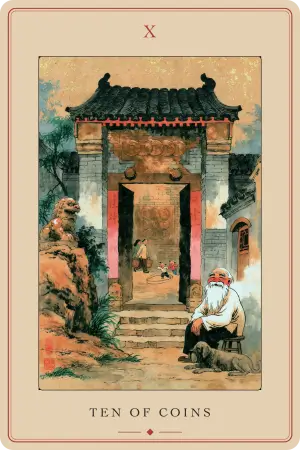
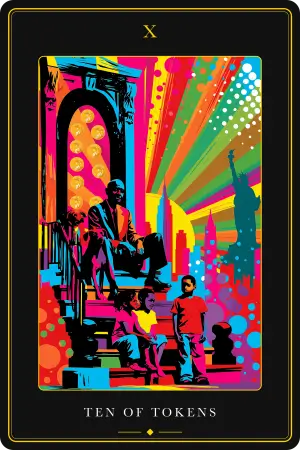
Ten of Pentacles in each deck
Every deck reimagines the same archetype. Compare the art, then open a deck to read its full interpretation.
Imagery and symbolism
The Rider-Waite-Smith scene gathers three generations under one stone archway. In the foreground an elderly grey-bearded patriarch sits on a bench, wrapped in a heavy robe embroidered with grapevines. Through the arch a younger man and woman stand in the courtyard of a sprawling estate, a small child at the mother's skirt, with two white dogs among them, one at the old man's feet and one under the child's hand.
This deck reads the family as a picture of society and its settled values, with harmony in the home taken as the foundation of prosperity. The elderly man carries the wisdom of a long life; the couple are the present generation enjoying what they have; the child is the future the wealth is meant for, and the boy at play with the dog stands for a carefree, protected childhood. The grapevines on the robe mark a long and fruitful life, and the coat of arms cut into the stone fixes the theme of old money and inherited standing. The stone arch works as a portal between one stage of life and the next, its engravings a note on the passage of time. A house with a tower stands for seclusion and safety, the castle in the distance for permanence and goals already reached, and the clear blue sky for the stability of present conditions. Most deliberate of all, the ten heavy pentacles are not scattered but laid out in the exact pattern of the Kabbalistic Tree of Life, set over the domestic scene to say that earthly wealth rests on a spiritual order, the material and the spiritual held in balance.
Core meaning
The Ten of Pentacles completes the suit of earth, the point where long work has hardened into legacy. In this deck it reads as the harvest of a life well built: wealth, well-being, inheritance, and the family traditions that hold a household together. The Golden Dawn titled it the Lord of Wealth, and its real subject is the keeping and passing on of resources, not the gaining of them.
On the Tree of Life the number ten belongs to Malkuth, the Kingdom, the final sphere where divine energy settles fully into matter. In the earth suit that makes it Malkuth in Assiah, the most material step of the most material world, which is why the card sits so solid. Ten carries a second note as well. In numerology it closes one cycle and opens the next, the movement from one back to zero, so the completeness here is a platform to start again from rather than a dead end, with everything already built kept intact as the spiral turns upward.
Upright meaning
Upright, the Ten of Pentacles is one of the most reassuring cards in the deck. It promises security that lasts, wealth built on a foundation laid over years, and a success that reaches past the individual to a family, a team, or a community. Maturity and material stability have been reached, and the reward is there to enjoy and to share. This deck ties true wealth to more than money: to a warm home, real family support, and confidence in what is coming.
In love. A relationship that has reached wholeness, a family life built on comfort and mutual respect. It confirms a bond strengthened over a long journey and settled into something durable, valued for its security and for its place in wider family life.
In career. Long-term stability and a lasting reputation, a major project brought to completion, or a step up within an established structure. It favours the durable institution or family business over a risky short-term gamble, with resources managed wisely and plans standing on firm ground.
In finances. Prosperity resting on a solid base: matured assets, property, inheritance, and steady returns from long-term investment. You reach the comfort you had hoped for, safe enough now to share what you have with the people close to you.
In health. Strong, stable health earned through a balanced life, good energy, and genuine satisfaction with your body. As a card of lineage it also points to inherited patterns, a reminder to know the family history and mind what runs in the blood.
Reversed meaning
Reversed, the solid structure gives way. On a material level it is the collapse of something assumed permanent: a family business going bankrupt, an estate lost, savings drained away. Because the foundation was built slowly, its fall lands hard, often pulling debt and disorder across several people at once. There is frequently a fear of change here too, a reluctance to loosen the grip on stability, and friction with relatives.
The deeper shadow is the toxicity of family and legacy. It shows bitter fights over inheritance, wills turned into weapons, and relatives treated as obstacles to money rather than as people. It is the gilded cage of tradition, where access to wealth is used to enforce compliance and a person cannot live honestly without risking the family name. Sometimes the wealth is genuinely in hand but the happiness that should come with it is missing. The work the card asks is often the hard break: choosing autonomy over an inheritance, or repairing the wounds an earlier generation handed down.
In love. A relationship that keeps its form but has lost its spirit, or a partnership strained by family pressure and beginning to fracture.
In career. A supposedly stable job or institution that is quietly failing, or a family-business dynamic turned toxic and draining.
In finances. Sudden instability, thoughtless spending, overreliance on possessions, or wealth stagnating into a lifeless vault instead of circulating.
In health. Neglected physical foundations, inherited bad habits, or the bodily toll of family stress.
Historical notes
The older Marseille tradition drew the Ten of Coins as a geometric arrangement of pentacles without figures, its meaning read from number rather than from any scene. The narrative image most readers know arrived in 1909 with the Rider-Waite-Smith deck.
Pamela Colman Smith, working under Arthur Edward Waite, filled the card with allegory: the aging patriarch, the estate, the three generations, and the Tree of Life hidden in the coins. Some readers link the seated old man to Odysseus home at last in Ithaca, recognised only by his loyal hound, an image of the dynasty-builder who has become a stranger in the world he made. The emotional reserve between the figures is set there on purpose, a quiet note of unease beneath the material triumph on the surface.
Correspondences
Number. Ten, which on the Tree of Life is Malkuth, the Kingdom, the final coagulation of energy into matter. It is completion, and also the end that must eventually return to the Ace to begin again.
Astrology. Mercury in the third decan of Virgo (roughly September 12 to 22). Mercury rules and is exalted in Virgo, so intellect and method fuse into what astrologers call technical virtuosity, the grand vision broken down into daily, manageable procedure. This gives the card its Golden Dawn title, the Lord of Wealth.
Element. Earth, through the suit of Pentacles: property, body, money, and the tangible world.
Kabbalah. The sephirah Malkuth, the lowest sphere in Assiah, the world of action, where the higher energies finally rest in solid form.
Elemental dignity. As a dense Earth card it anchors a spread and grounds Water and Fire around it, though stacked with other heavy cards it can read as inertia, wealth too settled to move.
Psychological perspective
Read for the inner life, the Ten of Pentacles is about what a person inherits and what they pass on, and not only in money. It points to inherited thought patterns, the customs and habits and assumptions handed down through a family, which serve as a foundation or a burden depending on how consciously they are looked at. The card asks the querent to tell a tradition that supports them apart from one that traps them.
Crowley added a warning that fits this exactly: wealth that stops circulating begins to decay. A fortune with no purpose becomes a stagnant vault, and a family held together only by its assets loses its life. This deck offers the healthier image against that risk. The grandfather does not hoard; he sits in the middle of the family scene and witnesses the life he helped create. The developmental task is that kind of stewardship, keeping the structure alive and generous rather than letting it harden into a monument or a means of control.
The Ten of Pentacles across decks
Against the other foundational decks, the Rider-Waite-Smith version stands out for its human drama. The Tarot de Marseille shows an abstract arrangement of ten coins, meaning carried by number alone, with none of the family scene. This deck gives the card the crowded estate with its three generations and the Tree of Life woven into the coins, the reading this page follows.
Crowley and Harris's Thoth deck, titling the card Wealth, drops the human figures for ten golden coins arranged as the Tree of Life against a field of violet, resembling a heavy sealed vault, with Malkuth at the bottom as the largest and heaviest coin. It represents Adam Kadmon, the primordial human, within the vault of the material world, and carries Crowley's blunt caveat that abundance beyond a certain point loses its dynamism and starts to decay. The card also invites comparison within a reading: the Ten of Cups matches it for emotional fulfilment where this one is structural, and the Nine of Pentacles offers solitary luxury where the Ten answers to a whole bloodline.
In combination and context
The Ten of Pentacles reads best against its neighbours. Beside the Ten of Cups it marks the line between structural and emotional success: a marriage secure and prosperous on paper is not the same as one deeply in love. Beside the Nine of Pentacles it marks the shift from the individual to the collective, from a feast for one to a trust fund and an estate that has to be managed for others. In breakup readings modern practitioners often take it as a deadlock, a relationship so crystallised by history and pride that it cannot move, which turns the card into a push to rebuild one's own foundations instead.
Position sharpens it. In a past slot it points to the settled security the present was built on. As advice it counsels putting down roots and tending what you have. As an outcome it promises lasting, inheritable success. In a yes-or-no reading it is a strong yes upright, and reversed a no that warns the ground you thought was solid may be giving way.
Questions for reflection
- What am I building now that I want still standing generations from here?
- Which of the traditions I inherited are a foundation, and which have quietly become a cage?
- Where have I let security matter so much that I have neglected the people inside it?
The general meaning follows the Rider-Waite-Smith reading — the reference used across Tarot Academy. Open a specific deck above for its own interpretation.
Frequently asked questions
Explore the Tarot
Latest Posts
Discover the ancient wisdom of tarot cards and unlock the mysteries of your spiritual journey. Our blog is your gateway to understanding the rich symbolism, meanings, and practical applications of tarot reading.




















































