
 EN (English)


Minor Arcana · Pentacles (Earth)
Ten of Tokens
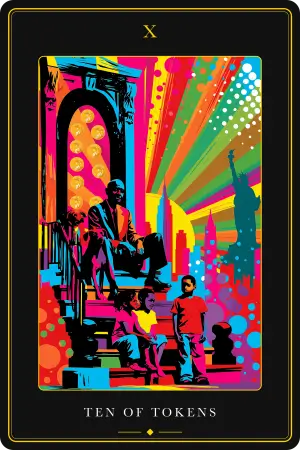
Legacy made concrete: a brownstone held three generations, the deed in the family's name, ten tokens hung in the open doorway where everyone walks past them.
Read the complete guide: Ten of Pentacles Tarot Card: A Complete Guide to Its Symbolism and Meaning
Card at a glance
- Numerology
- 10
- Element
- Earth
- Astrology
- Mercury · Virgo (third decan)
- Kabbalistic path
- Malkuth (Kingdom) in Assiah
- Timing
- September 12 to 22 · third decan of Virgo
- Yes / No
- Upright yes · Reversed no
Upright
legacy
the family brownstone
generational wealth
roots on one block
inheritance
the name the neighborhood knows
security that shelters others
the long game paid off
Reversed
the building sold
contested inheritance
family fight over money
the business without its founder
gilded cage
instability
wealth without warmth
Ten of Tokens in each deck
Every deck reimagines the same archetype. Compare the art, then open a deck to read its full interpretation.
Imagery and symbolism
In the Tarot of New York City the Ten of Tokens is a brownstone stoop in the evening, and it is the whole suit's answer to the question of what all the hustle was for. At the center an elderly man sits in a suit, one leg crossed over the other, calm and unhurried. He is this deck's version of the grey-bearded patriarch on the Rider-Waite-Smith card, the generation that built the thing. He does not guard the house. He belongs to it so completely that the stone steps read like a throne, and his stillness is the stillness of someone with nothing left to prove.
Beside him a dog leans in. It is the old emblem of loyalty and of a household safe enough for animals and children to be easy in it. Below the man on the steps sit three kids, the future of the line, not posed for anyone, just there the way kids are on a stoop on a warm night. Past, present, and future occupy the same address. That is the card's core statement, made without a word of explanation.
Behind the man rises the arched doorway of the brownstone, and inside the arch hang ten golden tokens laid out in the pattern of the Kabbalah's Tree of Life, exactly as the ten pentacles hang in the Rider-Waite-Smith original. The doorway does double duty as the engraved stone arch of the older card and as a literal portal: the threshold between generations, wealth framed inside the family home. The tokens hang in the doorway and not in a vault, and that placement is the point. This is money lived in and walked past daily rather than locked away.
The stoop itself is New York's great inheritance symbol, the stone steps where the family name is known and where the older generation watches the younger one grow up in public. Holding a stoop for three generations in this city is the material achievement the entire suit of Tokens climbs toward. Behind the family a sunburst breaks over the skyline in rays of every color, the clear sky of the original card rendered as pop-art assurance that the weather over this household is good. The Empire State Building stands in for the distant castle of the old image, a marker of permanence and goals already reached. At the edge of the scene the Statue of Liberty raises her torch, the promise made to whichever ancestor arrived with nothing, now visibly kept. Fields of halftone dots drift through the whole picture like confetti that needs no occasion.
Core meaning
The Ten of Tokens is the card of arrival at the security most of the city only dreams about: the deed instead of the lease, the business with the family name over the door, the stoop where three generations sit in the evening light. It is the Rider-Waite-Smith Ten of Pentacles translated into New York's most concrete terms. It marks the successful end of a long project, the peak of material stability, or prosperity that comes through family, an inheritance, or a foundation someone before you poured. This is wealth built slowly on solid ground, expanded over years, and now reliable enough to shelter more than the person who built it.
The card points to the moment when work, home, and family finally hold together. Rent is no longer the first thought of the month, the household runs, and the block knows your name. In the Golden Dawn tradition the Ten of Pentacles carried the title Lord of Wealth, and the meaning survives the move uptown: real wealth is not just getting resources but having the sense to maintain, manage, and pass them on. The tokens in the open doorway say the same thing the title does. Legacy here is something tended, walked through daily, kept in use rather than kept behind a wall.
Upright meaning
Upright, the Ten of Tokens is the long game paying off. Something you built or inherited has reached genuine maturity and is now solid enough to lean on and to shelter others. The counsel that comes with it is simple. Enjoy what has been built, and share it. This is the time to host the dinner, to hand the keys or the know-how down the steps, to say out loud what the family has actually accomplished. Keep tending what you established, because legacy is maintenance rather than a monument, and think in decades: whatever you decide now, decide it for the people who will sit on this stoop after you.
In love. This is the love that became a home. The relationship has a foundation, often a literal one: shared housing, joined finances, a place at each other's family tables. It can mark a move to a new level of commitment, moving in, marriage, buying the place, blending families, undertaken on years of demonstrated reliability rather than in a rush of feeling. The partnership sits inside a wider web of relatives, friends, and neighbors who hold it up, and it promises security and confidence in a shared future.
In career. Professional arrival. Stability reached through long effort, the position secure, the reputation established, your name itself starting to open doors. It can mark the completion of a major project, a promotion that formalizes what you already carry, or a workplace that runs like the card's brownstone, with mentorship flowing from senior to junior and institutional knowledge handed down rather than lost. Changes at work in this period tend to be improvements.
In finances. The strongest card of arrival in the suit: financial stability achieved, the long game paid off. It can signify property finally owned rather than rented, family money passing to you, or steady wealth grown over years. It often marks the moment money stops being the first anxiety of the month. A favorable time for consolidating assets and formalizing arrangements, the deeds, wills, and trusts that are the paperwork of continuity, and for sharing wealth with family without fear, because the foundation can carry it.
In health. Well-being with a foundation, health built the way the family built its house, through years of steady maintenance rather than dramatic renovation. It signifies stable good condition and vitality, the results of consistent care becoming visible. As the card of legacy it also touches the body's inheritance: good constitution passed down, family longevity, and the wisdom to know your family's vulnerabilities and tend to them early. Treat physical well-being the way the card treats wealth, as capital to be maintained and enjoyed.
Reversed meaning
Reversed, the established life develops cracks. The building goes up for sale, the family business struggles to outlive its founder, the inheritance turns into a dispute, the block changes faster than the household can absorb. It can mean financial instability where there used to be certainty, or family conflict over money, property, and who owes what to whom. Sometimes it describes the opposite trap: every material box checked, the brownstone, the accounts, the standing, and no joy in any of it, the wealth intact but the warmth gone from the stoop. The medicine is to address the structural problem before it addresses you. If there are unresolved questions in the family, have the uncomfortable conversation at the kitchen table now, rather than later through lawyers.
In love. Cracks in what was supposed to be permanent: the apartment, the routines, the joined accounts all still there, and the warmth inside them thinning. Family can be the pressure point, disapproving relatives or conflict over money and property. Financial stress is a frequent culprit, so the card advises naming the money problem openly before it corrodes everything else. Sometimes it describes a relationship kept for stability's sake alone, both partners quietly wondering. The counsel is honest reassessment: decide together what the foundation is actually for, then rebuild it or, with care, admit this house cannot stand.
In career. Instability in what seemed settled: the long-held job suddenly at risk, the institution restructuring, stagnation dressed up as security. It can flag golden handcuffs, staying in a role only for the stability while the work has gone dead, or the senior person whose knowledge is hoarded rather than handed down. It counsels preparing the foundation now, the savings and the network and the updated skills, and it can be an invitation to stop fearing the big decision and, if need be, to start again while carrying the experience rather than the dread.
In finances. A warning of instability where there was supposed to be certainty. It can indicate loss of wealth or a gnawing fear of it: the rent doubled, an inheritance contested, a family business bleeding money. It may point to poor planning or the inability to manage what was accumulated, money that arrived over decades leaving in months. The card counsels frugality and sober accounting, getting the paperwork in order before circumstances force it, and protecting the long-term base from short-term pressure. What took a generation to build can be lost in a season of carelessness.
In health. A foundation being neglected, fatigue accumulating like deferred maintenance, health taken for granted the way a family takes an old building for granted until something structural gives. As the card of inheritance, the reversal can also flag hereditary vulnerabilities being ignored, the check-ups postponed, the family history not mentioned to the doctor. The message is the landlord's lesson: small repairs now or large ones later. The structure is still standing, and consistent, unglamorous care will rebuild what neglect has worn down.
Historical notes
The Ten of Tokens inherits its scene from the Rider-Waite-Smith Ten of Pentacles, drawn by Pamela Colman Smith in 1909 under A.E. Waite's direction. In that card an elderly patriarch in a robe embroidered with grapevines sits beneath a stone archway, a younger couple and a child in the courtyard of a sprawling estate beyond him, and two white dogs at his feet. The scene is dense with generational subtext. Smith arranged the figures so they are physically close but emotionally disjointed, the adults facing opposite ways with no eye contact between any of the human figures, a quiet critique of the idea that total material stability comes free of cost. The ten coins are not scattered but placed to trace the Kabbalistic Tree of Life over the domestic scene, the detail online Tarot communities still trade as a hidden feature of the card.
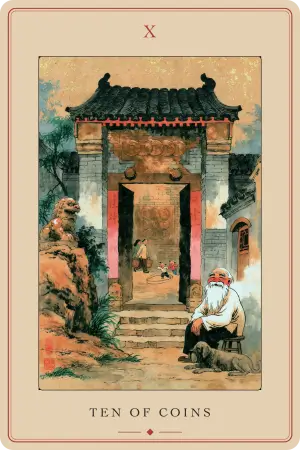
Older and parallel traditions frame the same wealth in their own keys. The Golden Dawn titled the card the Lord of Wealth and placed it in the third decan of Virgo under Mercury, reading it esoterically as Malkuth in Assiah, the lowest sphere in the lowest world, the final coagulation of energy into solid matter. In the Tarot de Marseille it is the Ten of Coins, an abstract arrangement of ten coins without human figures. In Crowley and Harris's Thoth deck it is the Ten of Disks titled Wealth, which drops the family entirely and shows ten coins in the Tree of Life pattern against a sealed vault, carrying Crowley's warning that wealth left uncirculated grows heavy and begins to decay. This deck keeps the archetype whole and moves it to the block: the patriarch becomes an elderly man in a suit on his own stoop, the estate becomes a brownstone, the coins become subway tokens hung in the doorway, and the distant castle becomes the Empire State Building on the skyline.
Correspondences
Number. Ten, completion and, in the same breath, a new beginning. Ten closes the cycle the Ace of Tokens opened, the single seed grown through gigs and hardship and patience into a household and a name the neighborhood knows. The number combines the 1 and the 0: the 1 of initiative, the ancestor who stepped off the boat or the bus with nothing, and the 0 of open possibility, the circle with no end. The grandfather on the steps is the 1 that began the line; the children below him are the 0, the future ready to run the cycle again from everything already built.
Astrology. Mercury in Virgo, the third decan of Virgo from roughly September 12 to 22, Virgo's energy at its ripest. Virgo is the mutable earth sign of skill, diligence, and exact work, and this decan is the season when precision finally pays out as property. Mercury, the decan's ruler, brings the intelligence of exchange and administration, the mind that manages what the hands have built: the ledgers, the leases, the wills, the quiet paperwork by which a family's wealth survives from one generation to the next. Mercury is the exalted ruler of Virgo, so the pairing is unusually strong.
Element. Earth, the suit of Tokens, carrying money, rent, work, and the material life of the city. Earth here reads as brownstone and mortar, stability and firmness, the determination to reach a concrete result. Not a windfall, a foundation.
Kabbalah. The card sits at Malkuth, the Kingdom, the tenth and final sphere, within Assiah, the active material world. Malkuth is the density of matter and the last resting place of divine energy, which is why the Ten reads as permanence, completion, and a reality so solid it takes real force to alter.
Elemental dignity. As the most material card in the deck it lends weight and permanence to lighter neighbors, and beside cards of sudden change or upheaval it warns how traumatic the collapse of something built slowly can be.
Psychological perspective
The Ten of Tokens describes a settled state of mind that measures its own well-being by the well-being of the household. The man on the stoop is practical, patient, and quietly proud of what has been assembled over time. He respects what was handed to him and thinks consciously about what he will hand forward. His authority is not loud. It is the authority of someone whose name is on the deed and whose plate is always full for guests. If scarcity thinking has been running you, and the city is very good at installing it, this card is the correction: count what you have in order to get accurate, not to get complacent.
There is a shadow to watch. The same solidity that shelters a family can harden into a gilded cage, tradition held so tightly that it strangles the people meant to inherit it. Someone can achieve every material marker and find the warmth has gone quiet underneath, or become an exhausted guardian of a legacy they never chose, keeping the house and the traditions running out of obligation while their own life waits. The card's health depends on remembering what the wealth is for. The man on the card does not clutch his tokens; they hang in the open doorway, walked past daily by everyone he loves. The question it keeps asking is whether the walls you built to protect what you have will serve as a sanctuary or a prison for whoever inherits the keys.
The Ten of Tokens across decks
The same architecture of legacy appears in different settings across the tradition, and this deck's contribution is to move it onto a brownstone stoop and make it unmistakably a New York achievement. In the Rider-Waite-Smith deck the scene is a grey-bearded patriarch beneath a stone arch, a younger couple and a child in the courtyard of a large estate, two white dogs at his feet, and ten coins arranged as the Tree of Life, a picture of dynastic wealth shadowed by emotional distance.
The Tarot de Marseille shows a plainer image, ten coins in an abstract pattern with no human figures. In the Thoth deck Crowley and Harris title it Wealth and strip the family out entirely, rendering ten disks in the Tree of Life pattern against a heavy sealed vault, with the warning that accumulated wealth left uncirculated turns stagnant and starts to decay. The Tarot of New York City keeps the archetype whole and trades the medieval estate for the block: the patriarch becomes an elderly man in a suit on his own stoop, the courtyard becomes a brownstone, the loyal hounds become the dog leaning against him, the coins become subway tokens hung in the arched doorway, and the distant castle becomes the Empire State Building rising over a skyline lit by a pop-art sunburst, with the Statue of Liberty raising her torch at the edge. The meaning holds across all of them: material completion so solid it becomes a foundation for the next generation.
In combination and context
Numerologically the Ten of Tokens is the end of the suit's journey, the point where energy that began as a single seed in the Ace has fully crystallized into structure. It grounds the number ten in the material world as inheritance, a completion that does not sever its roots but starts the next turn of the wheel higher than the last, because it stands on what was already built. Surrounding cards shift its weight. Beside cards of family joy it reads as a household whole in feeling as well as in fact; beside cards of conflict or loss it leans toward the shadow of inheritance disputes, the fight over money, the legacy that became a burden.
Spread position changes its job. In a yes-or-no reading the upright Ten is one of the most affirmative cards in the deck, a strong yes for anything concerning long-term stability, commitment, and lasting success, and reversed it turns to no or a warning that a seemingly secure situation is not. As advice it counsels the long view, tending what you have and deciding for the people who come after. As a challenge it can expose the gilded cage, the way security enforces compliance, or the painful and necessary work of breaking a generational cycle in order to reclaim your own life. Asked about timing it points to the slow scale, plans realized over years rather than weeks.
Questions for reflection
- Take the stoop view. Sit where the grandfather sits and look at what has actually accumulated around you, not just the accounts but the relationships and the block's worth of people who would notice if you were gone. Which of these have you been counting as wealth, and which have you overlooked?
- The man on the card does not clutch his tokens; they hang in the open doorway, walked past daily by everyone he loves. What knowledge, resource, recipe, key, or standing invitation could you hand down the steps today?
- Is the structure you have built or inherited a foundation that supports you or a tradition that entraps you? Name one place where security has quietly turned into control, and one small thing you could change about it this week.
The general meaning follows the Rider-Waite-Smith reading, the reference used across Tarot Academy. Open a specific deck above for its own interpretation.
Frequently asked questions
Explore the Tarot
Latest Posts
Discover the ancient wisdom of tarot cards and unlock the mysteries of your spiritual journey. Our blog is your gateway to understanding the rich symbolism, meanings, and practical applications of tarot reading.




















































