
 EN (English)


Minor Arcana ·
Two of Tokens
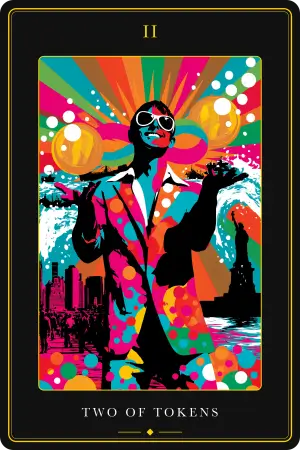
The grinning figure keeping two golden tokens in the air by motion and nerve, harbor heaving behind him and a grin that hides the math.
Card at a glance
- Numerology
- 2
- Element
- Earth
- Astrology
- Jupiter · Capricorn (first decan)
- Kabbalistic path
- Chokmah (Wisdom) in Assiah
- Timing
- Late December · first decan of Capricorn
- Yes / No
- Upright it depends · Reversed no
Upright
juggling
dynamic balance
two jobs and three gigs
adaptability
cash flow by hand
rhythm and timing
quick priorities
grace under a full calendar
Reversed
dropped balls
overload
double-booking
burnout
borrowing from next week
inflexibility
chaos in the calendar
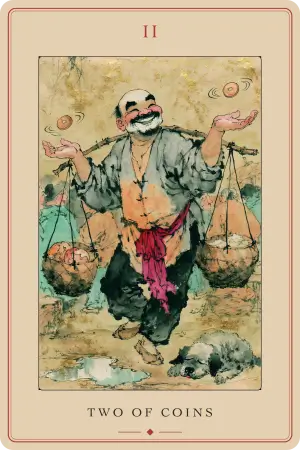
Two of Tokens in each deck
Every deck reimagines the same archetype. Compare the art, then open a deck to read its full interpretation.
Imagery and symbolism
In the Tarot of New York City the Two of Tokens is the city's oldest act: keeping it all in the air and making it look easy. At the center stands a figure in a loud jacket covered in halftone dots of every color, white sunglasses on, head tilted back, grinning wide. Both hands are open and empty, because the two things he is juggling are not in his hands. Two large golden tokens float at his shoulders, held up by nothing but his motion and his nerve.
The tokens are this deck's coin, standing for money, rent, work, and the material life. Two of them means two of everything: two jobs, two obligations, two halves of a life that both need tending. Colored ribbons loop around each token and cross behind his head, tracing the sideways eight of infinity. That loop is the meaning of the card. The act never finishes, it only continues, and continuing is the skill. The green cord of the Rider-Waite-Smith lemniscate becomes a tangle of pop ribbon here, but it does the same work, binding the two coins into one endless motion.
His ease is the second layer of the symbol. The sunglasses hide his eyes and the grin is broad and fixed. Whether the confidence is real or performed is exactly the question the card asks, and the deck's own line for this arcana is 'a grin that hides the math.' He is doing it, and he is also making sure you see him doing it. Behind him the harbor is in motion. Waves rear up in white foam on both sides and dark ships ride the swells across the waterline. In the older tradition the ships behind the juggler stood for circumstances that rise and fall outside anyone's control; here they are also literal, a working harbor moving its commerce whether you are ready or not. The waves crest close but never touch him. He is not above the turbulence, he is timing it.
On the right stands the black silhouette of the Statue of Liberty, the promise the whole act is performed for. On the left the downtown skyline rises over a crowd of silhouetted figures filling the street, everyone else running their own version of the same juggle. The card quietly insists that this balancing act is the city's shared condition rather than one person's predicament. Sunburst rays in pink, orange, green, and gold radiate from the figure's head like a halo, white bubbles drift up like sea foam or champagne, and the palette is the hot, saturated pop of the whole deck: magenta, teal, gold, and orange against hard black silhouettes. Nothing is at rest, and that is the message.
Core meaning
The Two of Tokens is the card of the working city, the balance that only holds because nothing stands still. It is the Rider-Waite-Smith Two of Pentacles translated into two jobs, three gigs, rent due Friday, and all of it kept in the air by constant motion. The juggling act is working. You are managing more than one demand at once, work and home, money and time, the day job and the thing you actually care about, and you are managing it with real skill even if nobody else sees the math behind the smile.
The balance the card describes is dynamic, not restful. It can point to two income streams, two projects, two roles you move between, and it says you have the timing to hold them. Often it means the situation is asking you to adapt, a schedule change or a new demand, and that flexibility rather than force is what carries you through. The Golden Dawn titled this card the Lord of Harmonious Change, and the phrase still fits: wisdom in the material world is not stillness but the practical, moment-by-moment work of shifting weight and reallocating what you have. You do not resolve the two halves of a divided life. You keep them moving.
Upright meaning
Upright, the Two of Tokens is the act that works. You are covering all your bases at once and doing it with genuine competence, and the card acknowledges that this is hard and that you are pulling it off. Stay in motion, but stay deliberate about it. The act works because of rhythm, so protect the rhythm: plan the week, know when the money lands and when it leaves, and say yes only to what actually fits between the things already in the air.
In love. For couples it points to two busy people who make the relationship one of the real things kept aloft rather than the thing that gets whatever time is left. Logistics run well, schedules coordinate, money gets talked about openly, and each partner covers when the other's week explodes. For singles it suggests a playful, lighthearted approach to dating while a full and independent life keeps running alongside.
In career. Often it is literally two jobs, a day job beside a side gig, or one desk holding several projects. Your timing is good, your priorities shift when they need to, and people get what they were promised even when they cannot see the effort. It rewards reliability under a full schedule and quick adaptation when plans change, and it can mark a transition managed gracefully, keeping the current job steady while building toward the next.
In finances. This is the stretched-but-working budget, balanced paycheck to paycheck or gig to gig by attention and timing rather than by a cushion. It frequently means two income sources and money moving through your hands quickly, arriving and going straight back out to cover what is due. The margin is thin but you have the acumen to stay afloat. Where you can, start building a little slack, even twenty dollars at a time.
In health. The body is kept in balance through motion, the workout fitted between shifts, a decent meal assembled from the bodega, sleep protected even when the schedule fights it. Energy holds as long as you keep moving. Consistency beats ambition here, so anchor a few non-negotiables and let the rest flex around the week.
Reversed meaning
Reversed, the rhythm breaks. The schedule that barely fit stops fitting: a shift runs long, a payment lands late, one gig collides with another, and the whole arrangement, which only ever worked in motion, starts coming down. This is overload, a life with no slack that finally hit friction. Often it describes not laziness but its opposite, too much taken on for too long with the honest math hidden behind a confident face until it could not be hidden anymore. Put something down. That is the whole medicine, and the hard part is choosing what.
In love. The relationship becomes the token dropped first, every time, because it is the one that does not send late notices. Nobody betrayed anyone and nobody stopped caring; quality time just shrinks to the leftover minutes at the end of exhausted days. One partner carries more of the logistics and quiet resentment builds when the imbalance is never named. Say out loud that the relationship has been getting the leftovers, then change one concrete thing this week.
In career. A workload that broke its own rhythm, tasks colliding and priorities changing hourly, the feeling of running between platforms all day without ever boarding a train. It often appears for people working two jobs, or one job doing the work of two, where the arrangement quietly stopped being sustainable. The problem is no longer effort. Effort is the one thing you have not run out of, so the medicine is subtraction: defer, delegate, or drop something before the visible failure.
In finances. The juggling act comes apart. Money meant for one obligation is covering another, and this is the card of borrowing from next week to survive this one. It can flag overextension, too many small commitments that are unmanageable together, or income that costs more than it returns. Do the triage: put every obligation on one page in real numbers, cut at least one recurring cost, and contact the landlord or lender before the missed payment, not after.
In health. The body pays the bill for the overloaded life. Sleep is the first token dropped, meals become whatever is fastest, and the schedule runs on caffeine and adrenaline. This is the physical signature of overextension: fatigue a weekend no longer fixes, tension in the shoulders and jaw, getting sick the moment there is finally a pause. Restore the floor first, a fixed bedtime and real food, and cut one obligation to fund that time.
Historical notes
The Two of Tokens inherits its scene from the Rider-Waite-Smith Two of Pentacles, drawn by Pamela Colman Smith in 1909 under A.E. Waite's direction. In that card a young man in a faux-medieval tunic and a tall, oversized red hat dances on one foot while juggling two large golden coins bound by a green cord in the shape of a lemniscate. Two ships ride massive waves in the background, upright despite the storm. Smith brought a theatrical eye to the Minor Arcana from her years with the Lyceum Theatre, and several cards, this one included, carry faint horizontal lines that read as a stage backdrop, hinting that the crisis might be partly performed and that the juggler retains the agency to step off the stage. The red hat itself echoes the plume of the Fool, marking a light, playful approach to life's burdens.
Older and parallel traditions frame the same balance in their own keys. The Golden Dawn named the card the Lord of Harmonious Change and placed it in the first decan of Capricorn under Jupiter. In the Tarot de Marseille it is the Two of Coins, an abstract image of commerce with two coins joined by an S-shaped floral ribbon, historically the card where the printer stamped their own mark. In Crowley and Harris's Thoth deck it is the Two of Disks titled Change, where a crowned serpent forms the infinity loop by biting its tail and the disks carry yin-yang motifs of the four elements. This deck keeps the archetype whole and moves it to the harbor: the dancing juggler becomes a grinning figure in a halftone jacket, the golden coins become subway tokens floating at his shoulders, the green cord becomes pop ribbon, and the stormy sea behind the juggler becomes New York's own working harbor.
Correspondences
Number. Two, the first plural, the moment one thing becomes a relationship between things. Where the Ace was a single seed, one offer or one check, the Two is what happens once you have more than one obligation and they begin to compete for the same hours. It is the number of this-or-that, and at its best the number of this-and-that. Two carries an instability that one and three do not: a single token sits still, three would form a triangle and stand on its own, but two can only balance dynamically, upright only while moving.
Astrology. Jupiter in Capricorn, the first decan of Capricorn from roughly December 22nd to 30th, at the cusp of the Winter Solstice. Capricorn supplies the discipline that keeps the juggling from being chaos, the internal clock and the refusal to drop what was promised, while its ruler Jupiter puts the grin on the figure's face and the belief that the hustle is going somewhere. Jupiter's appetite can outrun Capricorn's structure, and that tension is where the card's warning lives.
Element. Earth, the suit of Tokens, carrying money, rent, work, and the whole material grind of the city. Earth here is not stillness but ground, the paycheck and the lease and the physical fact of what things cost. Its core quality is pragmatism, and no card in the deck is more pragmatic than this one.
Kabbalah. The card sits at Chokmah, Wisdom, the sphere of all the Twos, within Assiah, the active material world. Wisdom in the material world is not passive knowledge but the practical application of energy to manage physical reality, which is why the Golden Dawn read this sphere in the suit of Earth as harmonious change.
Elemental dignity. As a mobile Earth card it lends adaptability to steadier neighbors and takes on friction beside forceful or scattering cards that would break its rhythm before the act is done.
Psychological perspective
The Two of Tokens describes a very New York state of mind: grinding realism performed with showman's flair. The figure is organized in a way that does not look organized, no color-coded planner, just an exact internal clock and a running total of what is due, when, and to whom. He adapts fast, reads situations quickly, and treats a change of plans as a scheduling problem rather than a crisis. The trademark of this personality is making a genuinely difficult balancing act look like ease, and taking quiet pride in exactly that.
There is a shadow to watch. The same busyness that keeps the tokens aloft can become a way to avoid something that needs stillness, the juggle turned into a barrier against an uncomfortable truth. A person who only knows how to survive in chaos can lose the ability to sit in peace, and may take on unnecessary tasks just to feel the familiar rhythm of the act. Underneath the confident face the driver is often fear rather than greed, the sense that if you set one thing down you will find out the whole arrangement never really worked. The card's counsel is to check the grin now and then and make sure it is still real, and not just the face you wear so no one asks how heavy the load is.
The Two of Tokens across decks
The same juggling act appears in different settings across the tradition, and this deck's contribution is to move it to the harbor and make it the city's shared condition. In the Rider-Waite-Smith deck the scene is a young man in a tall red hat dancing on one foot, juggling two coins bound by a green lemniscate, with ships riding turbulent seas behind him, the picture of human adaptability and mundane balance.
The Tarot de Marseille shows a plainer image of commerce, two coins joined by an S-shaped floral ribbon on a mostly blank ground, the traditional card where the printer left their signature. In the Thoth deck Crowley and Harris title it Change and render it as a self-correcting engine, a crowned serpent biting its tail to form the infinity loop while the disks carry yin-yang elemental motifs, the focus shifting from the human to the cosmic. The Tarot of New York City keeps the archetype whole and swaps the medieval shoreline for the working waterfront: the dancing juggler becomes a grinning figure in a halftone jacket and white sunglasses, the coins become floating subway tokens, the green cord becomes pop ribbon looping into the same infinity sign, and the storm-tossed ships become the literal harbor moving its commerce behind him. The Statue of Liberty and the downtown skyline flank the act, and the balance stays the same across all of them: equilibrium that exists only in motion.
In combination and context
Numerologically the Two of Tokens is the first step past the seed of the Ace, the moment a single resource becomes a pair that has to be weighed against itself. It grounds the number two in the material world, two income streams, two rents' worth of expenses, the concrete arithmetic of a stretched life, and it holds them together the only way the number allows, by never stopping. Surrounding cards shift its weight sharply. Beside a card of rest or isolation it warns that the frantic pace has become avoidance; beside cards of conflict or cross-purposes it warns the act may fail through outside interference rather than your own hand.
Spread position changes its job. In a yes-or-no reading it is famously a maybe, an 'it depends' that says too many variables are still in the air for a clean answer, and asked for timing it usually means not right now, not until you clear the space and set something down. As a challenge or obstacle it reveals busyness used as avoidance, or a paralyzing inability to prioritize where everything feels equally urgent and nothing moves forward. As advice it rejects passive waiting and asks for agile management: stay flexible, keep your footing on shifting ground, find some humor in the chaos, and if the load is genuinely too much, choose what to drop on purpose rather than letting life knock everything out of your hands at once.
Questions for reflection
- Look at everything you are keeping in the air right now. Which token have you been overfeeding out of guilt or habit, and which one has quietly gotten the least attention?
- The figure's grin hides the math. Is your own confidence real today, or is it the face you wear so no one asks how heavy the load has become?
- If you had to set one thing down this week on purpose, before the drop chose itself, what would it be, and what are you afraid you would learn by putting it down?
The general meaning follows the Rider-Waite-Smith reading — the reference used across Tarot Academy. Open a specific deck above for its own interpretation.
Frequently asked questions
Explore the Tarot
Latest Posts
Discover the ancient wisdom of tarot cards and unlock the mysteries of your spiritual journey. Our blog is your gateway to understanding the rich symbolism, meanings, and practical applications of tarot reading.




















































