
 EN (English)


Minor Arcana ·
Two of Coins
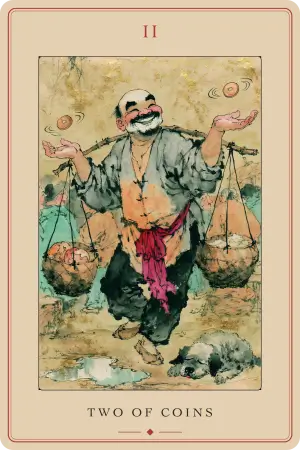
Balance kept by walking: a Beijing peddler dances a loaded shoulder pole through the market crowd, a copper coin spinning above each palm.
Card at a glance
- Numerology
- 2
- Element
- Earth
- Astrology
- Jupiter in Capricorn · first decan
- Kabbalistic path
- Chokmah (Wisdom) in Assiah
- Timing
- Delay · Capricorn's first decan · late December
- Yes / No
- Maybe, it depends
Upright
balance in motion
adaptability
multitasking
flexibility
good humor
dual income
rhythm
practical skill
Reversed
overload
imbalance
disorganization
overcommitment
financial strain
burnout
rigidity
dropped promises
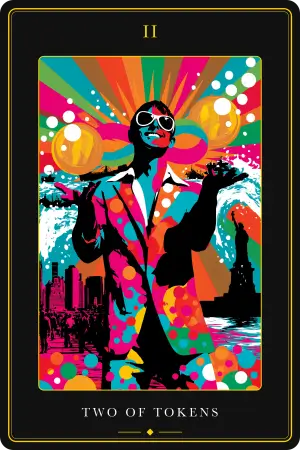
Two of Coins in each deck
Every deck reimagines the same archetype. Compare the art, then open a deck to read its full interpretation.
Imagery and symbolism
In the Tarot of Beijing the Two of Coins is a street peddler dancing his loaded shoulder pole through a market lane. Baskets bob at either end, a copper coin spins above each open palm, two customers are served in one moment, and nothing falls: not the pole, not the coins, not the patter, not the smile.
The central symbol is the pole itself, the bamboo bian dan that carried half of old Beijing's commerce. It works as a living balance beam, staying level because its bearer keeps walking rather than because he stands still. The pole flexes and springs with every step, and an experienced carrier times his gait to its rhythm. That is the card's whole teaching held in one object: equilibrium in the material world is dynamic, kept by motion and responsiveness instead of by freezing in place.
The two baskets hang at opposite ends, one heaped with fruit, the other with steamed buns. Two goods, two customers, two areas of a single life. Neither can be set down without upsetting the other, so work and home, money and feeling, duty and pleasure ride together as loads on one pole across one human back. Above each palm a copper coin turns, round with a square hole, the old cosmology of heaven round and earth square minted small. The coins never rest in his hands. They hover in motion, tracing little rings in the air, the deck's quiet answer to the endless loop of the classical card: infinity drawn as the whirl of small daily transactions rather than as a ribbon.
A magenta sash is knotted at his waist, its ends swinging with his step. In a palette of warm kraft browns and gray wash, that one loud accent marks the composition's center of gravity, and the balance point of the pole passes straight through the knot. The peddler laughs with his head thrown back and one foot lifted mid-step, and his dance is technique rather than performance: the ease is earned. He steps around a puddle that mirrors a scrap of teal sky, noticing the day's small hazard in time and moving past it. Behind him the market crowd blurs into wash and gesture, the human sea through which he keeps his footing. In the corner a shaggy dog sleeps undisturbed, the card's second teacher, proof that balance includes rest. Gold flecks drift across the aged paper like coin-light, and the small red seal holds its corner as on every card of the deck.
Core meaning
The Two of Coins is the card of balance in motion, and Beijing states it through the peddler: you can carry two loads on one back as long as you keep your step light and your humor lighter. It signifies a period when two important areas of life are asked to hang from a single pole, most often work and home, or the material and the emotional, and to stay level through rhythm rather than through grip.
The Golden Dawn titled the classical card the Lord of Harmonious Change, and this deck makes the phrase literal. The pole balances because the peddler walks; the moment he freezes, the baskets swing. So the card is about multitasking, blending different interests, and adapting to a lane that is crowded and always shifting. It can also mean learning new skills on the move, making change with one hand while weighing goods with the other. When several duties, projects, or relationships all demand attention at once, the Two of Coins promises they can all be carried, provided the load is redistributed instead of dropped and the rhythm is trusted more than the grip.
Upright meaning
Upright, the card shows dynamic balance that is working. You are managing several complex demands at once, and you are succeeding at it, having found a sustainable rhythm amid the crowd. It commends agility and presence of mind, the flow state that lets you pivot when the lane shifts and adjust your plans with grace. Often you are enjoying the challenge too, finding humor in the absurdity of a busy day. The card still carries a gentle warning: the line between juggling well and dropping the balls is thin, so it asks you to keep recalibrating your focus. What genuinely needs attention now, and what can wait?
In love. For couples, a partnership that navigates outside pressures together, dividing errands and expenses and trading duties while still making time for the relationship. Harmony built on the small fair exchanges of ordinary days rather than on grand gestures. For singles, a playful, lighthearted approach to dating, or the balancing of a wish for romance against a full and independent life.
In career. Two projects, roles, or workplaces carried at once, kept level through planning and a light step. It favors adaptability, the ability to shift attention from one task to another and give each a full hand, and it often marks dual income streams, a main round with a growing side pursuit. The research links this card traditionally to writing, journalism, and publishing, trades built on juggling deadlines. With good management of time and energy it promises countable results.
In finances. Money in healthy circulation: it comes in, it goes out, and the hands making change are quick and honest. Often it points to two income channels handled at once, a thin margin managed with real financial acumen. It can mean moving money laterally, transferring balances or making calculated investments. The core counsel is the peddler's own: keep the money moving, keep the count exact, and redistribute between the baskets before one grows too heavy.
In health. Fitness earned in the rhythm of daily movement rather than in exercises. The card favors a balanced approach to diet and routine and successful adaptation to a new pace. It warns that energy stays steady only while you keep moving, hinting at sleep debt or a reliance on adrenaline to sustain the round. Remember the sleeping dog: recovery is the other half of balance.
Reversed meaning
Reversed, the pole tilts. One basket has grown too heavy, the coins have stopped spinning, and the dance is turning into a stagger. The card points to overwhelm, disorganization, and chaos from overcommitment. Psychologically it means you have taken on more than one back can carry, often out of a misguided sense of obligation or an inability to enforce boundaries. Agility hardens into rigidity, and you fight the waves instead of riding them, which drains the humor out of the day. The urgent counsel is to set one burden down deliberately, on your own terms, before the crowd forces you to drop everything at once.
In love. A relationship squeezed out of balance by outside loads until the couple meets only in passing. One partner carries visibly more than the other, and small unresolved matters accumulate like debts of attention. Communication turns transactional, from making change toward keeping score, and the neglected partner feels short-changed in time and care. It asks the pair to stop, set the pole down together, and retie the knots.
In career. Overload and lost coordination: too many tasks accepted, deadlines colliding like shoulders in a crowded lane. It can show a lack of flexibility, insisting on old methods along a route that has changed, or skills not yet equal to the new load. Trust erodes quietly through dropped follow-ups and missed targets. Reassess priorities, decide what genuinely belongs in your baskets, and hand some of it to another carrier.
In finances. A stark warning of mismanagement, with expenditure outrunning income and the day's accounts refusing to add up. Two earning sources may now compete instead of complementing each other, a side venture draining the main one. In extreme cases someone has spread so thin that collapse looms, forcing a return to the Ace to start over. Pay attention to the small numbers, count the takings slowly and twice, and beware hurried change that invites mistakes.
In health. The balancing act has failed into a dysregulated nervous system, the classic picture of burnout and chronic fatigue from overwork. It can mean an unbalanced diet, exercise abandoned or overdone, or coordination and footing gone unsteady, the misstep into the puddle. The instruction is plain: set the pole down, restore the neglected basket of sleep or food or stillness, and learn from the dog who rests soundly in the middle of the market.
Historical notes
The Rider-Waite-Smith card of 1909 fixed the image most readers know: a young man in a faux-medieval tunic and an oversized red hat, dancing on one foot while juggling two golden coins. The artist Pamela Colman Smith, a member of the Golden Dawn who had traveled with the Lyceum Theatre group, drew horizontal lines in the background that read as a stage set. That theatricality suggests the chaos may be partly performative, and that the juggler retains the agency to step off the stage. A green cord loops the two coins into a lemniscate, aligning the card with The Magician and Strength, while two ships ride heaving waves behind, surviving the storm. The huge red hat is a deliberate homage to the red plume of The Fool, marking a light, playful approach to burden.
Other traditions frame the card differently. The Tarot de Marseille shows two coins joined by an S-shaped floral ribbon, historically the printer's stamped card where the maker placed an official mark, its focus trade and commerce. Crowley's Thoth deck renamed the suit Disks and titled the card Change, replacing the human figure with a crowned serpent forming an infinity loop, a self-correcting cosmic engine of gain and loss.
The Tarot of Beijing keeps the function and rebuilds the scene from the local street. The juggler becomes a bian dan peddler, the lemniscate becomes coins spinning above his palms, and where the classical card sets ships on a stormy sea, this deck sets the human sea of a market lane. The red hat's playfulness survives as the peddler's laugh and his magenta sash, and the sleeping dog adds a teacher the older cards lack, the rest that belongs inside the balance.
Correspondences
Number. Two, one and another one, the union of two forces that create a new reality together. The deck makes it visible three times: two coins above two palms, two baskets on the two ends of one pole, two customers served in a single moment. Two is the beginning of measurement and the number of rhythm, left step and right step, buy and sell, and rhythm is precisely how the peddler holds his equilibrium.
Astrology. The first decan of Capricorn, zero to nine degrees, spanning December 22 to 31 at the cusp of the Winter Solstice. The decan is ruled by Jupiter, the planet of expansion and good fortune, set inside Saturn-ruled Capricorn's structure and limitation. That tension is the juggling act itself: Jupiter throws the peddler's head back and fills the baskets, while Capricorn supplies the disciplined daily round that keeps the load from crashing.
Element. Earth, here the element of the market lane, the paving stones and copper cash and daily bread earned and counted. Its quality is pragmatism, and the peddler is pragmatism set dancing.
Kabbalah. All Twos belong to Chokmah, the sphere of Wisdom, the first spark of creation entering duality. The suit of Coins corresponds to Assiah, the active material world, so the card is Wisdom operating in matter: not passive knowledge but the practical application of energy to manage physical reality.
Elemental dignity. As an Earth Two it sits well beside other Earth and Water cards, which steady its practical balance, and it chafes against harsh Fire, which speeds the round past the point where the juggling holds.
Psychological perspective
As a person, the Two of Coins is the peddler of life: a flexible mind on light feet, accustomed to carrying two loads on one back and making it look like a dance. This is the ultimate multitasker, the freelancer with a dozen clients or the single parent running a household and a career with seeming effortlessness, kinetic and rarely still, able to handle high stress without panicking. The signature trait is good humor, the patter that makes a whole lane friendlier just by passing through it.
The shadow is inconsistency, and a subtler trap sits underneath it. Because such people are always reacting to the most urgent fire, they can go silent for days under an uncommunicated burden and struggle to offer steady emotional presence. Deeper still, busyness can become an avoidance mechanism: the juggle kept going so the person never has to stop and sit with an uncomfortable truth. When this card appears as an obstacle it often names exactly that, the misery of being frantic yet stagnant, everything treated as equally urgent so nothing genuinely moves. The work is to notice when the dance has stopped being technique and become a way of not standing still.
The Two of Coins across decks
Rider-Waite-Smith. A theatrical youth in a huge red hat dances on one foot, juggling two coins bound by a green lemniscate, with ships riding a stormy sea behind a stage-set horizon. The emphasis is human adaptability and the psychology of mundane balance. Beijing keeps that emphasis and moves it into a market lane, trading the stage for a real crowd.
Tarot de Marseille. Two coins joined by an S-shaped floral ribbon on a mostly blank ground, historically the printer's stamped card, its focus trade and the artisan's mark. Beijing shares the commercial theme but fills it with a working scene, the coins in motion above the peddler's hands rather than fixed on the page.
Crowley-Thoth. Titled Change, the suit renamed Disks, a crowned serpent forming an infinity loop with Yin-Yang motifs, a self-correcting cosmic engine of gain and loss. Beijing renders the same ceaseless alternation at human scale, as the spin of small daily transactions that never stops.
Modern reframings. Later decks keep the juggling figure and update its dress and setting. The Tarot of Beijing belongs to that line, replacing the medieval juggler with a laughing bian dan carrier and letting the local object, the springing shoulder pole, carry the whole lesson of dynamic balance.
In combination and context
The Two of Coins is highly sensitive to its neighbors, which tip it toward mastered balance or toward friction. Beside Temperance it reads as masterful mixture, spiritual and material harmony found in the right proportion. With the Four of Wands it becomes high-energy celebration and successful event-juggling, and with Strength a relationship or endeavor durable enough to weather intense ups and downs over time.
Other cards expose the strain. With the Hierophant the peddler's wish for flexible, unconventional methods grinds against a demand to follow rigid rules. Beside the Four of Swords the frantic need to multitask clashes with the body's absolute requirement for rest. With the Five of Wands the juggling fails outright through outside interference and cross-purposes.
Position matters as much as company. As the obstacle in a spread the card exposes busyness used to avoid a deeper truth, or a paralyzing inability to prioritize. As advice it rejects passive waiting and counsels flexibility and humor, and if the surrounding cards are heavy it grants explicit permission to choose what to drop, since setting one ball down on purpose beats having life knock them all from your hands. When it keeps returning as a stalker card, read it as a warning that the current pace is unsustainable and that the querent keeps refusing to set a load down. Asked about timing, it almost always means delay: not yet, because too many variables are still in the air.
Questions for reflection
- Which two baskets are you carrying on one pole right now, and is one of them quietly getting too heavy?
- Where are you gripping harder when the situation actually calls for a lighter step and a change of rhythm?
- If you had to set one load down deliberately today, before the crowd forced you to drop everything, which would it be?
The general meaning follows the Rider-Waite-Smith reading — the reference used across Tarot Academy. Open a specific deck above for its own interpretation.
Frequently asked questions
Explore the Tarot
Latest Posts
Discover the ancient wisdom of tarot cards and unlock the mysteries of your spiritual journey. Our blog is your gateway to understanding the rich symbolism, meanings, and practical applications of tarot reading.




















































