
 EN (English)



Minor Arcana · Pentacles (Earth)
Two of Pentacles
Pamela Colman Smith's dancing juggler, two coins bound in a figure-eight while ships ride the swell behind him.
Card at a glance
- Numerology
- Two
- Element
- Earth
- Astrology
- Jupiter in Capricorn (0°–9°)
- Kabbalistic path
- Chokmah (Wisdom)
- Timing
- Late December, or a stretch of flux and delay
- Yes / No
- Upright a qualified maybe · Reversed no
Upright
Balance
Adaptability
Juggling priorities
Time management
Flexibility
Flow
Prioritisation
Multitasking
Reversed
Overwhelm
Disorganisation
Overcommitment
Imbalance
Burnout
Dropped balls
Financial mismanagement
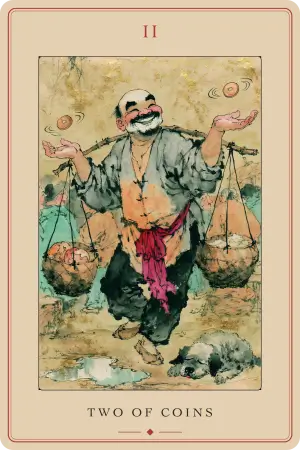
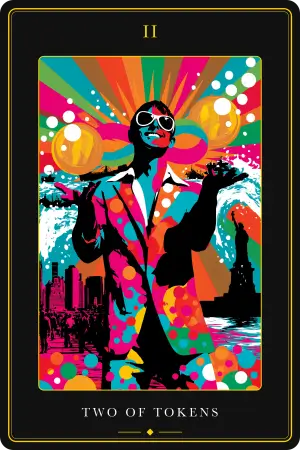
Two of Pentacles in each deck
Every deck reimagines the same archetype. Compare the art, then open a deck to read its full interpretation.
Imagery and symbolism
The Rider-Waite-Smith card, published in 1909, gives the Two of Pentacles the face most readers now picture. A young man in a faux-medieval tunic and a tall, oversized red hat dances on one foot, juggling two large golden coins. Pamela Colman Smith, nicknamed "Pixie," a Golden Dawn member and a designer for the London theatre world, staged him like an actor mid-performance. She drew distinct horizontal lines behind the figure that read as a stage backdrop, one of her so-called "stage cards." The device plants a quiet doubt: the terrifying waves and the precarious juggling act may be partly theatre, a crisis the juggler has chosen to entertain and could step away from if the show grew too tiring.
Smith's colour choices carry the reading. The palette runs warm, orange, yellow and green, tones of energy, vitality and growth, and the figure's clothing mixes those colours into a patchwork that stands in for multitasking itself. His pose is a dancer's, poised rather than braced, so balance here looks like pleasure taken in the process more than strain against it.
The symbols do the rest of the work. A green cord loops around the two coins in a lemniscate, the figure-eight of infinity that also crowns The Magician and Strength, marking the juggling of material concerns as an endless process between life's highs and lows. The ships on the turbulent sea trace that same looping curve; water stands for the emotional realm, so the storm reads as inner turmoil the juggler manages or willfully ignores while the ships stay upright. The oversized red hat echoes the red plume of The Fool, a light, playful approach to burden. The androgynous, dancing figure favours adaptability over fixed category, in keeping with Smith's habit of blurring rigid boundaries and modelling figures on friends such as the suffragist Edith Craig.
Core meaning
In the Rider-Waite reading the Two of Pentacles is about balance and transformation at once: the capacity to adapt to change while still keeping hold of your resources. Where the suit of Pentacles usually speaks of stability, this card introduces the volatility of the material world and the constant, conscious effort it takes to stay upright in it. The equilibrium on show is not a state of rest. It is a moving act.
The two coins in perpetual motion picture mastery in the material sphere, the skill of moving with change rather than resisting it. As they trace the figure-eight, they become a symbol of stability found inside constant shifting. Moving on from the pure potential of the Ace, the Two sets that potential into motion and duality, and maps the human capacity to juggle priorities and adapt to the swings of fortune: income against expenditure, work against play, focus against flexibility. The Golden Dawn named it the "Lord of Harmonious Change," and that is its lesson. Wisdom in the physical world lies in shifting weight and reallocating resources fluidly, not in bracing against the next wave.
Upright meaning
Upright, the Two of Pentacles signifies a state of dynamic balance that is currently working. The querent is likely managing several complex situations at once, two jobs, parenthood beside a career, a demanding schedule, and succeeding through agility and presence of mind. It commends a flow state where you can pivot quickly and even find humour in the absurdity of a busy life. Its gentle warning is that the line between juggling well and dropping the balls is thin, so it asks for conscious prioritisation: what actually needs attention now, and what can wait?
In love. For couples it shows a pair navigating external stress together, big financial decisions, a household, demanding careers, while still making time for each other. The looping cord suggests open, reciprocal communication. For singles it points to a playful, lighthearted approach to dating, or balancing the wish for a relationship with a full independent life.
In career. The "profit and loss card": managing two income streams, stepping into multiple roles and handling shifting priorities with ease. Money moves through the querent's hands quickly, and the margin for error is thin, but the financial acumen to stay afloat is there. It has old ties to writing, journalism and publishing, where deadlines are constantly juggled.
In finances. Capital and labour flowing fast: income arrives and is dispatched straight to bills or projects. It can mean moving money laterally, transferring balances or making calculated investments, with the querent just staying on top of the flow.
In health. The body balancing its needs against outside demands, nutritious habits fitted around a packed schedule. Energy holds steady only while the querent keeps moving, and the card hints at sleep debt or a reliance on adrenaline. For some it can flag hormonal shifts or the physical balancing act of pregnancy.
Reversed meaning
Reversed, the rhythm breaks and the balls begin to drop. The card points to overwhelm, disorganisation and chaos from overcommitment, usually because the querent took on more than any person can carry out of obligation or an inability to hold a boundary. The upright agility hardens into rigidity, fighting the waves instead of riding them, which leads to exhaustion and a loss of humour. Its urgent counsel is to build structure and to set one burden down deliberately, before circumstances knock everything out of your hands at once.
In love. The relationship suffers from a lack of prioritisation, love squeezed into shrinking gaps in the schedule while the partner feels neglected or treated as one more task. It can also mark a hot-and-cold partner who cannot offer consistency, calling for firm boundaries.
In career. Financial mismanagement where spending has outpaced income, unmanageable debt or missed deadlines. It can mean someone who overpromised and underdelivered, quietly eroding trust, or, fitting the stage card, someone putting on a "poor mouth" act while actually holding resources.
In finances. Expenditure running past income toward collapse, sometimes forcing the querent back to the Ace of Pentacles to start over. It calls for strict budgeting and time management before the situation shatters.
In health. A dysregulated nervous system, the classic marker of burnout or chronic fatigue from overwork. It asks for a radical shift: stripping away non-essential duties and prioritising rest and basic self-care.
Historical notes
The suit of Coins descends from the Latin-suited cards of medieval Europe, where the two of the suit was often the card the printer stamped with a maker's mark. In the Tarot de Marseille the Two of Coins stays abstract: two coins joined by an S-shaped floral ribbon or loop, minimalist and accented with sprouting motifs, an image of trade and the artisan's signature more than of human drama.
The Rider-Waite-Smith deck of 1909 is where the card gained its now-familiar story, and Pamela Colman Smith is the reason it reads as a scene rather than a diagram. Steeped in the London theatre of Ellen Terry, Henry Irving and Bram Stoker, with whom she travelled as a costume and stage designer for the Lyceum group, she staged the juggler like a performer on a set and folded in the red hat borrowed from The Fool. Her theatrical eye is what gives the Minor Arcana its narrative charge here. Later, Crowley's Thoth deck shifted the focus from the human to the cosmic, retitling the card the Two of Disks and subtitling it "Change."
Correspondences
Number. Two: the union and interaction of opposing forces, duality that becomes stronger in combination. The Ace's single seed divides into a pair that must be kept in motion and in balance, income and outgo, work and home, the material and the emotional. Interaction is the essence of the number, and the two pentacles make it visible.
Astrology. The card rules the first decan of Capricorn, from 0° to 9°, roughly 22 to 31 December, governed by Jupiter. Expansive Jupiter, the planet of luck and growth, sits inside restrictive, Saturn-ruled Capricorn, and that tension produces the juggling act: the wish to take on more, held within hard limits of time, energy and money, lifted by a note of optimism and confidence.
Element. Earth, the element of the body, money and the material world, whose core quality is pragmatism.
Kabbalah. As a Two it belongs to Chokmah, Wisdom, the sphere of the first creative spark entering duality. In the suit of Earth this is Chokmah in Assiah, wisdom applied as the practical management of physical reality.
Elemental dignity. Its Earth agrees with Water and works against restless Fire; through its Jupiter and Capricorn links it connects with The Wheel of Fortune and The Devil, the turning cycle it rides and the material trap it tries to avoid.
Psychological perspective
Psychologically, the Rider-Waite Two of Pentacles describes the mind under load, the felt experience of holding many things at once. At its best it is the flow state, a nervous system that can absorb high demand without panic and still keep its sense of play. Smith's stage setting behind the juggler sharpens the question: how much of the crisis is real, and how much is a role the person has chosen to perform?
Its shadow is busyness used as avoidance. In an obstacle position the card often shows someone keeping life deliberately chaotic to sidestep a deeper truth or a period of required stillness, trapped in perpetual motion because stopping would mean sitting with uncomfortable thoughts. The related trap is an inability to prioritise, treating everything as equally urgent and so making progress on nothing. The card's task is to tell the essential from the merely habitual, and to allow stillness without reading it as failure.
The Two of Pentacles across decks
This page follows the Rider-Waite-Smith card, so the other foundational decks read best as contrast. Smith's version is the theatrical one: a juggler dancing on the shoreline, two coins bound in a green lemniscate, ships riding the storm behind him, the human experience of balance staged as a small performance.
In the Tarot de Marseille the same card is the Two of Coins, two discs linked by an S-shaped floral loop that curves but never quite closes, an emblem of commerce and the printer's mark rather than a scene. Where Smith gives you a person, Marseille gives you a signature.
In Crowley's Thoth deck, painted by Lady Frieda Harris, it becomes the Two of Disks, subtitled "Change." A crowned serpent, the Ouroboros, bites its own tail to form an explicit infinity loop, and the disks carry Yin-Yang motifs for the four elements. Crowley renamed the suit Disks to stress its spinning, earthly nature, and read the card as a cosmic engine of continuous transmutation, the harmonious alternation of gain and loss. Set beside that macrocosmic machine, Smith's juggler keeps the focus resolutely human: one dancer, two coins, a stage.
In combination and context
The Two of Pentacles takes much of its colour from its neighbours. With Temperance it becomes masterful balance, the perfect mixture of elements; with Strength it marks a relationship or endeavour that can weather intense ups and downs over time; with the Four of Wands it turns to celebration and high-energy socialising. Against the grain it clashes with The Hierophant, flexibility fighting rigid rules, and with the Four of Swords, the drive to multitask against the body's need for rest. Alongside the Five of Wands the juggling fails outright through conflict and cross-purposes.
Position reshapes it further. As advice it counsels flexibility and humour, moving like a dancer on shifting ground and, if the load is too great, choosing which ball to set down on purpose. As an obstacle it exposes busyness as avoidance or a paralysing inability to prioritise. Drawn for timing it usually reads as delay, "not right now, too many variables in the air," until the querent clears the space.
Questions for reflection
- Which of the balls I am juggling actually matters, and which am I keeping in the air out of habit or fear of stillness?
- Where am I fighting the waves like the ships behind the juggler instead of riding them, and what would moving with the change look like?
- If I had to set one burden down on purpose today, which would it be, and what stops me?
The general meaning follows the Rider-Waite-Smith reading — the reference used across Tarot Academy. Open a specific deck above for its own interpretation.
Frequently asked questions
Explore the Tarot
Latest Posts
Discover the ancient wisdom of tarot cards and unlock the mysteries of your spiritual journey. Our blog is your gateway to understanding the rich symbolism, meanings, and practical applications of tarot reading.




















































