
 EN (English)



Minor Arcana · Pentacles (Earth)
Three of Pentacles
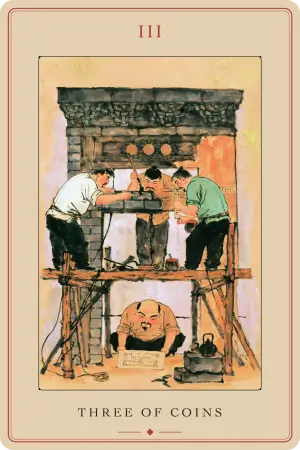
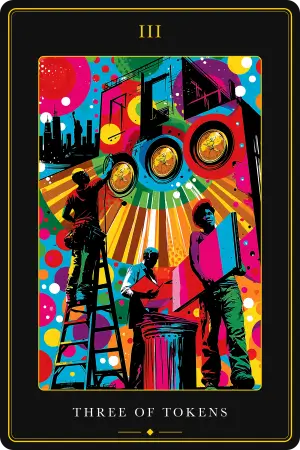
A mason, a monk and an architect at work in a cathedral: skill recognized and a shared plan taking physical shape.
Card at a glance
- Numerology
- Three
- Element
- Earth
- Astrology
- Mars in Capricorn (10°–19°)
- Kabbalistic path
- Binah (Understanding)
- Timing
- Early January, or a phase of building and apprenticeship
- Yes / No
- Upright yes · Reversed no
Upright
Collaboration
Apprenticeship
Craftsmanship
Recognition
Teamwork
Skill
Learning
Building
Reversed
Disharmony
Poor teamwork
Mediocrity
Ego
Delays
Resistance to feedback
Wasted effort
Three of Pentacles in each deck
Every deck reimagines the same archetype. Compare the art, then open a deck to read its full interpretation.
Imagery and symbolism
Pamela Colman Smith set the Rider-Waite-Smith Three of Pentacles inside the vaulted arches of a stone monastery. A young sculptor stands raised on a wooden bench, chisel in hand, working the stone overhead. Below him a tonsured monk in a dark habit and a second figure holding a sheet of building plans look up and consult with him. Smith trained in the theatre, and she stages the three like actors on a set: each holds a distinct role, and the moment caught is the one where they align.
This deck's reading of the scene runs on two levels at once, a lesson and a job of work. Read one way it is a master and a student, knowledge passing from the one who holds it to the one who listens closely. Read the other way it is three specialists pooling what each knows toward a result none could reach alone. The card keeps both meanings live, which is why it speaks equally to apprenticeship and to teamwork.
The symbols carry that theme into stone. Carved into the archway above the figures, three pentacles form an upward-pointing triangle that echoes the Supernal Triangle at the crown of the Kabbalistic Tree of Life, with a rose set inside it marked by the even-armed cross of Earth: grounded, passionate work is itself a route upward. The arch is a threshold, a gateway onto a new stage of understanding, and the pentacles cut into it name the labour that earns the passage. The domed workshop entrance hints at inspiration and, beyond it, spiritual support for the work. The sturdy stonework stands for the material foundation the three are laying, and the stone building places them in a city, the social setting where knowledge is traded and hands join. The mason stands on a bench rather than on solid ground, a reminder that mastery leans on temporary scaffolding and earthly support. Even the colour tells the story: a dark centre for the grind and the obstacles pushed through, a lighter surround for the understanding and material reward that the work brings.
Core meaning
In the Rider-Waite-Smith deck the Three of Pentacles reads as learning, collaboration and craftsmanship braided together. The generic Three is synthesis, the point where an abstract idea is committed to physical form; this deck stages that idea as a specific human transaction, a skilled hand guided by a plan and watched by people who know the work. The card marks the arrival of a chance to develop a skill, learn a trade, or make something real with others.
What this version insists on is that the work is shared and that quality matters. It rewards the willingness to be taught, to accept another eye on the piece, and to combine spiritual backing, mental planning and physical labour into one aligned act. The number three needs company to express itself, so the card resists solitary genius: it points to the apprentice at the bench, the plan in someone else's hands, and the result that only cooperation makes possible. The work itself is the initiation.
Upright meaning
Upright, the Three of Pentacles signals a fertile stretch of constructive collaboration, dedicated apprenticeship, and long-term plans put into practice. Skill is being recognized, and there is a mature willingness to listen to mentors, consultants and peers. Success here comes from precision, attention to detail, and drawing on the knowledge of the people around you rather than working alone.
In love. A relationship being actively built, one that takes real effort and cooperation. The card leans toward a mature step, moving in, marriage, children, with both partners treating the bond as something they construct together and keep supporting. In newer connections it points to reliable, stable intentions rather than infatuation.
In career. The card of the trade and skilled labour: effective teamwork, public recognition of expertise, and the start of formal study or an apprenticeship with long-term payoff. It advises using your professional circle, seeking the tools and accommodations you need, and staying teachable while your competence is validated.
In finances. Structured progress through collaboration and pooled effort, with money growing from patient, shared work rather than a quick return. Learning a new skill can translate directly into more income, and long-term projects reward the investment.
In health. A period of methodical self-improvement, real effort toward the body's condition through a considered plan and proper support. The decan carries the healing goddess Hygieia, so the card favours steady, guided rebuilding, working with practitioners and treating recovery as sustained, collaborative work.
Reversed meaning
Reversed, the collaboration at the heart of the card collapses. The alignment of mason, architect and monk devolves into misaligned goals, disharmony and a lack of skill. It warns of sloppy craftsmanship, mediocrity and pettiness, and asks whether ego, poor organization, or an unwillingness to learn is blocking the shared work.
In love. Communication problems, disagreement and mutual misunderstanding, with partners unable to reach agreement or work together to improve things. Feelings can cool, effort goes unappreciated, and unspoken issues leave real confusion. It calls for appreciating each other's efforts, finding common ground, and facing problems as a team.
In career. A workplace of squabbling coworkers, faulty plans and constant repair of other people's poor work. Projects stall through lack of commitment, sudden changes or leadership failure, roles are handed out badly, and genuine effort goes dismissed. Students and people early in their careers may feel overloaded and unsupported.
In finances. Money lost to ineffective work, partnerships that never came together, and goals that were never clearly defined. Unrealized talent and missed opportunities mark this card, along with delays in income and a pull toward poorly planned ventures.
In health. Fatigue from self-improvement without enough rest, effort tipping into burnout, or a lack of progress that chips at motivation. A deep resistance to learning shows up as repeating the same mistakes and ignoring good advice. The remedy is to ease the intensity, reassess the approach, and seek professional help.
Historical notes
The Rider-Waite-Smith deck of 1909 broke from the abstract pip tradition entirely. In the Tarot de Marseille and precursors such as the Pierre Madenié deck of 1709, the Three of Coins is pure geometry, three floral coins in a column or triangle bound with vine work, its theme realisation and the passage to a new stage of growth. Spanish cartomancy kept a strongly favourable sense for it, the card of the "good star," assured profit and fulfilled happiness.
Waite and Pamela Colman Smith, both members of the Hermetic Order of the Golden Dawn, replaced that abstraction with a staged human scene, drawing on the order's teachings and on the 15th-century Sola Busca tarot, one of the earliest decks to give its pip cards full figurative illustrations. Smith brought her own material to it. Her years at the Lyceum Theatre shaped how she blocked the figures, and she is thought to have used friends and fellow Lyceum players as models for her archetypes, while her affection for the Winchelsea landscape of Kent and East Sussex ran through the deck's settings. Waite fixed the astrological and doctrinal meaning; Smith gave the card its topography, its cast and its theatrical composition, and in doing so fixed the Three of Pentacles in the popular imagination as skilled collaboration.
Correspondences
Number. Three: synthesis, expression and the social impulse. The Ace's seed and the Two's balancing act resolve into a stable third point, the number that builds and needs company to do it.
Astrology. The card rules the second decan of Capricorn, from 10° to 19°, roughly 31 December to 9 January, governed by Mars. Mars is exalted in Capricorn, so its fiery drive is channelled cleanly by the sign's discipline, giving the card its perseverance and capacity for skilled, sustained labour.
Element. Earth, the element of the body, work and the material world.
Kabbalah. As a Three it belongs to Binah, Understanding, the great mother of form who takes raw energy and gives it structure and boundaries. In the suit of Earth this is Binah in Assiah, understanding made concrete as physical craft.
Elemental dignity. Its Earth agrees with Water and steadies restless Fire and Air; its exalted Mars lends the card unusual staying power for the slow, dense suit of Pentacles.
Psychological perspective
Psychologically, the Rider-Waite-Smith Three of Pentacles is about the willingness to be a student. Smith gives the moment a physical form: a person raised on a bench, mid-task, visibly still learning, with others watching the work. It marks the developmental point where someone accepts that improvement is slow, that mistakes are part of the craft, and that other eyes on the piece make it better. It asks for the humility to be seen mid-process rather than to pretend arrival.
Its shadow is the ego that refuses this. Reversed, the card shows a resistance to feedback, an inability to value what a wider team contributes, and a person stuck repeating the same lesson because they absorbed nothing from the last one. On a quieter level the upright card also points inward, to bringing contradictory parts of the self into working order, so that the collaboration it describes happens within as much as without.
The Three of Pentacles across decks
The foundational decks read the Three of Earth along a line from abstract to explicit, and the Rider-Waite-Smith version sits at the explicit end. In the Tarot de Marseille it is the Three of Coins, three ornate discs in a triangle joined by vine work, an emblem of realisation with no figures. The Rider-Waite-Smith deck, the version this page follows, turns that geometry into the cathedral scene of mason, monk and architect beneath three carved pentacles, and it is this staging that fixed the card's meaning as skilled collaboration for the English-speaking tradition.
In Crowley's Thoth deck it becomes the Three of Disks, titled "Works," a five-stepped pyramid seen from above with three disks floating in a triangle above it, marked with the hourglass of Saturn and the masonic tools of plumb, square and level. Where Smith keeps the human drama of people consulting over a plan, the Thoth image strips that out for the mechanics of building itself: time, patience and the mathematical rigour that lets a structure resist gravity and decay. James Wanless's Voyager Tarot renames the suit "Worlds" and titles the Three "Nurturing," trading the master mason for an organic image of sustaining what has been built.
In combination and context
The Three of Pentacles works as a practical anchor to the cards around it. With the Lovers or the Two of Cups it sheds any "situationship" ambiguity and becomes a healthy union that can both romance and build together. Following the Three of Swords it turns heartbreak into structured recovery, the querent doing the real work of therapy and support to rebuild, and with The Magician alongside, the power to shape a new future out of the ruins. With The Devil it darkens into a golden cage, a relationship of convenience turned trap or a lucrative but exploitative job. Beside the High Priestess or The Moon it heightens the third-party theme, hidden collaborations, workplace secrets or concealed influence not yet brought to light.
Position matters too. As advice it says seek mentorship, coordinate with others and stay teachable. As an obstacle it can point to friction in a team, ego blocking progress, or the disruption a third person brings to a pair. As an outcome it promises a solid, collaboratively built result that lasts because many hands and a shared plan went into it.
Questions for reflection
- Where am I trying to build alone something that would be stronger made with others, and whose help have I not yet asked for?
- When my work is critiqued, do I stay teachable, or does ego close the door?
- What am I building right now that I want still standing years from now, and is its foundation sound?
The general meaning follows the Rider-Waite-Smith reading — the reference used across Tarot Academy. Open a specific deck above for its own interpretation.
Frequently asked questions
Explore the Tarot
Latest Posts
Discover the ancient wisdom of tarot cards and unlock the mysteries of your spiritual journey. Our blog is your gateway to understanding the rich symbolism, meanings, and practical applications of tarot reading.




















































