
 EN (English)


Major Arcana · 8
The Yellow Cab
Gridlock from 34th to 59th, a flight in ninety minutes, and a driver who says nothing and gets you there by knowing the one side street the city forgot.
Card at a glance
- Numerology
- VII
- Element
- Water
- Astrology
- Cancer · ruled by the Moon
- Kabbalistic path
- Cheth (Binah → Geburah)
- Timing
- Summer · Cancer season
- Yes / No
- Yes, if you take the wheel
Upright
Willpower
Control
Momentum
Victory
Focus
Direction
Self-command
Arrival
Reversed
Gridlock
Loss of control
Road rage
Missed exits
Scattered ambition
Stalled progress
Recklessness
The Yellow Cab in each deck
Every deck reimagines the same archetype. Compare the art, then open a deck to read its full interpretation.
Imagery and symbolism
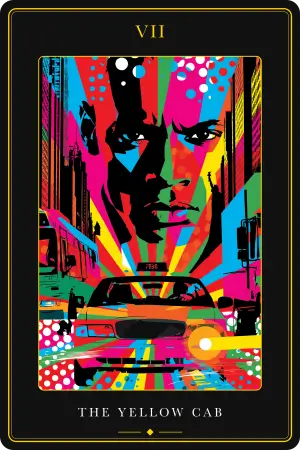
In the Tarot of New York City the Chariot arrives as The Yellow Cab, and the garden of stone and sphinxes becomes an avenue. The card shows a Crown Victoria threading gridlock from 34th to 59th, drawn in the deck's pop-art language: saturated sunburst rays, halftone dot fields, and hard black silhouettes set against blocks of pink, red, cyan, green, and yellow. The meter is ticking, a passenger has a flight in ninety minutes, and the driver says nothing.
The driver's face fills the upper half of the card, monumental between the canyons of skyscrapers, his eyes level and calm. He is the modern charioteer. Where the Rider-Waite-Smith warrior wears armor, the cab driver wears composure, and his gaze holds to the route only he can see. Rendered at the scale of the buildings, the face says what the old crown said: mastery of the situation, a mind lifted above the traffic.
The cab itself takes the place of the chariot. The square, stable stone vehicle of the RWS card is reborn as a Crown Victoria, a machine of pure function, battered but undefeated. Its illuminated rooflight plays the charioteer's star-crown, the signal above the traffic that this vehicle is in service and moving with purpose. Behind the cab the sunburst rays make the card's engine visible, standing for momentum, willpower, and the green wave of lights radiating outward. Where the RWS canopy carried stars overhead, here the whole sky is force and color.
The bus on the left and the truck on the right stand in for the two sphinxes. On the classic card the black and white sphinxes are the opposing forces the warrior balances without reins. Here they are two masses of traffic, one public and one commercial, forces that would crush an unskilled driver and that the master simply passes through, controlling them by timing rather than force. The Statue of Liberty appears as a small black silhouette between the buildings, the fixed star of the journey and the ideal this motion serves. She replaces the laurels of victory: freedom is the prize for the one who keeps the wheel.
The skyline pressing in on both sides is the same city that stands behind the RWS chariot, but it has moved from the background into the arena, opponent and racetrack at once. The halftone dots scattered through sky and street are the deck's signature texture, the crowd and the noise and the million simultaneous lives through which the driver holds a straight line. At the lower right a headlight flare burns like a torch, the forward light that projects will onto the road and cuts the way ahead.
Core meaning
The archetypal Chariot you already have from the canonical card holds underneath: triumphant will, momentum won by holding opposing forces steady, and the cap on the soul's first stretch of the journey. This deck takes that baseline and puts it behind a partition. The Yellow Cab is victory over a city built to stop you, poured into the one vehicle that performs that victory a hundred times a day.
The card signals movement and decisive progress. The situation is not calm. The avenue is jammed, the light is changing, and everything seems designed to slow you down, yet you have the wheel, you know the side street nobody else knows, and you are moving. It often marks the end of a stalled phase, when the project that crawled hits a green wave or a stalled decision finally pulls over and lets you in.
Inside the deck's street-level journey the Yellow Cab is the seventh arcanum, where contemplation ends and the drive begins. The Newcomer stepped off the bus at Port Authority with no map. Having gathered tools from the Hustler and wisdom from the Librarian, that same soul now takes the wheel, and the city itself becomes the test. The hero has the skills, the vehicle, and the deadline. What remains is to drive.
Upright meaning
Upright, the Yellow Cab is a green light and a clear road opening through the jam. It reads as willpower, control, and arrival for the person who takes command and stops waiting for traffic to clear, because in this city it never fully clears. Treat obstacles as things to be threaded, not reasons to pull over. Commit to a route and take it clean.
In love. A relationship in drive: momentum, pursuit, and two people moving through the city's obstacles toward the same address. It can mark the decisive start of a connection, crossing the room or sending the first text, or an established couple proving they can navigate distance, schedules, and an apartment hunt together. Its shadow is the driver who loves the chase and cools once the fare is won, so keep the speed honest and do not run lights to reach intimacy faster than trust can travel.
In career. A career in motion: the promotion track, the project delivered against an impossible deadline, and the reputation of the one who gets things there. It favors taking the wheel of your own trajectory and steering toward the role you actually want, and it rewards work that runs on movement and timing, from logistics and transport to any job won by nerve and follow-through.
In finances. The meter running in your favor. Money starts to move after a jam, a payment clears or a raise lands, and the card rewards the person who commits to a fixed financial destination and drives toward it. It favors a clear savings target and active income tied to effort, and it can point to earnings from transport, delivery, or a well-timed relocation.
In health. The decision to take the wheel of your own body and drive it with real energy. It favors motion of every kind, running the bridge at dawn, biking the avenues, walking fifty blocks instead of swiping through the turnstile, and it points to stamina, a training route, and the will to hold the line on sleep and discipline while the city offers ten thousand detours a night.
Reversed meaning
Reversed, the Yellow Cab is the cab going nowhere. The meter ticks, the avenue is locked bumper to bumper, and the driver leans on the horn, surrendering the wheel to his own frustration. It points to gridlock, loss of control, missed connections, and the feeling that the city is driving you. Plans stall in traffic and deadlines slide. Sometimes the fastest thing you can do here is pull over, look at the map, and admit the route was wrong.
In love. A couple stuck in traffic, both people in the same car with no motion and each blaming the road. Passion idles while logistics crowd out the destination the two once agreed on, or the partners grab for the wheel and collide over control. It can point to a relationship driven too fast past every warning sign, or a breakup when one person refuses to compromise on the route.
In career. A professional life stuck between stations. Effort is spent and the meter runs, but nothing moves forward. Too many fares get accepted at once and energy scatters across competing routes, conflicts with colleagues turn into lane disputes over credit and territory, and burnout sets in from driving hard toward an address you never chose.
In finances. The meter ticking while the car sits in gridlock. Expenses run with no forward motion to justify them, spending outpaces income, or an impulsive purchase jumps the light and takes a hit. It can mark income interrupted by a stalled deal or a late payment, or the literal costs of the vehicle, repairs and tickets, and it warns against risky shortcuts and borrowing to keep up the appearance of movement.
In health. A body stuck in traffic, or driven by someone other than you. Takeout every night because the day left nothing in the tank, the gym route abandoned, the whole machine running on stress, caffeine, and four hours of sleep like a cab that never returns to the garage. The counsel is to respect the vehicle: no cab runs forever without maintenance, so pull into the garage, rest, and retake control one block at a time.
Many readers also take the reversed card literally, as a caution about car trouble or an accident, and advice not to drive while emotionally frayed.
Historical notes
The Chariot behind The Yellow Cab descends from the Roman triumph, the days-long parade a victorious general led through the city, followed by chariot races in the hippodrome. Its direct literary ancestor is Petrarch's 1374 poem I Trionfi, whose triumph of Fame rode a chariot that trampled the dead underfoot. The earliest Italian decks kept it worldly. The Visconti-Sforza card shows a crowned woman with a scepter and a globus cruciger drawn by white horses, aristocratic power with none of the later occult symbolism, and oddly stationary at that.
The esoteric layer arrived in the French occult revival. Building on Court de Gébelin's Egyptian theories, Eliphas Levi swapped the draft horses for two sphinxes, one black and one white, the active and passive principles that will must subjugate. He set the conqueror in a cubical chariot with a pentagram coronet, crescent-moon Urim and Thummim on the shoulders, and a winged globe on the crest. Waite and Pamela Colman Smith carried Levi's design into the 1909 Rider-Waite-Smith deck and fixed the image most readers know: the stone vehicle, the starry canopy, the two sphinxes reined by nothing but the driver's mind.
The Tarot of New York City carries that long line one step further. Each earlier version set the triumph where its own world could stage one: a Roman street, a Renaissance court, a hermetic garden of stone. This deck sets it on the avenue, because the daily triumph a New Yorker actually recognizes is threading a jammed grid and arriving on time. The stone chariot becomes a Crown Victoria, the sphinxes become a bus and a truck, and the laurel of victory becomes the Statue of Liberty held in silhouette at the end of the route.
Correspondences
Number. Seven, the number of the seeker: inner wisdom, intuition, and the search for truth beneath the surface. In this deck the number is stitched into the fabric of the city, the 7 train running out to Queens, the seven digits of the old dispatch line, the lucky seven a driver plays at the bodega between fares. It insists that mastery of the outer city begins with mastery of the inner one. The driver who panics is stuck with everyone else, and the one who knows himself finds the side street.
Astrology. Cancer rules the card, the cardinal water sign of the Moon, and the pairing that puzzles beginners turns almost literal here. Cancer is the sign of the shell, a soft creature that survives by carrying its armor, and the yellow cab is exactly that, a hard steel shell moving through a hostile environment to protect the person inside. Cancer is also the sign of home, and the cab's deepest promise is the Cancerian one of getting you home. Its tenacity is the crab's: the driver does not give up the fare.
Element. Water. Beneath the horns and the hard motion runs the emotional, intuitive current of Cancer and the Moon, the radar by which the driver senses which streets are moving and which passengers mean trouble.
Kabbalah. The card holds the 18th path, from Binah (Understanding) to Geburah (Severity), crossing the Abyss. Its Hebrew letter is Cheth, the fence or enclosure, the boundary that guards something precious and volatile as it travels, which is the cab's own shape: a sealed cabin carrying a life across the whole city.
Elemental dignity. Beside fiery, driving cards the forward momentum intensifies. Beside watery, feeling cards the Cancerian undertow rises to the surface, and the reading turns toward the emotion the driver is steering by.
Psychological perspective
Plato drew this card's inner scene two millennia early. In the Phaedrus he pictures the soul as a chariot whose driver, Reason, steers a white horse of noble spirit and a black horse of base appetite; let them pull unchecked and they tear the cart apart or spin it in circles. The Yellow Cab restages that balance as a working shift: the bus and the truck are the two horses, the meter and the clock are the pull, and the driver holds them without ever raising his voice.
Jung adds the armor, and this deck swaps it for composure. The stiff, shielded charioteer is the Persona, the mask we show the world; the cab driver's version is the flat calm behind the partition, feelings kept out of sight while the hands stay on the wheel. Drawn on a question of identity the card still surfaces impostor syndrome, the fear of being a fraud working a heavy machine you do not fully understand, and it asks whether your composure is protecting you or hiding you from yourself.
As a personality the Yellow Cab is the person who drives their own life. They know where they are going before anyone else in the room does, they get quieter under pressure rather than louder, and they measure themselves by arrivals. The shadow of the wheel is the refusal to ever be a passenger: control hardening into domination, speed into recklessness, the destination reached while the passenger in the back seat is forgotten. The work of the card is to hold the calm eyes above the loud street without losing the reason for the trip.
The Yellow Cab across decks
Tarot de Marseille. The horses rear as if to bolt, but their bodies face outward and the wheels point the wrong way, so the whole card hangs in suspended motion, momentum held one breath before release.
Crowley-Thoth. Crowley armors his charioteer in amber and sets a crab on his head for Cancer. Four rotating sphinxes of mixed animal parts replace the two, standing for the Cherubim, the elements, and the fixed signs, and the driver's one true task is to bear the Sangraal, the Holy Grail tipped in his hands and shedding rays. The walled city behind him answers the enclosure of Cheth.
Modern decks. Across traditions the wheels stay curiously still, keeping the paradox intact: the movement is internal, and the real engine is a mind held in balance rather than a whip laid on the beasts.
The Tarot of New York City. This deck keeps the Chariot's meaning and renames the card The Yellow Cab. The stone vehicle becomes a Crown Victoria, the black and white sphinxes become a bus and a truck, the star-crown becomes the cab's lit rooflight, the starry canopy becomes a sky of sunburst rays, and the laurel of victory becomes the Statue of Liberty in silhouette. Where the classic driver holds no reins, this one holds none either: he controls the traffic by timing, threading the gap the way the charioteer masters the sphinxes by mind alone.
In combination and context
The Yellow Cab sharpens whatever sits around it into a matter of will and direction. As advice it says take the wheel, know your streets, keep your nerve, and refuse to brake before the destination. As the obstacle it is the route chosen badly, the horn leaned on instead of the map read. As the outcome it promises control, momentum, and arrival for the one who drives.
Position colors it heavily. In a money spread upright it is the meter running in your favor and income tied to motion; reversed it is expense with no forward motion to justify it. In work it is the promotion track and the project delivered against the clock; reversed it is effort spent while the career sits between stations. In love it is two strong wills learning to share one wheel; reversed it is the couple stalled in traffic, each blaming the road.
Inside this deck the Yellow Cab reads against its own cast. It stands seven stops past the Newcomer, the soul who stepped off the bus at Port Authority with no map, and it is the moment that soul finally takes the wheel. It carries the Hustler's tools and the Librarian's knowledge into live traffic, where knowing a thing and driving it turn out to be different skills. Its shadow rides in the rear-view mirror as the driver who wins every lane change but forgets the passenger, arriving first at an address that no longer matters to him.
Questions for reflection
- What traffic in your life are you treating as a reason to stop, when it is really just something to thread?
- Where are you leaning on the horn instead of reading the map and changing the route?
- When you finally arrive, will you know who you wanted waiting at the address?
The general meaning follows the Rider-Waite-Smith reading — the reference used across Tarot Academy. Open a specific deck above for its own interpretation.
Frequently asked questions
Explore the Tarot
Latest Posts
Discover the ancient wisdom of tarot cards and unlock the mysteries of your spiritual journey. Our blog is your gateway to understanding the rich symbolism, meanings, and practical applications of tarot reading.




















































