
 EN (English)


Major Arcana · 8
The Rickshaw Runner
Willpower proven in motion: a barefoot rickshaw runner flies through evening rain, laughing, one stride ahead of the weather.
Card at a glance
- Numerology
- VII
- Element
- Water
- Astrology
- Cancer · ruled by the Moon
- Kabbalistic path
- Cheth (Binah → Geburah)
- Timing
- Summer · Cancer season · night rain
- Yes / No
- Upright yes · Reversed no
Upright
willpower
momentum
victory
endurance
self-control
direction
progress
carrying others
Reversed
stagnation
burnout
running in circles
loss of control
no destination
exhaustion
recklessness
losing the passenger
The Rickshaw Runner in each deck
Every deck reimagines the same archetype. Compare the art, then open a deck to read its full interpretation.
Imagery and symbolism
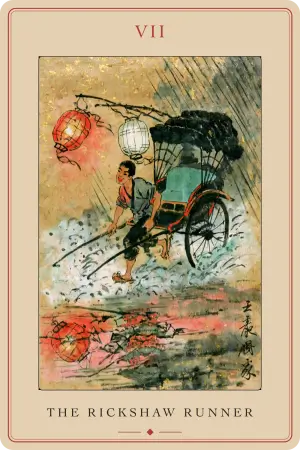
In the Tarot of Beijing the Chariot is The Rickshaw Runner (洋车夫), a young puller racing through evening rain between two swinging lanterns. He is drawn in the deck's Feng Zikai manner: a few calm brush lines, black and grey washes, accents of vermilion and teal on warm kraft paper flecked with gold, a small red seal in the corner. There is no armored warrior, no sphinxes, no city of towers behind him. The whole triumphant machinery of the classical Chariot has been distilled into one barefoot man, a two-wheeled cart, and the rain. Victory here is not a parade. It is a fare delivered dry.
The runner replaces both charioteer and horses at once. His legs are his horses and his willpower is the axle, and where the Rider-Waite warrior commands two sphinxes without reins, this puller commands his own body without a whip. He is laughing as he runs. That laugh is the card's crown, a mastery so complete it has turned into joy.
The two lanterns, one red and one white, are the deck's answer to the black and white sphinxes. Red carries vitality and celebration, the yang of appetite and drive; white carries restraint and mourning, the yin of caution and clarity. The runner keeps to the line exactly between them, borrowing light from both and stopping under neither. The canopy behind him is the shell of the Chariot, a portable roof carried at speed, and under it rides a passenger the picture never shows. That invisible passenger is the card's quietest symbol: the will serves a duty, a dream, or a loved one it cannot always see.
Rain slants across the whole card, ordinary Beijing evening rain that everyone has run through, and the gold flecks in the paper glint through the wet like streetlight on water. At the runner's feet the puddles hold the whole toppled city, lanterns and walls and rooftops hanging upside down, and he flies over it without sinking in. The wheel is a single sweeping stroke, the old sign of the Chariot's turning fate joined to the hub and spokes of the Chinese cosmos: the runner's calm face is the still hub, his flying legs the spokes.
Core meaning
The Rickshaw Runner is Beijing's Chariot, and the deck reduces the card's whole argument to one line: will is proven in motion, and motion is proven in bad weather. The archetype of triumph and momentum the reader already knows stays intact, but the conqueror changes shape. The classical Chariot is a warrior; Beijing makes him a worker. He conquers nothing but distance, defeats nothing but the rain, and rules nothing but his own two legs, and the deck insists this is the same victory.
Where the canonical charioteer masters two opposing sphinxes through sheer mind, this runner balances effort and restraint, the push of the legs against the steadying of the shafts. His triumph is not conquest but carriage. He holds total control of the journey, its route, pace, and every splash, yet the destination belongs to a passenger he cannot see. That is the card's mature form of will, a strength that has accepted a direction larger than its own appetite. The adolescent Chariot asks how fast it can go. The Rickshaw Runner asks how well he can carry.
Upright meaning
Upright, the card is a period of activity, rapid progress, and hard-won momentum. Something that stood still is now rolling, a project or a move or a relationship picking up speed, and the speed comes from your own legs rather than from luck. The counsel is the runner's: do not wait for the rain to stop, because the fare is earned precisely in weather like this. Keep both shafts in hand, choose your destination before you accelerate, and check now and then who is actually under your canopy. Your legs are strong enough. The only thing that can overturn this rickshaw is a divided mind.
In love. Love shown as effort: running through the rain so the other never feels a drop, rather than making speeches under a dry roof. It signals a courtship gaining real momentum or an established couple moving toward a shared home, a journey, a wedding. Keep passion and patience both lit, the red lantern and the white, and steer between them.
In career. An active professional stretch with visible results. Projects move, deadlines are met at a run, obstacles are taken in stride, and reliability becomes your reputation. It favors work involving travel, transport, logistics, or anything done with the body and hands, and it rewards a sustainable pace over a heroic one. The runner who finishes the month beats the sprinter who finishes the week.
In finances. Money earned in motion: active income and honest fares, wealth built stride by stride rather than won or inherited. It is a strong card for increasing earnings through your own effort, and it supports purchases connected with movement, a vehicle, travel, or equipment that makes you faster. Set a clear financial destination and keep a steady pace.
In health. The deck's great card of legs, lungs, and stamina. It favors running, brisk walking, cycling, and martial arts, anything rhythmic and sustained and done in all weathers. Discipline yields quick, visible results. Train the legs, guard the sleep, and the body repays you with a lightness you had forgotten it owned.
Reversed meaning
Reversed, the runner is soaked, stalled, or circling the same hutong. The wheels are stuck in a rut, or the rain has won, or he has run so long he forgot the address. The card shows stagnation disguised as effort: enormous energy spent, little distance covered. You may be pulling a load that was never yours, racing without a destination, or letting a passenger you cannot see dictate every turn. The remedy is to stop under an awning and set the shafts down, then ask where you are going, whom you are carrying, and whether you ever agreed to this fare.
In love. The runner and passenger are out of balance, one partner pulling the whole relationship while the other only rides. Devotion has become depletion, resentment soaking through the canopy. Sometimes the opposite happens: the bond moves too fast, corners taken at a run, commitments splashed through before anyone checked the depth. Put the shafts down together and say aloud where each of you thinks this rickshaw is going.
In career. The exhausted runner, too many fares and too little direction, busy every hour and advancing not at all. You may be carrying colleagues' loads along with your own, unable to refuse, or missing deadlines because the routes were badly drawn. Set the shafts down and reassess which tasks are truly yours and where this job is actually taking you. If the destination is no longer one you chose, the bravest run may be toward a different street.
In finances. Running hard for shrinking fares: work that no longer covers its own costs, income leaking through holes in the canopy. It can point to transport expenses, delayed payments, or losses from reckless speed, the impulsive purchase or the loan taken at a run. You may be supporting passengers who could walk. Count the day's coins honestly and redraw the route, fewer fares and better ones, with a fixed portion set aside before the next run.
In health. A vehicle driven past its limits or left in the shed. On one side, overtraining and running through injuries, the puller who will not stop until the knee gives out, so watch the legs, knees, feet, and heart. On the other, a total stall, the body stiffening in its rut while you keep promising yourself the run starts Monday. Restore the middle pace, gentle and regular, and repair whatever is creaking before you load the cart again.
Historical notes
The Chariot began as a public spectacle. Its imagery descends from the Roman triumph, the days-long parade granted to a victorious general, and its direct literary ancestor is Petrarch's 1374 poem I Trionfi, in which a hierarchy of allegorical chariots each defeats the last. The early card carried the triumph of Fame. The fifteenth-century Visconti-Sforza deck shows a crowned female figure with scepter and globus cruciger rather than a warrior, worldly power sitting oddly still in her stone car.
The occult redesign came in the nineteenth-century French revival. Eliphas Lévi replaced the draft horses with two sphinxes, one white and one black, and reframed the driver's mastery as the will subjugating raw nature. Arthur Edward Waite and Pamela Colman Smith fixed the modern image in the 1909 Rider-Waite-Smith deck: a golden-haired youth in armor standing in a heavy stone chariot, a starry canopy overhead, the sphinxes pulling without reins while the wheels rest over water.
The Tarot of Beijing keeps that reinless mastery and throws away the armor, the stone, and the sphinxes. What remains is a barefoot puller and a two-wheeled cart in the rain. The card is also a quiet bow to Lao She's Camel Xiangzi, Beijing's great novel of a rickshaw man, and it gently reverses the novel's tragedy. This runner is not being ground down by the city. Tonight he is beating it, laughing, one stride ahead of the rain.
Correspondences
Number. VII, the seeker's number, and the deck hides this contemplative figure inside its most physical scene. Seven is the search for what lies beneath the surface, and the card answers with its puddles, where the whole city trembles under the runner's feet while he keeps his footing anyway. Seven also combines the spiritual three and the material four, spirit riding matter, which here is the invisible passenger carried by the cart and the legs.
Astrology. Cancer, the cardinal water sign ruled by the Moon. Cancer is the sign of the shell, and the rickshaw's canopy is exactly that, a portable shelter the runner provides for another. Like the crab he moves his whole world with him, cart and livelihood and fate on two wheels, and he endures the rain so his passenger never feels a drop. The night scene, the lantern light, and the moonlit puddles all belong to the Moon's rulership.
Element. Water, the emotional tide beneath every practical errand. The puddles that hold the toppled city are the card's water made visible, the feeling that lies just under the surface of getting somewhere. The runner does not avoid it. He learns to run across it lightly.
Kabbalah. The Hebrew letter is Cheth, meaning a fence or enclosure, on the path that crosses the Abyss from Binah to Geburah. The letter's sense of a container that holds something precious and volatile matches the card exactly: the canopy is the fence, and the passenger is what it keeps safe as it travels between understanding and severity.
Psychological perspective
The person of this arcana has converted inner conflict into forward motion and made the body and its habits the vehicle of the will. They know what they want and, more to the point, they know what it costs per day and they pay it. Their confidence is the runner's laugh rather than the general's speech, and they steer their emotions the way a puller steers balance at speed, by constant small adjustment. They carry responsibility for others readily and carry it lightly, and they hold the rare skill of sustained effort, the long rhythmic run through weather rather than the sprint of enthusiasm.
Where the classical Chariot dresses this drive in armor and calls it a Persona, the mask of the victorious warrior held up against private doubt, Beijing swaps the armor for oiled cloth and the cart's humble canopy. The shadow underneath is the same. Drive can harden into compulsive motion, a person for whom rest feels like failure and stillness like death. They may value themselves only by what they carry and quietly resent passengers they never learned to refuse. At the extreme the runner passes his own life, always delivering and never arriving, the canopy empty behind him and no memory of whom the running was ever for.
The Rickshaw Runner across decks
Rider-Waite-Smith. The canonical Chariot stands armored in a stone vehicle, a starry canopy above, commanding two sphinxes that pull without reins. The Rickshaw Runner keeps that reinless control and the driver's balancing of opposites, then strips the armor and the stone down to a barefoot man who governs his own legs.
Tarot de Marseille. The older French card shows the horses rearing to go while their bodies face outward and the wheels point the wrong way, a triumph held in stillness. Beijing keeps the paradox of motion and stillness but resolves it in the runner's calm face, the still hub at the center of flying spokes.
Crowley-Thoth. Crowley set the letter Cheth and the crab of Cancer on the charioteer's head and made him the Bearer of the Sangraal, the Grail whose only purpose is to be carried. The Rickshaw Runner shares that idea in plain clothes: his passenger is the unseen thing he exists to convey, and his dignity is the dignity of carrying it well.
Modern reframings. Recent decks work to free the card's willpower and momentum from its martial costume. The Tarot of Beijing belongs to that movement, recasting the warrior-conqueror as a worker-conqueror whose whole triumph is a fare delivered dry through the rain.
In combination and context
The Rickshaw Runner pulls whatever spread he lands in toward motion, effort, and a chosen direction. Beside cards of stagnation or delay he is the push that finally gets the wheels rolling; beside cards of rest he asks whether the pause is repair or avoidance. His literal reading of travel and relocation runs strong, so among cards of movement he often signals an actual journey, a commute, or a change of address.
Set next to the Old Man on Jingshan, this deck's Emperor, he marries motion to structure, a swift and logical decision already carried into action, good for launching a well-planned venture. With cards of hardship such as the Five of Pentacles he points to work that pulls you out of a hard patch, a new route earning the freedom the old one lacked. Drawn again and again in a reading, he is less an omen pressing on you from outside than an instruction: pick up the shafts, name a destination, and let the body carry the mind somewhere new.
Questions for reflection
- What fare are you running in the rain right now, and would you still choose it if you lifted the canopy and looked your passenger in the face?
- Which of your two lanterns burns brighter, the red of appetite or the white of caution, and where does keeping to only one send you into the ditch?
- Where is enormous effort covering little distance, and what would you have to set down to run in a straight line again?
The general meaning follows the Rider-Waite-Smith reading — the reference used across Tarot Academy. Open a specific deck above for its own interpretation.
Frequently asked questions
Explore the Tarot
Latest Posts
Discover the ancient wisdom of tarot cards and unlock the mysteries of your spiritual journey. Our blog is your gateway to understanding the rich symbolism, meanings, and practical applications of tarot reading.




















































