
 EN (English)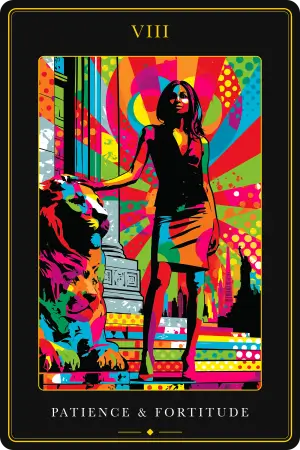


Major Arcana · 10
The Hermit
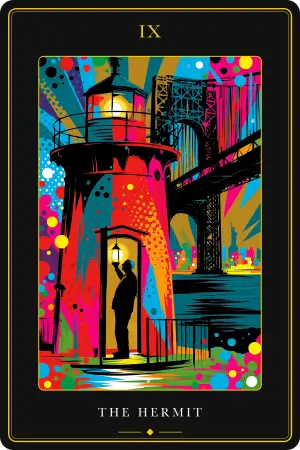
One lamp lit in the Little Red Lighthouse under the George Washington Bridge, chosen solitude in a city built to keep every eye pointed outward.
Card at a glance
- Numerology
- IX
- Element
- Earth
- Astrology
- Virgo · ruled by Mercury
- Kabbalistic path
- Yod (Chesed → Tiphereth)
- Timing
- Winter · Virgo season
- Yes / No
- Maybe · not yet
Upright
solitude
introspection
inner guidance
wisdom
self-analysis
reflection
chosen retreat
discernment
Reversed
isolation
loneliness
withdrawal
hiding
stubbornness
ghosting
alienation
The Hermit in each deck
Every deck reimagines the same archetype. Compare the art, then open a deck to read its full interpretation.
Imagery and symbolism
In the Tarot of New York City the Hermit keeps his full meaning and moves to the northern tip of Manhattan, to the Little Red Lighthouse standing under the George Washington Bridge. The card shows the keeper's dark silhouette in the lighthouse doorway, raising a small hand lantern before his face while the great lamp of the tower burns above him. He has pulled back from the noise on purpose to listen for something the crowd drowned out.
The lighthouse replaces the snow-covered mountain peak of the Rider-Waite-Smith card. Where the classical Hermit climbs above the world for perspective, the New York Hermit steps aside from it. The tower is small, human-scaled, almost forgotten, standing at the edge of the water while the city rushes past overhead, and it stands for the survival of a small faithful light in the shadow of enormous things.
The bridge looming above is the deck's answer to the world the Hermit has withdrawn from, colossal and endlessly trafficked, its steel lattice filling the sky the way worldly obligation fills a life. He does not reject it, since he lives directly beneath it, but he no longer mistakes its roar for meaning. That contrast of scale is the card's central teaching: the smallest light, tended honestly, matters more to the one who tends it than all the traffic above.
The hand lantern is the direct descendant of the RWS lantern and its six-pointed Seal of Solomon, the light of truth that shows only the next few steps. Held at the level of his face, it means self-knowledge examined at close range. The great beacon at the top of the tower extends the symbol outward: like the RWS sage who shines for those still climbing, the lighthouse exists to guide others through dark water. His featureless black silhouette carries the meaning of the grey RWS cloak, the withdrawal from status and display, and in a city obsessed with being seen he is the figure who no longer needs to be. Around him the pop-art field of halftone dots and sunburst rays scatters like distant windows and headlights, the millions of other lives present but held at a distance, while the small Statue of Liberty and a colored strip of skyline anchor the scene in the harbor and the dark water in the foreground stands for the subconscious he has turned to face.
Core meaning
The archetypal Hermit you already have from the canonical card holds underneath: the Sage, introspection, the solitary search for inner truth carried one lantern-step at a time. This deck gives that search an address. Its Hermit is the night-shift keeper, the rent-controlled tenant who has outlived three sets of neighbors, or the man alone in the Little Red Lighthouse, each of them a figure who stepped back from the city's noise to hear something true.
His number IX is the last single digit, the completion of a cycle before it resets, and in this deck's language it is the end of the line, the last stop before the train turns around. The withdrawal is deliberate, hermitude as an active verb rather than a collapse. The trains keep running and the deliveries keep arriving, but the Hermit is off the schedule for a while, doing the honest accounting that becomes possible only when the phone is face-down and the group chat is muted.
Upright meaning
Upright, the Hermit marks a deliberate turn inward, a solemn but positive season of reflection. It says the answers you are chasing cannot be borrowed from the crowd; they have to be excavated from your own depths, and this is a time for patience and discretion. Take the long walk along the river instead of the express train, let a weekend pass without plans, and trust your inner guide the way the keeper trusts his lamp, which lights only the next few steps.
In love. Often a partner who is prioritizing their own individuation and needs real space to sort out their values first. It can also be a healthy need for personal space inside a relationship, two people alone in the same apartment each with their own lamp, and it reads as peace rather than distance. Asked whether an ex will return, the Hermit usually says they are on a solitary healing path.
In career. Deep, focused, independent work over networking and self-promotion. It favors the solitary project and the rigorous course of study, the domain of scientists, archivists, writers, and mentors, where progress comes from concentration. In this city that profile gets promoted quietly: the person who mastered the work, not the one who performed it loudest.
In finances. A time for careful analysis and patience against the city's impulse economy. Stick to the budget, audit the subscriptions, read the lease before signing, and let no one rush a decision. Careful planning now leads to real savings and future stability.
In health. Rest, retreat, and restoration, the quiet winter the body and mind need. The card supports meditation, long solitary walks, and a disciplined slowing-down, a sustainable rhythm built rep by rep rather than a crash program.
Reversed meaning
Reversed, the Hermit's solitude sours. What began as a chosen retreat hardens into hiding: the apartment door that has not opened in days, the calls sent to voicemail, the buzzer left unanswered. It can be genuine, painful isolation, real loneliness in a city of millions, or the opposite problem, a fear of being alone with your own thoughts that drives constant socializing and digital noise to drown out the silence. It can also be spiritual bypassing, using "I need space to figure myself out" as cover to dodge responsibility, overthinking a situation into paralysis and calling the stuckness wisdom.
In love. Isolation building a wall between partners, conversations reduced to logistics, or a retreat into an idealized fantasy of love while real, imperfect candidates are dismissed at the door. It can hold up a mirror too, showing that obsessive questioning is blocking your own growth.
In career. Either you have stayed in the inward phase too long and now need to share what you have learned, or you lack the preparation the role demands and are hoping for an unearned break. It can also look like burnout hiding behind headphones, a withdrawal from colleagues that has stopped being restorative.
In finances. Excessive caution and indecision, savings sitting idle for years out of fear, or opportunities declined out of anxiety rather than analysis. It can mean refusing advice and carrying the whole weight alone when expertise is a phone call away.
In health. Avoidance of self-care, running on coffee and adrenaline while ignoring the body's signals, or the opposite extreme of a rigid regime pursued in isolation until it becomes another form of hiding. Either way the counsel is openness, to new methods and to help.
Historical notes
Waite built his Hermit partly by arguing with the occultists before him. He rejected Court de Gébelin's flat reading of the card as merely a wise man seeking truth and justice, and he dismissed Éliphas Levi's version, in which the Hermit stood for occult isolation and the guarding of personal magnetism from the profane. That idea of hoarding secrets had passed into French Martinism as the "Silent and Unknown Philosophy."
Against all of this Waite set a different claim. For him the Divine Mysteries protect themselves, since the unprepared cannot grasp them, so no human gatekeeper is needed to hide the light. His Hermit is a figure of attainment who lifts his lamp deliberately as a guiding star, declaring that where he stands, any willing seeker may also come.
The Tarot of New York City keeps that reading and restages it. The mountain becomes a working lighthouse and the guiding star becomes a keeper's beacon, so the light Waite insisted on offering is the one the tower throws across dark water for boats the keeper will never meet.
Correspondences
Number. He is IX, the final single digit and the completion of a cycle before it resets to ten. Every nine in the deck carries isolation or the limit of an experience, and here the number reads as the end of the line, the last stop before the train turns around. It gathers the earlier stages, the Newcomer's leap, the Hustler's craft, the Cab's will, and distills them into perspective. As a person the nine is the humanitarian who has set personal ambition aside.
Astrology. Virgo rules him, the analytical, service-minded earth sign that seeks truth through patient observation. Its professions are the deck's own: the lighthouse keeper, the night-shift worker, the archivist in the reading room between the stone lions, unglamorous and exact and essential. Virgo's ruler Mercury shows up in disguise, the solitary Hermes who wandered the earth as a ragged old man to watch and learn, an investigator more than a messenger.
Element. Earth, the grounded, methodical soil in which the Hermit's slow work takes root.
Kabbalah. His Hebrew letter is Yod, the hand, the small seed from which all the other letters grow, and he holds the path from Chesed (Mercy) to Tiphereth (Beauty). For timing, his moonless, wintry world points to winter and Virgo season, the New Moon, and spans of nine days, weeks, or months.
Elemental dignity. Beside Swords his analytical edge sharpens toward study; as a yes or no he tends to answer "maybe, not yet," a pause for reflection before deciding.
Psychological perspective
The Hermit describes chosen solitude, and modern readers often worry it means depression, since the picture of a figure alone in the dark makes the leap easy. The elemental detail argues otherwise. His staff belongs to the suit of Wands, to Fire and willpower, so his solitude is active and disciplined, a retreat undertaken to synthesize experience and seek clarity. Clinical depression reads instead through Water and Swords, the drowning emotion of The Moon or the mental anguish of the Nine of Swords, an involuntary withdrawal born of suffering. The honest caveat, and the warning of the reversed card, is that people are social by nature and solitude held too long can still corrode the mind.
In the Tarot of New York City this is the person who has learned to be alone in a crowd of millions. They possess genuine, unadvertised wisdom, seek understanding rather than status, and know the difference between being alone and being lonely, largely immune to public opinion in a city that keeps score so loudly. The shadow is the slide from solitude into alienation: too absorbed in thought to answer the door, self-analysis turning into the 3am replay of old mistakes, depth so prized that the warm surface of life, the stoop and the small talk and the shared meal, gets neglected.
The archetype has found a second life online as "Hermit Mode" or a "Hermit Era," a deliberate season of switching off social media, skipping the superficial events, and pouring energy into rest and creation. Commentators frame it accurately: this is a necessary winter of the creative cycle, the quiet phase that has to precede a return to the world, much as Brian Eno leaned on deep retreats to make his ambient records.
The Hermit across decks
Tarot de Marseille. L'Ermite is a wrinkled old man with a red staff and a red flame in his lantern. That flash of red, the color of vitality, says his inner fire still burns beneath the withdrawn exterior.
Crowley-Thoth. Crowley abstracts the figure almost past humanity. His Hermit carries a faceted lantern holding a small sun, an Orphic egg wound with a serpent rests before him, and Cerberus crouches at his feet as guardian of the underworld of the unconscious. A stylized spermatozoon crawls up his leg, the raw seed of life, tying him to the Hebrew letter Yod, the hand and the seed of all letters. Here the Hermit is a magician of seeds who knows they must be planted in darkness to grow.
The Tarot of New York City. This deck keeps the Hermit's name and meaning and moves him to the Little Red Lighthouse under the George Washington Bridge. The mountain peak becomes the small red tower, the lifted lantern glows in the doorway at the level of his face, and the beacon at the top of the tower plays the RWS light held up as a guiding star. The grey cloak becomes a calm black silhouette, the withdrawal from a city obsessed with being seen, and the harbor skyline and a distant Statue of Liberty hold the far edge of his solitude.
In combination and context
The Hermit is most often set beside The High Priestess, since both are cards of silence and hidden knowledge, and novices mix them up. Their methods are opposite. She works through the subconscious, Water and Moon, and already holds the answers within, a passive knowing that asks why you keep questioning when you already know. He works through the conscious mind, Earth and Mercury, and has to seek the truth actively, walking the path and lighting it as he goes.
With The Fool the pairing looks like a contradiction and resolves into a synthesis. The Fool is the blind leap of pure potential, the Hermit the careful study of every step, and together they call for the methodical mystic, someone ready to pioneer something wild while carrying hard-won wisdom. In love that reads as a real leap taken only after the solitary healing that keeps old mistakes from repeating. Reversed together they warn of the trap instead, hiding in isolation to avoid a new start, or throwing that wisdom away in a reckless impulse.
Inside this deck's Hero's journey the Hermit is the withdrawal that follows mastery. Patience & Fortitude taught the traveler to keep a hand on their own mane; now the same soul steps off the express track and descends into its own depths to meet the Wise Old Man within. The city is engineered to keep every eye pointed outward, at the skyline, the feed, the closing door of the train, and against all of it the card sets one small figure holding a lamp up to his own face. Its radical claim, made in the busiest place on earth, is that you already have the light and need only step out of the traffic long enough to see it.
As a straight yes or no, the Hermit answers "maybe" or "not yet," a pause that asks for more reflection before you commit.
Questions for reflection
- What answer are you seeking from the crowd that only your own solitude can give you?
- Is your withdrawal still a chosen retreat that restores you, or has it quietly hardened into hiding?
- If you turned the lamp on your own face tonight, what single next step would it show?
The general meaning follows the Rider-Waite-Smith reading — the reference used across Tarot Academy. Open a specific deck above for its own interpretation.
Frequently asked questions
Explore the Tarot
Latest Posts
Discover the ancient wisdom of tarot cards and unlock the mysteries of your spiritual journey. Our blog is your gateway to understanding the rich symbolism, meanings, and practical applications of tarot reading.




















































