
 EN (English)


Major Arcana · 12
Justice
The city adds up what you did and reads the total on the courthouse steps.
Card at a glance
- Numerology
- XI
- Element
- Air
- Astrology
- Libra · ruled by Venus
- Kabbalistic path
- Lamed (Geburah → Tiphereth)
- Timing
- Autumn · Libra season
- Yes / No
- Yes if you have been fair · conditional
Upright
fairness
accountability
cause and effect
the verdict
honesty
contracts
balance
due process
Reversed
bias
the rigged scale
corruption
avoidance
legal trouble
dishonesty
imbalance
shifted blame
Justice in each deck
Every deck reimagines the same archetype. Compare the art, then open a deck to read its full interpretation.
Imagery and symbolism
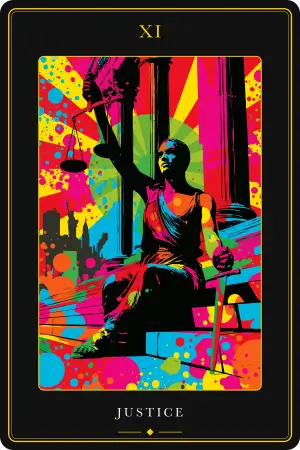
The Tarot of New York City sets Justice at Foley Square, the civic temple district of lower Manhattan where the courthouse steps rise wide as an altar. She sits between massive classical columns, out in the open air, in front of everyone. The deck renders her in its signature pop-art language: halftone dot fields, sunburst rays, and a figure built from black silhouette and saturated color blocks, so the law appears the way the city actually meets it, loud and lit from every direction.
Where her Rider-Waite-Smith ancestor sits enclosed behind a veil, this figure holds court on the same public steps where verdicts are announced and protests gather. The columns behind her carry the meaning of the RWS pillars: the fixed architecture of law, the structure that stands whether any single case goes well or badly.
She raises the scales high above her head rather than resting them at her side, so the weighing is visible to the whole square. The two pans hang level, every action in one answered by a consequence in the other. Her other hand grips the sword point-down against the steps, set like a staff. Judgment here is a ruling that has come down and now stands, not a threat held in the air.
Behind her, in silhouette, the skyline and the Statue of Liberty rise out of the halftone haze. The torch and the scale share the frame on purpose: they are the city's two promises, and the card quietly asks whether both are being kept in equal measure. The steps beneath her run in bright horizontal bands, appeal above appeal, and the sunburst behind her head reads as a civic halo of publicity. The palette of hot pinks, cadmium yellows, and taxi oranges departs from the gray sobriety of the traditional card, because in this deck consequence arrives in full color.
Core meaning
Justice is the law of cause and effect made into a figure and seated on real steps in a real square. It is karma stripped of moralizing, the impersonal principle that every action sends a matching consequence back through your life. In this deck the teaching has a plain civic sentence: you did the thing, now the city decides what it cost.
The card separates justice from fairness as you might wish it. It does not promise the outcome will feel good, only that it will be proportional, connected by traceable steps to what you set in motion. Foley Square is New York's version of a karmic ledger, a big city that runs like a small town because everyone eventually comes around: the sublet you handled honestly returns years later as the reference that lands you the apartment, and the person you stiffed on a split check turns up on the hiring committee. Balance here is not a state fate hands you. It is a verdict rendered case by case, and you are the one keeping the account.
Upright meaning
Upright, Justice announces a moment of reckoning, and the weighing is honest. A verdict lands and rearranges a life: a ruling, a signed lease, a settled dispute, an outcome exactly proportional to what was put in. Contracts, court dates, official decisions, and formal agreements are favored now, because the machinery of the moment is running clean. The card counsels you to act as if everything is on the record, because right now it is. Read what you sign, say what is true, pay what you owe, and claim what you are owed without apology.
In love. A relationship where the giving and receiving are in real proportion, both people carrying the weight and telling each other the truth. It often marks a formal stage: the talk that defines the relationship, moving in together, or marriage. Disagreements resolve by actually hearing both sides rather than by whoever concedes first.
In career. Performance measured accurately, with reviews, promotions, and salary landing on the merits. It favors the offer letter negotiated line by line and the dispute resolved through the proper channel. Come to negotiations with documentation and ask for exactly what the evidence supports.
In finances. The ledger is honest and the payout is proportional. The invoice gets paid, the raise reflects the work, the deposit comes back. It favors everything that runs through official channels: contracts, settlements, refunds, and claims decided on real numbers.
In health. The body is an exact accountant, returning what is deposited in sleep, food, movement, and rest. Choose the sustainable routine over the crash program, and let consistent care show up in energy and mood on schedule.
Reversed meaning
Reversed, the figure on the Foley Square steps holds a scale someone has quietly leaned on. The card points to bias and dishonesty in the situation: the verdict bought before the hearing, the landlord's lawyer against your no-lawyer, the credit taken by the person who did the least, the fine print that turns out to be the whole contract. A decision is being made without balance, influenced by connections or money instead of facts. It can foreshadow legal complications, a dispute that drags, or an accusation that is not true.
Reversed Justice often means the imbalance is partly yours. Consider the corner you cut, the thing you did not disclose, the responsibility you keep rescheduling while its bill grows interest in the dark. The way back to balance starts with the debt you can settle yourself. Get everything in writing, get real professional help where the matter is legal, and make sure your own pan of the scale holds nothing false before you demand an audit of anyone else's.
In love. One person carries the apartment, the plans, and the emotional maintenance while the other contributes reasons. Scorekeeping replaces generosity, and being right matters more than being close. In harder readings it touches the breakup where one keeps everything.
In career. Credit flows uphill to whoever spoke last, the promotion is decided before the interviews begin, and two sets of rules apply to two tiers of people. There may be an HR matter or a contract handled improperly. Document everything, contemporaneously.
In finances. The financial scale is leaned on: the lease clause that eats the deposit, the split that rounds against you, the claim denied on a technicality. Losses may trace to their dishonesty or your own untracked expenses and unread agreements.
In health. The body's scale knocked off balance by extremity, whether overtraining without recovery or care deferred until the sleep debt compounds. The body keeps flawless books, and every extreme is recorded for a later bill.
Historical notes
For centuries Justice sat at VIII and Strength at XI. That was the order in the fifteenth-century Mantegna cards and the Tarot de Marseille, matching how the cardinal virtues were placed in the Italian gaming and Minchiate decks. The change came with the Hermetic Order of the Golden Dawn, which insisted the twenty-two trumps line up exactly with the Hebrew alphabet and its astrological signs. In their system the letter Teth answers to Leo and Lamed to Libra, and since Leo comes before Libra in the solar year, the Leo card (Strength) had to precede the Libra card (Justice).
Arthur Edward Waite carried that switch into the Rider-Waite-Smith deck of 1909, making Strength VIII and Justice XI, and defended it in The Pictorial Key to the Tarot only with the line that he did it 'for reasons which satisfy myself,' keeping the astrology hidden from the uninitiated. The new number had its own logic: eleven reduces to two, tying Justice numerically to Judgement (XX, also a two), a resonance between the two cards of reckoning. Aleister Crowley later rejected the swap, returning the card to VIII and renaming it Adjustment, though he kept the Golden Dawn's Libra and Lamed attributions intact. The Tarot of New York City follows the Waite numbering, keeping Justice at XI on its courthouse steps.
Correspondences
Number. XI. In numerology a master number, read here as two matched uprights: the two pans of the scale, the two parties before the bench, the two columns behind the seated figure. In this deck the eleven also reads like two towers, two rails of a subway track, two rivers bracketing an island, a city built on paired lines kept level. Reduced to 2 (1 + 1) it becomes the number of partnership and the small private evenness of the deuce: splitting the check correctly, keeping your word on the handshake deal.
Astrology. Libra, the sign of the scales, the only sign shown by an instrument rather than a creature, with Venus as its ruler. Libra governs balance, partnership, contracts, and negotiation, and does its thinking in the space between two parties, which is exactly where this card sits, weighing in the open air of Foley Square. Venus shows in the card's unexpected beauty, its pop-art color and level poise: fairness here is attractive as well as correct.
Element. Air, the intellect and clear reason behind every judgment, the same clarity the card's sunburst and bright field carry.
Kabbalah. The Hebrew letter is Lamed, the 'ox goad,' an instrument of direction and discipline. Its path runs from Geburah (Severity, Mars) to Tiphereth (Beauty, the Sun), so the card is the active mitigation of force that keeps the center in balance, not a static peace. Crowley's title Adjustment names that continual recalibration.
Elemental dignity. Beside Cups the card often means marriage or a civil union, and reversed there a separation. Beside Swords it turns to contracts and legal disputes, beside Wands to workplace ethics and fast decisions, beside Pentacles to financial audits and settled debts. As a yes or no it answers conditionally: yes if your conduct has been fair, otherwise a warning that the same measure falls on you.
Psychological perspective
This arcana describes the psychology of the person who keeps a level scale in an unlevel city. The structure is organized around accuracy: they need the account to be true, the story told the way it happened, the check split the way the meal was eaten. Their thinking is evidentiary, and they change position when the facts change, which in a city of loud certainty makes them quietly rare. They are the friend both sides trust to settle the dispute, the highest psychological credential this card recognizes.
At its best this is objectivity without coldness. They hear both sides fully before deciding and deliver a hard truth in a steady tone, applying to themselves the standard they apply to others. When wrong, they say so and pay for it without theatrics. The shadow is the scale becoming a cage. Taken too far, the drive for accuracy hardens into rigidity: the person who relitigates a three-dollar discrepancy and cannot let an imbalance rest, confusing being right with being just. Excessive rationality can wall off feeling, so emotional appeals register as attempts to tamper with the evidence and intimacy suffers under cross-examination. The developed version learns what the figure on the steps models, the sword planted rather than brandished: judgment as a settled foundation to stand on, and a scale that can weigh grace as accurately as it weighs debt.
Justice across decks
Tarot of New York City. This deck's whole argument is that justice is a civic event done in public. Justice sits outdoors on the Foley Square courthouse steps, scales raised overhead and sword planted point-down, the skyline and the Statue of Liberty behind her in halftone silhouette. The pop-art palette insists that consequence in this city is vivid and arrives in full color, and the pairing of the torch and the scale asks whether liberty and justice are being kept level with each other.
Tarot de Marseille. Here Justice keeps its old seat at VIII, a crowned figure enthroned with an upright sword in one hand and the scales in the other, the plain emblem of weighed measure before the occultists elaborated it.
Rider-Waite-Smith. Waite moved the card to XI and enclosed it: a regal figure between two gray pillars, a violet veil behind, sword raised and scales held low, never blindfolded because spiritual fairness demands looking straight at the truth.
Crowley-Thoth. Retitled Adjustment and painted by Lady Frieda Harris, the card draws on the Egyptian goddess Maat, who embodies cosmic truth and order, pulling the focus toward the exact equilibrium of nature rather than a human court.
Sacred India Tarot. The archetype appears as Varuna, the Vedic god of the waters and of Rta, the principle of natural order and truth, framing justice as a fundamental law of the universe.
In combination and context
Justice takes its exact tone from the suit beside it. With Wands it turns to professional ethics and fast executive decisions, a situation demanding immediate correction. With Cups it centers on relational equity and often points to marriage or moving in together, though reversed it can mean divorce or legal separation. With Swords it sharpens into contracts, rational choice, and sometimes a hard legal battle. With Pentacles it becomes financial audits, settled debts, and formal business agreements.
Spread position steers it just as much. In the past it marks an earlier reckoning or decision that laid the ground you now stand on. In the present it is a call to assess your reality honestly rather than lean on a comfortable illusion. In the outcome position it predicts a moment of genuine accountability, a resolution that may be uncomfortable but will be authentic and final. As an obstacle it names the avoidance of truth itself, the denial you are using to delay an inevitable reckoning.
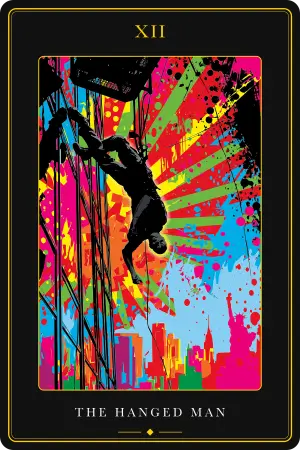
Justice is often confused with Judgement, and the difference is worth holding. Justice is the internal, present scale, concerned with human ethics and the immediate consequences of earthly choices, the querent auditing their own accounts on the courthouse steps. Judgement is the external, existential call, the trumpet blast that demands a full rebirth. Justice weighs whether a job or relationship is fair. Judgement is the realization that you can no longer live inside it at all. In this deck's hero's journey, Justice is where the Newcomer who stepped off the bus at Port Authority is finally presented with the bill, and only the hero who internalizes the scale is ready for the suspension of the Hanged Man that follows.
Questions for reflection
- If the scales of a situation you are in were read by someone with no stake in your story, what would they show about your own part in it?
- Where are you waiting for the city to deliver a verdict you already have the standing to render yourself?
- What are you carrying on your own pan of the scale that you have not yet settled?
The general meaning follows the Rider-Waite-Smith reading — the reference used across Tarot Academy. Open a specific deck above for its own interpretation.
Frequently asked questions
Explore the Tarot
Latest Posts
Discover the ancient wisdom of tarot cards and unlock the mysteries of your spiritual journey. Our blog is your gateway to understanding the rich symbolism, meanings, and practical applications of tarot reading.




















































