
 EN (English)



Minor Arcana ·
Six of Subways
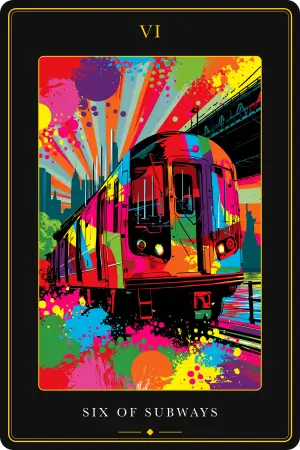
The quiet ride out: a subway train surfacing from the tunnel and crossing the bridge toward calmer water, carrying the hard lessons along as passengers.
Card at a glance
- Numerology
- 6
- Element
- Air
- Astrology
- Mercury · Aquarius (second decan)
- Kabbalistic path
- Tiphareth (Beauty)
- Timing
- Early February · second decan of Aquarius, Imbolc
- Yes / No
- Upright a qualified yes · Reversed no
Upright
transition
the ride out
recovery
calmer waters
relocation
moving on
support
bittersweet relief
Reversed
stuck between stations
resistance to change
riding the loop
stagnation
clinging to the past
cancelled move
fear of the unknown
Six of Subways in each deck
Every deck reimagines the same archetype. Compare the art, then open a deck to read its full interpretation.
Imagery and symbolism
In the Tarot of New York City the Six of Subways is a train that has come up out of the tunnel and onto the open elevated track, riding beneath a great bridge into a sky of pop-art sunburst rays. The darkest, underground part of the journey is already behind it. This is the deck's picture of surfacing: the storm has passed and the light is winning.
The six swords of the tradition stand upright inside the carriage, visible through the windows and doors, riding along as passengers. They are the hard lessons and experiences the traveler has come through, carried quietly to the new life to serve as memory rather than wounds. The fixed rails matter as much as the blades. Unlike a boat that can drift, the train follows its line, so the relocation is conscious and committed and cannot easily be reversed mid-crossing. This is the deck's version of the ferryman's steady hand on the pole. The empty driver's cab, with only the swords showing, echoes the passivity of the bowed figures in the original boat: once the real decision to leave is made, the city does the carrying.
The water beside the tracks recalls the river of the Rider-Waite-Smith card, rough water behind and smoother water ahead, its reflections still broken because the calm is new and not yet complete. On the horizon the Statue of Liberty stands where the trees on the far bank stand in the older image, the oldest New York symbol of arrival and the promise of a new beginning after the passage. Behind her the skyline glows, backlit by the dawn, the destination you can see but have not yet reached. The pop-art color breaks over the whole scene like feeling returning after numbness, the world loud again after the gray of the hard stretch.
Core meaning
The Six of Subways is transition, the quiet ride out of a situation that wore you down. It follows the hollow victory and the platform argument of the Five, and it is the mind finding its footing again as the doors close on the old station and the train crosses the bridge into the light. On the Tree of Life the sixes belong to Tiphareth, harmony, so this is a rare oasis in the suit of grief and conflict, the airy intellect brought into temporary equilibrium and clear enough to move.
Its Golden Dawn title is the 'Lord of Earned Success'. The success is earned rather than lucky, progress won through mental clarity and the release of paradigms that no longer serve, and here it takes the shape of a departure: the intelligent choice to stop fighting a losing battle and change lines. The travelers are moving toward safety, and they bring their swords with them, carrying the memories and the lessons across the water into the new life rather than leaving them behind. The tenderness you still feel about what you are leaving is not a sign of a wrong decision. It is the normal weight of leaving.
Upright meaning
Upright, the Six of Subways is the ride out: the doors have closed on the old station and the train is over the bridge and into the light. It signals a move away from conflict toward something calmer, often the aftermath of a chapter that ground you down. The worst is behind you, and while your stop is not fully visible yet, the direction is right. The card asks you to board the train that is actually leaving, stay on your chosen route, and give yourself time to rest during the crossing, since a ride is also a pause.
In love. A move into a calmer, more stable phase, the ride home together after the hard conversation has finally been said and survived. Couples leave the old fights on the far bank and may cross into new territory together, a shared apartment or a new neighborhood, with one partner often the steady hand carrying the other across.
In career. A transitional period: a new work location, a move to a new position, or the calm after turbulent times on the job. It often points to literal relocation, even a placement or a job in another city, with stability earned by adapting to the new line instead of clinging to the dying one.
In finances. A gradual recovery from money trouble and the chance to ride out of it. Sometimes it is a move made for financial reasons, a cheaper apartment or a different borough. Running from debt fails, since the swords of reality travel with you, while a calm, realistic budget reaches safe harbor.
In health. A transition toward a healthier and more balanced version of yourself, the body recovering once the mind stops grinding. It favors trading toxic habits for steadier ones and can point to restorative travel, a wellness trip or simply getting out of the city for a while.
Reversed meaning
Reversed, the forward motion stalls: the train is held between stations, the move keeps slipping, the transfer is never made. The card shows an unwillingness to leave problems behind, or avoidance of what has to be resolved before departure is possible. Often it is a person riding the same line back to the same stop day after day, chained to the past, romanticizing the block that hurt them and refusing to let go of old grievances. It warns against staying in the familiar carriage simply because it is familiar, declining the openings the city offers while the trains keep leaving.
In love. Unresolved issues that are hard to ride away from, a bond tied to past relationships or stuck on a loop that generates the same conflicts on a fixed schedule. It can also be plain fear of leaving a comfort zone that stopped being comfortable long ago.
In career. Resistance to a needed change: reluctance to move, trouble adapting to a new workplace, or staying on a dying line out of loyalty or fear. It also cautions that a move made without honest reassessment can land you in a new office with the old problems.
In finances. Delays in the transition to better circumstances, the raise postponed or the closing that will not close, sometimes a forced return to a previous state. It points to inflexibility about money and stress from uncertainty about the future.
In health. Reluctance to embrace the changes that would help, a checkup postponed another season or a routine that never holds because fatigue feeds itself. The old habits keep you at the previous station when a healthier line is standing right there.
Historical notes
The Six of Subways inherits its scene from the Rider-Waite-Smith Six of Swords, drawn by Pamela Colman Smith in 1909 under A.E. Waite's direction. In that card a cloaked figure and a child sit in a flat wooden boat while a ferryman poles them across the water, six swords standing upright through the floorboards. The image draws on a deep mythic well: the ferryman recalls Charon poling souls across the River Styx, and the boat of healing echoes the wounded King Arthur carried across the water to Avalon to recover and one day return. The Hermetic Order of the Golden Dawn gave the card its architecture, placing it at Tiphareth and titling it the 'Lord of Earned Success'.
The number six and the suit tie the card to the Hebrew letter Vav, a conjunction meaning 'and', drawn from an old image of an oar, the instrument that carries a traveler from one shore to the other. In Crowley and Harris's Thoth deck the card is retitled 'Science', six swords meeting at their points on a Rosicrucian cross, standing for the mind's ability to step back and observe a chaotic situation objectively. Vicki Noble's Motherpeace deck makes the same point with six women risen into the air for perspective, and Nicoletta Ceccoli's deck reads the crossing as the bittersweet loss of childhood innocence. The Tarot of New York City keeps that architecture and moves it above the tracks: the wooden boat becomes a subway train up from the tunnel, the ferryman's pole becomes the fixed rails, and the far shore becomes the Statue of Liberty on the horizon.
Correspondences
Number. Six, the number of Tiphareth: harmony, balance, and the synthesis of opposites. In the Subways suit it also carries decisiveness and the will to change, mental strength used to reach equilibrium and move.
Astrology. Mercury in Aquarius, the second decan of Aquarius, roughly January 30th to February 8th, centered on Imbolc and the first noticeable return of the light. Saturn sets the rigid boundaries of Aquarius while Mercury the messenger crosses them, so escape from the bedrock of defeat is earned by ingenuity. Mercury adds speed, adaptability, and transit, a fitting patron for a card whose whole image is a train crossing from one life to another.
Element. Air, the suit of intellect and communication, the New York survival skill of reading a situation like a subway map and choosing the right line.
Kabbalah. The card sits at Tiphareth, Beauty, the central sixth sphere associated with the Sun and equilibrium, within Yetzirah, the formative world of mind. The Golden Dawn calls it the high point of the airy suit.
Elemental dignity. As a balanced Air card it steadies and clarifies its neighbors, and it pairs naturally with travel cards like the Three of Wands to reinforce a journey over water.
Psychological perspective
The Six of Subways is cognitive distancing made visible. Crowley named the card 'Science', from the Latin scientia, knowledge, for the intellect's ability to step back from a volatile scene and observe it rather than stay trapped in it, unable to see the forest for the trees. Physically moving away, up out of the tunnel and across the bridge, grants the vantage point to think clearly, which is why the external crossing mirrors an internal one from old thoughts to new ones.
The detachment has a shadow. Over-reliance on cold logic can become an escape hatch from feeling the real grief of departure, what analyses linked to William Blake call 'Newton's Sleep', losing the soul to pure empiricism. The card's deeper counsel is patience. The swords ride upright in the carriage as memory now, not as injury, and you do not have to keep gripping them for them to stay yours. What you learned in the hard stretch travels with you, and the work of setting the heaviest of it down belongs to the safety of the far shore rather than the middle of the crossing.
The Six of Subways across decks
The traditions frame the crossing in their own keys, and this deck's contribution is to move it onto the rails. The Rider-Waite-Smith version is the narrative one behind this card: cloaked passengers, a ferryman, six swords standing in the boat, choppy water yielding to calm.
In Crowley and Harris's Thoth deck the card turns abstract and is retitled 'Science', six swords meeting precisely at their points on a Rosicrucian cross, standing for mental focus and objective distance. Vicki Noble's Motherpeace raises six women into the air for the same perspective, and Nicoletta Ceccoli's deck reads the departure as the loss of childhood innocence. It also helps to place the card against its cousins. Where the Eight of Cups is a lone seeker walking away from emotional emptiness and leaving the cups behind, the Six escapes toward safety with loved ones and takes its baggage along. Where the Chariot drives forward on willpower, this movement is passive, surrendered to the current. And where the Six of Wands is a public, cheering homecoming, the Six of Subways is a quiet, uncelebrated departure under a dawn sky. The Tarot of New York City gathers all of that into one image: the boat becomes a train surfacing from the tunnel, the swords ride as passengers behind the windows, and the promised shore is the Statue of Liberty lifting her torch over the water.
In combination and context
The Six of Subways takes its exact weight from its neighbors and its position. Read after the Five of Subways it is the escape from the platform argument toward calmer water, the natural next beat of the suit. Paired with the Three of Wands the travel reading sharpens into emigration, relocation, or launching something new over water. Alongside Death it gains a 'no looking back' finality, a life-altering rite of passage with a brighter dawn on the far shore, since the path of Death on the Tree of Life leads straight into Tiphareth where this card lives.
Position refines it further. In a past slot it names the crossing that brought the querent here. As an obstacle it is the difficulty of leaving, the swords weighing the carriage down. As advice it says accept the guidance, endure the passage, and change lines. As an outcome it promises calmer water reached through effort. In a yes-or-no reading it is a qualified yes, a quiet 'yes, if you are willing to move forward and leave the current station behind'.
Questions for reflection
- What am I carrying across this crossing that is genuinely serving me now as memory, and what could I safely set down once I reach the far shore?
- Am I riding toward calmer water, or quietly taking the same line back to a station that already hurt me because it is familiar?
- Who is riding with me through this transition, and where am I the steady one helping someone else through their own hard transfer?
The general meaning follows the Rider-Waite-Smith reading — the reference used across Tarot Academy. Open a specific deck above for its own interpretation.
Frequently asked questions
Explore the Tarot
Latest Posts
Discover the ancient wisdom of tarot cards and unlock the mysteries of your spiritual journey. Our blog is your gateway to understanding the rich symbolism, meanings, and practical applications of tarot reading.




















































