
 EN (English)


Minor Arcana ·
Seven of Subways
The turnstile jumper caught mid-leap, grinning at the free ride while the backward glance rides along in the price.
Card at a glance
- Numerology
- 7
- Element
- Air
- Astrology
- Moon · Aquarius (third decan)
- Kabbalistic path
- Netzach (Victory)
- Timing
- Mid-February, late Aquarius; slow, months not days
- Yes / No
- Upright no · Reversed leaning yes
Upright
strategy
the angle
stealth
street-smart tactics
getting away with it
discretion
unconventional routes
self-deception
Reversed
exposure
caught at the gate
the fare comes due
coming clean
failed scheme
ending the hustle
vindication
Seven of Subways in each deck
Every deck reimagines the same archetype. Compare the art, then open a deck to read its full interpretation.
Imagery and symbolism
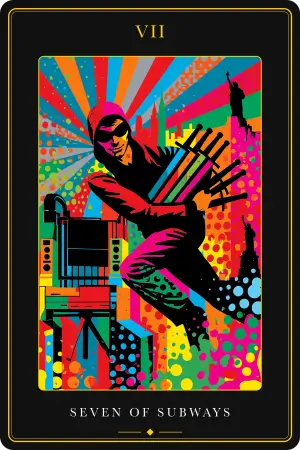
In the Tarot of New York City the Seven of Subways is a grinning figure in a hood and dark sunglasses vaulting away from a subway turnstile, hugging a stolen bundle of seven signal poles to his chest. He is caught mid-leap, one knee up, body twisted back toward the viewer, moving away while looking behind him. It is the city's oldest small heist, the turnstile jump, staged as the RWS Seven of Swords thief slipping from his camp.
The tension lives in his face and his shoulders. The grin and the sunglasses say he believes he is getting away with it. The backward glance says some part of him is not sure. Confidence in front, fear over the shoulder, and the whole card sits in the gap between them. The seven poles in his arms are painted in the official colors of the subway lines, red and green and blue and orange and yellow, the deck's version of the seven swords. He carries the full armful, awkward and overloaded, cleverness that has grabbed more than it can hold, and their black handles bristle past his shoulder like a quiver, a hint that what he carries could still cut him.
Behind him stands the turnstile with its HEET gate, the tall black revolving cage, dark and geometric against the riot of color. It is the rule he just skipped, the system's quiet demand that everyone pay the same fare, and its emptiness matters: no one is chasing him. The only pursuit in the picture is that glance, so conscience is the transit cop here. The background explodes in pop-art sunburst rays and halftone dots, the visual noise of the getaway and the loudness that lets a quiet act go unseen. Amid the color the skyline rises, and the Statue of Liberty appears twice, black and unmoving on both sides of his escape route. Liberty repeated is the card's dry joke and its verdict, because this figure has confused freedom with exemption. The hot palette of reds, magentas, and electric yellows carries the nerve the maneuver takes, while the composition tilts him downhill, off-balance, landing on a route he chose the moment he decided not to pay.
Core meaning
The Seven of Subways is the card of the angle: the turnstile jumper, the rider who knows which car stops at the stairs, the colleague who took the credit and the express and was three stops away before anyone noticed. It restages the RWS Seven of Swords, strategy and evasion and cleverness in the gray zone, inside the underground machinery of the city. It describes a situation where detours, timing, and quiet strategy matter more than brute force or the official channel. The city rewards those who see the gap and move through it, and here that shows up as sharp intellect, luck, and lessons learned from watching how things actually work rather than how they are supposed to.
The same card holds a warning. Something in the situation may be running technically fine and ethically unpaid-for, someone may be riding on your swipe, and a venture may be profitable without being entirely clean. The card asks you to notice the difference between clever and crooked, because from the platform they look identical. On the Tree of Life the sevens belong to Netzach, desire and emotion, set against the cold logic of Swords, so the mind here is divided against itself. The Golden Dawn called it 'Unstable Effort', the Thoth deck 'Futility'. Read at its most useful, the stealth is self-preservation, the quiet gathering of resources and planning of an exit, provided the plan can survive being looked at honestly.
Upright meaning
Upright, the Seven of Subways is the card of the well-timed move made out of sight: the unusual route nobody has mapped, the advantage taken by wit rather than force, or a warning that someone nearby is doing exactly that to you. It favors ingenuity and the indirect path, and it cautions against showing every card too soon. The person moving fastest may be moving away from something, so the card's standing question is whether the sneaking is smart survival or a way of dodging the truth. Study the situation more deeply, verify the schedule against the actual arrivals board, and check whose fare you are skipping to get there.
In love. Often the not-quite-said: the phone angled away, the story with smooth edges, a connection conducted in the gaps of the timetable. Sometimes it is plain deception, and sometimes it is the milder choice to keep something precious off the group chat until it is strong enough to survive it. Make sure both people are riding the same line with the same destination.
In career. Ambition run through careful planning and cold risk assessment, the well-mapped route over the impulsive sprint. It also names the colleague who took the credit and the express, so watch whose name lands on the work, keep your own records, and only maneuver in ways you could explain out loud at the all-hands.
In finances. Subtlety and timing toward a goal, the side angle or the arbitrage nobody else noticed, with a warning about the gray zone. Something may be running off the books, so read everything twice and count the change. The system you exploit today is the one you will need running tomorrow.
In health. The strategist of self-care: the walk of thirty blocks instead of the gym you never attend, small consistent adjustments threaded into a schedule with no slack. An individual, even eccentric approach fits this card, since the body answers a clever plan faithfully kept far better than a perfect plan abandoned by February.
Reversed meaning
Reversed, the Seven of Subways is the moment the angle collapses: the hand on the shoulder at the emergency gate, the forwarded email with the timestamps, the scheme that ran fine for months arriving at its final station. Hidden motives are being revealed or are about to be, and the fare that was dodged comes due with interest. The gray-zone move that was survivable last year is not survivable this quarter. The reversal can also point inward, where the self-deception you keep telling yourself on the ride home is wearing thin and part of you already knows. Assume the cameras work, and if something dishonest is in motion, exit it before it exits you. The cheapest moment to tell the truth is always the current one.
In love. The tunnel ends and the lights come on. Lies, infidelity, or a long-running evasion may surface, whether the deceiver was the other person or you. The reversal carries a liberation clause too, because the end of hiding is where an honest life becomes possible again, sometimes with this partner through the hard conversation finally held all the way through, sometimes on a line that actually goes somewhere.
In career. A plan coming apart and the maneuvering that failed. Credit is misappropriated or a system quietly gamed, and the arrangement is close to discovery. Retire your own workaround before the audit does. More gently, it can mean the lone-operator act has hit its limit, and asking colleagues for help is not exposure but the transfer that gets you on the right line.
In finances. Dishonest dealings and possible loss through deception or theft. Quickly gotten money proves quickly gone, and the dodged fare returns with penalties. Verify, confirm, and read the actual statement rather than the story about it, because the paranoid bookkeeper outperforms the trusting one here.
In health. Neglect dressed as busyness, the check-up dodged like a fare, the routine that was mostly a story about a routine. The correction is honesty rather than punishment: look at what the mirror and the bloodwork are both saying and build a modest, truthful plan you will actually keep.
Historical notes
The Seven of Subways inherits its scene from the Rider-Waite-Smith Seven of Swords, drawn by Pamela Colman Smith in 1909 under A.E. Waite's direction. In that card a figure in a polka-dot tunic and a fez creeps from a military camp with five swords bundled in his arms, glancing back at two swords left planted in the earth while three figures talk near the tents, oblivious to the theft. The image is caught mid-motion and mid-doubt, his body moving one way and his head turned the other. The New York deck keeps that exact posture and moves it above ground, so the camp becomes the turnstile, the stolen swords become the seven signal poles, and the backward glance stays.
The older forms were less literal. In the Tarot de Marseille the Seven of Swords is a non-scenic pip, a central sword crossed by six others with flowers at the intersections, read as a futile love and as the paralysis of analysis, the thinker who plots every outcome and never picks up the sword at all. The Astrolabium Planum had already drawn the third decan of Aquarius as a sneaky figure hiding something under his coat, a direct ancestor of Smith's thief. Waite's own 1910 Pictorial Key gives the card meanings of 'design, attempt, wish, hope, confidence' and 'a plan that may fail', then adds a stray positive note promising 'a country life after a competence has been secured', a pastoral reading that clashes with Smith's thief and is almost never used now. In Crowley and Harris's Thoth deck the card is titled 'Futility', a single solar sword battered and chipped by six smaller planetary swords, one noble idea eroded by a restless, overactive mind.
Correspondences
Number. Seven, the number of inner exploration, self-awareness, and the mind turned inward. In the city's terms it is the ride home at night with no signal, when the only thing left to look at is yourself reflected in the dark window of the car. It points to independent thinking and an unconventional perspective, but it also demands integrity in that thinking: a shortcut that cannot bear examination is a detour with a delayed toll.
Astrology. The Moon in Aquarius, the third decan of Aquarius, roughly February 9th to 18th. The Moon's fluctuating, illusory nature washes out the rigid scaffolding of Aquarian logic, so people delude themselves as readily as they mislead others. Aquarius favors the original route and the solution nobody filed a permit for.
Element. Air, the suit of intellect and communication. In this deck it runs as the mental transit map every New Yorker carries, thought and calculation and the weighing of angles, which line and which car and which version of the story.
Kabbalah. The card sits at Netzach, Victory, the seventh sphere of desire and emotion, within Yetzirah, the formative world of mind. Feeling disrupting logic here yields the 'Unstable Effort' of a compromised plan.
Elemental dignity. As a slippery Air card it destabilizes certainty in the cards around it, and in cartomancy it maps to the slow-moving Seven of Spades, pointing to delay measured in months.
Psychological perspective
The Seven of Subways is a mirror for self-deception, and the deck makes that literal in the window reflection on the last ride home. When the card recurs, community wisdom turns the suspicion inward rather than outward, asking where you are riding past a truth in yourself, letting it pull away from the platform because the next train will be less crowded. Self-deception is the smoothest ride in the city, no delays and no transfers, and it charges the most expensive fare of all. It names covert people-pleasing, saying everything is fine while quietly seething at a crossed boundary, a way of managing your own reality to avoid conflict.
It also names imposter syndrome directly. The feeling of getting away with something is the fraud's dread of being unmasked, and the card urges you to stop stealing from your own potential by playing small. The mythic figures around this decan sharpen the theme. Odysseus is the wily, resourceful mind that treats every obstacle as a puzzle for guile, while Don Quixote loses himself to the Moon's phantasms and mistakes delusion for vision. The lesson sits between them, since cunning is a real survival art in rigged systems, yet the same intellect can talk a person out of feeling what is true. By tonight, the card asks the window reflection one question: did I act in alignment with my own values today, even when no one was watching the turnstile?
The Seven of Subways across decks
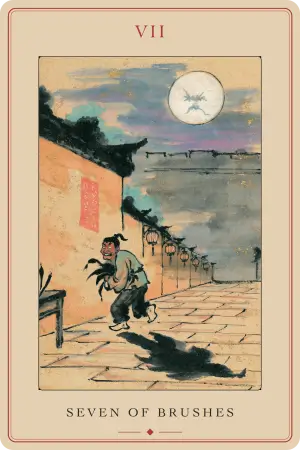
The same figure of stealth appears in different settings across the tradition, and this deck's contribution is to relocate it to the turnstile, the one place a New Yorker actually runs the small heist. In the Rider-Waite-Smith deck the scene is the thief slipping from a military camp with five swords, glancing back at the two he left behind, the defining image of stealth and calculated risk.
The Tarot de Marseille pip reads instead as futile love and analysis paralysis, all planning and no action. In Crowley and Harris's Thoth deck the card is 'Futility', a noble solar sword chipped away by six restless smaller ones, the mind's own chatter eroding a single good intention. Modern decks soften or reframe it: the Wild Unknown shows a fox asleep on a sword with one eye open, shifting theft toward guarded peace; the Shadowscapes raven warns against stealing others' ideas; Everyday Tarot leans into imposter syndrome and the 80/20 rule. The Tarot of New York City keeps the archetype whole and swaps the camp for the subway: the polka-dot thief becomes a hooded figure in sunglasses, the five stolen swords become seven signal poles in the subway line colors, the tents become the HEET gate, and the oblivious soldiers become a Statue of Liberty watching twice from both sides of the getaway. Across all of them the blades stay hidden under a cloak rather than wielded in the open.
In combination and context
The Seven of Subways is clarified by its neighbors. Set beside the Five of Subways the contrast is method: the Five is an open, brutal battle of egos, while the Seven is a covert battle of wits, a surprise ambush that learns from the Five's ruin that a rigged game sometimes has to be outmaneuvered rather than met head-on. Against the Page of Swords it is the guarded, secretive cousin of that open curiosity, hiding facts where the Page rushes to speak them.
Major Arcana pairings deepen it. With The Tower, both tied to Uranus through Aquarius, a hidden flaw becomes the trigger for an unavoidable collapse, and in this deck's own language a business that doubles down on the angle usually meets its Tower a few stops later. With the High Priestess the card confirms that a gut feeling about a hidden agenda is correct. With The Moon it is delusion and deception at full strength, reality so obscured that no fact can be trusted. In timing it runs slow, months rather than days, mapping to the winter-slow Seven of Spades. In a yes-or-no reading the upright card is generally a no, a call for caution and strategy, while reversed, as the truth comes out and the fare comes due, it eases toward yes.
Questions for reflection
- Where am I riding past a truth about myself, letting it pull away from the platform because the next version of the story will be less crowded?
- Is the angle I am running here clever self-preservation in a rigged situation, or a fare I am skipping that I will need paid up tomorrow?
- On tonight's ride home, looking at my own reflection in the dark window, did I act in line with my values even when no one was watching the turnstile?
The general meaning follows the Rider-Waite-Smith reading — the reference used across Tarot Academy. Open a specific deck above for its own interpretation.
Frequently asked questions
Explore the Tarot
Latest Posts
Discover the ancient wisdom of tarot cards and unlock the mysteries of your spiritual journey. Our blog is your gateway to understanding the rich symbolism, meanings, and practical applications of tarot reading.




















































