
 EN (English)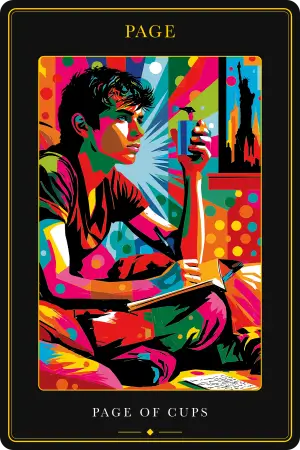


Minor Arcana · Cups (Water)
Knight of Cups
The city's resident romantic, walking the waterfront with the offer held out ahead of him before anyone has asked for it.
Card at a glance
- Numerology
- Knight
- Element
- Water
- Astrology
- 21° Aquarius – 20° Pisces · Fire of Water
- Timing
- Months · mid-February to early March
- Yes / No
- Upright yes · reversed no
Upright
romance in motion
an offer arriving
charm
creative inspiration
intuition
an invitation
sensitivity
falling in love
Reversed
gesture without follow-through
charm as performance
unrealistic fantasy
emotional immaturity
moodiness
stalled romance
creative burnout
no follow-through
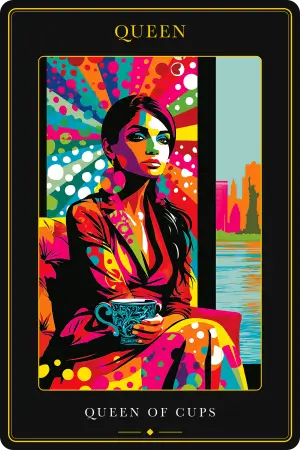
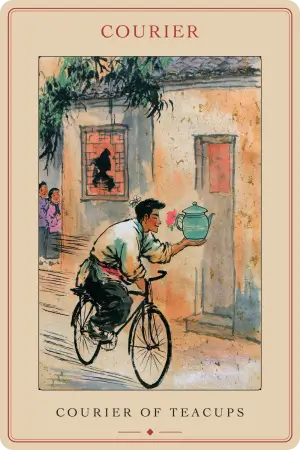
Knight of Cups in each deck
Every deck reimagines the same archetype. Compare the art, then open a deck to read its full interpretation.
Imagery and symbolism
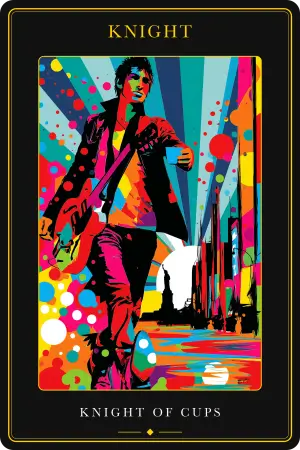
In the Tarot of New York City the Knight of Cups rides no horse. He walks, because in this city the romantic covers his ground on foot. He is a young musician striding along the waterfront at the golden end of the day, guitar slung across his body, one arm extended ahead of him holding out a blue paper coffee cup.
The guitar takes the place of the traditional knight's armor and lance. It is his whole equipment: gesture, poetry, song. The RWS knight advances protected by steel; this one advances protected by nothing but charm, which the deck names as both his gift and his risk. It marks him as the artist of the court, the messenger who delivers his news in melody.
The cup he carries is the suit's signature vessel, the blue Greek "We Are Happy To Serve You" paper coffee cup that runs through the whole Cups family. Held out at arm's length ahead of his own body, it is the offer arriving before the man himself: the invitation, the declaration, the message of feeling this knight has always carried. Here love is proposed the New York way, over coffee, on a corner, right now.
Behind him, at the center of the composition, the Statue of Liberty stands in black silhouette inside a white sun disk at the end of the avenue. The torch-bearer echoes his own raised cup, the harbor's promise of welcome rendered as a romantic ideal, the grand dream this knight is always walking toward. That she stands across the water ties the card back to the suit's element. The street beneath his feet runs with rippled bands of color like a river of reflected light, the traditional stream at the knight's feet repainted as wet asphalt shining after rain.
The pop-art language of the deck does the emotional work the old RWS landscape once did. Sunburst rays fan out across the sky behind him, his feeling projected onto the whole city. Fields of halftone dots rise and scatter around him like carbonation, like the fizz of infatuation itself. The palette is saturated to the edge in magenta, red, cyan, and gold. Nothing about this knight is muted, and that is the point. He is emotion moving through the city at full volume.
Core meaning
The Knight of Cups is the emissary of the suit of Cups, bound to Water and its territory of emotion, intuition, and relational intimacy. As a Knight he is also animated by Fire, the active energy of the court's riding rank, which makes him the "Fire of Water": feeling that will not sit still and instead thrusts itself out into the world. He takes the amorphous, internalized emotion of the suit and acts on it.
In this deck that chemistry is drawn as city chemistry. He is romance in motion, the charmer with the guitar and the perfect text, following the heart down every avenue it points to. When he appears, something is arriving with feeling behind it: an invitation, a declaration, a date, a creative opening. This is a season of infatuation, inspiration, and heightened intuition, when the city itself starts looking like a song. He can announce a romantic proposal, a message that matters more than it first appears, or a project that wants to be followed the way this knight follows his heart. His counsel is to trust that the heart is reading the map better than logic is right now.
Upright meaning
Upright, the Knight of Cups asks you to lead with the heart and express what you feel rather than store it. Something is arriving, and it is arriving with feeling: accept the coffee, be open to the meeting and the unconventional offer, say the thing you have been composing in your head on the train. Communication, chance encounters, and new horizons can turn out to be signs worth reading. This is a time to turn toward creativity as self-expression, to pick the guitar back up, literally or otherwise. The deck keeps one caution alongside the romance: he is lovely company, so before you build the house, check whether he, or the dream he represents, intends to stay.
In love. This is the deck's love letter of a card: a surge of feeling and tenderness entering a relationship or announcing one about to begin. It signals the approach of a romantic proposal, an invitation, a first date that feels scripted by the city, coffee held out on a corner and the walk that neither of you ends. In an existing bond it promises romance turning brighter, gestures made or received, passion given fresh air. The streetwise footnote stays: gestures are wonderful, just watch over time whether the one making them also stays.
In career. In work readings the card advises accepting opportunities that appeal to the soul and the creative vision rather than choices made only from a résumé or a spreadsheet. At work itself it reads as diplomacy and rapport, disputes softened, an atmosphere where people actually want to collaborate, and a phase of calm, careful craft where how the thing is done matters as much as that it is done.
In finances. Money tends to arrive as an offer extended toward you, often through relationships and conversation rather than cold analysis: a profitable proposal, a new investment, income from art, taste, and charm. The gig that pays, the side project that finds its audience. A good time to let intuition weigh in and to back what genuinely inspires you. The one condition is the knight's own: feelings open the door, but somebody still has to do the paperwork.
In health. Physical well-being here depends on tending the emotional state rather than forcing the body harder. The card favors the city's gentler pleasures: long walks along the water at golden hour, music while you cook, an unhurried bath, a park bench with a coffee. It can mark inner renewal that shows up outwardly, care for skin and body, running by the river because the light is good rather than to punish yourself.
Reversed meaning
Reversed, the Knight of Cups is the serenade with nobody behind it: the gesture that was the whole relationship, the plan that was mostly mood lighting. It can indicate deceptive dreaming and unfounded illusions, losing touch with reality because the romantic version of events is simply nicer to live in. You may be dealing with someone, possibly yourself, who is all avenue and no address, following feelings wherever they point without ever arriving anywhere. It can point to suppressed emotions, fear of showing real feeling behind the polished charm, narcissism, stalled romance, or creative burnout, the guitar carried everywhere and played nowhere. The repair is to bring the dream down to street level: keep the romance, but give it a schedule, an address, a next step. When the beautiful offer sounds too cinematic, ask the New York question, what's the catch and who pays.
In love. Emotional overload, unhealthy dependence, or feelings performed rather than felt: someone excessively emotional, immature, or unsteady. It often points to an over-idealized version of the relationship pursued while the actual person goes unseen, expectations no partner in any borough could satisfy. The romance may be cooling, the texts shorter, the gestures gone. It can warn of promises without follow-through, and in some spreads a third party or a wandering attention. Judge the relationship by its behavior across ordinary Tuesdays, not by its best evening.
In career. Charm curdled: moodiness in meetings, unprofessional flourishes, ethics treated as optional for the talented. Motivation collapses the moment the work stops being fun, deadlines slip because the boring parts are beneath the dream, and small neglected details compound into real mistakes. This can be a draining stretch of emotional or creative burnout. The advice is to rebuild on the rational side of the platform, with a clear plan and honest communication in place of gesture.
In finances. The beautiful pitch with no numbers behind it. It warns of illusions, inflated expectations, and financial dreams styled more for the montage than for the bank statement, with losses possible through impulsive spending and the expectation of quick, easy money the city rarely hands out. Seemingly attractive offers may be more performance than substance, so check what's under the charm before you sign, and postpone decisions made in a beautiful mood until a boring morning confirms them.
In health. The romantic running on espresso and adrenaline, emotional imbalance showing up in the mirror. Unprocessed feeling becomes a body neglected: erratic eating, skipped sleep, self-care postponed to a calmer month that never comes. There is a particular city trap here of performing wellness for others while feeling depleted underneath. The reversed knight asks for an honest audit of lifestyle and energy: real rest, regular meals, movement that soothes rather than punishes.
Historical notes
The Knight of Cups began as an aristocratic placeholder in the playing-card decks of the Renaissance and only later became a psychological signifier in modern cartomancy. In the fifteenth-century Sola Busca Tarot he is associated with Natanabo, or Nectanebus, the mythical pharaoh and magician of the Alexander Romance who approaches Olympias in serpent form, which lends the archetype an ancient layer of beguilement and magic.
Arthur Edward Waite and Pamela Colman Smith fixed the imagery most readers now picture. Their knight rides a white horse at a measured trot, visor raised in a gesture of openness, a fish-patterned tunic marking the element of Water, and the winged sandals and helm of Hermes marking him as a messenger. Where older decks such as the Tarot de Marseille faced the knight toward the left, toward the past, the RWS deck turned him to the right, toward the future. The Tarot of New York City keeps his role as the messenger of feeling and his outstretched cup, then trades the white horse for a walk along the waterfront and the medieval armor for a guitar.
Correspondences
Rank. Knight, the court's rider and messenger, the figure who takes the suit's feeling and carries it out into the world. In the progression of the Cups court he sits between the Page, who only theorizes about an emotion, and the Queen and King, who sustain and master it. The Knight is the moment feeling turns into pursuit.
Astrology. In the Golden Dawn decan system the Knight of Cups rules from 21° Aquarius through 20° Pisces, straddling Air and Water. He is primarily Piscean, which the deck reads as the dreamer of the zodiac walking the waterfront: grace, generosity, charm, strong intuition, and an imagination that shades into vision, with the Aquarian tail-end lending the charm and social acumen to win over a crowd. In the natural horoscope his home is the twelfth house of mysticism, secrets, and the inner life.
Element. Water, the suit's element of emotion, intuition, and receptivity, crossed with the Fire of the Knightly rank. The deck draws that Fire-of-Water friction as literal city chemistry: the heat of ambition everyone brings to New York, dissolved into the harbor water and the coffee in the blue cup.
Timing. Practitioners assign the suit of Cups to the timing of months. Because the Knight is tied to the mutable sign of Pisces the timing runs fluid, and the Golden Dawn decans point specifically to events between mid-February and early March.
Elemental dignity. In yes-or-no work the Knight of Cups reads as a yes upright, especially to questions of romance, art, and heart-led endeavors, provided the follow-through is there to verify. Reversed it turns to a no, a warning of illusion or impure intent.
Psychological perspective
The Knight of Cups is the hopeless romantic, the figure in love with the idea of being in love, and this deck sets that temperament loose in the streets. He wears his heart openly and treats emotional intimacy as the ultimate pursuit, which is exactly why strangers fall for him on first meeting. He idealizes people and situations generously and sincerely, and he can give himself over to a romantic idea without fear of setting practicality aside.
The Piscean gifts carry Piscean caveats, and the deck keeps them: inconsistency, forgetfulness, a carefree drift. His fiery nature compels him to act on feeling rather than sit with it, and the danger is that the appetite for the next spark of new love outpaces the sustaining depth of Water. He flows boldly with the current of his feelings, down every avenue they point to, best appreciated by those who understand that the tide bringing him in is the same tide that may carry him out. The card's growth edge is the same one the wider tradition names: to stop moving long enough to truly inhabit the emotional space, and so mature from the pursuing Knight toward the Queen or King of Cups.
The Knight of Cups across decks
Tarot of New York City. This deck strips the knight of horse and armor and sets him walking the waterfront at golden hour, guitar across his body, the blue "We Are Happy To Serve You" cup extended ahead of him, the Statue of Liberty's torch echoing his raised cup at the end of the avenue. Pop-art sunbursts and halftone fizz do the emotional work the old landscape used to carry.
Rider-Waite-Smith. The canonical knight rides a white horse at a gentle trot, visor raised, a fish-patterned tunic and the winged sandals of Hermes marking him as the messenger of Water, cup held out toward an unseen beloved across a shallow river.
Tarot de Marseille. The older knight faces left, toward the past rather than the future, an aristocratic rider closer to the card's playing-card ancestry than to the RWS psychological reading.
Crowley-Thoth. The Thoth system realigns the court to the Tetragrammaton, so the airy, communicative aspect that the RWS calls the Knight of Cups corresponds to Crowley's Prince of Cups, the figure of directed intellectual momentum riding in a chariot. Readers using Thoth attributes for the standard RWS Knight read from the Prince, which explains his link to the winged helm of Mercury and his forward drive.
In combination and context
The Knight of Cups shifts sharply with its neighbors and its place in a spread. Drawn for how a person feels, it reads as genuine, sometimes overwhelming infatuation. Drawn for intentions, it reads as the move to make a romantic proposition or start a creative collaboration. Readers consistently add one caution: the intention may be pure in the moment, but long-term follow-through usually wants a grounding Earth card, a Pentacle or a structured Major like The Emperor, to survive past the honeymoon.
The surrounding cards color him further. With the Ace or Two of Cups he points to true love, engagement, or a deeply romantic bond. With Death he can mark a karmic connection that requires the superficial romance to be stripped away before a mature love can emerge. With The Chariot he becomes unstoppable emotional momentum, a flow state aimed at a single heart's desire. The shadow pairings sharpen the warning: with the Seven of Cups he is lost in fantasy or juggling options with no intent to commit, and with The Devil the chivalry curdles into obsession and manipulation. In this deck the counsel stays street-level. Feeling is worth following, but ask whether the beautiful offer also has an address.
Questions for reflection
- What feeling are you carrying around in the drafts folder, and what would it take to hold the cup out first?
- Where are you following the romantic version of events because it is nicer to live in than the real one?
- When someone charms you quickly, can you tell the difference between their gestures and their behavior over time?
The general meaning follows the Rider-Waite-Smith reading — the reference used across Tarot Academy. Open a specific deck above for its own interpretation.
Frequently asked questions
Explore the Tarot
Latest Posts
Discover the ancient wisdom of tarot cards and unlock the mysteries of your spiritual journey. Our blog is your gateway to understanding the rich symbolism, meanings, and practical applications of tarot reading.




















































