
 EN (English)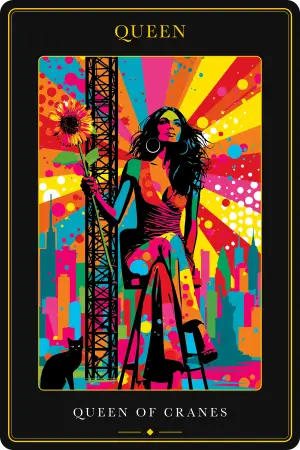


Minor Arcana ·
King of Cranes
The master builder of the skyline, raw ambition forged into a furnace that commands the crane and owns the finished tower.
Card at a glance
- Numerology
- King
- Element
- Fire
- Astrology
- Last decan of Aries, first two of Taurus
- Kabbalistic path
- Tiphareth (Beauty)
- Timing
- Mid-April to mid-May, Aries into Taurus
- Yes / No
- Upright a confident yes, reversed no
Upright
Mastered ambition
Leadership
Authority
Vision realized
The long view
Decisiveness
Master builder
Command
Reversed
Tyranny
Arrogance
Inflexibility
Burnout
Ego
Loss of control
No follow-through
King of Cranes in each deck
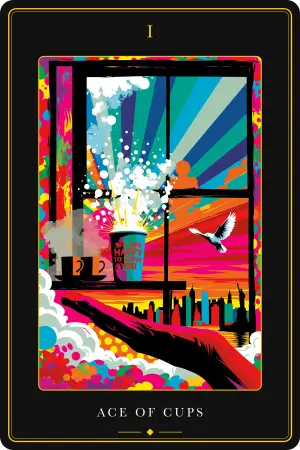
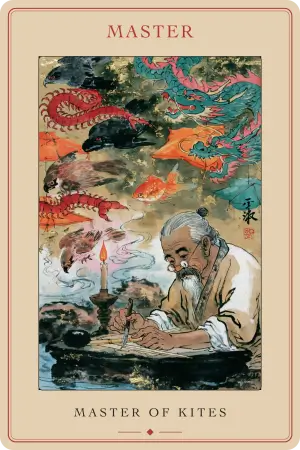
Every deck reimagines the same archetype. Compare the art, then open a deck to read its full interpretation.
Imagery and symbolism
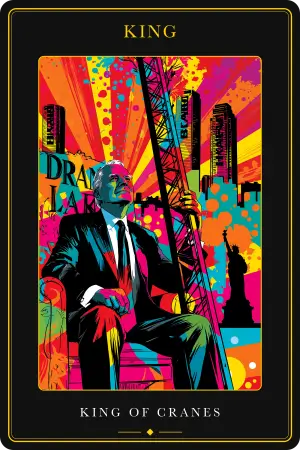
In the Tarot of New York City the King of Wands becomes the King of Cranes, the master builder at the top of the suit's fire. The deck draws him in its pop-art language: a bold sunburst behind him, dense halftone dots standing in for radiating energy, and the human figure rendered as a black silhouette. He stands tall and immovable at the dead center of the frame, stable and absolute, a man who has already arrived where the earlier cards were still climbing.
He holds the crane mast, but not as a tool for the next build. Here it is a staff of office. The crane is the emblem of construction itself, and the King is the one who commands it. In this deck the Cranes carry the fire of the Wands, the ambition that raises steel out of nothing, and the King is where that fire stops being raw and becomes governed.
His crown is a ring of sharp, stylized rays, and a vibrant yellow cape falls from his shoulders, the color the deck reads as intellect and clarity. His clothing is a patchwork of the suit's fiery colors, red, magenta, yellow and cyan, a sign that the raw energy of ambition has been built into his own structure. He does not simply use the fire. He is the furnace.
Behind him the completed New York skyline sits in a deep, authoritative blue. Earlier in the suit the skyline was a distant goal or a contested arena; for the King it is neither, it is his domain. The Statue of Liberty stands beside him for the monumental work he oversees, her raised torch rhyming with the mast in his hand. Everything in the frame reports to a figure who no longer chases the city, because he runs it.
Core meaning
The King of Cranes is the permit approved, the tower built, the authority established. He is the culmination of the Cranes, the point where the suit's fire is mastered and aimed with deliberate strategy. The flickering ambition of the early cards and the reckless charge of the Knight have settled into a controlled furnace, productive and sustained. He does not just start projects. He finishes them, and he owns the skyline they add to.
This is mature leadership: experience, decisiveness, and the will to turn a grand vision into poured concrete. Where the Queen of Cranes draws success toward her by presence, the King directs it, bending the physical city to his plan. His power builds rather than boasts. The lesson underneath the card is the stewardship of energy, the wisdom to hold a fire steady for decades and point its heat at something that will still be standing long after him.
Upright meaning
Upright, the King of Cranes says take charge. You have the leverage and the track record to dictate terms, and the card rewards executive decisions over hesitation or consensus-seeking. There is real authority on offer here, earned rather than granted, and people are looking to you for direction. Be fair, be clear, and expect others to follow. The city respects the builder who knows what he is doing.
In love. A relationship built on mutual respect, stability, and deep commitment, often a partner who is mature, protective and reliable, someone who brings the same decisiveness to love that he brings to his work. The bond is strong and passionate but grounded in reality. For singles it says you are ready for a serious adult partnership and will not settle for less, and the counsel is to build a relationship where both partners empower each other.
In career. A position of authority, respect and real responsibility. It often heralds a major promotion, an executive role, or the successful leadership of a crucial project. You are managing the work now, not just doing it. Act with confidence, mentor the people below you, and make the hard calls a leader is there to make, because your track record already speaks for you.
In finances. Strong financial stability and masterful command of resources. It points to successful investments, profitable ventures, and wealth generated through leadership and long-term thinking. This is the time to solidify the foundation, and it can also signal valuable backing or advice from an experienced, well-capitalized investor.
In health. Robust health, endurance, and a disciplined approach to the body. You have the willpower to hold a healthy regimen and the maturity to listen to what the body needs. The fire here is controlled and sustainable, so consistency and structure are the tools that keep vitality going over the long run.
Reversed meaning
Reversed, the King of Cranes is authority curdled into tyranny, or the fire burned down to ash. It shows power maintained through intimidation instead of respect: rigidity, arrogance, and a refusal to hear good advice, the kind of inflexibility that eventually cracks the foundation it stands on. In its other form it is a loss of power, a crisis of confidence, or the burned-out executive who has lost the drive that built the empire in the first place. Check your ego. If you are forcing compliance rather than earning cooperation, the structure is already failing.
In love. A controlling, dominant partner, a relationship marked by power struggles and short on emotional warmth. One person may be dictating the terms and demanding obedience where there should be partnership. It can also point to a partner so consumed by ambition that the relationship is left to starve. The card advises a hard look at boundaries and at who actually holds the power.
In career. A toxic environment under a tyrannical boss: micromanagement, unreasonable demands, and a culture of fear. If the card is you, then rigidity and arrogance are alienating your team and damaging your own standing. If it is a superior, you are dealing with an entrenched, inflexible authority. Document everything, keep your professionalism, and ask whether this is an empire worth serving.
In finances. Losses driven by arrogance and stubbornness, by insisting on outdated strategies while the market moves on. It can indicate a misuse of funds, a dictatorial grip on shared money, or a powerful person acting against your interests. The remedy is to swallow the pride, get objective counsel, and correct course before the foundation gives way.
In health. The warning that pushing through pain out of sheer stubbornness leads to a breakdown. Stress from overwork, the iron-will approach doing more damage than the effort is worth. Even the strongest engine needs maintenance, so the card advises surrendering some control, resting, and getting proper help when the body asks for it.
Historical notes
The Cranes inherit the whole history of the suit of Wands, and the King inherits one of its oldest arguments. The Golden Dawn rebuilt the tarot court to fit the four letters of the divine name and decided the raw masculine spark of Fire, the Yod, belonged on a swift mounted figure, so the traditional mounted Knight became their King. The airy, administrative force, the Vav, went to the seated ruler, so the old enthroned King became their Prince. Crowley locked that naming into the Thoth deck.
The practical result is that the Rider-Waite-Smith King of Wands answers to the Thoth Prince of Wands, which is why the two systems seem to disagree about the same seated figure. It also fixes his elemental dignity as Air of Fire, the intellect and strategy of Air used to direct the flames rather than merely burn. The older Tarot de Marseille had shown him more plainly as the Roy de Bâton, a static enthroned ruler holding his staff, settled authority over the suit. The Tarot of New York City keeps that enthroned master and hands him a crane mast and a finished skyline.
Correspondences
Rank. King, the mature, directing authority of the suit, the master who governs the fire rather than merely spends it.
Astrology. This deck places the King of Cranes on the last decan of Aries and the first two decans of Taurus. Aries gives him the unyielding drive, the pioneering nerve and the courage of a commander; the Taurus decans add earth, the stability and endurance to actually materialize the vision. It describes a leader who is not only an idea person but a builder, with the fire to conceive the tower and the discipline to see the concrete poured. The traditional King of Wands is instead debated between Scorpio into Sagittarius and Leo.
Element. Fire, and specifically its airy part: intellect, strategy and communication applied to ambition. This is fire steered by a master plan rather than the first spark.
Kabbalah. As the enthroned figure he answers to the Vav of the divine name, seated at Tiphareth, Beauty, the harmonizing heart of the Tree of Life that gathers the forces above it into ordered, radiant form.
Elemental dignity. As Air of Fire he strengthens and organizes the other Cranes and fire courts, works naturally beside the airy Swords, and grows impatient next to the slow Earth and deep Water that would try to rein him in.
Psychological perspective
Psychologically the King of Cranes is quiet, proven confidence. These are the architects of the city, the veterans and founders who survived the lean early years and now run the block. They do not need to shout, because the results are visible in the skyline behind them, and when they speak the room listens. The card carries the older reading of the King of Wands too, the soldier who came up the hard way and earned the throne rather than inheriting it.
For the seeker it is an instruction to step into that authority and banish imposter syndrome. When you feel defeated or cast yourself as the one who does not belong at the table, the card answers by telling you to trust your own competency and honor the resilience that got you this far. Stop measuring your private struggle against other people's finished towers.
The shadow is a matter of proportion. Cut loose from empathy or self-discipline, the same drive hardens into the arrogant tyrant certain of his own infallibility. Its subtler trap is an addictive need to keep moving: because the King is built for forward momentum, his hardest test comes once the goal is won and no battle is left, when he manufactures fresh conflict rather than sit in the stillness of what he has already built.
The King of Cranes across decks
The archetype holds while the imagery shifts. In the Tarot de Marseille he is the Roy de Bâton, a static enthroned ruler holding his staff, the foundational image of settled command over the suit. In Crowley's Thoth deck he is the seated Prince of Wands, read as Air of Fire in the Leo decans, the archetypal executive and proud, occasionally boastful boss who bends intellect to creative drive.
Modern decks restyle him freely. The Wild Unknown makes him the Father of Wands, a dominant snake struck by red and orange lightning, primal power that strikes with calculated aim. Prisma Visions wreathes him in a tireless sunset as a man truly alive, and warns in reverse against the death of empathy. The Unveiled Tarot casts him as Freddie Mercury at Live Aid, catching his flamboyant, magnetic stage presence exactly. The Tarot of New York City makes its own translation: the throne becomes the whole skyline, the sceptre becomes a crane mast, and the king becomes a black pop-art silhouette with the Statue of Liberty at his side. Under every version sits the same mastered fire, aimed and held.
In combination and context
Read the King against his own court first. He is the one who directs where the Queen of Cranes attracts, who finishes what the Knight of Cranes only starts, and who masters what the Page of Cranes has barely begun. He is the last stage in the suit's lifecycle of ambition, the fire that has learned to build.
Among the Major Arcana his meaning swings hard with his neighbors. The Tower is explosive leadership and the downfall of an authority who shatters his own empire through overreach. The Devil weaponizes his charisma into lust, obsessive control and manipulation masked by charm. Temperance is the antidote, cooling his fire into patient, sustainable leadership. The Lovers is a passion built on shared ambition, and the Moon hides his real intentions behind a driven, charismatic surface.
Within his own suit the pairings sharpen. With the Eight of Cranes his plans manifest at speed, rapid expansion and swift resolution. With the Three of Cranes he is the far-sighted strategist expanding his influence over a long horizon. With the Ten of Cranes he has taken on too much and carries the whole vision on his own back, a blunt warning to delegate or collapse under the weight of the tower he insisted on carrying alone.
Questions for reflection
- What have you already built that entitles you to take charge here, and where are you still waiting for permission you no longer need?
- Are you leading these people by earning their cooperation, or forcing their compliance, and what is the difference costing you?
- When the current project is finished and no battle is left, can you sit in the stillness of what you built, or do you go looking for a new fire?
The general meaning follows the Rider-Waite-Smith reading — the reference used across Tarot Academy. Open a specific deck above for its own interpretation.
Frequently asked questions
Explore the Tarot
Latest Posts
Discover the ancient wisdom of tarot cards and unlock the mysteries of your spiritual journey. Our blog is your gateway to understanding the rich symbolism, meanings, and practical applications of tarot reading.




















































