
 EN (English)


Minor Arcana · Cups (Water)
Ace of Cups
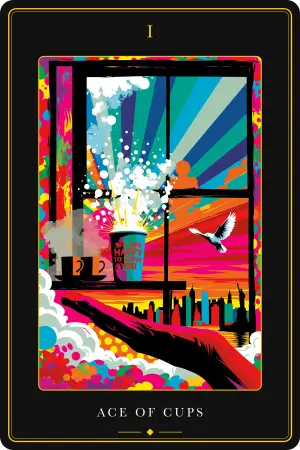
The blue-and-white Greek coffee cup held out full, water spilling over the rim: the city pouring you a fresh one on an ordinary Tuesday.
Card at a glance
- Numerology
- Ace
- Element
- Water
- Astrology
- Root of Water · Cancer, Scorpio, Pisces
- Kabbalistic path
- Kether (Crown) in Briah
- Timing
- New feeling, arriving soon
- Yes / No
- Upright yes · Reversed no
Upright
New love
Emotional renewal
Open heart
Compassion
Intuition
Creative inspiration
Joy
Receptivity
Reversed
Closed heart
Numbness
Emotional exhaustion
Missed connection
Suppressed feeling
Loneliness
Creative block
Self-isolation
Ace of Cups in each deck
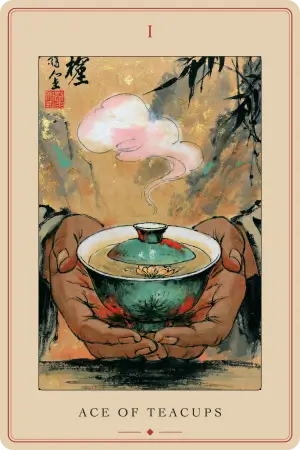
Every deck reimagines the same archetype. Compare the art, then open a deck to read its full interpretation.
Imagery and symbolism
In the Tarot of New York City the Ace of Cups keeps its name and its suit, and trades the golden chalice for the one vessel every New Yorker already holds: the blue-and-white "We Are Happy To Serve You" Greek coffee cup. It is drawn oversized and dead center in the deck's pop-art language of saturated color and halftone dots, the city's ultimate cup of daily renewal blown up to the size of an altar piece.
The cup overflows, but not with coffee. Pure, vivid blue water pours over the rim, standing in for a limitless emotional source the way the five streams did in the older card. Where the Rider-Waite cup poured its water toward lotus ponds, this one pours over a paper rim that usually holds a two-dollar coffee, which is the whole joke and the whole tenderness of the deck. Grace shows up in the cheapest, most ordinary container the city owns.
A white dove descends toward the cup carrying a small bright token in its beak, the traditional sign of peace and inspiration, the unexpected arrival of something good on a regular Tuesday. Behind it the background bursts into pink and orange halftone dots, a field of warmth radiating out from the vessel like heat off the sidewalk in July.
The skyline runs low and small across the bottom of the frame. For once the city is not the subject. The massive cup dwarfs the towers, and the scale says plainly that today the feeling is bigger than the place it happens in. The card is an invitation to drink from a source that does not run out.
Core meaning
The Ace of Cups is the source of the whole suit, the pure and undiluted essence of Water. Where the suit of Cranes carries fire and ambition, Cups govern the heart: emotion, intuition, the subconscious, and the ties between people. The Ace is the seed of all of it, the first spark of feeling before it has been divided into the twos and threes of relationship and loss that follow.
In this deck that abstraction gets an address. It is the moment the city softens for you, the heart cracking open after a long cold season, the first honest conversation, the morning you wake up and realize you feel something again. New love, a restored friendship, a wave of creative inspiration, a deep and sudden peace: the Ace is any of these arriving unearned, the full cup held out with the offer already made. The instruction the image gives is simple. The coffee is poured, so drink it.
Because an Ace is potential and not a finished thing, the water is raw and unshaped. A cup that overflows can nourish, and a cup that overflows can also drown. The same emotional force that fills a life can flood it when it runs without banks. The Ace hands you the feeling. What you build from it is the work of the cards that come after.
Upright meaning
Upright, the Ace of Cups is the city pouring you a fresh one. It marks pure emotional renewal, a surge of joy or connection, an open heart and the willingness to let good things in. In plain yes-or-no terms it is an enthusiastic yes, especially in matters of the heart. The counsel is to say yes, stay open to new feeling, and pour your own energy out generously rather than guarding it. Do not bring yesterday's cynicism to a clean slate.
In love. The quintessential card of new love, the thrilling and overwhelming start of a romance, or a profound renewal of feeling inside a relationship that had gone quiet. The heart is wide open, and the whole city seems to conspire to bring two people together. Expect deep connection and sincere communication. The card asks you to embrace vulnerability in a place that usually demands armor, and to let the feeling flow before you have finished pricing it.
In career. A wave of job satisfaction and a renewed sense of purpose, sometimes the offer for a role you have always wanted. The environment turns supportive and creative, people are willing to help and share, and following your heart in a career decision tends to lead somewhere good right now. In business the reading sharpens: this is the venture born of real passion, the project you actually love, launched on genuine mutual respect rather than the spreadsheet alone.
In finances. Money that arrives feeling like a blessing rather than a transaction, a loan approved by someone who believes in you, a bonus, or an opportunity that lines up with what you care about. The emphasis is abundance that fills the cup, not bare security. It favors a generous and open hand, because money moves best now when it is shared and in motion.
In health. The physical glow that comes from emotional well-being. When the heart is full the body answers with vitality, good hydration, and a natural radiance, water being the suit's own element. This is a time to nourish yourself with care and pleasure rather than rigid discipline, and to trust that emotional healing will show up directly as physical improvement.
Reversed meaning
Reversed, the Ace of Cups is the coffee spilled on the morning commute, an emotional offering wasted or gone cold. It points to blocked feeling, emotional exhaustion, or a connection missed. You may be withdrawing out of fear of getting hurt, or watching enthusiasm drain away for no reason you can name. The cup is empty, or what is in it has gone bitter. The advice is not to force a feeling that isn't there. Acknowledge the fatigue, clean up the spill, and give yourself time to refill before you try to pour for anyone else. Take care not to shut down completely, because the block is internal.
In love. A block in the flow of love: unrequited feeling, a sudden loss of connection, or emotional withdrawal by you or a partner out of old hurt or plain tiredness. It can describe a relationship that looks fine on the surface and feels empty underneath. The honest move is to name the block rather than pretend the cup is full when it isn't.
In career. Emotional exhaustion and deep dissatisfaction with your current path, a job that drains the spirit and leaves you empty by the time you swipe out. It can flag a toxic atmosphere, a lack of appreciation, or the discovery that a role you once loved no longer fills you. It warns against quitting impulsively out of frustration, while insisting you find a way to replenish your reserves.
In finances. Emotional spending, the attempt to fill an inner void with things you buy. It can also mark a financial letdown that lands hard, a promised raise that never comes or a passion project that fails to fund. The flow is blocked. Keep money and raw emotion apart for now, and do not decide anything out of guilt, infatuation, or a sudden hunger for comfort.
In health. Emotional stress and sadness surfacing in the body as fatigue, lethargy, or a sense of being out of touch with yourself. It can point to matters of the body's fluids and a simple need to hydrate and rest. Physical health depends heavily on the emotional state right now, because the body will not thrive while the cup stays empty.
Historical notes
The coffee cup sits on top of a long line of far more solemn vessels. In the Tarot de Marseille the Ace of Cups is not a hand offering a chalice at all but a massive architectural cup that resembles a walled city, a cathedral, or an ornate reliquary, its pointed towers and battlements sealing the interior off from the world. Historians trace that structure back to the Visconti-Sforza deck of 15th-century Italy and read it as the New Jerusalem of scripture, a love that is foundational and eternal rather than personal and romantic. Other early variants went their own way: the 1830 Vergnano ace shows a great bowl of blossoming flowers, the Avondo Brothers deck of 1880 sets a cherub in an urn ringed by dolphins sacred to Aphrodite, and Claude Burdel's 1751 version raises a phoenix from fire beneath the sun.
The layered card most readers now picture came from the occult revival around the turn of the 20th century. Pamela Colman Smith, working under Arthur Edward Waite, drew a golden chalice held in a pale hand out of a cloud, five streams of water for the five senses, a descending dove carrying the communion host, Yod-shaped droplets falling like the spark of the divine, and a pond of lotuses below. Aleister Crowley's Thoth deck, painted by Lady Frieda Harris, stripped the religion out and rendered a glowing grail with water exploding upward like an endless fountain, which Crowley called inner and outer wealth. The Tarot of New York City inherits the outstretched offering and the pouring water, then trades the sacred chalice for the paper cup the city hands out ten thousand times a morning.
Correspondences
Number. One, the Ace, the number of beginnings and undivided potential. In numerology one is the seed, and everything the suit will become is already present in it, unspent and undecided. This deck reads that through a city that runs on ones: one swipe through the turnstile, one coffee to start the day, one stranger who becomes the person. The Ace of Cups is that single unit applied to the heart, the full cup before it is poured into the twos and threes of the suit.
Astrology. As the root of the element, the Ace rules no single decan. It governs the whole water quadrant of the zodiac: Cancer, Scorpio, and Pisces, held here in their highest form. It is the protective nurture of Cancer, the deep transformative passion of Scorpio, and the boundless empathy of Pisces, all present as pure potential before any of it has taken shape.
Element. Water, in its purest and least manifested state, the source of all emotion, intuition, and subconscious flow.
Kabbalah. Kether, the Crown, in Briah, the World of Creation, which the Golden Dawn titled the Root of the Powers of Water. It is the first Sephirah of the watery world, the point from which the rest of the suit descends.
Elemental dignity. As a Water card it strengthens beside Earth and meets tension with Fire, whose heat it cools and which in turn evaporates it, so the neighbouring cards decide whether the water nourishes or is scattered.
Psychological perspective
Read psychologically, the Ace of Cups is the sudden opening of the heart, a wave of pure feeling arriving before the mind has decided what to do with it. It asks for receptivity and vulnerability, the willingness to be filled with awe and to feel something you cannot yet name.
The deck gives that state a human face in the people who navigate the city by heart. They are deeply empathetic and openly intuitive, generous with their emotions, the first to offer help and the first to fall in love. They keep finding magic in the skyline and are not afraid to be soft in a place that rewards armor, and standing near one you find your own guard dropping.
Its difficulty is folded into its gift. Feeling this raw has no container yet, so it can flood as easily as it can nourish, spilling into oversharing or into loving faster than trust can grow. Reversed, the psychology inverts into the emotional well run dry: numbness worn as armor, cynicism hardening over old hurt, the depression of someone internalizing grief instead of letting it move. The developmental task is to keep the heart genuinely open while giving the feeling enough shape to survive contact with another person.
The Ace of Cups across decks
The core meaning holds steady while the vessel keeps changing. In the Tarot de Marseille the Ace is a walled architectural cup, a fortress or cathedral read as the eternal New Jerusalem, a love that is communal and foundational rather than romantic. In the Rider-Waite-Smith deck a pale hand offers a golden chalice from a cloud, five streams pour out for the five senses, a dove brings down the communion host, Yod-shaped drops fall as sparks of the divine, and lotuses bloom on the pond below. In Crowley's Thoth deck the chalice becomes a glowing grail with water bursting upward like an endless fountain, an image of raw and freely floating emotional force. Older variants add their own vessels, from Vergnano's bowl of flowers to Burdel's phoenix rising from fire.
The Tarot of New York City keeps every one of those functions and swaps the objects for the city's own. The sacred chalice becomes the blue-and-white Greek coffee cup, grace poured into the cheapest container on the block. The RWS lotus pond and heavenly gray give way to a field of pink and orange halftone dots, the five streams collapse into a single overflow of vivid blue water, and the dove survives almost unchanged, still descending with its small bright token. The skyline shrinks to a strip along the bottom while the cup fills the frame. Under every version sits the same root of Water and the same unformed first feeling.
In combination and context
The Ace of Cups shifts sharply with its neighbours because it describes an emotional environment rather than a fixed event. With the Ace of Wands it becomes the marker of intense attraction, sudden passion, and often conception. With the Three of Swords the heartbreak of that card cracks the vessel open so a purer love or a deeper self-awareness can pour in, turning grief into growth. With The Empress it is the classic sign of happiness in the home and successful pregnancy, and with The Lovers it is the undeniable spark of falling in love, which in a shadow reading tips into codependency. With The Tower it can mean a sudden emotional revelation that hurts and then clears the air, or, in a darker cast, the breaking of a deep bond. With The Devil it warns of overwhelming passion used as a tether, the pure-romance mask of love bombing.
Position sharpens it further. As advice it says say yes, extend the invitation, and pour generously without pricing the cost first. As an obstacle it can be feeling that overflows without boundaries, the flood that drowns rather than feeds. Remember that the Ace is only a seed. It takes two people to build a relationship, which the Two of Cups represents, so on its own the Ace is an internal shift, a wellspring of new feeling still undifferentiated and unassigned. In a fertility spread it is the very first spark of new life, strongest when maternal cards such as The Empress sit beside it to confirm it.
Questions for reflection
- Where in my life is a full cup being held out to me right now, and what cynicism am I bringing that keeps me from drinking?
- If I let myself feel this without immediately pricing the cost, what would I actually do next?
- Is this overflow of feeling nourishing me, or am I pouring so fast I risk flooding the very connection I want?
The general meaning follows the Rider-Waite-Smith reading — the reference used across Tarot Academy. Open a specific deck above for its own interpretation.
Frequently asked questions
Explore the Tarot
Latest Posts
Discover the ancient wisdom of tarot cards and unlock the mysteries of your spiritual journey. Our blog is your gateway to understanding the rich symbolism, meanings, and practical applications of tarot reading.




















































