
 EN (English)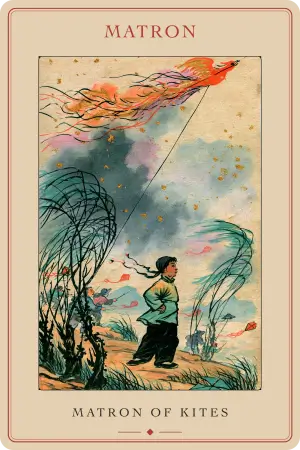


Minor Arcana ·
Master of Kites
Mastery banked to a candle flame: the old Wei kite maker whose frames lift the whole sky over Beijing.
Card at a glance
- Numerology
- King
- Element
- Fire
- Astrology
- Leo (fixed fire) · ruled by the Sun
- Timing
- Summer · Leo season · the long game
- Yes / No
- Upright yes · Reversed no
Upright
mastery
quiet authority
mentorship
vision
craft
leadership
legacy
long-term planning
Reversed
tyranny
rigidity
burnout
refusal to delegate
arrogance
coasting on reputation
control without warmth
Master of Kites in each deck
Every deck reimagines the same archetype. Compare the art, then open a deck to read its full interpretation.
Imagery and symbolism
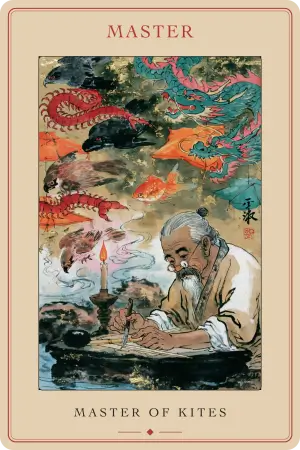
In the Tarot of Beijing the King of Wands is the Master of Kites, an old kite maker of the famous Wei family line who sits at his workbench at night and splits bamboo by candlelight. The throne of the canonical card becomes a workbench, and the crown becomes a single candle. His head is bowed to the work and his hands are veined and certain around the knife and the strip. He wears round spectacles and plain robes with no regalia, because in this deck authority is a way of working. He does not look up. Everything above him is already his.
Above him hangs the whole sky. The upper two-thirds of the card fill with a life's work: a teal dragon coiling through gold-flecked air, hawks and falcons stooping, red hundred-legged centipede kites, a swallow, a goldfish, orange and blue lozenge kites. They are drawn as living creatures rather than toys, because in a true master's workshop the line between the made thing and the living thing has worn through. What he builds flies, and what he imagines breathes.
The single candle is the suit's fire brought indoors and disciplined, a steady flame for precise work that echoes the long-spout kettle of Temperance and stands opposite the wildfire of the Five of Kites. The knife splitting bamboo is decisive will, the stroke that once made commits the spine of the kite the way a first brushstroke commits the page. Smoke curls up from the candle until it becomes indistinguishable from wind, tying the workbench to the sky. A small red seal sits in the corner as on every card, the maker's mark, which on this card is not decoration but the whole meaning.
Core meaning
The Master of Kites is Beijing's answer to the King of Wands, fire in its mature and governing form. Where the canonical King is the charismatic founder who still charges into the fray, this old man no longer holds a single string. He has not flown a kite in years and does not need to, because everything that rises over the city rises on his frames. His power sits upstream of every flight in Beijing.
The card marks the point where will has ripened into mastery: authority that is real and earned, projects that succeed because the hand guiding them no longer trembles. Others come to him the way apprentices come to a workshop, for the knife, the pattern, and the judgment. Where the Matron of Kites holds her phoenix steady in a gale and the Courier of Kites races through the hutongs half-flying himself, the Master directs rather than attracts. He bends the physical world to a long and patient vision, one strip of bamboo at a time. The card can also point to such a figure entering your life: a founder, a senior mentor, the person whose one quiet sentence redirects your whole venture.
Upright meaning
Upright, the Master of Kites says your authority in some area is genuine and hard-won, and the situation asks you to act from it without apology. Lead from the workbench, not the balcony. Trust decisions that rest on decades of practice instead of on mood, give your ambitions structure of frame, spine, and bridle rather than more wind, and take responsibility for outcomes and for the people who depend on them. Do not chase every kite in the sky. Build the one that will still be flown when you are gone.
In love. The mature flame: a partner, often older or more established, in whom passion has settled into deep and reliable warmth without going out. He loves the way he works, with full commitment and few words, and builds frames meant to hold in any wind. The bond acquires structure and safety, and loyalty here is less a vow than a habit decades in the making.
In career. Arrival at senior standing, or the clear road toward it: the department head whose authority rests on demonstrable craft, the veteran whose review everyone actually wants. Expect greater responsibility and formal recognition. The card strongly favors mentoring, so take on apprentices, lead the team, and set the standard others train toward.
In finances. Wealth of the workshop kind, built slowly and held firmly on real craft rather than luck. It favors consolidating a business, investing in quality and reputation, and profit from long expertise such as consulting, teaching, or licensing what you already do better than anyone on the lane. Fund the workshop, not the fireworks, and let every fen of spending answer one question: will this still be standing in ten years?
In health. The body governed by craft, discipline practised so long it has become character. This is the card of steady regimes kept for years, structured training under experienced guidance, and technique valued over raw effort. Habits set now hold, because they are built like bamboo frames. Care for yourself with the master's economy, precise and unhurried, and the results will fly on their own.
Reversed meaning
Reversed, the Master of Kites is the workshop with the door barred. The candle still burns, but no apprentice is allowed near the flame. Authority curdles into despotism: the leader who dictates instead of guides, the expert whose experience has hardened into contempt for anything new, the founder who cannot let go of a single string. At the other pole it is a master who has quietly stopped working and lives on reputation alone, the fire gone out under the ash of an old name. Sometimes it is you, afraid to claim authority you have actually earned. Open the workshop. Let younger hands make their crooked strokes, because the lineage dies otherwise.
In love. The workshop turned into a cage. One partner rules, decides, corrects, funds, and quietly requires gratitude for all of it. Care hardens into control and protection into surveillance. The other pole is ash: a long relationship the master has retired from, present at the bench and absent from the marriage, coasting on old love while making none new.
In career. Most often a difficult senior figure, the boss who cannot delegate, mocks new methods, claims credit for the workshop's flights, and treats questions as insubordination. It can equally describe your own position, coasting on seniority or refusing a leadership role out of fear disguised as modesty. Watch for micromanagement and for the tell of the reversed master, more time spent recounting old victories than producing new work.
In finances. Pride has entered the ledger. Losses come from refusing advice, dismissing newer methods, or assuming an old reputation will keep paying after the work has stopped improving. The card can also show capital hoarded to no purpose, resources locked in the chest while opportunities pass the shuttered window. Delegate the oversight you have been clutching and cut expenses that exist only to keep the old sign gilded.
In health. Discipline lost or misapplied. Either the regime has collapsed and health runs on the memory of former fitness, or it has hardened into tyranny over the body: punishing routines, contempt for rest, pain ignored because 'I have always trained this way.' That is the master refusing to let the bamboo bend, and bamboo that cannot bend snaps. Rebuild at candle-flame intensity, small and steady, and let an expert look at your technique.
Historical notes
The court cards were the last part of the tarot to settle into fixed meaning, and the King of Wands carries an unusual amount of that unsettled history. In the Rider-Waite-Smith deck of 1909, Pamela Colman Smith drew him in side profile, leaning slightly forward on a throne carved with lions and salamanders, his crown shaped like licking flames and a living salamander resting at his feet. The salamander biting its own tail into an Ouroboros marks the completed mastery of fire, the volatile energy of the suit turned into a self-sustaining loop.
The deeper complication came from the Hermetic Order of the Golden Dawn, whose Book T rearranged the court to fit the Tetragrammaton. The Golden Dawn assigned the raw masculine spark of Fire to a mounted figure, so their King became a Knight, and the seated enthroned figure became a Prince. Crowley fixed this in the Thoth Tarot, where the equivalent of the RWS King of Wands is the Prince of Wands. This is why the card's elemental dignity is usually given as Air of Fire, the intellect that structures and directs the flame rather than the pure Fire of Fire carried by the Knight.
The Tarot of Beijing keeps the mature governing fire and removes the monarchy entirely. The throne becomes a workbench, the crown a candle, and the fierce heraldic beasts become the real dragons and hawks the master has built with his own hands. What remains is the function the card always described: authority earned through a lifetime of craft, now vested in an old man who never ruled anything but his own bench.
Correspondences
Rank. King, the highest court rank of the suit, the point where the energy of Kites reaches full maturity and command. Where the Ace is the first spark and the lower court carries it through youth and quest, the King is the element mastered and put to lasting use.
Astrology. Fixed fire, the sun of the suit at its highest and steadiest point. The card governs the third decan of Cancer and the first two decans of Leo, and its natural home is the fifth house of creation, play, and what one leaves behind. The deck translates Leo's blaze into Beijing's register: not the roaring lion of a throne room, but the New Year lion that has learned when to lower its head. Like the Sun that rules Leo, the Master is a source, and the kites over the whole city are lit in a sense by his candle.
Element. Fire in its governing form, surviving as discipline. Leo's fixity is the Master's bamboo, flexible in the flame and unbendable once set, which gives him constancy of purpose across decades and the ability to keep a craft alive through dynasties and demolitions.
Elemental dignity. Air of Fire in the Golden Dawn scheme, the intellect of Air fanning the flames of Fire. This is what separates the King from the all-fire Knight: he logically structures and directs his creative urges rather than charging at them.
Kabbalah. As the Golden Dawn Prince, the seated King of Wands carries the airy, administrative Vav force of the Tetragrammaton, the reasoning intellect that governs the fire rather than embodying its first spark.
Psychological perspective
Psychologically the Master of Kites is the figure whose authority no longer requires demonstration. He is patient the way only genuinely powerful people are patient, having split enough bamboo to know that force applied in the wrong place snaps the spine. He thinks in decades and acts in single precise gestures. The passion is still there but banked to a candle flame rather than a bonfire. Praise from him is rare and therefore priceless, and he is generous with knowledge because he is secure enough not to hoard it.
The card's core psychological demand is to trust your own competency and banish imposter syndrome. In the research it is read as the story of a soldier who came up the hard way and survived his trials by fire to earn the throne, not a man born into privilege. The lion carved on the canonical throne is noble courage, but the lowly salamander beside it is the grit and adaptability that let him take the heat and endure. The Master urges you to stop measuring your private struggles against other people's glossy results, to honor the resilience that carried you this far, and to take up space you have actually earned.
The shadow is the tyrant of the small kingdom: experience hardened into a wall where every new method is an insult and every young talent a threat. Sometimes the harshness masks burnout, the fire that once lifted dragons over the city now barely warming the tea, the sharp temper a cover for the fear that the best work is behind him.
Master of Kites across decks
Rider-Waite-Smith. The canonical King of Wands leans forward on a throne of lions and salamanders, flame-crowned and ready to spring into the fray, the entrepreneur who still leads from the front. The Master of Kites keeps the mastered fire but sets down every string, trading the founder still in motion for the old craftsman whose work now flies without him.
Golden Dawn and Thoth. Because Book T rebuilt the court around the Tetragrammaton, the RWS King answers to the Thoth Prince of Wands, the seated airy-fire ruler rather than the mounted Knight. Crowley painted him as the proud executive and boss, Leo at its most commanding.
The Wild Unknown. Kim Krans replaces the human court with animals and titles the card the Father of Wands, a massive dominant snake against a black ground with red and orange lightning descending, the primal and slightly dangerous power of the suit acting in measured, calculated strikes.
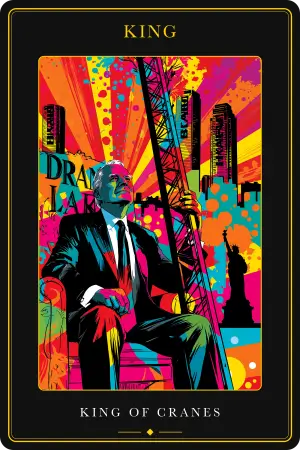
Prisma Visions and modern decks. James R. Eads wreathes his King in a tireless sunset with tongues of fire lapping at the body, the patron of a man truly alive, and warns in reverse against the death of empathy when ego outgrows the larger vision. The Unveiled Tarot famously casts the King as Freddie Mercury at Live Aid, catching the archetype's flamboyant and life-affirming stage presence. The Beijing deck belongs to this reframing movement, keeping the fire and the command while grounding both in an old man's steady hands.
In combination and context
The Master of Kites pulls whatever spread he lands in toward authority, craft, and the long game. With the Matron of Kites he completes the mature fire of the suit, the maker and the radiant beacon side by side. Set beside cards of foresight and planning, the equivalent of the Three of Wands, he becomes the visionary executing long-term strategy and expanding a lineage. Alongside the swift Eight of Wands his plans manifest at speed, with rapid expansion and immediate action.
The neighbors decide whether his fire warms or scorches. With the Ten of Wands he is the manifestation of burnout, the master who took on every job himself and now carries the whole vision on his own back, a warning to delegate or collapse. Near the Tower he is explosive leadership and the sudden downfall of an authority figure whose unchecked ego shatters under pressure. Near the Devil the toxic reading sharpens, charisma weaponized into control and relationships rooted in power rather than care. Temperance is the antidote in the deck's own language, the long-spout kettle cooling his fire into patient, sustainable command.
When he keeps returning in a reading, treat him less as an outside authority pressing on you and more as an instruction: name the area where your experience is genuine, act from it without apology, and give one hard-won piece of knowledge away, because in this deck teaching is how a fire keeps burning past the length of its own candle.
Questions for reflection
- Where is your experience genuinely the most seasoned in the room, and what would change if you stopped apologizing for it?
- Which string are you refusing to let go of, and whose kite stays grounded because of your grip?
- What one piece of hard-won knowledge could you hand to a younger pair of hands this week?
The general meaning follows the Rider-Waite-Smith reading — the reference used across Tarot Academy. Open a specific deck above for its own interpretation.
Frequently asked questions
Explore the Tarot
Latest Posts
Discover the ancient wisdom of tarot cards and unlock the mysteries of your spiritual journey. Our blog is your gateway to understanding the rich symbolism, meanings, and practical applications of tarot reading.




















































