
 EN (English)


Major Arcana · 12
The Hand Scale
Fairness as a daily public practice: an old vendor raises the hand scale above her head so the whole lane can see the balance point.
Card at a glance
- Numerology
- XI
- Element
- Air
- Astrology
- Libra · Venus
- Kabbalistic path
- Lamed (Geburah → Tiphareth)
- Timing
- Autumn · Libra season
- Yes / No
- Yes if deserved · Reversed no
Upright
fairness
balance
honest measure
accountability
truth
integrity
transparency
cause and effect
Reversed
dishonesty
rigged scale
bias
corruption
avoidance
short measure
lost trust
imbalance
The Hand Scale in each deck
Every deck reimagines the same archetype. Compare the art, then open a deck to read its full interpretation.
Imagery and symbolism
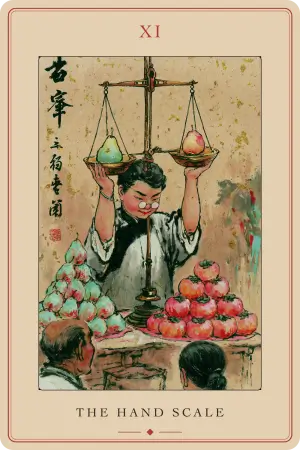
In the Tarot of Beijing, Justice steps out of the throne room and sets up behind a fruit stall at a morning market. There are no pillars, no crown, no upright sword. There is an old vendor woman, a brass hand scale, and a whole lane of witnesses. The deck states its argument in the staging itself: justice is not an institution but a daily practice, done in public, one weighing at a time.
She raises the scale above her own head, higher than herself. This is the deck's replacement for the sword and the throne, and it carries the card's ethics: the measure stands above the one who measures. She does not hide the beam under the counter, because the balance point belongs to everyone in the lane.
On the two pans lie two pears, one green and one blushing pink. They look different and weigh the same, and the scale reads what they are rather than how they look. It is the card's quiet answer to prejudice. Her round glasses stand for the trained eye that checks even what the instrument says, the deck's substitute for the blindfold: Beijing justice keeps its eyes open and lets everyone else look too.
Before her rise two pyramids of fruit, green pears and vermilion persimmons, the deck's teal and vermilion accents stacked like the two sides of a dispute, distinct and orderly and both welcome at the same stall. Two customers, an old man and a woman, watch from the lower edge as the lane itself, because a measure no one can verify is no measure at all. The upright pole of the scale runs down the center of the composition like a small Central Axis, the same vertical order that runs through the Old Man's city. On the left, the artist's calligraphy and a small red seal act as the card's own contract, since in old Beijing a seal is what makes a document binding, while the gold-flecked kraft paper glimmers behind the scene like scattered coins: value everywhere, weighed before it changes hands.
Core meaning
The Hand Scale is Beijing's Justice, and the deck delivers its whole thesis in the choice of scene: the great equilibrium of the universe is maintained from below, by millions of small honest measurements, and a civilization is exactly as just as its most ordinary scale. Where the canonical Justice sits robed and crowned as an institution, this old woman does justice with her hands, in the street, for the price of a pear.
The card is the marketplace form of karma. What you placed on the scale in the past is now weighed in front of everyone, and the conclusion will be fair whether or not it is comfortable. Its two governing images say the rest. The two pears, different in color and equal in weight, carry the epistemology: truth is what the beam shows, not what the eye prefers. The raised arm carries the ethics: whoever weighs, a vendor or a judge or a parent or a state, is bound first by their own instrument. Everyone eventually receives what their own hand placed on the pan. The Beijing accent only adds that this bookkeeping is public, daily, and remembered by the whole lane.
Upright meaning
Upright, the card calls for an objective, impartial choice made in plain view: a contract, a dispute, a legal matter, a verdict. A period of reckoning has arrived, and the outcome will be fundamentally fair, even if it is not the one your ego wanted. It favors logic over unchecked emotion and asks you to strip away the self-protective story and assess your reality with a clear eye. Weigh openly. Add the pear or take away half a pear's weight in words, but let everyone see the balance point, because a reputation for honest measure is built over years and spent in a single afternoon.
In love. Directness and deep mutual respect, a bond where giving and receiving hang level. It often marks an official milestone, a marriage or a formal commitment or an agreement about the shared household, where love settles into a calmer, weighed, durable state. Partners may be honestly evaluating the relationship; let them, and keep the beam visible to both.
In career. Decisions made after careful, visible analysis rather than haste. It points to formal negotiations, audits, evaluations, or official agreements, everything by the book and the book open on the counter. Your contribution is being weighed accurately, so credit and reward will match the pan. Document your work and hold your own beam high enough that colleagues can see the balance point too.
In finances. Honest transactions and income proportional to effort: the scale pays out what the pan holds, no more and no less. It suggests financial stability, transparent accounting, the settling of debts, and prices both sides accept because both sides can see the beam. Distribute resources as evenly as the vendor weighs her charity, on the same scale she uses for trade.
In health. A rational, balanced approach: sensible nutrition, exercise, and rest weighed against effort like fruit against the counterweight. The body keeps honest accounts and returns exactly what you place on the pan. Remember the two pears, green and pink, equal on the beam: bodies that look different can be equally sound, so measure progress by well-being rather than appearance.
Reversed meaning
Reversed, a thumb is pressing on the pan. Someone is weighing dishonestly: short measure, hidden fees, a biased judgment, a verdict reached before the fruit was placed. The scales have tilted through self-interest, corruption, or a refusal to face reality, and you may be dealing with legal trouble, dishonest competition, or false accusations while the balance point is kept out of view. Insist on transparency. Check every figure and every clause yourself, the way a buyer looks at the scale over the vendor's shoulder, and do not trade your own honest measure for a quick advantage: in the hutong, everyone knows whose scale lies, and that knowledge outlives the profit.
In love. Inequality and hidden accounts: one partner giving full weight and receiving short measure, manipulation, or a private ledger of grievances kept where the other cannot see it. Distrust grows from the hidden beam. Restore the balance point to public view through honest conversation and acknowledged debts of attention and care, or the stall will quietly lose its only customer.
In career. Bias, favoritism, or open unfairness: someone else's thumb on the pan of evaluations, promotions, or blame. Anticipate conflicts, unfair competition, or decisions made on missing facts, and your effort may be weighed short, or you may be falsely accused of weighing short yourself. Gather your documentation, insist on transparent criteria, and refuse to answer a rigged scale with a rigged counter-scale, which convinces no one.
In finances. Short weight in your accounts: hidden fees, doctored figures, questionable deals, or losses through poor management, with bureaucratic and legal complications around money possible. Someone may be weighing in their own favor, so check the scale before you pay and review every matter that affects others.
In health. A punishing or dishonest approach to the body: overtraining, severe diets, or judging yourself by the eye instead of the beam. The body's scale cannot be cheated, and exhausting regimens in pursuit of an ideal are weighed as damage rather than virtue. Ease the strict regime, return rest and nourishment to the pan, and measure by well-being, the one counterweight that never lies.
Historical notes
For most of the Tarot's history this card was numbered VIII, not XI. The fifteenth-century Mantegna sequence and the Tarot de Marseille both placed Justice at VIII and Strength (Fortitude) at XI, following the cardinal virtues as they appeared in Italian Minchiate and gaming decks. The Hermetic Order of the Golden Dawn broke that order in late nineteenth-century Britain. Their system matched the twenty-two trumps to the Hebrew alphabet and the zodiac, and since the letter Teth answers to Leo and Lamed to Libra, and Leo precedes Libra in the solar year, they moved Strength ahead of Justice.
Arthur Edward Waite carried the swap into the 1909 Rider-Waite-Smith deck, making Strength VIII and Justice XI, and defended it in The Pictorial Key to the Tarot only as done 'for reasons which satisfy myself,' a line meant to keep the astrology from the uninitiated. Aleister Crowley reversed course in the Thoth Tarot, painted between 1938 and 1943 with Lady Frieda Harris. He returned Justice to VIII and renamed it Adjustment, though he kept the Golden Dawn's Libra and Lamed attributions and reframed the card around Maat, the Egyptian goddess of cosmic order, so that justice reads as the balance of nature rather than of human law.
The Tarot of Beijing keeps the reckoning and drops the courtroom. It removes the throne, the pillars, the crown, and the sword, and keeps only the function, handing it to an old vendor at a market stall. The palace survives as scenery, and the weighing passes to whoever raises an honest scale in front of the lane.
Correspondences
Number. XI, the master number 11, whose shape is the card itself: two vertical strokes standing level, like the two pans, the two pyramids of fruit, the two watching customers. Eleven holds duality in tension, yin and yang, buyer and seller, claim and counterclaim, and it reduces to 2 (1+1), the number of partnership, diplomacy, and the choice between two paths, the green pear and the pink one, equal on the beam. That link to 2 also ties Justice to Trump XX, Judgement (2+0), the other card of reckoning.
Astrology. Libra, the sign of the scales, and in this deck the correspondence is literal: the scales themselves. Libra seeks balance and truth in relationships through constant small adjustments, one pear on and half a pear's weight of words off, until equilibrium settles between opposites. Its ruler is Venus, which supplies the drive toward harmony and relational grace.
Element. Air, appearing here as the vendor's word: the spoken price, the public verdict, the sentence the whole lane will quote.
Kabbalah. The Hebrew letter is Lamed, the 'ox goad,' an instrument of direction and discipline, on the path from Geburah (Severity) to Tiphareth (Beauty). Justice is the active mitigation of force that keeps the balance, which is why Crowley named it Adjustment: continuous recalibration rather than a single punitive verdict.
Psychological perspective
A Hand Scale personality holds objective views and acts on logic made visible. They weigh all sides before deciding, show their reasoning openly, and hold the beam patiently until it truly settles. Their authority is accumulated rather than granted, one honest weighing at a time over years, which is why people bring them disputes voluntarily, the highest form of trust. At their best they are practical negotiators whose transparency disarms suspicion, tempering emotion with the steadiness of a held beam.
The shadow sits in the gap between the truth they claim to value and the reality they are willing to see. Fairness can harden into a rigid, punitive superiority that keeps score, degrading balance into a transactional 'eye for an eye' that mistakes retribution for equilibrium and only extends the cycle of harm. The same eye that catches every gram can fail to notice that not everything human belongs on a scale, weighing words, gifts, and affections that were never meant for the pan. Their sharpest question is the one they avoid: if these scales were read by someone with no stake in my story, what would they show about my own culpability?
The Hand Scale across decks
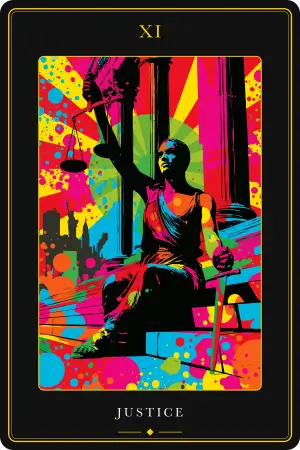
Rider-Waite-Smith. The canonical Justice sits crowned on a stone throne between two pillars, a double-edged sword raised in the right hand and golden scales held in the left, and pointedly without a blindfold, because spiritual fairness demands clear-eyed looking. The Hand Scale keeps the scales and the open eyes, trades the sword for a raised arm, and moves the whole scene from the throne to a market stall.
Tarot de Marseille. The older French decks number this card VIII and show a seated, crowned Justice with sword and balance, one of the three cardinal virtues in the trump sequence. Beijing keeps the balance and lets the number go to XI, where the Golden Dawn placed it.
Crowley-Thoth. Crowley retitled the card Adjustment and centered it on Maat, the Egyptian goddess of truth, shifting the theme from human morality toward the exact equilibrium of nature. The Beijing card shares that instinct, treating an honest weighing as a small enforcement of a cosmic law rather than a legal ruling.
Sacred India Tarot. This deck reads Justice through Varuna, the Vedic guardian of Rta, the natural order, framing fairness as a universal law woven into the cosmos. The Tarot of Beijing lands in the same place by an ordinary route: the same law, kept every morning at the price of a pear.
In combination and context
The Hand Scale pulls a spread toward accountability, contracts, and the restoration of balance, and its neighbors sharpen the verdict. With the suit of Wands it turns to professional ethics and fast, decisive action to correct an imbalance. With Cups it weighs relational and emotional truth, often marriage or a civil union upright and separation reversed. With Swords it emphasizes contracts and rational decision, cutting through confusion to the facts, sometimes a difficult legal battle. With Pentacles it centers on audits, settled debts, and the fair distribution of money.
Position matters as much as company. In the past it marks a reckoning already delivered that set your present reality; in the present it demands an honest assessment instead of a comfortable illusion; in the outcome it predicts an accountable, final resolution that may be uncomfortable but will be true; as an obstacle it names the avoidance of truth itself. Beside the Old Man on Jingshan, this deck's Emperor, the small Central Axis in the scale's pole meets the city's, and the reading turns to order held in the open. When the card keeps returning, treat it less as a verdict handed down and more as an instruction to raise your own scale, weigh the matter in public, and take the thumb off the pan.
Questions for reflection
- What have you placed on the scale that is now being weighed in front of everyone, and would you leave your hand where it is if the whole lane were watching?
- Where are you weighing something human, a word, a gift, an affection, that was never meant for the pan?
- If a stranger with no stake in your story read your scales, where would they find your own thumb pressing down?
The general meaning follows the Rider-Waite-Smith reading — the reference used across Tarot Academy. Open a specific deck above for its own interpretation.
Frequently asked questions
Explore the Tarot
Latest Posts
Discover the ancient wisdom of tarot cards and unlock the mysteries of your spiritual journey. Our blog is your gateway to understanding the rich symbolism, meanings, and practical applications of tarot reading.




















































