
 EN (English)


Minor Arcana ·
Ace of Teacups
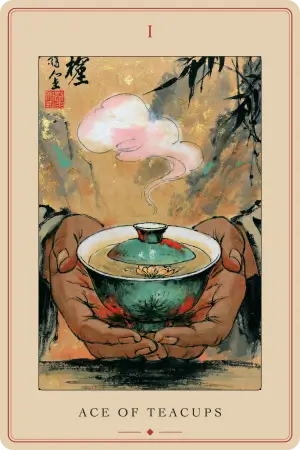
An offered heart: two hands hold out a full gaiwan across a threshold, its lid just lifted, the jasmine inside beginning to unfurl.
Card at a glance
- Numerology
- Ace
- Element
- Water
- Astrology
- Root of Water · Cancer, Scorpio, Pisces
- Kabbalistic path
- Kether (Crown), the root of the suit
- Timing
- A new feeling beginning · a warm season opening
- Yes / No
- Yes, warmly and wholeheartedly
Upright
offered heart
new love
hospitality
emotional openness
trust
creative inspiration
intuition awakening
reconciliation
Reversed
cup gone cold
emotional withdrawal
guardedness
unreciprocated feeling
withholding
loneliness in company
refused warmth
hospitality without heart
Ace of Teacups in each deck
Every deck reimagines the same archetype. Compare the art, then open a deck to read its full interpretation.
Imagery and symbolism
In the Tarot of Beijing the Ace of Cups holds no chalice from the clouds. Two weathered hands offer a full gaiwan, the lidded bowl of everyday Beijing tea drinking, across a threshold. The gift has come down to earth and turned human. In this city an offered cup is an offered heart, and the Ace shows the first word of that language.
The cup is held out with both hands. In Chinese custom, to give or receive anything with both hands is a sign of full respect and full sincerity, nothing kept back and nothing done casually. The gesture tells the querent that the feeling arriving in their life is whole-hearted, and teaches how it should be taken: with both hands as well.
The gaiwan is glazed teal with accents of vermilion, the deck's two signature colors meeting in one vessel, calm water beside living warmth. Its lid sits slightly ajar. A covered cup keeps its heat and shares nothing, while a lifted lid is an opening heart, and the Ace is exactly this first tilt. On the surface floats a single jasmine blossom, only beginning to unfurl, so what the querent is given is the living beginning of a love or a friendship rather than a finished one.
The steam rises and gathers into a small cloud tinged with dawn pink. This is the deck's quiet answer to the Rider-Waite dove descending from heaven. Here the sacred does not come down into the cup, it rises out of it, brewed from a small and human gesture. A single wisp connects cup to cloud and draws the card's vertical axis. Bamboo leans into the upper corner, the classic emblem of an upright and resilient heart that bends in wind without breaking. The background of aged kraft paper is flecked with gold, and a small red seal in the corner marks the card like a letter, because that is what this Ace is: a sealed message from one heart, delivered by hand, still warm.
Core meaning
The Ace of Teacups opens the suit of Teacups (茶碗), the deck's suit of water, and stands for the pure potential of feeling before any particular relationship has given it a shape. It is the capacity for love, empathy, and intuition at the moment it is freshest. Where the canonical Ace of Cups shows a divine vessel offered by a hand from the clouds, this deck grounds the same grace in an ordinary kitchen gesture, because in Beijing hospitality is the plainest language of love and the Ace is its opening line.
As a one, the card is a beginning that holds the whole suit in embryo. No one heats water for a single sip. The shared pot of the Two, the courtyard laughter of the Three, the four-generation table of the Ten are all folded inside this first offered cup, the way the whole flower is folded inside the jasmine ball. Its initiative is the initiating warmth of water rather than the conquering push of fire: the courage to pour first, to speak first, to hold the cup out before it is asked for. Upright, it heralds emotional renewal, a new love or friendship, a reconciliation, or a surge of creative inspiration and waking intuition, an invitation into someone's inner courtyard that is being extended freely and without conditions.
Upright meaning
Upright, the Ace of Teacups marks the beginning of a warm emotional period. Something genuine is being extended to you, the way tea is poured for a guest before the guest has asked. The card's whole counsel fits in one instruction: accept the cup, take it with both hands, and receive what is given fully without suspicion or haggling. Do not rush the jasmine. Let the feeling unfurl at its own pace. If you are the one holding the cup out, offer it plainly and warmly, and do not stand guarding the door afterward.
In love. One of the happiest cards in the deck. It is the offered heart itself: a new love beginning, a confession about to be made, an invitation across a threshold. If you are single, someone may soon hold the cup out to you, or you may finally feel ready to pour first. In an existing relationship it signals renewal, a return of tenderness or a reconciliation, sometimes news that enlarges the family. It restores the small daily gestures in which love actually lives, the saved portion and the warmed teapot and the door left unlatched.
In career. A warm new beginning: a job offer, a new team, a project that genuinely engages the heart. Work under this card refreshes you the way the first cup of the morning does. Expect a welcoming atmosphere, colleagues who share and a mentor who pours for you first. It is a good time to accept invitations and begin roles built around people, care, and communication, and to be the one who warms the room yourself.
In finances. Money that arrives the way tea is offered, through goodwill and human connection rather than cold calculation. It can point to a gift, help from family or friends, an inheritance, or income from work that feeds the heart as well as the purse. The card favors a fresh start in ventures tied to hospitality, care, food and drink, or anything that gathers people at one table, and it advises trusting the offers that feel warm and clean.
In health. A period of gentle renewal, the body responding to warmth and care the way a dry leaf responds to hot water. It favors a kinder daily rhythm: better hydration and rest, unhurried meals, practices that soothe rather than punish. Healing goes well here, especially where emotional relief is part of the cure. Water is the card's medicine in every form, so begin one small warm ritual and keep it daily.
Reversed meaning
Reversed, the Ace of Teacups shows the cup going cold on the threshold. An offer of warmth, yours or someone else's, has been declined, unnoticed, or made without sincerity. Feelings are present but not flowing, and the tea is steeping into bitterness because no one is drinking it. Ask honestly which side of the threshold you are standing on. If you refused a cup out of pride, fear, or old scalds, weigh whether that refusal still serves you. If your own offer was rejected, do not conclude that the tea itself was bad, since some doors do not open on the first knock. Pour a cup for yourself first, and offer again when you are ready.
In love. Love stalled at the threshold. A feeling exists but is held under the lid out of shyness, pride, or fear of scalding, or the cup was offered and declined: an unreciprocated confession, an invitation left unanswered. In an established couple it warns of emotional withholding, two people at one table each drinking alone, politeness standing in for intimacy. The way through is honest vulnerability in small, bearable doses: lift the lid a little and say one true thing.
In career. Emotional coldness in professional life. The job may be tolerable but joyless, cups on the table with nothing in them. A promising offer can fall through or prove less welcoming than it looked from the doorway, or a new team may keep you politely outside its circle. The card also shows your own withdrawal, enthusiasm gone flat and ideas kept under a firm lid. Ask what would actually restore the warmth, and do not normalize work that never touches the heart.
In finances. Generosity misplaced or goodwill cooling. Promised help may not arrive, a gift may come with hidden strings, or support from loved ones may dry up and turn into resentment. It can point to money lost through emotional decisions: lending from pity, investing out of loyalty rather than judgment. Before extending or accepting financial kindness, make sure both hands are open on both sides, with clear terms and honest expectations.
In health. Neglected self-care and the physical signature of held-back feeling. Suppressed emotion shows up in the body as tension, shallow sleep, heaviness, or an appetite that swings between forgotten and joyless. You may be caring for everyone at the table while your own cup stays empty. The advice is to stop treating your body as staff and start treating it as a guest: warm food eaten sitting down, real rest, water and tea instead of another cold push through fatigue.
Historical notes
The dominant image of the Ace of Cups comes from the 1909 Rider-Waite-Smith deck, drawn by Pamela Colman Smith under Arthur Edward Waite. A golden chalice rests in a pale hand emerging from a gray cloud, five streams of water falling from its brim for the five senses, while a white dove descends with a cross-marked host and Yod-shaped droplets fall like mist. An inverted letter on the cup, read as a W or an M, ties the vessel to water, the womb, and the maternal principle.
The older Tarot de Marseille took a different path. In decks such as the Nicolas Conver of 1760 there is no hand and no dove, only a massive architectural chalice resembling a walled city or a cathedral. Historians trace this structure back to the fifteenth-century Visconti-Sforza deck and its image of the New Jerusalem, the biblical city of divine and eternal love. Later variants ran wilder: the 1751 Burdel ace shows a phoenix rising from fire beneath a bright sun. In Aleister Crowley's Thoth Tarot, painted by Lady Frieda Harris, the card became a glowing grail from which water explodes upward like an endless fountain, which Crowley named inner and outer wealth.
The Tarot of Beijing carries the reframing one step further. It removes the chalice from the clouds and hands the gift to a person. What remains is a gaiwan offered across a threshold, its steam rising into the sky instead of a dove coming down out of it. The heavenly, in this deck, is always brewed from the small and human.
Correspondences
Number. One, the number of beginnings, initiative, and undivided wholeness. In this deck the one is the first pour, the single gesture from which a whole tea table can follow. It is complete in itself and yet exists entirely for the sake of what comes next, holding the entire suit of Teacups in embryo. One is also the number of the threshold, the narrowest of all places, and the card stands exactly on it: one hand extended, one door, one cup.
Astrology. As the root of the water element, the Ace governs the three water signs of the zodiac. Cancer gives it the threshold and the home, the instinct to shelter, feed, and welcome. Scorpio gives the depth under the calm surface, the intensity hidden beneath the gaiwan's lid. Pisces gives the rising steam, the intuition and tenderness that dissolve the boundary between two people who drink from the same pot.
Element. Water, and in this deck always domesticated water: not the ocean but the kettle, the canal, the summer lake of Houhai, the tea poured across a table. Water here behaves the way tea-water behaves. It must be heated to be of use, it takes the shape of whatever vessel receives it, and it draws out what it touches, the way feeling opens a person.
Kabbalah. As an Ace, the card sits at Kether, the crown and the first sphere on the Tree of Life, the pure root of water before it descends into the numbered cups. It is the element still whole and unassigned, hot and clear and just poured.
Psychological perspective
Upright, the card describes a warm, openhearted temperament, the kind of person who refills your cup exactly when your story gets hard to tell. Such people are hospitable by instinct and generous without keeping ledgers, and their love shows in gestures more than declarations: a saved seat, a covered bowl, a lantern left lit. They possess strong intuition and genuine empathy, sensing what a guest needs before it is said. Their trust can be touching to the point of risk, which is where the shadow begins.
A cup that overflows can drown as easily as it can nourish. Modern readers use the card to name emotional dysregulation and the manipulation tactic called love bombing, where a flood of disproportionate affection is used to secure control fast. It can mark someone chasing the intoxicating high of infatuation without the capacity to sustain a grounded bond, or oversharing too soon and mistaking a data dump of old wounds for real intimacy. The reversed pole is the opposite failure: warmth driven behind a shut gate, a host who serves perfect tea and shares nothing, guarded because they have been scalded and now cannot hold out their hands. Beneath the closed lid the feeling is usually still there, steeping and slowly turning bitter for lack of air.
Ace of Teacups across decks
Rider-Waite-Smith. The canonical Ace of Cups shows a chalice held by a hand from the clouds, five streams for the senses and a descending dove bringing the host. The Beijing card keeps the offering and the grace but brings both down to earth, replacing the disembodied hand with two human ones and the dove with steam that rises rather than falls.
Tarot de Marseille. The older ace is an architectural chalice like a walled city or cathedral, a fortress of divine and communal love rather than a romantic gift. Beijing keeps the idea of the vessel as a threshold and a shelter, but opens it: the walled city becomes a lidded bowl whose lid is lifting.
Crowley-Thoth. Harris painted a glowing grail with water exploding upward as an endless fountain, Crowley's image of inner and outer wealth. The Beijing steam rising into a dawn-pink cloud echoes that upward motion, though it trades cosmic volatility for the quiet rise of heat off a fresh cup.
Modern reframings. Later decks push the card toward everyday emotional life and away from overt religious iconography. The Tarot of Beijing belongs to that movement, staging the whole archetype of first feeling as one gaiwan offered by hand across a doorway.
In combination and context
The Ace of Teacups acts as an emotional catalyst, softening harsh cards and amplifying joyous ones. With the Ace of Wands it points to sudden passion and, in fertility readings, conception. Beside the Empress it becomes the paramount sign of happiness in the home and a likely pregnancy. With the Lovers it is the undeniable spark of falling in love, though in a shadow reading the same pair can show codependency. Alongside the Three of Swords, a card of heartbreak, the meaning turns toward healing: the grief has cracked the vessel open so that a purer feeling can pour in.
In questions of reconciliation the card is best read as the emotional weather around an event rather than the mechanics of a return. It is the seed of new feeling, undifferentiated and unassigned, and it often points to the querent's own journey of the heart rather than a guaranteed reunion. Stronger signs of someone returning are the Six of Cups, Judgement, and the Wheel of Fortune. In yes-or-no draws the Ace is a warm affirmative for matters of love and creativity, with one caution: it confirms the presence of strong feeling, and strong feeling is not always tender.
In a spread, the neighbors reveal whether the offered cup is taken or refused. When the card keeps appearing, treat it as an invitation to pour first: reach out plainly, lift your own lid a little, and let the beginning have its first whole gesture.
Questions for reflection
- A cup is being held out to you right now. Are you taking it with both hands, or keeping yours behind your back?
- Where has your own warmth stalled at the threshold, held under the lid out of pride or fear of being scalded again?
- If you poured a cup for yourself first, honestly naming what you feel, what would you notice that politeness has been hiding?
The general meaning follows the Rider-Waite-Smith reading — the reference used across Tarot Academy. Open a specific deck above for its own interpretation.
Frequently asked questions
Explore the Tarot
Latest Posts
Discover the ancient wisdom of tarot cards and unlock the mysteries of your spiritual journey. Our blog is your gateway to understanding the rich symbolism, meanings, and practical applications of tarot reading.




















































