
 EN (English)


Minor Arcana ·
Four of Kites
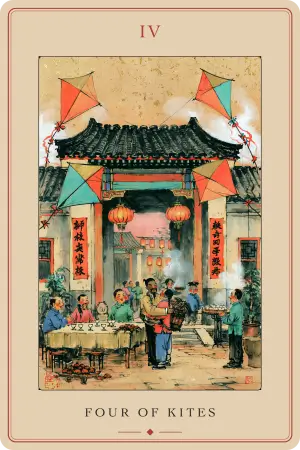
Celebration as stability that dances: four kites tied to the courtyard gate while the homecoming feast is laid below.
Card at a glance
- Numerology
- 4
- Element
- Fire
- Astrology
- Venus in Aries · third decan (April 11–20)
- Kabbalistic path
- Chesed (Mercy) in Atziluth
- Timing
- Homecoming · spring · Aries season
- Yes / No
- Upright yes · Reversed no
Upright
stability
homecoming
celebration
harmony
belonging
the shared table
phase completion
anchored joy
Reversed
instability
postponed celebration
family discord
fragile alliances
stagnation
lack of support
a feast without warmth
slipping knots
Four of Kites in each deck
Every deck reimagines the same archetype. Compare the art, then open a deck to read its full interpretation.
Imagery and symbolism
In the Tarot of Beijing the Four of Wands becomes the Four of Kites, and the deck states its whole meaning in one line: celebration is stability that dances. Four kites are tied to the four corners of a courtyard gate, snapping festively in the wind. The kite is the suit's fire, will and ambition and enterprise, and here that fire is anchored. The strings are knotted fast, yet the kites still fly. Nothing is furled or put away. The achievement has simply been given a home.
The gate itself is the great entrance of a siheyuan, crowned with dark tiles and hung with two red lanterns, and it stands as the threshold between the world of striving and the world of belonging. In the Rider-Waite tradition four wands form a canopy before a distant castle. Here the canopy is the family gate, and the castle is the courtyard behind it, glowing with a string of festival lanterns that recede into the pink dusk.
At the center is a homecoming embrace. A returning traveler with a woven pack still on their back is caught in the arms of family before even crossing the threshold. The pack not yet set down is the whole card in one gesture: the work is done, and love does not wait for the unpacking.
The rest of the scene speaks the language of the feast. A laid table carries a row of small wine cups, dishes of crayfish and fruit, and a vendor bears a tray of steaming baozi past a foreground basket of persimmons. The persimmon is a homophone of 事 in 事事如意, "may all things go as you wish," old Beijing's quiet blessing on the household. Red couplets flank the gate as they do at New Year, written wishes made architecture. The vermilion and teal of the kites repeat in the gate's beams and the guests' robes, binding sky and courtyard into one palette, while gold flecks fall through the kraft-paper sky like festival confetti. Neighbors and friends fill every side of the composition. No figure stands alone, because in this deck stability is communal: the strings hold because many hands tied them.
Core meaning
The Four of Kites is Beijing's card of homecoming and well-earned rest, the moment when effort solidifies into something you can live inside. The Golden Dawn named the Four of Wands the "Lord of Perfected Work," and that title survives intact here. The kites climbed as high as the string allowed and now ride the wind steady, no longer straining upward. The restless energy of the earlier Kites has found a solid corner to tie itself to.
Where the generic archetype gives you a communal threshold, a wedding canopy or a harvest festival, this deck makes the threshold literal and domestic: your own gate, your own courtyard, your own people at the table. The card marks a deliberate pause rather than a final ending. It asks you to stop labor long enough to honor what has been built, tie the kites to the gate for an evening, and let them snap festively in the wind before ambition demands more string. The reading turns on one balance, between flying and belonging, between the wind that lifts the kite and the anchor that keeps it home.
Upright meaning
Upright, the Four of Kites is a card of stability, harmony, and celebration. Efforts have yielded tangible results, and the results have come home. It is a time for feeling at home among your own people, when the homecoming feast is laid, the wine is poured, and the chestnuts are roasting. Acknowledge the successes already achieved, mark the milestone even when it is not the final goal, and strengthen the bonds with your people and your home. The strings are anchored precisely so the joy can fly.
In love. Two kites tied to the same gate, each flying, neither flying away. It points to closeness, engagement, marriage, or a long-term romance in which both partners contribute equally, and to the shared threshold of moving in together and being welcomed by each other's families. This is the embrace at the gate that does not wait for the pack to be set down: a happy home, security, warmth, and festivals kept together.
In career and work. The successful completion of a project or phase that brings genuine satisfaction, the kite launched long ago now flying steady over your own gate. It may arrive with news of promotion, an award, or recognition within your professional community. For enterprise it reads as a business growing on solid foundations, often a family or team venture built by many hands, and it insists that the feast in the courtyard is not a distraction from the work but its reward and its glue.
In finances. Success consolidated, the harvest carried home through the gate. It indicates financial well-being, the completion of a paying stage, steady cash flow, or a durable partnership whose strings led back to your own courtyard. It is a favorable time to secure and grow savings and to enjoy the fruits of labor, often with generous, hospitable spending: a feast, a family occasion, the pleasant expenses of a host.
In health. Stability built into the everyday care of the body, the same knot tied well each day. It favors regular, rhythmic practice, morning exercise in the park, tai chi, walking, dance, movement that is both free and held like a kite on an anchored string. Sleep in its season, meals at their hour, and festivals enjoyed without excess becoming habit. A well-kept body, like a well-kept courtyard, gives shelter to everything else.
Reversed meaning
Reversed, the kites strain at their knots, or the wind has died and they hang slack against the gate. Previous successes no longer satisfy, or plans feel uncertain. It reflects unease about home and personal relationships: harmony disrupted, family disagreements, a feast where the seats stay half empty. Often it is the plain fact of a homecoming postponed, a celebration cancelled or delayed by logistics or drama. Work on what unsettles the courtyard, retie the knots, and stay patient. Sometimes a kite must be brought down, mended, and launched again.
In love. Instability, tension, or a fear of commitment: one partner keeps a hand on the string, ready to let the kite go rather than tie it. Disagreements, cooling interest, or misaligned goals leave the home less warm than it should be, with celebrations postponed or joyless. It can also signal a need for personal space or a fairer division of the household. Patience, honesty, and small acts of homemaking are what retie the knot.
In career and work. Hard work goes unrewarded, or a project stalls short of its results. Personal circumstances interfere with work, or work devours the home and the balance between the kite and the gate is lost. In enterprise it warns of team conflicts, power struggles, or a venture fragmenting: kites tangling over one courtyard. Negotiate honestly and early, and keep the balance between the business and the home it is meant to feed.
In finances. Stagnation, lost momentum, or instability. The knot looks firm, but the wind is testing it, and a position once thought safe now seems fragile. It can mean disappointing returns, delays, or expenses the budget cannot carry, perhaps on celebrations themselves. Reassess the strategy, review the plans, and retie what has loosened before letting out more string.
In health. Insufficient attention to the body: absent routine, skipped movement, or the opposite extreme of feast-day excess become everyday habit, too much of the wine and roasted chestnuts and too little of the morning walk. The remedy is to restore the daily knots, regular sleep, regular meals, regular movement, in small repeated measures rather than sudden bursts.
Historical notes
The Four of Wands began as a pip. In the Tarot de Marseille it shows four batons woven into a lattice or a large crossing, with organic vegetation and flowers emerging from the triangular spaces, structure that breeds fertile ground rather than a sterile end. A famous accident deepened the reading: in the 17th-century Gerard Bodet Tarot from Belgium, a pool of blue ink spilled across the bottom of the fiery card, and many readers took the stray cooling of that fire as the card's exact meaning.
The Golden Dawn's Book T described something far more visionary, two white angelic hands issuing from clouds and clasped in a secret grip over four crossed and flaming wands, marked with the sigils of Venus and Aries. This is where the title "Lord of Perfected Work" comes from, a completion achieved through effort and grace rather than mere planning.
In 1909 Arthur Edward Waite and Pamela Colman Smith gave the card its now-familiar human scene: four staves bound with a garland of fruit and flowers, two figures waving bouquets beneath, and a stone castle with revelers on a bridge behind. The imagery borrows from the chuppah, the Jewish wedding canopy, cementing the card's link to marriage and rites of passage. The Tarot of Beijing takes that reframing one step further east. It keeps the canopy and the castle but rebuilds them from local materials: the canopy becomes the family gate of a siheyuan, and the castle becomes the courtyard behind it, lit with festival lanterns. The abstract "perfected work" becomes a homecoming you can smell, wine and roasted chestnuts drifting through the lane.
Correspondences
Number. Four, the number of the built world: four walls of a courtyard house, four corners of the gate to which the four kites are tied, four directions, four seasons. In old Beijing the siheyuan is literally the "four-joined courtyard," the number four made into a home, and this card is that architecture in miniature, fire given walls without being extinguished. Numerologically the fours belong to the Emperor: stability, containment, and foundational reliability.
Astrology. Venus in Aries, the third decan of the sign, roughly April 11 to 20. Venus is love, harmony, and the shared table; Aries is cardinal fire ruled by Mars, and Venus sits in detriment here. The third decan is the moment Aries stops to enjoy what it fought for, the kite that has climbed as high as the string allows and now rides the wind steady. Venus supplies the knots that tie the fire to the home gate, and the lanterns, the wine, and the embrace beneath them.
Element. Fire, the will and motion of the Kites suit, framed and anchored rather than furled. The erratic blaze is brought inside the courtyard walls and put to domestic, sustainable use, warmth and a gathering place instead of open burning.
Kabbalah. Chesed, the fourth sphere, meaning Mercy or loving-kindness, in Atziluth, the fiery World of Emanation. Chesed is the first ordered step of manifestation below the Abyss, the divine blueprint of a stable structure, which is why the Golden Dawn read this card as the perfected work descending into form.
Psychological perspective
At its core the Four of Kites is an invitation to exhale and let a milestone genuinely land. Driven people, and the fiery Kites suit above all, tend to run from one finished task straight into the next, which is a recipe for burnout. This card interrupts that. It says having fun for no productive reason, without an ounce of guilt, is part of a balanced life, and it honors the small milestones as much as the grand ones: surviving a brutal week, finishing a hard conversation, a quiet Saturday morning that simply feels safe. Joy that goes unwitnessed tends to shrink, while joy shared in the courtyard takes deep root.
The person of this card has learned to bring success home rather than chase the next wind immediately. They are hospitable and generous hosts, and they can keep several ventures aloft at once because each string is tied to something solid. The shadow is the danger of the number four itself. Fire kept in a furnace too long without new fuel goes out. The safety of the walls can begin to feel like a gilded cage, and the once-passionate harmony can settle into routine, which is the moment the card quietly asks whether it is time to let out more string again.
The Four of Kites across decks
Rider-Waite-Smith. Four garlanded staves before a castle, two figures waving bouquets, the chuppah made scenic. The Four of Kites keeps the canopy and the celebration but rebuilds them as a siheyuan gate and a lantern-lit courtyard, and it makes the homecoming central by placing a returning traveler in a family embrace at the threshold.
Tarot de Marseille. Four crossed batons in a flowering lattice, pure geometry with vegetation breaking through. Beijing keeps that idea of order that stays fertile, but trades the abstract crossing for four kites still aloft on knotted strings.
Crowley-Thoth. Crowley titled the card "Completion" and painted four wands tipped with the Ram and the Dove, Aries and Venus locked in a high-tension balance around a contained central fire. The Beijing card carries the same Venus-in-Aries engine, but resolves the tension as hospitality rather than schematic circuitry: the will that launched the kite now holds the celebration together.
Modern reframings. Recent decks push the card toward chosen family and domestic achievement. The Deviant Moon makes the four wands the literal pillars of a new house; the Modern Witch shows a diverse group taking a deliberate break to celebrate hard-won success; the Wild Unknown reads it as a portal of meeting energies. The Tarot of Beijing belongs with these, grounding the same themes in a specific place, the hutong gate where the whole lane fits under one string of lanterns.
In combination and context
The Four of Kites pulls a spread toward stability, belonging, and the reward that follows effort. Its nearest cousin is the Three of Cups, and readers often confuse the two, since both are cards of celebration. The distinction is elemental: the Three of Cups is Water, fluid and social and emotionally expressive, joy for its own sake. The Four of Kites is Fire grounded in structure, the celebration that also builds something permanent, the wedding that founds a household or the venture that finds a permanent address. Cups pour out feeling; Kites tie it to a gate.
Surrounding cards tell you which way the courtyard leans. Beside cards of security and family the feast is real and the embrace is warm. Beside cards of avoidance or delay, especially reversed, the homecoming may be a facade, a public display of unity that masks a colder private truth, or a celebration that keeps being postponed. When the Four of Kites keeps returning to your readings, treat it as a standing instruction: stop letting out string for a moment, tie the kites to your own gate, and let the people who anchor you gather at the table before the wind picks up again.
Questions for reflection
- What have you finished that you have not yet let yourself celebrate, and who would you want at the table when you do?
- Where in your life is the fire safely walled but starting to feel like a cage, quietly asking for more string?
- Which knots hold your celebration together, and whose hands helped you tie them?
The general meaning follows the Rider-Waite-Smith reading — the reference used across Tarot Academy. Open a specific deck above for its own interpretation.
Frequently asked questions
Explore the Tarot
Latest Posts
Discover the ancient wisdom of tarot cards and unlock the mysteries of your spiritual journey. Our blog is your gateway to understanding the rich symbolism, meanings, and practical applications of tarot reading.




















































