
 EN (English)


Major Arcana · 9
The Girl and the Lion
Strength that makes strength kneel gladly: a giant festival lion lowers its head to a small girl, and she scratches its chin.
Card at a glance
- Numerology
- VIII
- Element
- Fire
- Astrology
- Leo · ruled by the Sun
- Kabbalistic path
- Teth (Chesed → Geburah)
- Timing
- Summer · Leo season
- Yes / No
- Yes, but it cannot be rushed
Upright
soft power
courage
patience
gentle mastery
composure
self-control
resilience
quiet authority
Reversed
self-doubt
intimidation
loss of control
insecurity
raw temper
powerlessness
bullying
fear
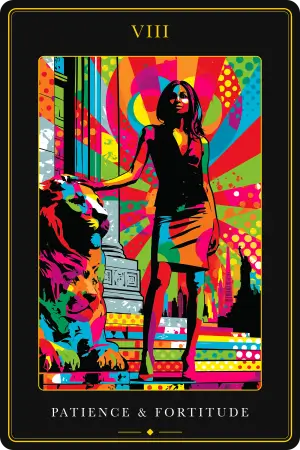
The Girl and the Lion in each deck
Every deck reimagines the same archetype. Compare the art, then open a deck to read its full interpretation.
Imagery and symbolism
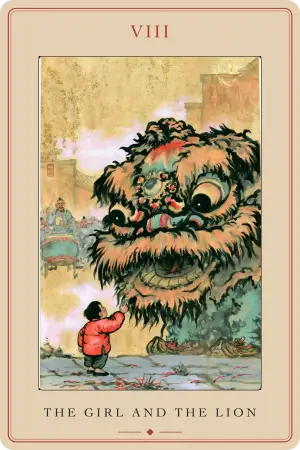
In the Tarot of Beijing, Strength is called The Girl and the Lion (姑娘与狮子), and it holds the traditional eighth position. The scene is a New Year lion dance in a hutong. There are drummers, smoke, and the red paper of spent firecrackers scattered across the paving stones. In the middle of the noise the great silk lion has lowered its enormous head before a tiny girl in a red jacket. She does not run. She reaches up and gently scratches its chin.
The deck removes the classical heroine taming a wild beast and puts a small child and a festival lion in her place, and the card's truth gets sharper for it. This lion is a made thing of silk, bamboo, and fur, animated by two grown men hidden inside. That is the point. Most of what roars at us in life is a construction with people in it: anger performed, intimidation choreographed, power a costume someone has to carry while sweating underneath. The girl's strength is that she is not fooled by the lion, and not fooled by her own fear either.
Her red jacket carries the color that in the Rider-Waite tradition belongs to the lion, the red of passion and life force. In Beijing red is also the color of the New Year, of joy and protection, so her courage reads as festive rather than martial. The lowered head is the deck's whole formula: the lion is not humiliated, and bowing to the child is the most graceful figure of its dance. The two men inside replace the lemniscate of the classical card. Where the infinity sign said spirit stands above force, the dancers say the same thing with their bodies: the beast is moved from within by human skill and years of training. Behind them the drummers keep the pulse of instinct and excitement, and the girl stands inside the drumming untouched by it. The gold-flecked kraft sky and the small red seal, constant across the deck, keep the scene ordinary and human. No gods, no thunderbolts, just a child's hand under a giant chin.
Core meaning
The Girl and the Lion is Beijing's Strength, and the deck states its meaning in a single line: true strength is what makes strength kneel gladly. Power here has nothing to do with defeating the beast. It comes from staying unafraid of it and seeing it clearly. The card is about inner steadiness, resilience, and the ability to face what towers over you with calm rather than force.
Where the canonical Strength shows a woman quietly taming a lion through soft control, this deck sharpens the lesson by making the lion a performance. The thing that intimidates the girl is enormous, loud, and surrounded by drums, and it will still lower its head the moment she approaches it without aggression. Much of what frightens us is a display that has forgotten it is one, carried by someone as tired and human as we are. The girl's real power is accuracy of perception: fear multiplies what it looks at, and her calm restores the lion to its true size, a thing of silk with feet in cloth shoes.
Upright meaning
Upright, the card promises that the largest and loudest problem in front of you will yield if you walk up to it calmly. The strength you need will not come from size or leverage. It comes from composure and openness. Rely on inner steadiness rather than pressure. Do not try to shout over the drums; step closer instead, and the great head will lower itself. This is the taming of a situation by refusing to be frightened of it, and in this deck the winner of any confrontation is the one who scratches the lion's chin. Discipline and patience achieve what force cannot.
In love. Intense feeling paired with the maturity to hold it, passion that has learned to dance rather than trample. Each partner can be their largest, loudest self and still lower their head gently to the other. The bond rests on trust, tenderness, and emotional control, a place where vulnerability is safe and the smaller hand is always answered gently.
In career. Confidence in your role and the willpower to take on the biggest task on the desk, the one everyone else circles at a distance. You can calm a difficult boss or a panicking team by being the steady one inside the drumming. This favors stepping into leadership, handling demanding work that requires endurance, and influencing softly rather than by confrontation. Do not raise your voice to match the noise, and stand by your decisions.
In finances. Stability won by steadiness rather than aggression. Large obligations, debts, and negotiations lower their heads when approached directly and without panic. The card favors skillful, gentle persuasion over pressure, and like the lion dance visiting each doorway, this disciplined confidence is the kind that brings luck and abundance home.
In health. A harmonious balance of body and mind, vitality expressed as grace of movement. The card favors patient daily discipline over violent bursts, since the lion dance is mastered over years of practice, not in one festival. It is a positive omen for recovery and steady vigor, and it encourages regular, joyful activity: strength as celebration.
Reversed meaning
Reversed, the lion does not lower its head. The child hides behind her mother, and the dance collapses into noise and teeth. The card points to insecurity, fear, and a loss of personal power, and it usually splits into two failures. In the first, you are the one roaring: using size, position, or temper to intimidate exactly those who are smaller, like the lion that has forgotten there are people inside it. In the second, you are frozen at the edge of the crowd, convinced that everything large is dangerous and everything small is you. Both come from the same fear.
In love. One partner has become a lion that no longer bows, dominating and roaring, using temper or noise to control, while the other shrinks into the frightened child at the edge of the festival. Watch for aggression, intimidation, or manipulation, and for dependency fueled by fear, staying close to the lion because leaving the lane feels more frightening still. Strength in love is legitimate only when it kneels gladly.
In career. A loss of control and a crisis of confidence. You may be roaring at colleagues to hide insecurity, or shrinking from responsibilities that are far smaller than they sound. Accumulated stress and shattered confidence make ordinary tasks loom like a lion refusing to bow. Remember that the dancers inside the costume are exhausted too. It is time to rest and recover, or to admit a task exceeds your capacity and ask for help.
In finances. Money roaring through your hands like an unmanaged lion in a crowded lane. The reversal warns of reckless spending or paralysis before large sums, avoidance of statements and bills, and rash decisions driven by either bravado or fear. Restore strict discipline, and stop being frightened by numbers that are, on close inspection, made of silk and bamboo, smaller than they roar.
In health. A lack of discipline in either direction. You may be neglecting exercise and basic care out of lethargy, or driving your body like an unmanaged beast through overtraining and crash regimes. The impressive exterior is carried by muscles and lungs that tire, and prolonged stress is taking its toll under the silk. Step out of the costume, rest, and rebuild the quiet daily training that makes strength graceful again.
Historical notes
Long before the maiden and her lion, the card was one of the four cardinal virtues, named La Forza or La Force, Fortitude. Early decks borrowed competing strongmen for the image: the biblical Samson, who killed a lion barehanded and later pushed apart a temple's pillars, and the Greek Hercules, whose first labor was to strangle the Nemean Lion. The Charles VI card shows a woman holding a broken pillar in homage to Samson, and around 1470 the Mantegna "Forteza" combined both, a woman subduing a lion while holding a broken column. Over the centuries the interaction softened, from the Visconti figure forcing a resisting lion's jaws to the calm Tarot de Marseille woman seated atop a passive beast.
The card's number has been disputed for just as long. In the Marseille tradition and older Italian decks, Justice sat at VIII and Strength at XI. At the turn of the twentieth century, Arthur Edward Waite and the Golden Dawn swapped them so the sequence would follow the zodiac, where Leo precedes Libra, and the 1909 Rider-Waite-Smith deck fixed Strength at VIII. Aleister Crowley kept the older XI in his Thoth deck and renamed the card Lust, replacing the demure maiden with a naked, ecstatic Babalon riding a many-headed beast. The Tarot of Beijing sits comfortably at the eighth position and takes the softening one step further, removing the heroine entirely and handing her role to a child at a festival.
Correspondences
Number. 8, the number of power and leadership, and of infinity, cycles, and the bond between material and spiritual worlds. In the classical card this was the lemniscate above the woman's head. Here it hides in the dance itself: the lion's traditional footwork traces weaving, returning loops through the lane, and the New Year is the great cycle that comes back each year to frighten off the old and welcome the new. Eight also asks for constant self-renewal, the way the dancers have trained since boyhood, and it carries a note of karmic balance: strength must never be spent thoughtlessly, because a lion that stumbles in a crowded lane hurts real people.
Astrology. Leo, the fixed-fire sign ruled by the Sun, and the deck makes the link literal, since the lion is on the card with mane, eyes, and pride intact. Leo is individuality, performance, and the desire to be seen, and the festival lion is that essence made of silk and bamboo, magnificent and adored by the crowd. Leo rules the heart, and the card shows the sign at its best: the grand performer voluntarily lowering its head to something small and sincere.
Element. Fire, choreographed rather than unleashed. The two dancers inside the lion are Leo's creative discipline, the years of craft behind every effortless-looking display, fire trained into grace.
Kabbalah. The Hebrew letter is Teth (ט), meaning serpent or lion-serpent, on the path from Chesed to Geburah. The serpent connects the card to Kundalini, the primal life force coiled at the base of the spine, and Strength signifies its controlled ascent, raw instinct sublimated into higher awareness rather than caged.
Psychological perspective
The person of this arcana is self-assured without display. They walk toward what others back away from, calmly rather than recklessly, the way the girl steps up to the lowered head, and they direct their emotions the way the dancers direct the lion, with trained and invisible skill. Their authority rarely needs a raised voice. Aggressive people become reasonable around them, tense rooms settle, and even the large and fierce seem to bow willingly. Their kindness is a deliberate gentleness, the restraint of someone who could push and chooses not to.
The shadow appears when fatigue sets in and the costume takes over. The same energy that made them impressive turns into roaring and stubbornness, intimidation of the smaller, and they can frighten the very people who trusted them. Firmness hardens into inflexibility. The real risk is becoming the lion that no longer bows, dominant, loud, and lonely in the middle of its own festival. Shadow work here means looking the inner lion in the eye: naming the temper, the appetite, or the fear one is performing as strength, and offering it patience instead of a whip.
The Girl and the Lion across decks
Rider-Waite-Smith. The canonical Strength shows a serene maiden in white gently closing a lion's jaws, a lemniscate over her head and a garland of roses chaining the beast, soft control over instinct. The Girl and the Lion keeps that soft control but swaps the maiden for a child and the wild lion for a festival costume, so the taming becomes a moment of recognition rather than management.
Tarot de Marseille. The older tradition seats a calm woman atop a passive lion and numbers the card XI, with Justice at VIII. Beijing returns to the RWS eighth position but keeps the Marseille serenity, the sense of a beast already at ease.
Crowley-Thoth. Crowley renamed the card Lust and painted Babalon riding the beast in ecstatic union, instinct embraced rather than tamed. The Beijing card shares that refusal to cage the animal: the dancers do not imprison the lion, they become it, skillfully and on purpose, for the joy of the whole street.
Modern reframings. Recent decks strip the mythological lion for something closer to daily life, from a blossoming desert cactus to a woman shape-shifting into a lion to a protester placing flowers in a rifle's muzzle. The Tarot of Beijing belongs to that movement, relocating the archetype from wilderness to a crowded hutong where the whole community watches strength kneel.
In combination and context
The Girl and the Lion pulls a spread toward composure, resilience, and the quiet handling of what looms large. Its meaning shifts with the size of what stands beside it. Near cards of crisis and upheaval it reads as the inner fortitude to survive and rebuild, a promise that the querent can endure the shock. Beside cards of obsession or toxic attachment it becomes the willpower to master a base urge and break a cycle without self-hatred.
With cards of focus and manifestation the pairing turns into steady, unstoppable follow-through, the endurance that carries a project past its first failures. In relationship spreads the neighbors tell you which lion you are looking at: alongside gentle, trusting cards it is a bond where both partners lower their heads willingly, while alongside cards of control or fear it warns of a dynamic where one roars and the other shrinks. When the card keeps returning, read it as an instruction rather than a description: stop shouting over the drums, walk up to the largest thing in the lane, and reach out a hand.
Questions for reflection
- What in your life is roaring loudest right now, and what might change if you stepped closer to it instead of shouting back?
- Where are you performing strength for an audience, and what would it cost you to set the costume down?
- Think of a time your calm made someone else's anger reasonable. What did you know in that moment that you could use again?
The general meaning follows the Rider-Waite-Smith reading — the reference used across Tarot Academy. Open a specific deck above for its own interpretation.
Frequently asked questions
Explore the Tarot
Latest Posts
Discover the ancient wisdom of tarot cards and unlock the mysteries of your spiritual journey. Our blog is your gateway to understanding the rich symbolism, meanings, and practical applications of tarot reading.




















































