
 EN (English)


Major Arcana · 14
The Character on the Wall
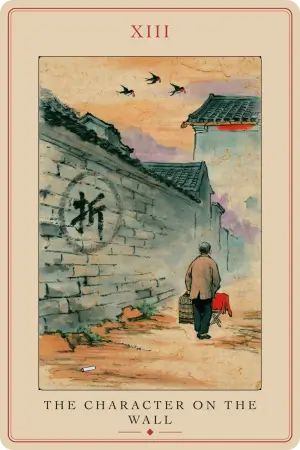
A single chalked character marks a hutong wall for demolition, and an old resident walks away carrying only what sings.
Card at a glance
- Numerology
- XIII
- Element
- Water
- Astrology
- Scorpio · ruled by Mars and Pluto
- Kabbalistic path
- Nun (Tiphereth → Netzach)
- Timing
- Autumn · Samhain · about 30 days
- Yes / No
- Upright yes · Reversed no
Upright
transformation
conscious ending
letting go
clean break
renewal
dignity in leaving
travel light
moving on
Reversed
stagnation
refusal to pack
clinging
denial
nostalgia
avoidance
fear of change
unfinished endings
The Character on the Wall in each deck
Every deck reimagines the same archetype. Compare the art, then open a deck to read its full interpretation.
Imagery and symbolism
In the Tarot of Beijing, Death carries no skeleton, no scythe, and no rider. The whole arcanum is compressed into one chalked character on a gray brick wall: 拆, meaning "to be demolished," drawn inside a rough circle. In the real Beijing of the reform years this mark on a hutong wall meant one thing, that the house's time was ending, and the deck lets that everyday sign stand for every ending a life contains. The card is quiet on purpose, and the quietness is the teaching.
The character 拆 is a sentence already pronounced. It is a fact written in chalk, temporary material used for a permanent decision, so even the announcement of the end is itself impermanent. The rough circle around it echoes the cycle, an ending drawn as a closed round, the completed loop of one stage of life.
An old resident walks away down the lane, his back to the viewer, unhurried. He does not look at the wall and he does not look back. His straight, calm posture carries the deck's whole ethic of parting: leave standing up. He holds two things only. The birdcage is what sings, the living and essential thing one must never abandon; the folding stool is the readiness to sit down and be at home anywhere. Between them they answer the card's question, what do you take when you cannot take everything. A red cloth lies over the stool, the deck's single vermilion accent, the thread of life and celebration carried out of the old house into the new one.
Above the wall, swallows fly with mud in their beaks, already building a nest under a new eave two streets away. Where the Rider-Waite Death shows a sun rising behind two towers, here renewal is shown as birds that never once debated whether to rebuild. The evening light on the kraft paper is warm rather than mournful, because the demolition has not happened yet. The card lives in the exact interval between the decision and the dust. A small red seal sits in the corner, the master's mark that this remembered city continues.
Core meaning
The Character on the Wall is Beijing's Death, and it says at once what the archetype has always meant beneath its fearsome face: not a physical ending but the close of a cycle and the confirmed start of another. A home, a job, a relationship, an identity that has served its term, all of these can be chalked 拆. The notice is up, the decision is made, and the only real question left is what you will carry with you.
The deck rests the card on one distinction: the difference between the structure and the life inside it. The wall will come down; the man will not. His home was never the bricks. It was the bird's song and the habit of sitting among neighbors, and both of those fit in his hands. Whatever cannot be demolished is what you are.
The swallows carry the second half of the meaning. Renewal is not a reward for grieving correctly, it is simply what life does. The birds do not honor the old eave with a mourning period before building under the new one, and the card suggests continuity is our nature too, if we do not obstruct it. To read the character on your own wall is to accept that a stage is finished, choose your birdcage and stool, and walk down the lane at your own pace. Life does not stop at the demolition site. It changes address.
Upright meaning
Upright, The Character on the Wall marks a confirmed ending that clears the ground. The stage is over, the notice is genuine, and the card frames the loss as clearance rather than catastrophe. Do not argue with the character on the wall, read it. Choose calmly the one or two things that are truly yours, leave the rest with the bricks, and walk, because the swallows are already carrying mud.
In love. The end of a stage in love, sometimes of the relationship, more often of its old form. Where a partnership continues, it means renovation by demolition: the old pattern comes down so two people can rebuild under a new eave. Where a parting is true, it can be done the resident's way, quietly and with respect, each person carrying away what genuinely sang.
In career. A confirmed professional ending, a role concluded, a project finished, a department restructured, or you finally chalking 拆 on a job you have outgrown. The card treats it as promotion by demolition, the clearing of a stage that had become a ceiling. Take your skills, portfolio, and real relationships, walk out on good terms, and trust that the next role is being built two streets away while you pack.
In finances. A demolition of the old financial structure: a debt finally closed, an income source ending, an asset sold, an obligation dissolved. Keep the assets, skills, and trusted relationships that hold real value, hold a modest reserve that makes you at home anywhere, and release the rest without mourning. Those who accept the rebuilding early tend to get the better new address.
In health. Rarely a literal warning. It signals the confirmed end of an old regime of the body, a habit whose time is up, and it favors decisive, clean transitions: quitting rather than tapering forever, the changed diet begun on an ordinary Tuesday. Shedding the old pattern paves the way for recovery, and cooperating with the body's own rebuilding keeps you at home in yourself at every age.
Reversed meaning
Reversed, The Character on the Wall shows a person still living inside a house that has already been marked. The chalk circle is on the bricks, the neighbors have gone, and yet the kettle stays on the same stove as if the notice could be outlasted. This is resistance to an ending that has in truth already happened, and the card is blunt: demolition does not wait for consent. Refusing to pack only means leaving in a hurry later, with less dignity and fewer of the right things.
In love. A relationship inhabited after its notice, kept standing by habit, fear, or archive. Two people curate a museum of what they were, or one cannot move out of a bond the other has already left. An ending unacknowledged does not preserve love, it embalms it. Whatever truly sings between you will survive the move; whatever only stands will not.
In career. Staying past the ending, a role hollowed out, a workplace everyone else has quietly left, an identity maintained after the profession itself moved on. Fear disguises itself as loyalty to the desk and the title. It can also mark a transition begun and never finished, notice half-given, a person commuting daily to a condemned building of their own career.
In finances. Financial life continued inside a condemned structure: paying to maintain what is already lost, servicing debts on the past, refusing to sell or write off what the wall has plainly marked. Money can freeze in nostalgia, a venture kept alive for sentiment, property held because letting go feels like defeat. Delay only raises the cost of the demolition that will proceed anyway.
In health. The body's changes resisted rather than inhabited, habits kept long past their notice, decisions postponed because beginning them would admit a stage has ended. Sometimes the opposite, a drastic cosmetic demolition attempted in the hope of evicting time itself. The card counsels the quiet middle: acknowledge what is over, keep what sings, and make the changes the wall has already announced.
Historical notes
The Death card was born from collective trauma. After the Black Plague reached Europe in 1347 and killed between thirty and sixty percent of the population, Western art turned obsessively to the macabre. Early Italian decks such as the Visconti di Modrone and the Visconti-Sforza rendered Death as visceral physical horror, gray skin stretched over skeletal frames. The Visconti-Sforza is the only known historical deck to show a skeletal Death drawing a bow and arrow, weapons long associated with the swift and indiscriminate strike of the plague. Other early variants drew from the Book of Revelation, depicting Death as a Grim Reaper on a pale horse, trampling emperors and commoners alike.
The Tarot de Marseille standardized a new pattern by the mid-seventeenth century, replacing the apocalyptic rider with a walking reaper and a long scythe. Famously it left the thirteenth trump unnamed, the Arcane sans nom, since to speak the name of Death aloud was thought to invite its presence. Its severed heads and hands sprout from the soil like wheat, recasting Death as the cosmic fertilizer that clears the old to feed the new. French occultists including Eliphas Levi and Oswald Wirth hardened this reading into doctrine: death as transformation. In 1909 Arthur Edward Waite and Pamela Colman Smith returned to the Italian rider on a white horse and layered it with Rosicrucian symbolism, the white Mystic Rose promising that new life blooms out of the void.
The Tarot of Beijing strips all of that machinery away. It removes the skeleton, the scythe, the horse, and the rider, and keeps only the function. What remains is a single chalked character on a gray wall and a man walking home. The card that once trampled kings has become the quietest arcanum in the deck, and it makes the same argument with a piece of chalk that Waite made with an armored horseman: whatever is cut down by the scythe of time will sprout anew.
Correspondences
Number. 13, and in this deck a demolition that contains its own construction. Numerologically 13 resolves to 1 and 3, which sum to 4. The 1 is the first stride down the lane and the first brick of the new house; the 3 is the swallows overhead, past, present, and future carried together like mud for a nest; the 4 is structure, the four walls of the courtyard and the four corners of the folding stool that opens anywhere into a home. In Beijing's older lanes a house was renumbered constantly as the city rebuilt, so a number was never the house. 13 is a change of address, not a curse.
Astrology. Scorpio, the fixed water sign of depth, regeneration, and radical transformation. Scorpio governs the hidden processes by which one form of life ends so another can begin, exactly the work of the chalked 拆, and it names an ending precisely before committing to the passage through it. Its intensity appears here as concentration rather than drama: everything inessential has already fallen away, and only the birdcage, the stool, and the road remain.
Element. Water, the element of Scorpio, of the river that flows through the older imagery and of emotion that moves rather than settles. Grief passes through this card the way water passes through a lane, leaving the ground washed rather than flooded.
Kabbalah. The Hebrew letter is Nun, on the 24th path from Tiphereth to Netzach, the descent of harmonious consciousness into raw instinctual nature. As a noun Nun means "fish," an ancient emblem of the unconscious depths and of resurrection; as a verb it means "to grow" or "to sprout." Encoded in the letter itself is the same promise the Marseille sprouting soil made, that what is cut down comes up again.
Elemental dignity. As a fixed water card its endings are organic and foreseeable, the slow turn of autumn into winter rather than the lightning of The Tower. Near cards of rest or nostalgia it deepens into completed grief; beside cards of drive it speeds the clearance and hurries the packing.
Psychological perspective
Psychologically, The Character on the Wall describes the capacity to complete. Every life accumulates finished stages, outgrown roles, ended relationships, exhausted beliefs, and much of mental health rests on whether a person can mark them 拆 and move out, or whether they keep paying rent on condemned buildings of the psyche.
The person of this card has an unusually clear inner customs office. When a stage ends they can name it as ended, without minimizing the loss and without inflating it. They perform the triage the picture paints: identify the birdcage, what is alive and must come along, identify the stool, the inner steadiness that makes any new place habitable, and consciously leave the rest. Grief passes through them rather than settling in, and they convert endings into biography instead of into identity. Others seek them out during upheavals, because their calm is not denial but practiced familiarity with impermanence.
In shadow the same disposition splits two ways. One extreme is premature demolition, chalking 拆 on relationships at the first difficulty and mistaking escape for transformation. The reversed pole is the opposite, a person barricaded inside the marked house, curating a museum of the past, whose fear of the unknown is stronger than their discomfort in the untenable. Both distortions confuse the wall with the life. The healthy center is the man in the lane, attached to what sings and detached from what merely stands.
The Character on the Wall across decks
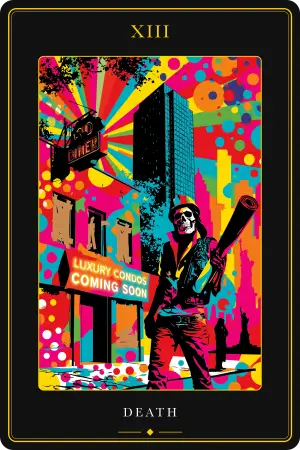
Rider-Waite-Smith. The canonical Death rides a white horse in black armor, a five-petaled Mystic Rose on his black banner, trampling a king while a bishop, a maiden, and a child meet him in prayer, denial, and acceptance. The Character on the Wall keeps the meaning and discards the whole cast, compressing horseman and victims into one chalked mark and one man walking away.
Tarot de Marseille. The Marseille card is the unnamed thirteenth trump, a skeletal reaper mowing a field where severed heads and hands sprout like new wheat. Beijing keeps that promise of sprouting, but moves it above the wall to the swallows carrying mud, renewal shown as instinct rather than as a harvest of limbs.
Crowley-Thoth. Crowley titled the card Death and painted a skeletal figure weaving new forms with a scythe, transformation as ceaseless alchemical motion under Scorpio. The Beijing card shares the Scorpio attribution and the alchemy, but slows the motion to a single held breath, the exhale that closes a cycle.
Modern reframings. Recent decks work to rescue Death from its literal dread, rendering it as a butterfly, a phoenix, or a quiet threshold. The Tarot of Beijing belongs to that movement and goes further into the ordinary, meeting the archetype where people actually meet it: in a notice on a wall, a last day at work, a final visit to a childhood home.
In combination and context
The Character on the Wall pulls a spread toward completion and clearance, and its neighbors tell you whether the querent is leaving well or refusing to leave. Beside cards of rest such as the Four of Swords it reads as an ending accepted and mourned cleanly, the resident already at his stool in the new street. Beside The Tower it warns that the subtle notice has been ignored: if you will not join Death quickly enough, catastrophic force may step in to clear the building for you.
With cards of the mind, especially the suit of Swords, a repeated Character on the Wall points to over-analysis of a situation that has already ended, the querent trapped in the cocoon rather than emerging from it. Paired with cards of new beginnings it confirms the swallows literally, the next thing under construction while the old one comes down. In love spreads its neighbors decide between renovation and farewell; in work and money spreads they decide between an orderly wind-down and a costly refusal to sell.
When the card keeps returning across readings, treat it not as an escalating threat but as unfinished business. Something has been chalked and not yet packed. The cards are asking one plain question: what, exactly, is this person still refusing to set down?
Questions for reflection
- What in your life has already been chalked 拆, marked as finished, that you are still keeping house inside?
- If you could carry only your birdcage and your folding stool out of this ending, what is the one thing that actually sings and the one steadiness you take everywhere?
- Where are you mistaking a stage of life for life itself, guarding the wall when the living was never in the bricks?
The general meaning follows the Rider-Waite-Smith reading — the reference used across Tarot Academy. Open a specific deck above for its own interpretation.
Frequently asked questions
Explore the Tarot
Latest Posts
Discover the ancient wisdom of tarot cards and unlock the mysteries of your spiritual journey. Our blog is your gateway to understanding the rich symbolism, meanings, and practical applications of tarot reading.




















































